
Membrane Kitchen Cabinet Turkey
Introduction: The Evolution of Seamless Surface Technology in Millwork
In the landscape of modern residential architecture and commercial property development, the kitchen has shifted from an isolated utility room into the central design anchor of the home. This change demands cabinetry that balances sophisticated design with long-term durability. For international interior architects, real estate developers, and global furniture procurement managers, sourcing a Membrane Kitchen Cabinet Turkey project has emerged as a premier strategy to balance these goals.
Membrane cabinetry—technically known as thermofoil or vacuum-pressed polymer cabinetry—represents a highly efficient marriage of advanced polymer chemistry and automated wood processing. Unlike traditional flat laminates that require separate edge-banding strips, a membrane door features a continuous, flexible sheet of polyvinyl chloride (PVC) or polyethylene terephthalate (PET) plastic foil fused over a three-dimensionally routed core under intense vacuum pressure and thermal activation. This seamless wrapping eliminates open edge joints on the face and sides of the panel, providing a strong defense against moisture vapor, liquid spills, and fine micro-scratches.
However, introducing a vacuum-wrapped composite panel into a kitchen environment presents specific technical challenges. Cabinetry must perform reliably under demanding residential conditions, including frequent swings in relative humidity, exposure to hot cooking steam, impacts from heavy cookware, and radiant heat from built-in ovens. Sourcing millwork that can handle these challenges without peeling, bubbling, or delaminating requires a deep understanding of core substrate material science, polyurethane adhesive activation chemistry, and automated membrane press technology.
Turkey’s modern manufacturing infrastructure has established itself as a global leader in this specialized sector, combining centuries of Mediterranean woodworking heritage with top-tier German and Italian automated computer-numeric-control (CNC) machining and cleanroom pressing lines. This comprehensive technical guide details the substrate selections, foil formulations, multi-stage manufacturing workflows, architectural typologies, and global procurement logistics that define the premium market for a Membrane Kitchen Cabinet Turkey build.
1. The Turkish Manufacturing Infrastructure: Industrial Clusters and Scale Mechanics
To understand why sourcing a Membrane Kitchen Cabinet Turkey project is highly efficient for international buyers, one must analyze the country’s specialized industrial geography. Turkey’s furniture sector is organized into advanced manufacturing clusters, with each region specializing in specific production techniques, raw material processing paths, and volume capabilities.
+-----------------------------------------------------------------+

|         TURKISH KITCHEN CABINET MANUFACTURING CLUSTERS          |
+-----------------------------------------------------------------+

|  [Kayseri Cluster]      ---> High-Volume Automated Press Lines  |
|  [İnegöl Hub]           ---> Custom Core Processing & Joinery   |
|  [İstanbul/Modoko Hub]  ---> Bespoke Luxury Architectural Runs  |
|  [Aegean/İzmir Zone]    ---> High-Efficiency Export Logistics   |
+-----------------------------------------------------------------+
The Kayseri Industrial Cluster
Kayseri hosts highly automated, high-volume production facilities. These factories feature massive automated vacuum membrane pressing lines, computerized beam saws, and robotic routing systems. Kayseri is the primary sourcing zone for large-scale commercial contracts, such as outfitting multi-family residential towers, student housing developments, or global hotel chains that require strict dimensional consistency and rapid manufacturing turnarounds for high runs of membrane cabinets.
The İnegöl Furniture Ecosystem (Bursa Province)
İnegöl is an international woodworking center with a long heritage of craftsmanship. This region excels at combining automated machinery with skilled manual woodwork. Factories here focus on custom structural engineering, multi-layer core stabilization, and complex transitional cabinetry, making it a key hub for high-end implementations of a Membrane Kitchen Cabinet Turkey project where custom sizes or unique door profiles are required.
The İstanbul Modoko and Masko Design Centers
İstanbul serves as the center for custom luxury design. Workshops in Modoko and Masko cater to bespoke architectural drawings, working with premium materials like moisture-resistant cores, integrated low-voltage LED systems, and custom natural stone or solid-surface countertops.
The Aegean and İzmir Manufacturing Zone
The western coast of Turkey, centered around İzmir, leverages excellent port access and proximity to European markets. Factories in this zone specialize in high-efficiency manufacturing of contemporary cabinetry, utilizing advanced automated processing lines and sterile dust-free environments optimized for international distribution networks.
2. The Material Science of Thermofoil Layers: Foil Formulations
The physical character and durability of a Membrane Kitchen Cabinet Turkey panel are dictated by the chemical composition and thickness of the synthetic wrapping foil. Turkish manufacturers categorize thermofoil sheet lines into three distinct material tiers based on polymer density and scratch resistance.
         THERMOFOIL COATING CORRIDORS (Value Tier to Premium Luxury)
 ┌───────────────────┬───────────────────┬───────────────────┐
 │ Monomeric PVC     │ Polymeric PVC     │ Premium PET Foil  │
 │ Budget Base Tier  │ Standard Premium  │ Luxury Eco Tier   │
 │ (0.2mm Thickness) │ (0.4mm Thickness) │ (Highly Stable)   │
 └───────────────────┴───────────────────┴───────────────────┘
Monomeric PVC Foils (Entry-Level Commercial)
- Chemical Anatomy: Formed from short-chain plasticizers that provide baseline flexibility. They typically measure between 0.18mm and 0.25mm in thickness.
- Performance Metrics: While providing a highly competitive entry-level price point for volume developments, monomeric foils feature a thinner protective layer. Over extended exposure to thermal cycles, the plasticizers can gradually migrate out of the sheet, causing the foil to become brittle over long timeframes.
Polymeric PVC Foils (The Standard Premium Choice)
The primary choice for high-end residential kitchen manufacturing is polymeric PVC foil.
- Chemical Anatomy: Formed from long-chain, high-molecular-weight plasticizers that resist chemical migration. They typically measure between 0.35mm and 0.50mm in thickness.
- Performance Metrics: Polymeric foils offer excellent elongation properties, allowing them to stretch evenly over deep profile steps and intricate carved grooves without tearing or thinning out at the corners. They feature strong resistance to everyday impacts, fine scratches, and household cleaning chemicals.
Premium PET (Polyethylene Terephthalate) Foils (The Eco-Luxury Choice)
For modern projects requiring high environmental standards or ultra-matte finishes, premium Turkish factories utilize PET foils.
- Chemical Anatomy: A completely halogen-free thermoplastic polymer that contains zero chlorine or heavy metal plasticizers.
- Performance Metrics: PET foils naturally achieve high dimensional stability and deep matte or high-gloss visual clarity. They do not fade or discolor when exposed to ultraviolet (UV) radiation, ensuring a white or light cream kitchen face will maintain its color tone over its entire lifecycle.
3. Substrate Material Science: Engineering the Foundation Panel
The durability of a Membrane Kitchen Cabinet Turkey model relies entirely on the quality of its underlying core substrate. Because the thermofoil is pressed over a routed board under high pressure, any imperfection, void space, or fiber clustering in the core will telegraph through the thin foil, destroying the finish clarity.
Moisture-Resistant Medium Density Fiberboard (MR-MDF / Green Core)
For virtually all membrane kitchen doors, high-density MR-MDF is the mandatory industry-standard core substrate choice.
- Chemical Composition: Formed by blending fine wood fibers with hydrophobic wax emulsions and moisture-resistant polyurethane or melamine-urea-formaldehyde resins before hot-pressing. The core is often tinted green during production for straightforward identification.
- Performance Parameters: Features a uniform, dense core profile (ranging from 720 to 820 kg/m³) with zero internal void spaces or chip pockets. This structural density allows 3-axis CNC routers to cut complex Shaker profiles or raised panels into the face of the board without fraying the fibers, providing a smooth surface that readily accepts liquid adhesives. It features a low thickness swelling rate (typically under 6% when submerged for 24 hours), making it an excellent substrate choice for a long-lasting kitchen installation.
The Law of Symmetrical Flat Balancing
A critical principle in the engineering of a Membrane Kitchen Cabinet Turkey panel is structural symmetry. When a thick polymer foil is pulled over the front face and edges of an MDF panel under vacuum pressure, it creates substantial inward surface tension. If the back face is treated with an inferior, lightweight backing sheet, the panel will cup and warp immediately as ambient humidity changes.
To prevent this distortion, premium Turkish factories utilize pre-laminated MDF panels where the back face is sealed at the mill with a thick, high-density layer of melamine resin that exactly matches the tensile pull of the front thermofoil layer. This balanced composition neutralizes internal structural tension, ensuring the cabinet doors remain flat over decades of residential service.
4. Advanced Bonding Chemistry: Polyurethane (PUR) Adhesive Sprays
Adhering a flexible plastic foil to an open-grained MDF substrate requires precise chemical controls. The strength of a Membrane Kitchen Cabinet Turkey panel depends entirely on the multi-stage application of reactive adhesive formulations.
  CNC CORE PROFILE MILLING ---> AUTOMATED DE-DUSTING BRUSH ASSEMBLY
                                                │
                                                ▼
  EDGE ZONE REINFORCED SPRAYING <--- TWO-COMPONENT WATER-BASED PUR RESIN
                │
                ▼
  FORCE-DRY ENCLOSURE ACTIVATION ---> FLASH-OFF DRYING LINE
                │
                ▼
  MEMBRANE VACUUM THERMO-PRESS MATRICES (80°C - 120°C Cross-Linking)
Two-Component (2K) Polyurethane Dispersion Adhesives
Turkish manufacturers utilize advanced water-based polyurethane dispersion (PUD) glues mixed with an isocyanate cross-linking hardener agent immediately before application.
- The Dual-Stage Application Matrix: The adhesive is applied using automated reciprocating spray guns inside pressurized spray booths. Because MDF edges and routed profiles are highly porous compared to the flat face of the panel, operators apply a double coat along the perimeter edge zones to ensure adequate glue thickness.
- The Flash-Off Phase: The sprayed panels pass down a heated drying line where water evaporates from the adhesive, leaving a completely dry, non-tacky film of glue crystals on the surface of the MDF. This dry-state handleability prevents dust from sticking to the panels before they enter the press.
Thermal Activation and Cross-Linking Chemistry
The chemical magic occurs inside the membrane press chamber. The dry glue layer remains inactive until it reaches its thermal activation threshold, typically between 75°C and 90°C. Once this temperature is reached inside the press, the polyurethane crystals instantly melt, wetting the underside of the thermofoil sheet.
As the heat continues to rise toward 110°C, the isocyanate hardener undergoes a permanent chemical cross-linking reaction with the polyurethane molecules. This reaction converts the glue from a heat-sensitive thermoplastic into a hard, un-meltable thermoset network, locking the foil to the wood fibers with a high-strength bond that will not peel or soften when exposed to everyday kitchen heat.
5. Automated Vacuum Membrane Press Technology: The Manufacturing Process
The physical consolidation of a Membrane Kitchen Cabinet Turkey panel requires advanced industrial machinery capable of balancing heat, vacuum suction, and positive hydraulic pressure simultaneously.
Step 1: Pin-Table Layup Configuration
The dried, glue-coated MDF panels are arranged onto the loading bed of a membrane press. Because the thermofoil must wrap completely around the outer radius of the door edges, the panels cannot sit flat on the loading tray. They are elevated on smaller support pieces called pedestals or automated magnetic pin tables. This elevation creates a continuous 15mm clearance gap beneath the panel edges, allowing the foil to pull under the door profile smoothly.
Step 2: Thermal Softening and Membrane Closure
A continuous roll of thermofoil sheet is drawn over the entire loading tray, sealing the chamber. The machine lowers an upper heating platen equipped with infrared heating elements over the tray. The foil is warmed until it reaches its glass transition temperature, making it highly flexible and stretchy.
Step 3: Combined Pressure and Vacuum Execution
Once the foil is soft, the machine initiates a multi-stage press cycle:
- The Vacuum Phase: A powerful vacuum pump draws air out from beneath the loading tray, creating negative pressure that pulls the flexible foil down over the routed shapes of the doors.
- The Positive Pressure Phase: Simultaneously, compressed air (ranging from 4 to 8 bar of pressure) is pumped into the upper chamber above the foil. This pressure pushes the foil tightly into sharp 90-degree internal steps and profile corners.
- The Thermal Hold: The combined vacuum and pressure forces are maintained for 60 to 120 seconds, allowing the heat to pass through the foil and activate the underlying PUR glue layer.
Step 4: Cooling and Precision Trimming
The tray slides out of the press chamber, and cooling fans lower the temperature of the polymer sheet back to a rigid state. Operators slide the panels onto trimming tables and use specialized hook-bladed knives to slice away the excess foil webbing between the doors, leaving a clean, trimmed rear edge line.
6. Architectural Typologies: A Taxonomy of Membrane Models
The versatile manufacturing setups found across Turkey allow factories to produce a wide range of kitchen styles. When sourcing a Modern Membrane Kitchen Cabinet Turkey run, designs are categorized into three main architectural typologies, each featuring distinct profile geometries and construction steps.
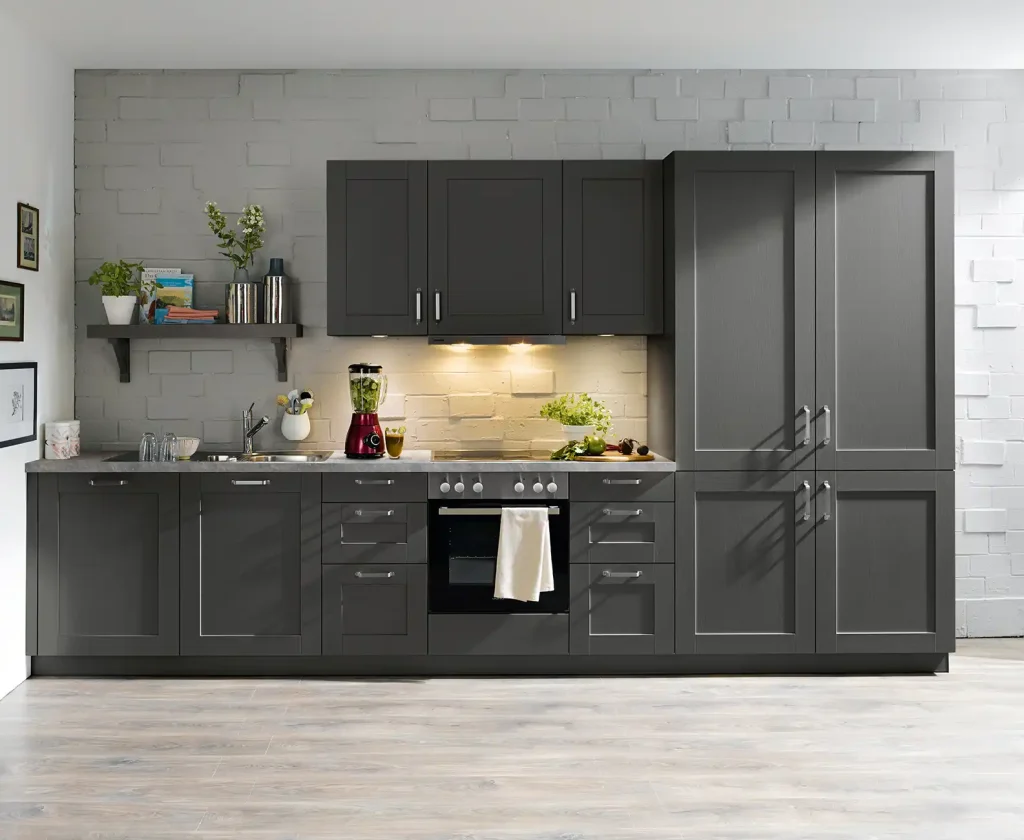
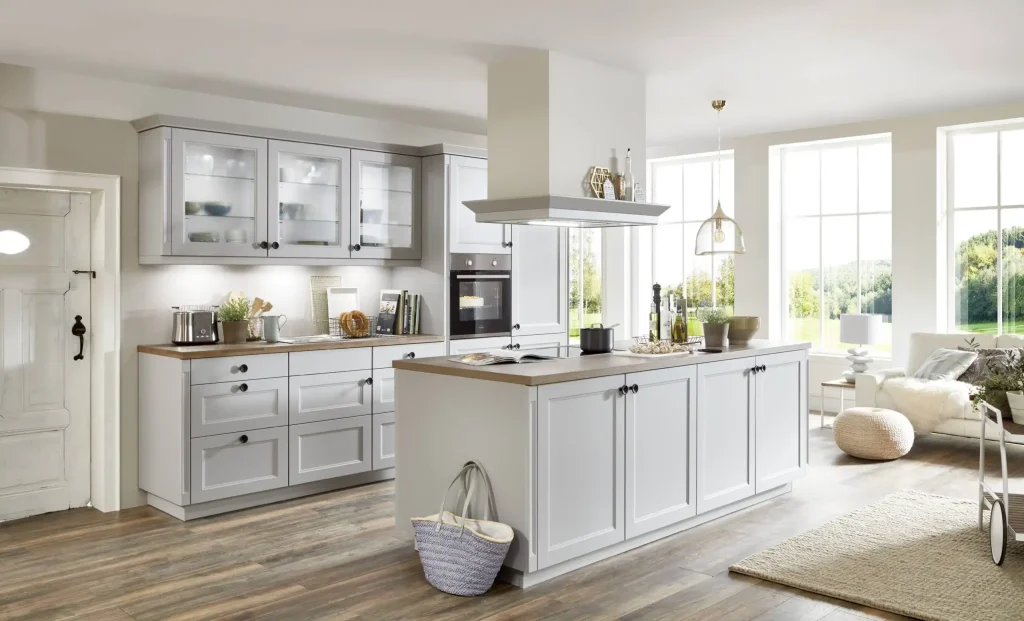
Typology A: The Transitional Shaker Model (The Volume Leader)
- Profile Geometry: A classic five-piece door aesthetic featuring a recessed center panel framed by two vertical stiles and two horizontal rails. In membrane manufacturing, this design is milled from a single solid block of high-density MR-MDF instead of assembling five separate pieces. This single-piece construction eliminates open joints where wood movement could crack the paint shell.
- Internal Detailing: The transition step can feature a crisp 90-degree angle or a soft, easy-to-clean beveled chamfer.
- Visual Appeal: Offers a balanced aesthetic that works well in both traditional and contemporary homes. It is frequently finished in elegant wood grain or soft silk-matte colors, providing a uniform texture across the face and profiles of the kitchen run.
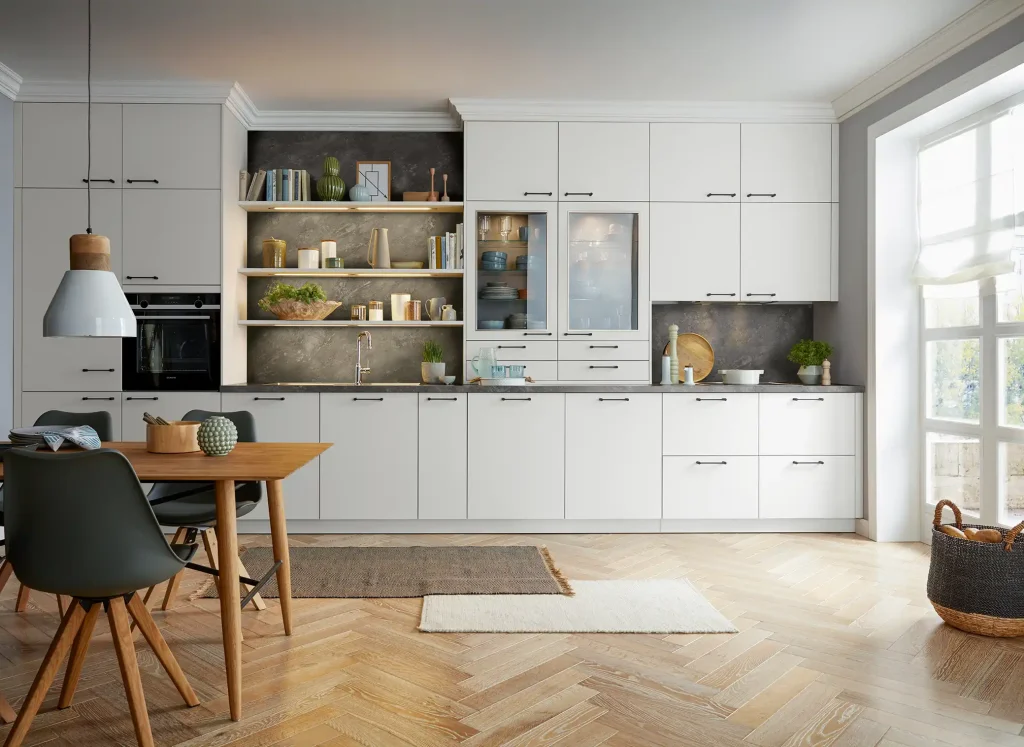
Typology B: The Modern Minimalist Slab Model
- Profile Geometry: Completely flat, smooth front surfaces with soft radiused outer edges. This design features an absence of external decorative moldings or handles.
- Mechanical Integration: Employs integrated J-pull handles cut directly into the door edge using CNC routers before the pressing stage. The membrane press draws the foil over the complex J-groove profile seamlessly, creating an easy-to-clean, handleless finger pull.
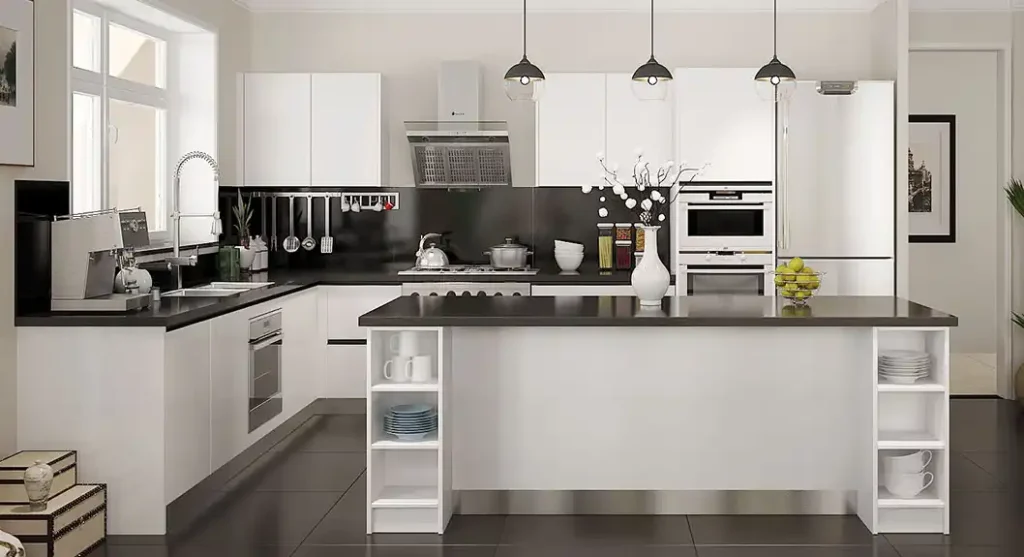
- Visual Appeal: Delivers clean lines and a minimalist look, with a preference for ultra-matte fingerprint-proof textures or high-gloss surfaces that reflect natural light across the kitchen.
Typology C: The Ornate Classical and Country Model
- Profile Geometry: Characterized by complex raised center panels, multi-stepped edge details, and arches routed into the face of the core.
- Mechanical Integration: Ready to accept traditional handles, matching valances along the bottom of wall cabinets, and crown moldings wrapped in matching thermofoil sheets.
- Visual Appeal: Celebrates historical design styles, often finished in textured wood grain patterns that mimic the natural feel and pore structure of genuine timber.
7. Core Kitchen Cabinet Configurations and Hardware Systems
The performance of a Membrane Kitchen Cabinet Turkey build depends heavily on the internal cabinet box structure and mechanical motion hardware used to build the final modules.
       +---------------------------------------------------+

       |             VENEERED CABINET CARCASS HUB          |
       +---------------------------------------------------+

       | [Backing Sheet] -> 8mm Veneered MDF Slide Dado     |
       | [Top/Bottom]    -> 18mm Marine Plywood or MR-MDF   |
       | [Front Face]    -> Solid Wood Laser Edge-banded Seam|
       | [Concealed Leg] -> ABS Adjustable Heavy Weight Feet |
       +---------------------------------------------------+
Cabinet Box (Carcass) Engineering Options
- Veneered Marine Plywood: The premium option for luxury builds, offering excellent screw-holding strength, high water resistance, and structural stability under heavy stone tops.
- Veneered MR-MDF: A reliable, cost-effective mid-tier option that provides completely flat interior walls, uniform color matching, and dependable moisture protection.
- Melamine-Faced Chipboard (MFC): Often used for interior shelving and partitions in budget-conscious projects, featuring a linen or stone textured finish paired with genuine wood veneer doors on the exterior.
Premium Mechanical Hardware Integration
Turkish kitchen manufacturers cooperate with top-tier European hardware brands to complete their cabinetry configurations:
- Concealed Soft-Close Hinges: Blum Blumotion or Grass Tiomos hinges featuring 3D micro-adjustability (height, side, and depth alignment) rated for up to 200,000 opening cycles.
- Under-Mount Drawer Runners: Heavy-duty synchronized runner tracks capable of supporting dynamic weights up to 40kg or 70kg per drawer without sagging, equipped with integrated fluid dampers for silent closing.
- Space-Optimizing Storage Access: Motorized touch-to-open servo systems and smooth corner pullouts (such as Kesseböhmer LeMans tracks) are integrated into the cabinet frames to maximize accessibility in corner layouts.
8. Structural Comparison Matrix: Evaluating Sourcing Choices
To assist procurement managers and interior architects in evaluating material specifications for a Membrane Kitchen Cabinet Turkey order, this matrix outlines how different construction options compare across key performance vectors:
| Engineering Dimension | Premium Polymeric Membrane (MR MDF Core) | Catalyzed Polyurethane Lacquer Paint | High-Pressure Laminate (HPL Plastic) | Melamine Direct Lamination |
|---|---|---|---|---|
| Seam Interface Profile | Seamless face & edges; back is melamine | 100% Monolithic (Seamless shell) | Requires separate edge-banding strips | Requires separate edge-banding strips |
| Profile Routing Capability | High (Excellent for Shaker & 3D profiles) | High (Excellent for Shaker & 3D profiles) | Limited to flat slab doors only | Limited to flat slab doors only |
| Impact and Chip Resistance | High (Flexible polymer sheet absorbs blows) | Low-Medium (Brittle lacquer can chip) | Extremely High (Dense phenolic shell) | Moderate (Thin resin paper can scratch) |
| Color Customization Scope | Limited to factory foil color catalogs | Infinite (Full RAL & NCS color charts) | Limited to manufacturer sheet lines | Limited to baseline paper catalogs |
| Relative Pricing Index | Balanced Mid-Market Tier | Premium Luxury Tier | High-Durability Commercial Tier | Economy Baseline Tier |
9. Sustainability Frameworks and Eco-Compliance Standards
As eco-conscious building practices become standard worldwide, the environmental credentials of furniture manufacturing are increasingly important. Turkish premium kitchen processing complies with rigorous European ecological safety regulations.
Zero-Formaldehyde E0/E1 Substrate Ratings
The resins used to bond engineered wood substrates can off-gas formaldehyde, which impacts indoor air quality. Certified Turkish export factories utilize substrates that carry E1 certification (European market standard limiting emissions to less than 0.1 ppm) or meet the rigorous EPA TSCA Title VI requirements for the North American market, ensuring clean, safe indoor environments.
FSC Chain-of-Custody Certification
Eco-conscious developers prioritize tracking raw material sources. Premium Turkish cabinetry producers maintain an FSC (Forest Stewardship Council) Chain of Custody certification. This documentation verifies that all timber fibers used in the manufacturing run are sourced from responsibly managed forests where replanting rates meet or exceed logging limits, helping projects qualify for valuable LEED or BREEAM building credits.
Chlorine-Free PET Sourcing Options
For green building developments, selecting PET membrane foils instead of standard PVC ensures the final cabinetry is 100% chlorine-free. PET is fully recyclable and does not emit toxic hydrochloric acid vapors if subjected to high-temperature thermal destruction, meeting strict global eco-procurement parameters.
10. Procurement Logistics, Project Engineering, and Global Delivery
Sourcing custom Membrane Kitchen Cabinet Turkey configurations for international residential developments or private estates involves an organized, step-by-step production and logistical process to ensure success.
+-------------+      +-------------+      +-------------+      +-------------+

| 1. Design & | ---> | 2. Profile  | ---> | 3. Precision| ---> | 4. Surface  |
| 3D CAD/CAM  |      | Routing     |      | Glue Coating|      | Vacuum Press|
+-------------+      +-------------+      +-------------+      +-------------+
                                                                      |
+-------------+      +-------------+      +-------------+             |

| 7. On-Site  | <--- | 6. Sea/Land | <--- | 5. Factory  | <------------+
| Installation|      | Container   |      | Assembly    |
+-------------+      +-------------+      +-------------+
- Design and 3D CAD/CAM Modeling: Technical designers convert architectural floor plans into millimeter-precise production blueprints using advanced software like IMOS or TopSolid Wood. This software maps out every joint, hinge boring, and panel boundary, ensuring that the profile cuts align cleanly across the entire kitchen run.
- Precision Core Profile Routing: Raw MR-MDF panels are processed on high-speed CNC nesting machines to slice individual door dimensions and mill detailed Shaker or handleless profiles with zero tolerance for error.
- Adhesive Spray and Drying: The routed components pass down automated spray lines where 2K polyurethane dispersion glues are applied, followed by a force-dry evaporation phase.
- Vacuum Membrane Pressing: The panels enter hydraulic vacuum presses where heating elements and air pressure pull the selected thermofoil sheet smoothly around the front faces and edge radii.
- Factory Pre-Assembly Inspection: Cabinets are fully assembled on the shop floor. Quality control inspectors verify door gaps (held to a strict 1.5mm tolerance), structural squareness of the carcass configurations, and seamless adhesion along the back edges of the foil.
- Disassembly and Custom Export Crating: Components are wrapped in thick, anti-static polyethylene foam, reinforced with honeycombed corner guards, and enclosed in heavy-duty wooden crates or OSB boxes built to withstand international sea or land freight.
- On-Site Installation: Local installation teams or dispatched factory representatives assemble the modular cabinets on-site, securing them to structural wall systems.
11. Technical Care, Maintenance, and Heat Shield Configuration
To ensure a premium membrane kitchen maintains its finish quality and structural balance for generations, homeowners and installers should follow a structured care and protection routine.
The Critical Role of Deflector Heat Shields
While modern cross-linked PUD glues offer excellent thermal resistance, prolonged exposure to high temperatures can eventually soften the bond. When installing a Membrane Kitchen Cabinet Turkey layout next to a built-in oven, dishwasher, or range cooker, installers must attach slim aluminum heat deflector shields to the front edges of the cabinet carcasses. These shields deflect escaping radiant heat away from the door edges, protecting the thermofoil bond during high-temperature baking or cleaning cycles.
Cleaning Chemistry Restrictions
Never use cleaning agents that contain harsh solvents, paint thinners, acetone, or abrasive scrubbing powders. These chemicals can melt or score the flexible polymer face of the foil. Clean cabinet surfaces using a soft microfiber cloth and a drop of pH-neutral dish soap, wiping gently across the panel face.
Spill Mitigation along the Rear Edge Seam
Because membrane doors wrap the front face and four edges from a single sheet, the only open seam sits on the back face where the foil meets the rear melamine backing sheet. Homeowners should wipe away water droplets that collect along the bottom edges of doors or under sink modules immediately, preventing sitting liquid from bypassing the rear seam via capillary action.
Conclusion: The Strategic Sourcing Choice
Investing in a custom Membrane Kitchen Cabinet Turkey project combines architectural versatility with robust materials and competitive production costs. By understanding the underlying substrate material science, polymer foil options, two-component adhesive chemistry, and logistical steps detailed in this guide, architects, real estate developers, and corporate procurement officers can confidently establish accurate project budgets and build highly functional kitchen spaces that balance modern performance with timeless aesthetic appeal.

Şunları da sevebilirsiniz
Wooden Bathroom Cabinet Turkey
Wooden Kitchen Cabinet Turkey