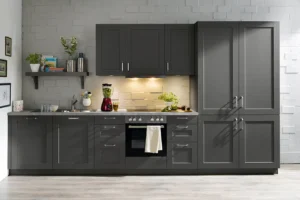

Handleless Kitchen Cabinet Turkey
Handleless Kitchen Cabinet Turkey: The Definitive Architectural Guide to Typologies, Structural Engineering, and Premium Sourcing
Introduction: The Modernist Shift to Streamlined Culinary Spaces
In contemporary luxury residential architecture, the kitchen has undergone a profound spatial transformation. No longer treated as an isolated, purely functional utility room, it has emerged as the central design anchor, social hub, and primary equity-driving zone of the modern home. This evolution demands cabinetry that balances sophisticated design aesthetics with long-term material durability.
For international interior architects, real estate developers, and high-volume furniture distributors, establishing a reliable supply chain for a Handleless Kitchen Cabinet Turkey project has emerged as a premier strategy to optimize project timelines, control material expenditures, and maintain uncompromising build quality.
The physical and mechanical demands placed on handleless kitchen furniture are exceptionally high, often exceeding the wear-and-tear metrics of traditional cabinetry fitted with surface hardware. A handleless kitchen vanity operates within a punishing microclimate characterized by rapid fluctuations in relative humidity, frequent temperature swings, direct water exposure, and airborne chemical vapors from high-temperature cooking grease. Furthermore, modern minimalist styles—such as flat-front slab doors with razor-thin profile lines—remove traditional protective face frames and external hardware bars.
This structural omission means that users must apply opening forces directly to the door edges or face panels, shifting all load-bearing and alignment stress directly onto the underlying substrate core, edge joints, and mechanical tracking hardware. Manufacturing furniture that can withstand these environmental and mechanical forces without warping, peeling along seams, or losing dimensional alignment requires advanced material science, precise engineering, and specialized chemistry.
Turkey’s modern manufacturing infrastructure has established itself as an absolute global leader in this specialized sector. By combining centuries of Mediterranean woodworking heritage with top-tier German and Italian multi-axis automated computer-numeric-control (CNC) machining lines, Turkish factories produce custom handleless cabinetry that satisfies rigorous European build standards while maintaining a highly competitive structural cost advantage.
This comprehensive technical guide analyzes the regional manufacturing clusters, technical design typologies, substrate material engineering, surface finish chemistry, assembly hardware mechanics, and international procurement logistics that define the premium market for a Handleless Kitchen Cabinet Turkey build.
1. The Turkish Manufacturing Infrastructure: Industrial Clusters and Scale Mechanics
To understand the logistical efficiency and cost competitiveness of the Handleless Kitchen Cabinet Turkey export pipeline, one must examine the country’s specialized industrial geography. Turkey’s furniture sector is organized into advanced manufacturing clusters, with each region specializing in specific production techniques, raw material processing paths, and volume capabilities.
+-----------------------------------------------------------------+

|        TURKISH HANDLELESS KITCHEN MANUFACTURING CLUSTERS        |
+-----------------------------------------------------------------+

|  [Kayseri Cluster]      ---> Ultra-Scale Automated Slab Lines   |
|  [İnegöl Hub]           ---> Mass-Customization & Fine Woodwork |
|  [İstanbul Ecosystem]   ---> Architectural Bespoke Luxury Runs  |
|  [Aegean/İzmir Zone]    ---> High-Efficiency Modern Port Export |
+-----------------------------------------------------------------+
The Kayseri Industrial Cluster (The Scale Giant)
Kayseri hosts some of the largest, highly automated furniture production facilities in Eastern Europe and the Middle East. These factories are characterized by multi-acre under-roof automated lines featuring computerized high-capacity beam saws, continuous through-feed edge-banders, and robotic multi-spindle drilling centers. Kayseri is the primary sourcing zone for large-scale commercial contracts—such as outfitting massive multi-family residential towers, student housing developments, or global retail distribution networks that require tens of thousands of uniform flat-slab components with absolute dimensional consistency.
The İnegöl Furniture Ecosystem (Bursa Province)
İnegöl is an international woodworking center with a long heritage of carpentry craftsmanship. This region excels at blending automated mass production with flexible customization. Factories here focus on processing premium substrates, multi-layer veneering, and complex transitional handleless configurations. It is a key hub for mid-to-high-end implementations of a Handleless Kitchen Cabinet Turkey run where developers seek modular speed but require premium finishes like real wood veneers or multi-coat catalyzed polyurethanes.
The İstanbul Design and Corporate Hub
İstanbul serves as the engineering and technical hub for bespoke architectural layouts. Advanced factories in the industrial outskirts of İstanbul specialize in transforming complex architectural drawings into customized minimalist modules. These workshops integrate advanced smart home technologies, built-in sensor lighting pathways, and premium European motion hardware directly into handleless configurations, making it a primary sourcing center for luxury property developments.
The Aegean and İzmir Export Corridor
The western coast of Turkey, centered around İzmir, leverages excellent port access and proximity to European sea lanes. Factories in this zone specialize in high-efficiency manufacturing of contemporary minimalist cabinetry, utilizing advanced automated edge-banding technology and flat-pack packaging engineering optimized for rapid ocean and land container shipping logistics.
2. A Taxonomy of Handleless Design: The Three Core Typologies
A common misconception among early-stage procurement officers is that all handleless kitchens are engineered identically. In professional millwork design, the term Handleless Kitchen Cabinet Turkey encompasses three distinct structural typologies, each requiring completely different carcass configurations, CNC routing profiles, and mechanical hardware allocations.
                  HANDLELESS ARCHITECTURAL TYPOLOGIES
 ┌───────────────────┬───────────────────┬───────────────────┐
 │ True J-Pull       │ Structural Gola   │ Push-To-Open      │
 │ Finger groove     │ Recessed aluminum │ Magnetic latches; │
 │ cut directly into │ channel inside    │ completely flat   │
 │ the door panel.   │ cabinet carcass.  │ monolithic face.  │
 └───────────────────┴───────────────────┴───────────────────┘
Typology A: The Integrated J-Pull Profile Model
The J-Pull profile represents a highly popular mid-market premium handleless option.
- Structural Geometry: A continuous horizontal or vertical J-shaped finger groove is milled directly into the upper or side edge of the cabinet door panel before the finishing or painting stage. Users open the cabinet by catching their fingers inside this recessed channel.
- Manufacturing Requirements: Machining a precise J-pull profile demands high-density core substrates and advanced 5-axis CNC routers equipped with diamond-tipped profile cutters. Because the finger groove creates a sharp radius curves, the surface coating system (such as catalyzed lacquer or vacuum membrane thermoform foil) must possess exceptional elongation and adhesion capabilities to wrap tightly inside the channel without peeling or thining at the inside corners.
- Aesthetic Profile: Provides a clean, modern face with subtle horizontal accent lines running along the drawer steps, removing the need for separate carcass modifications.
Typology B: The True Handleless Gola Channel System
The Gola channel layout sits at the pinnacle of modern architectural design, highly requested for luxury high-end residential estates.
- Structural Geometry: The cabinet door fronts are cut as completely flat, uniform slabs. The handle function is moved entirely into the cabinet box structure (carcass). An extruded aluminum profile—known as a Gola channel—is recessed into a custom notch cut out of the top and sides of the cabinet box. This channel creates a permanent 30mm clearance gap behind the door, allowing users to reach behind the flat door panel and pull it open from the back face.
- Carcass Modifications: Sourcing a Handleless Kitchen Cabinet Turkey order utilizing Gola channels requires advanced factory engineering. The side walls of the cabinet boxes must be milled with precise horizontal templates to accept C-shaped channels (positioned between stacked drawers) or L-shaped channels (positioned immediately beneath the countertop).
- Aesthetic Profile: Delivers a highly uniform look. Because the aluminum rails run continuously across the entire width of the kitchen facade, they create dark shadow gaps that make the stone countertop appear to float weightlessly above the cabinetry.
Typology C: The Mechanical Push-To-Open (Tip-On) System
For ultra-minimalist spaces where designers want to eliminate shadow lines and finger channels completely, factories implement the mechanical or electrical push-to-open system.
- Structural Geometry: The door panels are flat, rectangular slabs with zero grooves, recess channels, or gap rails. The cabinetry forms an absolute monolithic wall of continuous material.
- Mechanical Integration: The doors and drawers are fitted with spring-loaded mechanical latches or motorized electronic servo units hidden inside the carcass. When a user applies slight pressure anywhere on the front face of the panel, the latch releases, pushing the door outward by several inches to allow a hand to catch the edge.
- Aesthetic Profile: Maximizes the material beauty of the kitchen facade, making it the ideal typology for sequentially book-matched wood veneers or large-format sintered stone cabinet doors.
3. Core Substrate Material Science: Engineering the Foundation Panel
The ultimate lifespan, screw-holding power, and deflection resistance of any premium Handleless Kitchen Cabinet Turkey module rely entirely on the quality of its underlying core substrate. Because handleless units feature flat expanses and subject door edges to frequent finger contact, the core panels must possess high dimensional stability to prevent surface distortion or warping.
Moisture-Resistant Medium Density Fiberboard (MR-MDF / Green Core)
For the vast majority of modern flat slab doors and integrated J-pull models, high-density MR-MDF is the industry-standard substrate choice.
- Chemical Composition: Formed by blending fine wood fibers with hydrophobic wax emulsions and moisture-resistant polyurethane or melamine-urea-formaldehyde resins before hot-pressing. The core is often tinted green during production for straightforward field identification.
- Performance Parameters: Features a uniform, dense core profile (ranging from 720 to 820 kg/m³) with zero internal void spaces or chip pockets. This structural density allows multi-axis CNC routers to cut deep J-pull profiles or crisp 45-degree mitered edges without fraying the fibers, providing a smooth surface that readily accepts liquid primers or sheet lamination. It features a low thickness swelling rate (typically under 6% when submerged for 24 hours), making it an excellent substrate choice for a long-lasting kitchen installation.
Multi-Ply Marine-Grade Birch Plywood (Su Kontrası)
For high-end structural cabinet boxes (carcasses) and luxury contemporary door configurations, premium producers utilize marine-grade plywood.
- Chemical Composition: Constructed by laminating thin sheets of high-density birch veneers at alternating 90-degree grain angles. The layers are bonded under intense hydraulic heat and pressure using completely waterproof phenolic or polyurethane cross-linking adhesives.
- Performance Parameters: Does not delaminate, twist, or split when exposed to direct water contact or boiling steam. Plywood offers exceptional screw-holding strength, ensuring heavy-duty hinges and drawer slides remain securely anchored over decades of heavy daily use. When specified for handleless configurations, it provides the structural stiffness needed to support heavy built-in appliances and stone countertops without sagging.
The Law of Symmetrical Flat Balancing
A critical principle in the engineering of an Handleless Kitchen Cabinet Turkey model is structural symmetry. If a manufacturer presses a thick premium acrylic, veneer, or laminate sheet onto only the front face of a core panel while treating the back face with a cheap, thin melamine backing paper, the uneven surface tension will cause the door to cup and warp over time as humidity levels change. In a handleless kitchen, even a minor 2mm warp is instantly visible along the continuous linear shadow gaps.
To prevent this distortion, factories follow a strict balance rule: whatever material thickness, chemical layout, and weight configuration is applied to the front face must be matched with an identical balancing layer on the back face. This balanced composition neutralizes internal structural tension, ensuring the cabinet doors remain flat over decades of residential service.
4. Surface Finishing Technologies: Shields Against Water, Grease, and Fingermarks
The exterior finish applied to a Handleless Kitchen Cabinet Turkey face serves as the primary aesthetic statement and acts as the defensive shield protecting the core substrate. Because users constantly touch the panel faces directly, finishes must offer high resistance to skin oils, cosmetics, and fine scratching. Sourcing from Turkey provides access to advanced industrial surface treatments.
| Finishing Process | Substrate Compatibility | Liquid Impermeability | Scratch Resistance | Design Aesthetics |
|---|---|---|---|---|
| Catalyzed Polyurethane Lacquer | MR-MDF, Solid Hardwood | Excellent (Seamless) | Medium-High | Seamless matte, satin, or mirror high-gloss |
| Polymethyl Methacrylate (PMMA) | Flat MR-MDF Core | High (Requires edge-bands) | High (Buffable face) | Optical glass-like depth; absolute mirror sheen |
| High-Pressure Laminate (HPL) | Flat MR-MDF / PB | High (Requires edge-bands) | Extremely High | Ultra-matte fingerprint-proof; metallic sheets |
| Vacuum Membrane Thermoform | Routered MR-MDF | Perfect on face/edges | High | Seamless J-pull coverage; zero edge seams |
Multi-Stage Polyurethane Lacquer Lines (The Luxury Standard)
A premium lacquer finish is highly labor-intensive and represents the luxury tier of the Handleless Kitchen Cabinet Turkey market. The core MR-MDF panel undergoes a multi-layer chemical application process: an isolation primer seals the wood fibers, two coats of high-solid polyurethane filler form a flat surface, and catalyzed acrylic color coats are cross-sprayed inside sterile cleanrooms.
This multi-layered approach builds a seamless, non-porous chemical shell that wraps the front, back, and all edges of the door, completely eliminating seams where moisture can bypass the finish. This is highly suitable for J-pull doors, as the liquid coating flows perfectly into the routed finger channels without leaving open edge joints.
Solid PMMA Acrylic Sheets (The High-Gloss Icon)
Acrylic cabinetry represents an elegant marriage of polymer science and precise flat-line lamination technology. Premium acrylic panels feature a thick co-extruded synthetic sheet fused to an engineered wood core using reactive PUR glues.
This configuration creates a hard-wearing, non-porous face that achieves an absolute glass-like mirror sheen (90+ Gloss Units) or an ultra-matte texture that cannot be replicated by standard finishes. PMMA is naturally stable when exposed to ultraviolet (UV) radiation, ensuring a white or light grey kitchen face will not yellow or discolor over decades of exposure to direct sunlight.
Electron-Beam Cured High-Pressure Laminates (The High-Traffic Technical Choice)
For high-use residential projects or high-end commercial developments, Turkish factories offer advanced technical laminates. These materials utilize decorative papers bonded with phenolic resins under high pressure, topped with a specialized acrylic resin layer cured via electron-beam technology (EBC).
The resulting surface is ultra-matte (under 3 Gloss Units), exceptionally soft to the touch, and completely resistant to oily fingerprints and micro-scratches. Furthermore, it possesses thermal healing properties, allowing users to buff out minor surface scuffs using a damp microfiber cloth and a standard household iron.
5. Precision Edge Fabrication: Laser Fusion and PUR Bonding
In a contemporary minimalist kitchen layout, the weakest point of any flat-slab panel is its exposed perimeter edge. If water droplets or steam find a path through a loose edge joint, the core substrate will expand, destroying the linear alignment. Sourcing a Handleless Kitchen Cabinet Turkey program ensures access to two advanced industrial edge-sealing technologies.
       +---------------------------------------------------------+

       |           LASER EDGE-BANDING FUSION PROCESS             |
       +---------------------------------------------------------+

       | [Laser Diode Source] ---> Melts Functional Polymer Layer|
       | [ABS Edge Band]      ---> Pressed Directly into Core     |
       | [Resulting Interface]---> Zero-Joint, 100% Waterproof Seam|
       +---------------------------------------------------------+
Reactive Polyurethane (PUR) Edge Bonding
Standard economy edge-banders use Ethylene Vinyl Acetate (EVA) hot-melt glues, which melt inside an open glue pot and adhere panels via simple physical friction. EVA glues can soften if exposed to high kitchen heat (such as escaping steam from dishwashers) and leave a visible glue line that can collect dirt over time.
Premium Turkish factories implement reactive PUR hot-melt edge-banding. PUR adhesive is applied via specialized enclosed nozzles. As it cools and reacts with ambient humidity, it undergoes a permanent chemical cross-linking reaction. Once fully cured, the PUR layer forms an inert, flexible bond that is 100% waterproof and heat-resistant, ensuring edge-bands will not peel or delaminate near range cookers or under-sink moisture zones.
Zero-Joint Laser Fusion Edge-Banding
For modern flat-slab and true handleless Gola models, top-tier Turkish production facilities utilize advanced laser fusion edge-banding systems. Instead of applying liquid glue, the machine uses a concentrated laser beam to instantly melt a co-extruded polymer functional layer on the back of a thick ABS or solid-hardwood edge-band (typically 1.0mm to 2.0mm thick). The edge-band is then pressed firmly against the panel edge, fusing the two components together at a molecular level.
This process creates a seamless, zero-joint transition that is completely waterproof, heat-resistant, and visually clean, eliminating the unsightly “black line” typical of standard cabinetry and ensuring a completely continuous visual plane across the kitchen fronts.
6. Mechanical Hardware Integration: The Engineering of Motion
Because handleless kitchens eliminate external door pulls, they rely entirely on internal mechanical hardware to control motion, support heavy-duty drawers, and maintain crisp alignment over decades of daily use. Sourcing a Handleless Kitchen Cabinet Turkey system involves utilizing top-tier mechanical components.
       INTERNAL HARDWARE MOTION MATRIX
+---------------------------------------------------------+

| [J-Pull/Gola]  -> Soft-Close Under-Mount Runners (70kg) |
| [Tip-On Option]-> Spring-Loaded Mechanical Push Latches  |
| [Luxury Servo] -> Electronic Motorized Touch Drives     |
+---------------------------------------------------------+
Heavy-Duty Soft-Close Drawer Systems
Handleless drawer configurations place substantial stress on running tracks because users frequently pull drawers open from off-center finger locations. Sourcing from premium Turkish factories provides access to concealed, under-mount synchronized runner tracks engineered by global leaders like Blum (Legrabox/Tandembox), Grass (Vionaro), or Samet (Turkey’s premier hardware manufacturer).
- Load Capacities and Fluid Damping: Standard drawers use 40kg capacity glides, while deep pots-and-pans drawers or wide pantry pullouts integrate heavy-duty 70kg systems to prevent structural sagging. These glides incorporate sealed hydraulic cylinders that slow the drawer’s momentum just before closing, ensuring it shuts silently and preventing internal contents from rattling.
Electronic Servo-Drive and Touch Systems
For the ultimate luxury experience in a push-to-open handleless kitchen, Turkish factories integrate motorized electronic touch drives.
- The Servo Mechanism: Cabinet carcasses are wired with a low-voltage (24V) electrical grid connected to small motorized drive units positioned behind the drawer back walls. When a user touches any part of the flat cabinet door with their hand, knee, or hip, an electric impulse triggers the motor, which smoothly pushes the drawer open.
- Smart Safety Compliance: These electronic modules incorporate built-in collision detection loops. If a drawer meets any physical resistance (such as a child’s hand or an open neighboring door) during its opening path, the electrical drive stalls instantly, preventing injury or impact damage.
Three-Dimensional Micro-Adjustable Concealed Hinges
Because minimalist designs feature long, uninterrupted shadow gaps, a misaligned door panel stands out instantly. Doors are hung using concealed soft-close hinges equipped with integrated oil dampers. Installers use integrated adjustment screws to calibrate the doors across three axes (horizontal alignment, vertical height, and inset depth) down to fractions of a millimeter, ensuring the continuous horizontal shadow lines remain perfectly straight down the entire length of the kitchen installation.
7. Structural Comparison Matrix: Sourcing Specifications Evaluated
To assist procurement directors and supply chain managers in structuring their project budgets for a Handleless Kitchen Cabinet Turkey import program, this matrix compares the primary material options across key performance vectors:
| Technical Property | Integrated 2K Lacquer J-Pull | True Handleless Gola (Acrylic MDF) | Electron-Beam Matte HPL Slab | Value Melamine Flat Slab |
|---|---|---|---|---|
| Typology Core Match | Typology A (Integrated J-Groove) | Typology B (Carcass Gola Channels) | Typology B & C (Flat Slabs) | Typology B (Flat Slab Base) |
| Perimeter Seam Profile | 100% Monolithic (Seamless shell) | Laser-fused ABS or 3D PMMA band | Zero-Joint Laser Fused ABS Band | Standard EVA Edge-banded Strip |
| Fingermarks & Oil Defense | Moderate (Satin lacquer hides scuffs) | High (Gloss sheets can show smudges) | Exceptional (Anti-fingerprint EBC) | Moderate (Flat paper can hold stains) |
| Color Customization Scope | Infinite (Full RAL & NCS color charts) | Limited to factory sheet catalogs | Limited to manufacturer sheet lines | Limited to baseline paper catalogs |
| Relative Pricing Index | Premium Luxury Bracket | High-End Contemporary Bracket | Technical Premium Bracket | Economy Value Bracket |
8. Sustainability Frameworks and Eco-Compliance Standards
As eco-conscious building practices become standard worldwide, the environmental credentials of furniture manufacturing are increasingly important. Sourcing a certified Handleless Kitchen Cabinet Turkey project ensures full compliance with rigorous European ecological safety regulations.
Zero-Formaldehyde E0/E1 Substrate Ratings
The resins used to bond engineered wood substrates can off-gas formaldehyde, which impacts indoor air quality. Certified Turkish export factories utilize substrates that carry E1 certification (European market standard limiting emissions to less than 0.1 ppm) or meet the rigorous EPA TSCA Title VI requirements for the North American market, ensuring clean, safe indoor environments.
FSC (Forest Stewardship Council) Chain of Custody
High-end manufacturers maintain an FSC Chain of Custody certification. This tracking code certifies that all logs used in the cabinetry can be traced back to managed forest plots where replanting rates equal or exceed harvesting rates, helping developments qualify for valuable LEED or BREEAM building credits.
Clean Finishing Chemistry
By implementing advanced polyurethane hot-melt (PUR) glues for edge-banding and water-based polyurethane dispersion (PUD) glues for membrane presses, premium Turkish factories eliminate urea-formaldehyde resins from their final assembly stages. Furthermore, large-scale factories operate carbon-bed filtration and thermal oxidation systems to neutralize volatile organic compounds (VOCs) from lacquer lines before air exits the plant, meeting strict global eco-procurement parameters.
9. Procurement Logistics, Customs Compliance, and Incoterms
Sourcing custom Handleless Kitchen Cabinet Turkey configurations for international residential developments or private estates involves an organized, step-by-step production and logistical process to ensure success.
+-------------+      +-------------+      +-------------+      +-------------+

| 1. Design & | ---> | 2. Precision| ---> | 3. Through- | ---> | 4. Quality  |
| CAD/CAM Plan|      | CNC Routing |      | Feed Boring |      | Toler Audit |
+-------------+      +-------------+      +-------------+      +-------------+
                                                                      |
+-------------+      +-------------+      +-------------+             |

| 7. On-Site  | <--- | 6. Sea/Land | <--- | 5. Custom   | <------------+
| Installation|      | Container   |      | Rigid Crate |
+-------------+      +-------------+      +-------------+
Phase 1: Architectural Drawing and CAD/CAM Engineering
The project starts with the client’s site floor plans. Factory architects translate these room measurements into millimeter-precise production drawings using advanced software like IMOS or TopSolid Wood. This step is especially critical for Gola layouts, as the software must map out the exact structural notches required in the carcass side walls to accommodate the horizontal aluminum profiles.
Phase 2: Factory Pre-Assembly and Quality Tolerance Audit
Before finishing coats or custom crating are approved, the cabinetry modules are fully assembled on the factory shop floor. Quality control inspectors verify:
- Hinge boring alignment and reveal tolerances between flat doors (held to a strict 1.5mm gap).
- Structural squareness of all carcass configurations.
- Precise fitment and continuous alignment of the recessed Gola aluminum rails.
- Complete integration of internal mechanical hardware, push-latches, and pull-out tracks.
Phase 3: Rigid Export Packing and Container Optimization
Handleless cabinet doors require heavy-duty packing capable of enduring long-distance shipping movements without scratching the polished or ultra-matte faces. Components are wrapped in multi-layered, anti-static polyethylene foam, reinforced with thick, honeycombed corner guards, and enclosed in heavy-duty wooden crates or OSB boxes built for container shipping. For high-volume projects, shipping flat-packed maximizes container space, while high-end private estates often specify rigid pre-assembled modules to minimize on-site installation labor.
Navigating Trade Documentation and Incoterms
- The A.TR Movement Certificate (The European Cost Advantage): For procurement managers operating within the European Union, the single greatest financial advantage of the Turkish supply chain is the A.TR Movement Certificate. Under the terms of the EU-Turkey Customs Union agreement, industrial goods—including cabinetry and furniture products—can move between Turkey and EU member states without being subject to customs duties. This duty-free status saves EU buyers between 2% and 8% in capital costs compared to importing from non-union nations.
- FOB (Free on Board – Named Port of Export): The Turkish manufacturer handles domestic production, inland transport to the port, and export customs clearance. The buyer assumes responsibility and freight costs once the shipping container is loaded onto the vessel at major deep-water ports like Ambarlı (İstanbul) or Alsancak (İzmir).
10. Technical Care, Maintenance, and Heat Shield Configuration
To ensure a premium minimalist kitchen layout maintains its finish sheen and structural balance for generations, homeowners and installers should follow a structured care and protection routine.
The Critical Role of Deflector Heat Shields
While modern cross-linked edge adhesives and polymer finishes offer excellent thermal resistance, prolonged exposure to high temperatures can gradually weaken bonds. In true handleless Gola configurations, radiant heat from built-in ovens can rise through the carcass channels.
When installing a Handleless Kitchen Cabinet Turkey layout next to a built-in oven or dishwasher, installers must attach slim aluminum heat deflector shields to the front edges of the cabinet carcasses. These shields deflect escaping radiant heat and hot water vapors away from the door edges, protecting the edge-band bond during high-temperature baking or cleaning cycles.
Cleaning Chemistry Restrictions
Because users pull doors open by gripping the back face or finger channels directly, these areas can accumulate skin oils and kitchen residue. Never use cleaning agents that contain ammonia, chlorine bleach, or abrasive scrubbing powders. These chemicals can score or dull high-gloss finishes and degrade the protective clear coats of lacquered finishes. Clean cabinet surfaces using a soft microfiber cloth and a drop of pH-neutral dish soap, always wiping gently across the panel surfaces.
Spill Mitigation along Internal Carcass Channels
In Gola layouts, the recessed aluminum channels are open from the top, meaning liquid spilled on the countertop could potentially drip into the lower cabinet channel. Installers should apply a clean bead of anti-fungal silicone beneath the countertop lip during assembly. Homeowners should wipe away water droplets that collect inside the Gola channels or along base shelves immediately, preventing sitting liquid from standing for extended periods.
Conclusion: Sourcing Success in the Turkish Cabinet Sector
Investing in a custom Handleless Kitchen Cabinet Turkey project combines architectural versatility with robust materials, precision automated manufacturing, and competitive production costs. By understanding the underlying substrate material science, surface protection coatings, joinery mechanics, and trade documentation requirements detailed in this guide, architects, real estate developers, and corporate procurement officers can confidently establish accurate project budgets and build elegant, high-performance contemporary kitchen spaces that deliver lasting asset value.

Şunları da sevebilirsiniz

Rustic Kitchen Cabinet Turkey
Country Kitchen Cabinet Turkey