

Country Kitchen Cabinet Turkey
Country Kitchen Cabinet Turkey: The Definitive Architectural Guide to Sourcing, Timber Engineering, and Traditional Millwork Excellence
Introduction: The Resonance of Rustic Sourcing in Modern Culinary Architecture
In contemporary high-end residential architecture, the kitchen has undergone a profound spatial transformation. No longer treated as an isolated, strictly functional service room, it has emerged as the central design anchor, social hub, and primary equity-driving zone of the modern home. While minimalist aesthetics have dominated urban landscapes for years, a major shift toward warm, organic, and historical design paths is occurring in the luxury sector. For interior architects, international developers, and discerning homeowners worldwide, establishing a reliable, premium pipeline for a Country Kitchen Cabinet Turkey project has become a primary strategy to balance timeless rustic appeal with advanced technical execution.
The architectural challenges of executing a country or farmhouse aesthetic are uniquely demanding and often cross into complex material science. Unlike modern flat slab doors that hide core substrates behind synthetic sheets, a true country kitchen relies on visible joinery, open-grain hardwoods, deep profile carvings, patinas, and ornate architectural crown details. Introducing authentic timber framework into a kitchen environment presents clear technical risks. Cabinetry must perform reliably under punishing everyday conditions, including frequent swings in relative humidity, exposure to hot cooking steam, structural loading from heavy stone countertops, and regular contact with acidic ingredients. Sourcing millwork that can handle these challenges without warping, split joints, or finish breakdown requires an expert understanding of core substrate balance, wood cell anatomy, hydrothermal wood stabilization, and specialized finishing chemistry.
Turkey’s modern manufacturing infrastructure has established itself as an absolute global leader in this specialized wood-carving sector. By combining centuries of Mediterranean woodworking heritage with top-tier German and Italian multi-axis automated computer-numeric-control (CNC) machining lines, Turkish factories produce custom and modular country cabinetry that satisfies rigorous European build standards while maintaining a highly competitive structural cost advantage. This comprehensive technical guide analyzes the regional manufacturing clusters, technical design typologies, timber botanical choices, moisture management science, assembly hardware mechanics, surface protection chemistry, and international procurement logistics that define the premium market for a Country Kitchen Cabinet Turkey build.
1. The Turkish Manufacturing Infrastructure: Industrial Clusters and Regional Capacity
To understand the logistical efficiency and cost competitiveness of the Country Kitchen Cabinet Turkey export pipeline, one must examine the country’s specialized industrial geography. Turkey’s furniture sector is organized into highly integrated manufacturing clusters, with each region specializing in specific production techniques, raw material processing paths, and volume capabilities.
+-----------------------------------------------------------------+

|         TURKISH COUNTRY CABINET MANUFACTURING CLUSTERS          |
+-----------------------------------------------------------------+

|  [İnegöl Hub]           ---> Custom Solid Timber & Detailed Art |
|  [İstanbul/Modoko Hub]  ---> Bespoke Luxury Architectural Runs |
|  [Kayseri Cluster]      ---> Scaled Semi-Solid Modular Lines   |
|  [Aegean/İzmir Zone]    ---> High-Efficiency Port Container Ship|
+-----------------------------------------------------------------+
The İnegöl Woodworking Ecosystem (Bursa Province)
Located in the Bursa province, İnegöl represents the heart of Turkey’s solid wood and detailed joinery production. This cluster features centuries of multi-generational carpentry heritage that has transitioned smoothly into modern factory ecosystems. İnegöl’s factories excel at complex timber manipulation, deep-profile multi-axis routing, manual distressing, and custom glaze finishing. For a premium Country Kitchen Cabinet Turkey run that requires genuine mortise-and-tenon doors, carved corbels, and solid oak panels, İnegöl is the primary architectural sourcing hub.
The İstanbul Modoko and Masko Design Hubs
İstanbul serves as the engineering, technical, and high-end design hub for bespoke residential projects. Advanced workshops in the industrial zones of İstanbul focus on low-volume, ultra-luxury custom architectural specifications. These factories integrate hidden smart home technologies, under-cabinet sensor lighting layouts, motorized larder systems, and premium European movement hardware straight into traditional farmhouse cabinet layouts, creating an ideal sourcing center for luxury property developments.
The Kayseri Industrial Cluster
Kayseri hosts some of the largest, highly automated furniture production facilities in Eastern Europe and the Middle East. While Kayseri is known for mass-producing modern flat-pack cabinetry, its advanced lines also support high-volume manufacturing of transitional country kitchen designs. These factories use engineered moisture-resistant substrates faced with polymeric thermoform foils that mimic wood grains, serving as the go-to sourcing zone for high-volume commercial contracts such as outfitting multi-family holiday villages or scaled suburban housing developments.
Regulated Forestry and Raw Material Hubs
Turkey’s unique geographic position across multiple climate zones provides access to excellent domestic timber reserves managed by the General Directorate of Forestry (OGM). This state agency enforces strict harvesting limits to verify that logging operations do not exceed annual forest growth rates. The high-humidity mountain forests of the Black Sea region supply dense, premium hardwoods like beech, ash, and oak, which form the structural foundation of a high-end Country Kitchen Cabinet Turkey installation.
2. Timber Species Anatomy and Botanical Selection Criteria
The choice of wood species determines more than just the final color of a country kitchen; it dictates the cabinetry’s density, hardness, cellular stability, and response to changing indoor climates. A premium Country Kitchen Cabinet Turkey project utilizes a select group of hardwoods, each chosen for its specific mechanical performance vectors and grain definition.
       TIMBER HARDNESS VECTOR (Janka Rating Spectrum)
 ┌───────────────────┬───────────────────┬───────────────────┐
 │ Anatolian Walnut  │ White Oak         │ European Ash      │
 │ 1,010 lbf         │ 1,290 lbf         │ 1,320 lbf         │
 │ (Rich tones,      │ (Dense tyloses,   │ (High elasticity, │
 │ stable core)      │ moisture defense) │ expressive grain) │
 └───────────────────┴───────────────────┴───────────────────┘
Anatolian Oak (Anadolu Meşesi)
- Janka Hardness Rating: 1,290 lbf to 1,350 lbf depending on the regional growth microclimate.
- Cellular Anatomy: Open-pored with a high content of tyloses—microscopic bubble-like structures that form within the vascular tubes of the heartwood during the tree’s growth. Tyloses effectively clog the wood’s internal conduits, blocking capillary water absorption and making white oak highly resistant to decay and water infiltration under kitchen steam.
- Visual Characteristics: Prominent growth rings, striking medullary rays when quarter-sawn, and a color spectrum spanning pale straw to deep amber.
- Best Architectural Use: Heavy raised-panel doors, structural face frames, solid center kitchen islands, and plate-rack modules that demand high tensile strength.
Premium Anatolian Walnut (Ceviz)
- Janka Hardness Rating: 1,010 lbf.
- Cellular Anatomy: Semi-diffuse porous structure with uniform pore distribution and highly interlocked grain pathways. This interlocked growth pattern makes walnut remarkably stable across all axes, reducing seasonal twisting or warping.
- Visual Characteristics: Deep, rich chocolate tones accented by swirling dark grain lines, structural knots, and creamy sapwood highlights.
- Best Architectural Use: High-contrast island tops, exposed breadboard-end baking stations, and natural-finish display hutch backing panels.
European Beech (Avrupa Kayını)
- Janka Hardness Rating: 1,300 lbf.
- Cellular Anatomy: Diffuse porous with small, evenly distributed cell structures that create a uniform surface.
- Visual Characteristics: Pale pinkish-tan hue with subtle, fine flecking throughout the grain.
- Best Architectural Use: Painted country cabinetry components, internal structural frames, and inner drawer boxes where an ultra-smooth, lacquer-receptive substrate is required.
Premium Ash Wood (Dişbudak)
- Janka Hardness Rating: 1,320 lbf.
- Cellular Anatomy: Ring-porous with excellent natural elasticity and shock resistance against daily structural impacts.
- Visual Characteristics: Bright white to light cream body with broad, flowing, highly expressive grain variations.
- Best Architectural Use: Wire-brushed country cabinet door faces, textured open-shelf storage units, and deep-grained dark charcoal or sage green reactive stains.
3. Material Science: Moisture Equilibrium and Kiln-Drying Optimization
The primary technical challenge when building a premium country kitchen with real wood is its hygroscopic nature. Timber naturally absorbs and releases water vapor, expanding and contracting as indoor humidity levels fluctuate. Uncontrolled wood movement will lead to warped doors, split frame joints, and binding drawer glides. Managing this risk is a critical priority for any premium Country Kitchen Cabinet Turkey manufacturer.
       THE HYGROSCOPIC DRYING CURVE
  RAW TIMBER (50%+ Moisture Content)
                 │
                 ▼
  AIR-DRYING YARDS (12–24 Months; stabilized to ~18%)
                 │
                 ▼
  COMPUTERIZED KILN DEHUMIDIFICATION (6% - 8% EMC Target)
                 │
                 ▼
  STRESS-RELIEF ACCLIMATIZATION (48–72 Hour Balancing)
Cellular Water Chemistry: Free Water vs. Bound Water
Living trees hold water in two forms: free water within the cell cavities and bound water held chemically within the cell walls. When timber dries, it first sheds its free water until it reaches the Fiber Saturation Point (FSP), roughly 28% to 30% moisture content. Structural shrinkage and cell wall modification begin only when bound water exits the cell walls.
Reaching the Target Equilibrium Moisture Content (EMC)
To guarantee a stable country kitchen installation, the timber must be dried to match the average Equilibrium Moisture Content (EMC) of its destination environment. For most residential interiors in North America and Western Europe, this target range is 6% to 8%. If wood is processed at a higher moisture content, it will shrink post-installation in dry, climate-controlled environments, cracking paint layers and loosening joint tolerances. Turkish producers utilize electronic multi-point probes driven by automated software algorithms to manage the drying schedule, checking that the moisture profile is consistent from the core to the surface of the timber.
Prevention of Internal Case Hardening
If a kiln drying cycle operates too aggressively, moisture evaporates from the surface of the wood faster than it can migrate from the core. This imbalance locks the outer shell in tension while the core remains compressed, a flaw known as case hardening. When this timber is subsequently cut by a CNC machine, the sudden release of internal tension can cause immediate warping. To prevent this, premium factories use steam conditioning phases at the end of the drying cycle to equalize stress levels across the wood boards.
4. Cabinet Joinery Architecture and Structural Engineering
A durable Country Kitchen Cabinet Turkey build relies on smart product engineering that guides wood movement safely rather than fighting it blindly.
+---------------------------------------------------------+

|             5-PIECE STICK-AND-COPE PANEL DESIGN         |
+---------------------------------------------------------+

|      [Stile]  <-- Grain Runs Vertically -->  [Stile]    |
|   +-------------------------------------------------+   |
|   |  [Top Rail] <-- Grain Runs Horizontally -->     |   |
|   |  +-------------------------------------------+  |   |
|   |  |                                           |  |   |
|   |  |            NATURAL WOOD FLOATING          |  |   |
|   |  |                 CENTER PANEL              |  |   |
|   |  |                                           |  |   |
|   |  |       (Expands laterally within deep      |  |   |
|   |  |       dado grooves; no rigid glue lines)  |  |   |
|   |  |                                           |  |   |
|   |  +-------------------------------------------+  |   |
|   |  [Bottom Rail]                               |   |
|   +-------------------------------------------------+   |
+---------------------------------------------------------+
The Five-Piece Frame Isolation System
Traditional country kitchens avoid flat slab doors, relying instead on raised or recessed center panel configurations [Lacquered Kitchen Cabinet Turkey, Ready-Made Kitchen Cabinet Turkey]. Sourcing a Country Kitchen Cabinet Turkey program means doors are built using a five-piece frame assembly designed to manage dimensional movement:
- Vertical Stiles: Run the full height of the door on the left and right edges, directing vertical alignment [Natural Wood Kitchen Turkey].
- Horizontal Rails: Join the stiles at the top and bottom using high-tensile wooden dowels or traditional mortise-and-tenon joints [Natural Wood Kitchen Turkey].
- The Floating Panel: Sits within a deep perimeter dado groove along the inner edge of the frame [Natural Wood Kitchen Turkey]. It is not glued or nailed down [Natural Wood Kitchen Turkey]. Instead, it rests on flexible space-balls or compression foam inserts, allowing it to expand laterally during high-humidity seasons without breaking the structural frame joints [Natural Wood Kitchen Turkey].
Mechanical Integrity via Dovetail Drawer Joinery
High-end drawer boxes in a Country Kitchen Cabinet Turkey configuration avoid basic butt joints or metal corner brackets, relying instead on interlocking dovetail joints [Natural Wood Kitchen Turkey]. The interlocking pins and tails distribute load forces evenly across the drawer box, preventing pulling forces from separating the drawer front over decades of heavy daily use [Natural Wood Kitchen Turkey].
| Joint Quality Vector | Blind Interlocking Dovetail | Standard Dowelled System |
|---|---|---|
| Mechanical Strength | Superior; interlocking fingers lock tighter under pull [Natural Wood Kitchen Turkey]. | Relies entirely on adhesive friction or screw sheer [Natural Wood Kitchen Turkey]. |
| Visual Aesthetics | Premium craft look; visible wood grain transitions [Natural Wood Kitchen Turkey]. | Industrial look; hardware connection points visible [Natural Wood Kitchen Turkey]. |
| Structural Longevity | Excellent; holds together even if adhesive ages [Natural Wood Kitchen Turkey]. | Prone to loosening under heavy loading over time [Natural Wood Kitchen Turkey]. |
Face-Frame Construction vs. Frameless Construction
Turkish manufacturers construct country cabinetry in two distinct formats based on regional market preferences:
- Traditional Face-Frame Format: Popular in North America, this method attaches a solid wood frame over the front face of the cabinet box carcass. Hinges are anchored straight into this solid wood frame, adding structural stiffness and an authentic look.
- Frameless European Format: Popular in Western Europe, this format mounts door hinges straight to the interior walls of the carcass box, maximizing internal storage access and simplifying cleaning paths while utilizing decorative columns to mask module seams.
5. Advanced Substrate Engineering for Transitional Profiles
While 100% solid timber is prized for high-end artisan builds, contemporary engineering often pairs genuine wood veneers with advanced composite substrates to achieve superior structural stability in damp microclimates. When evaluating a Country Kitchen Cabinet Turkey build, international procurement teams analyze three primary substrate tiers.
Moisture-Resistant Medium Density Fiberboard (MR-MDF / Green Core)
For painted country or transitional Shaker layouts, high-density MR-MDF serves as an excellent substrate material.
- Chemical Composition: Formed by blending fine wood fibers with hydrophobic wax emulsions and moisture-resistant polyurethane or melamine-urea-formaldehyde resins before hot-pressing. The core is often tinted green during production for straightforward field identification.
- Performance Parameters: Features a uniform, dense core profile (ranging from 720 to 820 kg/m³) with zero internal void spaces. This structural density allows the edges and faces to be profile-routed into complex country shapes without fraying, providing a smooth surface that readily accepts liquid primers or sheet lamination. It features a low thickness swelling rate (typically under 6% when submerged for 24 hours), making it an excellent substrate choice for a long-lasting kitchen installation.
Multi-Ply Marine-Grade Birch Plywood (Su Kontrası)
For high-end structural cabinet boxes (carcasses) and floating country modules, marine plywood represents the gold standard core.
- Chemical Composition: Constructed by laminating thin sheets of high-density birch veneers at alternating 90-degree grain angles. The layers are bonded under intense hydraulic heat and pressure using completely waterproof phenolic or polyurethane cross-linking adhesives.
- Performance Parameters: Does not delaminate, twist, or split when exposed to direct water contact or boiling steam. Marine plywood offers exceptional screw-holding strength, ensuring heavy-duty hinges, drawer slides, and hanging brackets remain securely anchored over decades of heavy daily use.
Symmetrical Coated Balancing
A critical principle in the engineering of an veneered or lacquered Country Kitchen Cabinet Turkey panel is structural symmetry. If a manufacturer applies a multi-layer premium finish to only the front face of a substrate panel, the uneven surface tension will cause the door to cup and warp over time as humidity levels change. To prevent this distortion, factories follow a strict balance rule: whatever material, thickness, and paint configuration is applied to the front face must be applied identically to the back face, neutralizing internal structural tension.
6. Advanced Surface Finishing Chemistry: Glazes, Distressing, and Paint Armor
The exterior coating serves as the primary barrier protecting the underlying wood cells from kitchen moisture, grease, and stains. Sourcing a Country Kitchen Cabinet Turkey project provides access to advanced chemical finishing methods capable of achieving durable, antique aesthetics.
  SUBSTRATE MACHINING (5-Axis CNC Profile Milling)
                         │
                         ▼
  MANUAL HAND-DISTRESSING MATRIX (Optional faux wormholes/dents)
                         │
                         ▼
  ISOLATION RESIN PRIMER APPLICATION (Seals cellular pores)
                         │
                         ▼
  HIGH-SOLID FILLER BASECOAT LINE (Two separate spray passes)
                         │
                         ▼
  MANUAL TONE PAINT SPRAY SUITE (Satin acrylic polyurethane)
                         │
                         ▼
  HAND-APPLIED ACCENT GLAZING MATRICES (Wiped into detail profiles)
                         │
                         ▼
  UV-PROTECTIVE CLEAR ANTIMICROBIAL TOPCOAT SHIELD
Multi-Stage Polyurethane and Acrylic Paint Systems
For painted country kitchens, Turkish factories implement multi-coat catalyzed acrylic polyurethane systems. These formulations undergo an exothermic chemical cross-linking reaction as they dry, building an inert plastic barrier across the surface. This layer prevents liquid penetration, resists heat marking from hot cookware, and blocks ultraviolet rays from yellowing or fading the pigment tone beneath over time.
Traditional Hand-Applied Glazes and Patinas
Achieving the deep, lived-in appearance of a traditional country kitchen requires hand-applied highlight glazes:
- The cabinet door is sprayed with its base color coat (such as antique white, sage green, or soft butter cream) and allowed to cure completely.
- A semi-transparent dark glaze fluid (such as burnt umber or warm charcoal) is wiped over the entire door panel, forcing the pigment deep into the routed profile channels and corners.
- Master finishers wipe the face clean with soft cloths, leaving a soft shadow of pigment trapped inside the design grooves. This step adds visual depth, highlighting the carved lines and detail shapes of the woodwork.
Structural Wire-Brushing and Ceruse Finishes
For projects specifying a natural wood country look, factories pass hardwoods like oak or ash through texturing machines fitted with stiff wire wheels. These wheels scrape away the softer springwood cells while leaving the dense summerwood structures untouched, creating a deep, textured surface. Operators then apply contrasting ceruse stains—wiping white pigments into the deep grains while keeping the surface wood dark—to achieve an elegant country look.
7. Architectural Typologies and Kitchen Layout Styles
The versatile manufacturing infrastructure of the Turkish wood sector allows designers to realize diverse global aesthetics for a Country Kitchen Cabinet Turkey project.
       +-----------------------+-----------------------+

       |                       |                       |
       |  FARMHOUSE PROVENCAL  | TRANSITIONAL COUNTRY  |
       |                       |                       |
       | - Hand-carved details | - Clean shaker lines  |
       | - Open plate racks    | - Inset mesh panels   |
       | - Integrated corbels  | - Muted satin colors  |
       |                       |                       |
       +-----------------------+-----------------------+
The French Provencal and Mediterranean Farmhouse Style
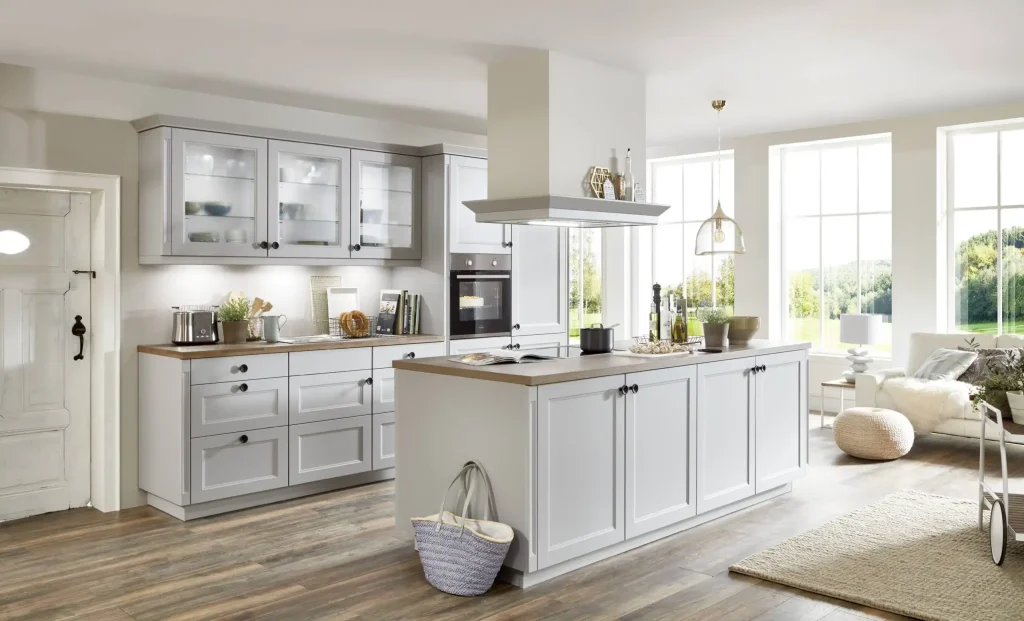
- Design Features: Focuses on rich, historical details. Doors feature arched top rails, heavy raised center panels, and visible hand-distressing. Kitchen layouts incorporate open plate racks, fluted pilasters, slatted vegetable baskets, and massive mantel hoods that frame the cooking alcoves.
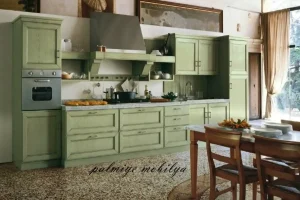
- Color Finishes: Dominated by warm, distressed tones such as antique ivory, sea-foam blue, olive green, and soft terracotta glazes.
The English Country Cottage Style
- Design Features: Emphasizes cozy, functional utility. Cabinet configurations combine glass-front display cabinetry with inset wire mesh door inserts, allowing internal contents to show through. Features large butler sink configurations and exposed plate racks.
- Color Finishes: Often utilizes traditional muted tones like sage green, stone grey, deep forest green, and classic cream satin finishes.
The Modern Transitional Farmhouse Style
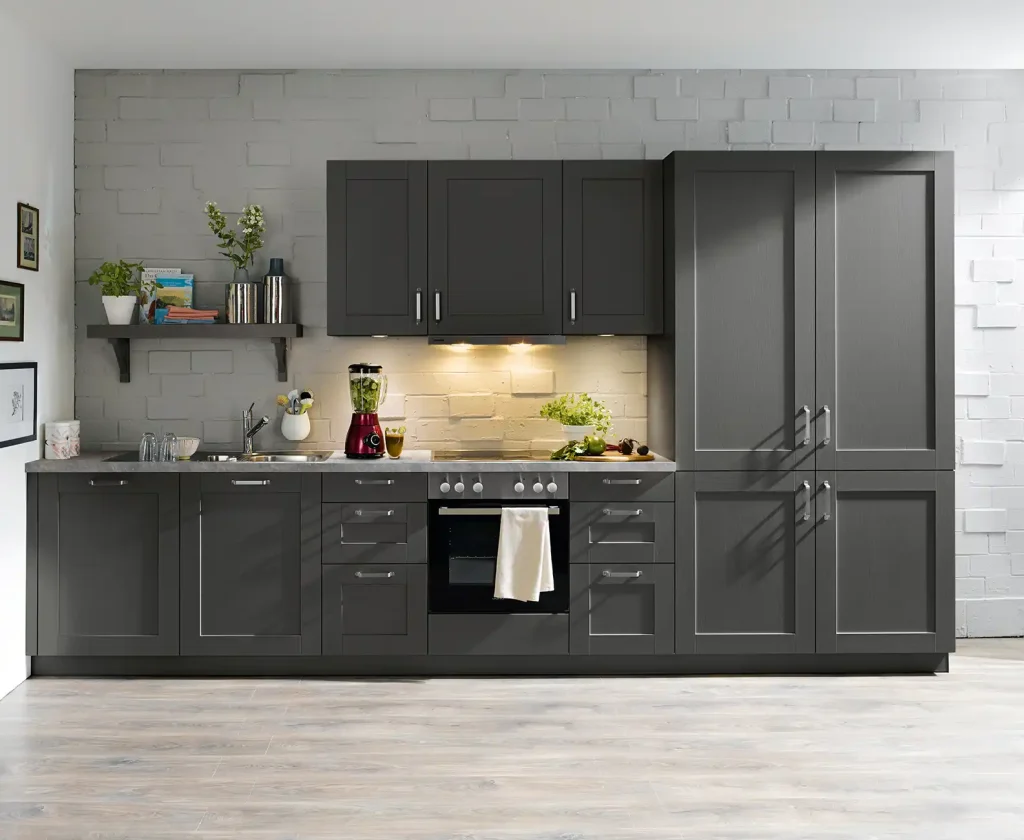
- Design Features: A clean approach tailored to modern suburban homes. It replaces heavy historical carvings with straight Shaker door frames, clean beveled transitions, and geometric layouts.
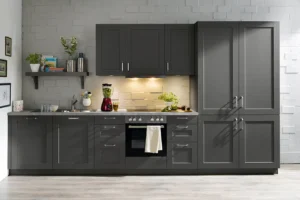
- Color Finishes: Combines natural open-grain oak kitchen islands with perimeter cabinetry painted in deep matte charcoal or absolute navy blue, providing a bold, high-contrast aesthetic.
8. Mechanical Hardware Integration: Sourcing Hidden Performance
A premium Country Kitchen Cabinet Turkey build relies on top-tier mechanical hardware to ensure smooth, effortless operation and handle the substantial weight of solid wood doors and heavy stone counters.
- Heavy-Duty Soft-Close Drawer Systems: Turkish manufacturers partner with premium European brands like Blum (Legrabox/Tandembox) or Grass (Vionaro) to supply under-mount, synchronized runner tracks. These systems prevent drawer sagging and handle dynamic loads up to 70kg, closing smoothly even when fully loaded.
- Three-Dimensional Micro-Adjustable Hinges: Doors are hung using concealed soft-close hinges featuring integrated oil dampers. Installers can easily calibrate the doors across three axes (horizontal alignment, vertical height, and inset depth) down to fractions of a millimeter, ensuring uniform 1.5mm door reveals.
- Space-Optimizing Storage Access: Motorized touch-to-open servo systems and smooth corner pullouts (such as Kesseböhmer LeMans tracks) are integrated into the cabinet frames to maximize accessibility in corner layouts.
9. Technical Sourcing Metrics: Structural Comparison Matrix
To help procurement teams and interior architects make informed decisions when evaluating specifications for a Country Kitchen Cabinet Turkey order, this matrix outlines how different construction options compare across key performance vectors:
| Technical Property | 100% Solid Hardwood Timber | Premium Wood Veneer (MR Core) | Vacuum Membrane Press (PET Foil) | High-Pressure Laminate (HPL on Board) |
|---|---|---|---|---|
| Profile Routing Scope | Infinite (Deep 3D carvings & columns possible) | High (Requires engineered core balancing) | High (Foil stretches over deep grooves) | Limited to flat slab designs only |
| Dimensional Stability | Low (Moves with humidity shifts) | Extremely High (Core resists warping) | High (Wrapped face limits movement) | Perfect (Inert synthetic layer) |
| Authentic Wood Texture | 100% Genuine tactile wood grain | 100% Genuine tactile wood grain | Textured embossing mimics wood grain | Synthetic printed pattern repetition |
| Refurbishment Paths | Can be sanded down & repainted any tone | Can be carefully sanded & restained | Cannot be sanded; requires re-wrapping | Cannot be sanded or repaired if damaged |
| Relative Pricing Index | Luxury Heirloom Bracket | Premium Sourcing Bracket | Balanced Mid-Market Bracket | Value Baseline Bracket |
10. Sustainability Frameworks and Eco-Compliance Standards
As eco-conscious building practices become standard worldwide, the environmental credentials of furniture manufacturing are increasingly important. Sourcing a certified Country Kitchen Cabinet Turkey project ensures full compliance with rigorous European ecological safety regulations.
Zero-Formaldehyde E0/E1 Substrate Ratings
The resins used to bond engineered wood substrates can off-gas formaldehyde, which impacts indoor air quality. Certified Turkish export factories utilize substrates that carry E1 certification (European market standard limiting emissions to less than 0.1 ppm) or meet the rigorous EPA TSCA Title VI requirements for the North American market, ensuring clean, safe indoor environments.
FSC (Forest Stewardship Council) Chain of Custody
High-end manufacturers maintain an FSC Chain of Custody certification. This tracking code certifies that all logs used in the cabinetry can be traced back to managed forest plots where replanting rates meet or exceed logging limits.
Clean Finishing Chemistry
By implementing advanced polyurethane hot-melt (PUR) glues for edge-banding and water-based polyurethane dispersion (PUD) glues for membrane presses, premium Turkish factories eliminate urea-formaldehyde resins from their final assembly stages. Furthermore, large-scale factories operate carbon-bed filtration and thermal oxidation systems to neutralize volatile organic compounds (VOCs) from lacquer lines before air exits the plant, helping projects qualify for valuable LEED or BREEAM building credits.
11. Sourcing Logistics, Quality Audits, and Global Delivery
Sourcing custom Country Kitchen Cabinet Turkey configurations for international residential developments or private estates involves an organized, step-by-step production and logistical process to ensure success.
+-------------+      +-------------+      +-------------+      +-------------+

| 1. Design & | ---> | 2. Profile  | ---> | 3. Precision| ---> | 4. Surface  |
| 3D CAD/CAM  |      | Routing     |      | Hand Craft  |      | Finish line |
+-------------+      +-------------+      +-------------+      +-------------+
                                                                      |
+-------------+      +-------------+      +-------------+             |

| 7. On-Site  | <--- | 6. Sea/Land | <--- | 5. Factory  | <------------+
| Installation|      | Container   |      | Assembly    |
+-------------+      +-------------+      +-------------+
Phase 1: Architectural Drawing and CAD/CAM Engineering
The project starts with the client’s site floor plans. Factory architects translate these room measurements into millimeter-precise production drawings using advanced software like IMOS or TopSolid Wood. This step is critical for country kitchens, as the software must map out the exact clearance tolerances required for thick raised panels and decorative corbels.
Phase 2: Factory Pre-Assembly and Quality Tolerance Audit
Before finishing coats or custom crating are approved, the country kitchen modules are fully assembled on the factory shop floor. Quality control inspectors verify:
- Hinge boring alignment and reveal tolerances between doors (held to a strict 1.5mm gap).
- Structural squareness of all carcass configurations.
- Continuous horizontal alignment of complex crown moldings and decorative base valances.
- Complete integration of internal mechanical hardware and pull-out tracks.
Phase 3: Packing and Trade Logistics Optimization
Country cabinetry components require heavy-duty packing capable of enduring long-distance shipping movements without scratching the painted or hand-glazed faces. Components are wrapped in multi-layered, anti-static polyethylene foam, reinforced with thick, honeycombed corner guards, and enclosed in heavy-duty wooden crates or OSB boxes built for container shipping.
- The A.TR Movement Certificate (The European Cost Advantage): For procurement managers operating within the European Union, the single greatest financial advantage of the Turkish supply chain is the A.TR Movement Certificate. Under the terms of the EU-Turkey Customs Union agreement, industrial goods—including cabinetry and furniture products—can move between Turkey and EU member states without being subject to customs duties. This duty-free status saves EU buyers between 2% and 8% in capital costs compared to importing from non-union nations.
12. Technical Care, Maintenance, and Lifecycle Cost Evaluation
To ensure a premium country kitchen layout maintains its finish sheen and structural balance for generations, homeowners and installers should follow a structured care and protection routine.
Indoor Environmental Control
Keep the home’s indoor relative humidity between 40% and 60% and maintain a consistent temperature. Drastic shifts (such as running high dry heat during sub-zero winters without a humidifier) can over-dry wood cells, potentially causing micro-cracking along joints. Ensure the kitchen has an exhaust fan rated for the room’s volume to clear out warm, humid air quickly after cooking.
Cleaning Chemistry Restrictions
Never use cleaning agents that contain ammonia, chlorine bleach, or abrasive silicones. Silicones can penetrate the topcoat and complicate future refinishing work. Instead, clean surfaces using a soft microfiber cloth and a diluted solution of pH-neutral soap, always wiping gently along the direction of the natural wood grain.
Spill Mitigation along Profile Channels
Because country doors feature deep horizontal grooves and recessed panels, water drops from sinks or boiling pots can gather inside these crevices. Homeowners should wipe away water droplets that collect inside these channels or under sink modules immediately, preventing sitting liquid from standing for extended periods and safeguarding the finish shell.
Conclusion: Sourcing Success in the Turkish Cabinet Sector
Sourcing your cabinetry project from Turkey offers an efficient balance of robust material engineering, advanced space-saving mechanical integration, and competitive production costs. By understanding the underlying substrate performance, surface protection options, structural corner joinery, and trade documentation requirements detailed in this guide, architects, real estate developers, and corporate procurement officers can confidently establish accurate project budgets and build elegant, high-performance urban kitchen spaces that deliver lasting asset value.

Şunları da sevebilirsiniz
Rustic Kitchen Cabinet Turkey
Small Kitchen Cabinets Turkey