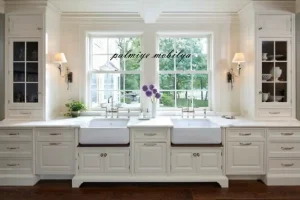

Modular Kitchen Cabinet Turkey
Modular Kitchen Cabinet Turkey: The Definitive Guide to Architecture, Manufacturing, Sourcing, and Technical Specifications
The global residential furniture industry has undergone a radical transformation, moving away from rigid, slow-built masonry and custom carpentry toward highly adaptive, standardized, and factory-engineered systems. At the forefront of this shift is the concept of modular cabinetry. The phrase Modular Kitchen Cabinet Turkey has become a primary touchpoint for international property developers, architects, interior designers, and homeowners seeking world-class interior fit-outs that blend European precision engineering with competitive manufacturing economics.
Turkey has positioned itself as an industrial powerhouse for modular furniture production. Utilizing automated German and Italian machinery, implementing strict European eco-labels, and leveraging an advantageous geographical position at the crossroads of Europe, Asia, and Africa, Turkish factories deliver high-performance kitchen systems. This technical manual explores the structural engineering, material science, spatial logistics, and global sourcing paradigms defining the Turkish modular kitchen sector.
1. Defining the Modular Kitchen Grid System
The fundamental engineering principle behind a Modular Kitchen Cabinet Turkey system is the metric grid matrix. Unlike traditional bespoke carpentry where cabinets are fabricated as singular, continuous units on-site, modular systems rely on pre-engineered, independent box structures (modules) manufactured to precise dimensional standards.
Universal Dimensional Standards
Turkish modular manufacturing follows standard European metric increments. This ensures absolute compatibility with built-in appliances (such as ovens, dishwashers, and hobs) from global brands like Bosch, Siemens, Miele, and Beko.
- Module Widths: Base and wall units are manufactured in standardized width increments of 15 cm, 30 cm, 45 cm, 60 cm, 90 cm, and 120 cm. The 60 cm module is the standard unit for integrated appliances.
- Base Cabinet Depth: Standardized at 56 cm to 58 cm (excluding the door thickness), which results in a finished 60 cm deep work surface once the countertop overhang is factored in.
- Wall Cabinet Depth: Typically engineered between 30 cm and 35 cm, ensuring that users do not strike their heads while working at the main counter.
- Ergonomic Heights: Base units generally stand at 72 cm to 76 cm high. When combined with an adjustable plinth system (10 cm to 15 cm) and a standard countertop profile (2 cm to 4 cm), the total finished ergonomic working height reaches the universally optimal 85 cm to 92 cm range.
The Systemic Advantages of Modularity
Deploying a Modular Kitchen Cabinet Turkey architecture offers clear operational advantages over traditional wood joinery:
- Precision Quality Control: Factory automation ensures that every panel is cut, drilled, and edge-banded within a zero-tolerance margin of error (<0.5mm).
- Rapid Field Installation: Because modules arrive on-site as pre-drilled, flat-packed, or rigid components, a complete kitchen can be assembled in a fraction of the time required for conventional millwork.
- Interchangeability and Scalability: If a door panel is damaged or a user decides to upgrade to a different internal pull-out mechanism years later, the component can be swapped out without altering the surrounding framework.
- Optimized Shipping Volume: Knocked-Down (KD) or flat-pack engineering maximizes shipping container volume, reducing international logistics costs.
2. Substrate Engineering and Core Material Science
The structural integrity, load-bearing capacity, and lifespan of a Modular Kitchen Cabinet Turkey depend heavily on its internal substrate composition. Kitchens are challenging indoor environments, characterized by fluctuating temperatures, localized steam, high humidity, and mechanical impacts.
+---------------------------------------------------------+

|        TYPICAL MODULAR CARCASS HOUSING STRUCTURE        |
+---------------------------------------------------------+

|                                                         |
|    +-----------------------------------------------+    |
|    | Top Rail (Solid MDF/Wood Stability Bar)       |    |
|    +-----------------------------------------------+    |
|    |                                               |    |
|    | [Side Panel]                             [Side|    |
|    | 18mm Melamine                            Panel]    |
|    | Faced MDF                                18mm  |    |
|    | (MFMDF)                                  MFMDF |    |
|    |                                               |    |
|    |       +-------------------------------+       |    |
|    |       |  Adjustable Internal Shelf    |       |    |
|    |       |  Supported by Steel Pins      |       |    |
|    |       +-------------------------------+       |    |
|    |                                               |    |
|    +-----------------------------------------------+    |
|    | Bottom Panel (18mm Heavy Duty Core)          |    |
|    +-----------------------------------------------+    |
|      ||                                         ||      |
|   +------+                                   +------+   |
|   |Plinth|                                   |Plinth|   |
|   |Leg   |                                   |Leg   |   |
|   +------+                                   +------+   |
+---------------------------------------------------------+
Melamine-Faced Chipboard (MFC) vs. Melamine-Faced MDF (MFMDF)
Turkish industrial factories utilize two primary core boards for carcass construction, sourced from dominant regional suppliers like Kastamonu Entegre, Starwood, and AGT:
- Melamine-Faced Chipboard (MFC / Suntalem): High-density industrial chipboard serves as the standard carcass material globally. High-grade Turkish MFC utilizes wood chips compressed under immense pressure with thermosetting resins. It provides excellent structural rigidity, flat surface stability, and tensile strength across long spans. It is highly cost-effective for internal shelves and vertical partition panels.
- Medium-Density Fibreboard (MDF / Medelam): MDF is composed of broken-down lignocellulosic wood fibers blended with synthetic resin binders. It exhibits a denser, more uniform cross-section than particle board. This high density allows for clean routing, intricate profile edge detailing, and superior screw-retention properties. Premium Turkish kitchen lines often use MDF for the entire carcass housing, not just the front-facing doors.
Moisture-Resistant (MR) Substrates
In immediate water-exposure zones—such as underneath the main kitchen sink or around high-steam dishwashers—elite manufacturers of the Modular Kitchen Cabinet Turkey utilize green-dyed Moisture-Resistant MDF or Marine Plywood. These specialty substrates incorporate advanced hydrophobic polyurethane or melamine-urea-formaldehyde (MUF) resin formulations, limiting thickness swelling to under 5-8% when fully submerged in water, compared to over 20% for baseline economy boards.
Formaldehyde Emission Ratings and Safety Compliance
Compliance with international environmental health criteria is a critical marker of industrial competence. Turkish manufacturers targeting European and North American markets formulate substrates to meet strict chemical emission controls:
- E1 Grade: The standard European safety benchmark, ensuring formaldehyde emissions remain safely below 0.1 ppm (parts per million).
- E0 / CARB Phase 2 Grade: Ultra-low or zero-added formaldehyde (NAF) boards specified for green building certifications (such as LEED or BREEAM) and high-end residential spaces.
3. Surface Finishes, Polymer Coatings, and Aesthetics
The visible skin of a Modular Kitchen Cabinet Turkey determines its visual appeal, tactile feel, scratch resistance, and ease of daily sanitization. Turkish factories are highly advanced in applying diverse decorative overlays.
Membrane (PVC Vacuum-Pressed) Doors
Membrane technology involves wrapping a flexible Polyvinyl Chloride (PVC) foil over a CNC-routed MDF panel using heat and a vacuum chamber.
- Design Flexibility: Allows for seamless execution of classic shaker profiles, traditional recessed panels, or modern integrated handles without visible joints.
- Water Barrier: Because the PVC foil wraps continuously around the front surface and all four lateral edges, it forms an absolute monolithic seal against moisture ingress.
High-Gloss and Super-Matte Acrylic Panels
Acrylic surfaces are produced by laminating a co-extruded, high-grade polymethyl methacrylate (PMMA) plastic sheet onto a calibrated MDF core panel.
- High-Gloss Finish: Offers an optically flat, mirror-like reflectivity with a gloss rating exceeding 90 units. It resists UV discoloration, preventing white kitchens from yellowing over time.
- Super-Matte PET Finish: Utilizing advanced Polyethylene Terephthalate surfaces, these doors provide a soft, velvet-like texture with zero gloss reflectivity. They are engineered with anti-fingerprint surfaces and possess thermal healing capabilities, where minor surface scuffs can be polished out using a clean cloth and iron heat.
Lacquer and Polyurethane Enamels
Lacquering represents the premium end of the Modular Kitchen Cabinet Turkey product portfolio. It involves automated or hand-spraying multiple coats of polyurethane, polyester, or acrylic primers and topcoats onto an MDF substrate.
- Seamless Edging: Unlike laminated panels that require an external edge-band strip, lacquer coats the panel continuously, eliminating dirt-collecting seams.
- Infinite Color Palette: Can be color-matched to global color systems such as RAL or NCS, providing architects with complete aesthetic autonomy.
4. Industrial Edgebanding and Adhesive Integrity
The weakest point of any modular kitchen panel is its exposed raw edge. If water penetrates the edge seam, the internal wood fibers swell, ruining the entire panel structure. Therefore, the edge-processing phase of a Modular Kitchen Cabinet Turkey is a critical determinant of product lifespan.
ABS and PVC Edgeband Strips
Turkish industrial plants have abandoned thin paper edgeband treatments in favor of heavy-duty Acrylonitrile Butadiene Styrene (ABS) or thick PVC (Polyvinyl Chloride) strips, generally ranging from 0.8mm to 2.0mm in thickness. ABS is highly impact-resistant, recyclable, and does not release toxic chlorine gases during municipal incineration processes.
PUR (Polyurethane) Glue vs. EVA Hot-Melt Adhesive
The chemistry of the adhesive used to bond the edge-band to the substrate defines its resilience:
| Adhesive Property | EVA (Ethylene Vinyl Acetate) | PUR (Polyurethane) Reactive | Laser / Hot-Air Fusion |
|---|---|---|---|
| Moisture Resistance | Moderate; can weaken over time if exposed to constant water. | High; forms an irreversible cross-linked chemical bond. | Absolute; eliminates the glue line completely. |
| Heat Resistance | Up to 60°C–70°C; can soften near ovens or kettles. | Up to 130°C–150°C; highly stable in hot zones. | Excellent; zero adhesive breakdown risk. |
| Visible Seam Line | Thicker, darker glue line that can collect dust. | Ultra-thin, nearly invisible translucent bond line. | Completely seamless; zero glue line visible. |
Advanced Turkish manufacturers prioritize PUR edge-banding technology or modern Laser-Air fusion edging systems to guarantee that cabinetry installed near high-steam dishwashers and built-in ovens will never experience edge delamination.
5. Architectural Hardware Engineering and Internal Ergonomics
A modular kitchen is essentially a mechanical system wrapped in aesthetic paneling. The internal hardware and moving mechanisms bear the daily physical load of the kitchen workspace.
Structural Soft-Close Hinges
The doors of a Modular Kitchen Cabinet Turkey are hung using heavy-duty, European-certified concealed hinges (often referred to as Euro-hinges or cup hinges). Brands like Samet (a Turkish hardware manufacturer with significant global market share), alongside international counterparts like Blum and Hettich, supply these systems.
- Three-Dimensional Adjustment: Allows installers to align doors precisely along the X, Y, and Z axes using a simple screwdriver.
- Integrated Hydraulic Dampers: Prevents door-slamming by decelerating movement in the last 15 degrees of closure.
Full-Extension Tandem Drawer Systems
Modern modular kitchens maximize usable space by replacing lower shelving units with deep tandem drawers.
- Load Rating: Double-walled steel drawer slides are engineered to support static loads of 30kg to 70kg, allowing safe storage of heavy cast-iron cookware, porcelain dinnerware, and pantry dry goods.
- Synchronization Mechanisms: Ensure smooth, linear travel without lateral wobbling or stick-slip effect, even when the drawer is fully extended and loaded to maximum capacity.
Space-Maximizing Pull-Out Mechanics
To eliminate dead zones inside corner cabinets and deep vertical tall units, Turkish modular configurations integrate high-performance storage hardware:
- Larder Units (Tall Pantry Pull-outs): Heavy-duty steel structural frames linked to the door. When pulled forward, the internal wire or solid-bottom baskets slide outward in tandem, exposing all stored items.
- Blind Corner Pull-outs (LeMans or Magic Corners): Intelligently shaped kidney-style shelves that independently pivot completely out of hidden corner cavities, bringing storage right to the cook’s fingertips.
6. Layout Configurations and Spatial Ergonomics
The application of a Modular Kitchen Cabinet Turkey system must conform to proven architectural layout typologies to optimize the kitchen work triangle (the spatial relationship between the cooking hob, preparation sink, and food refrigeration storage).
+---------------------------------------------------------+

|                  THE ESSENTIAL WORK TRIANGLE            |
+---------------------------------------------------------+

|                                                         |
|         [ REFRIGERATOR ] <---------> [ PREP SINK ]      |
|                \                          /             |
|                 \                        /              |
|                  \                      /               |
|                   \                    /                |
|                    v                  v                 |
|                     [ COOKING HOB ]                     |
|                                                         |
+---------------------------------------------------------+
The Straight Line (One-Wall) Layout
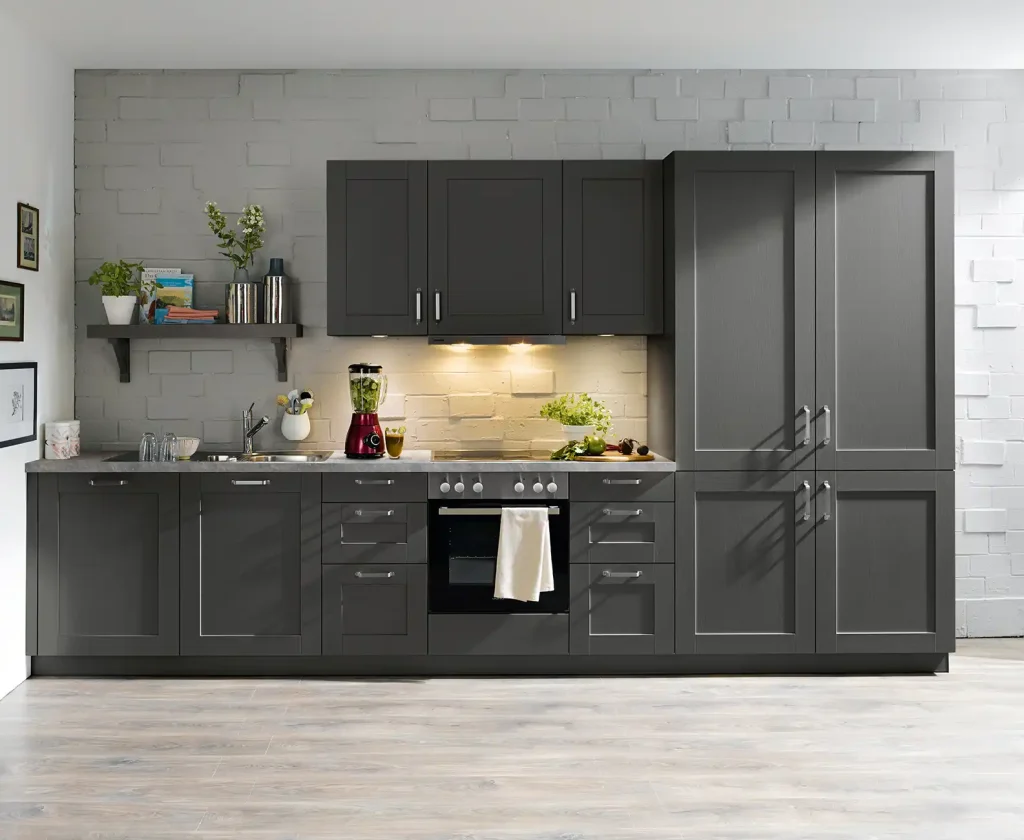
Ideal for compact urban apartments and micro-living spaces. All modular base, wall, and tall appliance housing units are organized along a singular linear wall plane. Storage space is maximized vertically by utilizing extra-tall 92 cm wall cabinets or double-stacked configurations that extend completely to the ceiling line.
The L-Shaped Layout
The most common structural configuration for residential homes. It utilizes two intersecting walls to form a natural, highly efficient work triangle. It provides a balanced distribution of counter workspace and storage modules while naturally opening up the kitchen space to connect with an adjacent dining room or open living space.
The U-Shaped Layout
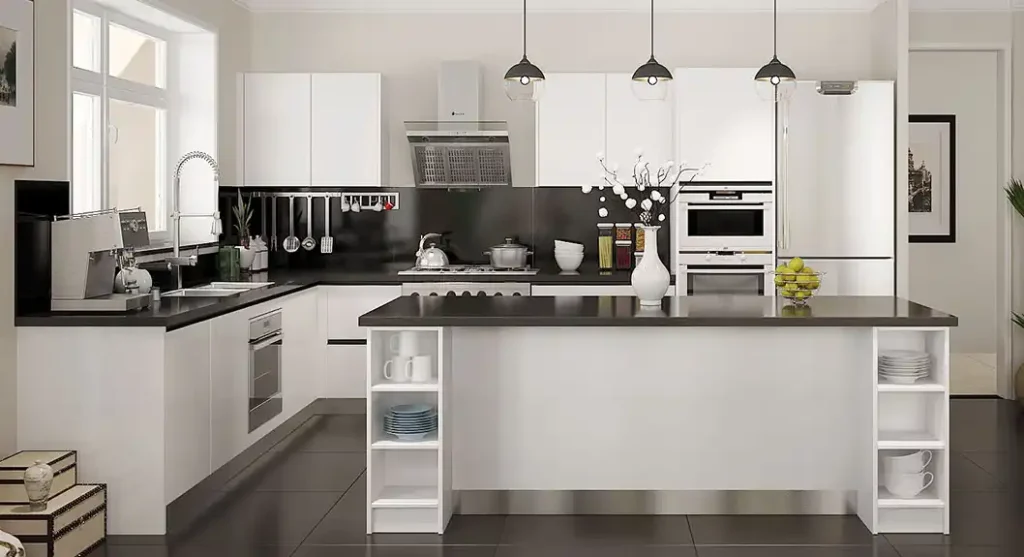
Best suited for dedicated enclosed kitchen rooms or large, expansive open-plan configurations. Modules run along three continuous walls, maximizing available workspace and under-counter storage capacity. This layout allows for distinct zonal division: one leg for cold food storage, the central bridge for washing and preparation, and the opposing leg for thermal cooking processes.
7. Mechanical, Electrical, and Plumbing (MEP) Site Preparation
Because a Modular Kitchen Cabinet Turkey system is pre-fabricated to exact dimensions, structural and mechanical services on-site must be routed accurately prior to cabinet installation.
Electrical Placement Matrix
- Built-in Oven and Microwave Sockets: Must be placed within the designated appliance housing tower module, typically positioned in an adjacent cavity rather than directly behind the high-heat appliance itself to allow for simple emergency isolation.
- Countertop Task Power Outlets: Installed a minimum of 15 cm to 20 cm above the finished countertop line to clear any stone backsplashes and prevent water splash contamination.
- Induction Cooktop Demands: Requires dedicated high-amperage lines (usually 32A single-phase or three-phase wiring) routed directly through the base cabinet carcass baseboard with proper ventilation gaps to protect the appliance cooling fans.
Plumbing and Drainage Specifications
- Sink Module Openings: The base cabinet carcass designed for the kitchen sink features an open back or dedicated cutout zones to accommodate water supply inlets and drain traps.
- Dishwasher Location: A dishwasher module should be positioned immediately to the left or right side of the main sink module. This allows the appliance water inlet and drainage hoses to route through the side panel of the sink cabinet carcass, connecting directly to the main plumbing stack without requiring dedicated behind-appliance pipes that would prevent the unit from sliding flush against the rear wall.
8. Sourcing, Logistics, and Quality Inspection Frameworks
Sourcing your Modular Kitchen Cabinet Turkey project requires an understanding of the industrial ecosystem and export shipping parameters.
Industrial Hubs of Turkish Production
The modular furniture manufacturing sector is concentrated in highly developed industrial zones equipped with deep logistics infrastructure:
- Istanbul and Bursa Regions: Advanced high-end design, high-capacity automated factories, and immediate access to major container ports (Ambarlı and Gemlik).
- Ankara (Siteler Region): Famous for a hybrid approach combining large-scale CNC production with traditional custom artisan wood finishing.
- Kayseri and Izmir Zones: Dominant in high-volume, cost-efficient mass production, ideal for multi-unit commercial real estate developments.
Quality Verification Checklist for Buyers
When reviewing production prototypes or inspecting bulk orders at a Turkish factory, utilize this professional inspection framework:
- Dimensional Accuracy: Verify panel thicknesses using a digital caliper. Standard high-quality carcasses must measure a full 18mm thickness (avoid economy 16mm alternatives).
- Edgeband Adhesion Test: Inspect the joint line under bright lighting. Look for any visible squeeze-out of adhesive or micro-gaps between the ABS strip and core material.
- Hardware Stress-Testing: Verify that all integrated soft-close hinges and drawer slides bear official international certification stamps (such as LGA, TÜV Rheinland, or SGS).
- Packaging Integrity: Ensure that flat-pack shipments use multi-layer double-wall corrugated cardboard boxes. Internal contents should be separated by high-density polyethylene foam sheets and corner protectors to survive maritime container transit.
9. Total Cost Estimation and Value Engineering
Selecting a Modular Kitchen Cabinet Turkey product line allows for value engineering based on material selection without sacrificing structural performance.
Material Cost Tiers
- Tier 1 (Budget/High Volume): High-density MFC (Melamine-Faced Chipboard) carcasses paired with standard MFC slab doors and durable EVA hot-melt edgebanding.
- Tier 2 (Mid-Range/Premium Residential): Moisture-resistant MDF carcasses combined with high-gloss acrylic or super-matte PET vacuum-wrapped doors, utilizing PUR waterproof adhesives.
- Tier 3 (Luxury/Custom High-End): Calibrated green MDF substrates coated in multi-layer polyurethane matte or high-gloss lacquer, fitted with top-tier internal pull-out storage mechanics and solid wood veneer structural elements.
Installation and Leveling Systems
Every high-quality Turkish modular base unit is fitted with heavy-duty adjustable polymer legs hidden behind a clip-on removable plinth (kickplate). These legs allow installers to achieve a perfectly level horizontal line on uneven subfloors, preventing structural stress on stone countertops and ensuring internal drawer slides glide smoothly.
10. Long-Term Maintenance and Structural Longevity
To preserve the finish and structural integrity of a modular kitchen layout, implement these professional care protocols:
- Steam Mitigation: Always operate the range hood or downdraft extractor during cooking processes to draw away moisture before it can condense on the undersides of upper wall cabinets. Leave the dishwasher door completely closed for 15-20 minutes after a cycle ends to allow internal steam to dissipate fully before exposing adjacent cabinet edges.
- Cleaning Formulations: Clean surfaces using a clean microfiber cloth dampened with warm water and a mild, pH-neutral detergent. Never use abrasive cleaning powders, steel wool, ammonia-based glass cleaners, or acetone, which can scratch polymer finishes and break down protective lacquer coatings.
- Weight Distribution: Place heavier items (such as cast-iron cookware or small appliances) toward the outer edges of drawer bottoms or base shelves rather than dead-center to optimize weight distribution across the structural support runners.
11. Conclusion: The Industrial Competence of Turkish Modular Systems
Investing in a Modular Kitchen Cabinet Turkey system provides an optimal combination of precision engineering, durable material selection, and sophisticated interior design. By structuring your kitchen layout around standardized metric coordinates and specifying high-performance substrates like moisture-resistant MDF combined with PUR edge-banding and certified soft-close hardware, you can build a highly resilient workspace.
Turkey’s manufacturing hubs offer the industrial capacity and technical precision required to fulfill both custom single-residence renovations and expansive multi-unit commercial real estate developments, elevating the modern kitchen into an ergonomic center of functionality and value.

Şunları da sevebilirsiniz
MDF Bathroom Cabinet Turkey

MDF Kitchen Cabinet Turkey