
Door Factory Turkey
Door Factory Turkey: The Comprehensive B2B Sourcing Guide and Industrial Engineering Manual
The international commercial construction, real estate development, and high-volume wholesale distribution sectors depend on highly consolidated manufacturing hubs to supply premium architectural joinery. Within the modern global supply chain, partnering with a premier Door Factory Turkey has established itself as an essential procurement standard. Turkey’s specialized timber processing and door manufacturing corridors—spanning vast industrial zones in Kayseri, Bursa, Istanbul, and Izmir—combine advanced computer numerical control (CNC) wood processing networks with meticulous chemical surface engineering. This unique industrial infrastructure allows a leading Door Factory Turkey to supply international markets with interior and exterior doors that balance custom design with strict compliance with international building codes.
This industrial manual provides a comprehensive, technically in-depth guide to the manufacturing capabilities, material sciences, chemical treatments, functional typologies, quality control benchmarks, installation requirements, and global distribution logistics that define the operations of a modern Door Factory Turkey.
1. The Industrial Geography of Turkish Door Manufacturing
To execute an efficient B2B procurement strategy, international procurement managers, real estate developers, and quantity surveyors must understand the industrial geography underpinnings of a Door Factory Turkey. Production lines are strategically clustered in organized economic zones designed to optimize raw material supply chains, shared technological infrastructure, and specialized local engineering talent.
The Kayseri Industrial Cluster: Scale and High-Volume Automation
The industrial organized zones (OSB) of Kayseri represent the high-volume backbone of the Turkish joinery industry. A typical Door Factory Turkey in this cluster spans tens of thousands of square meters of covered assembly space.
- Core Technological Competence: High-velocity automated production lines, large-scale wide-belt calibration networks, and continuous robotic ultraviolet (UV) curing tunnels.
- Primary Sourcing Mandate: Large-scale commercial real estate developments, multi-unit mass-housing tenders, and international retail distribution networks requiring thousands of identical, highly standardized door sets per month at competitive price points.
The Bursa (İnegöl) Cluster: Bespoke Architectural Joinery and Luxury Design
İnegöl operates as the global center of design engineering and high-end artisanal woodworking in Turkey. A Door Factory Turkey located in this region focuses heavily on custom tailoring and visual depth.
- Core Technological Competence: Multi-axis (3, 4, and 5-axis) CNC carving arrays, complex structural veneering, and hand-applied manual finishes such as antique patinas, distressed texturing, gold-leaf overlay, and specialized glazing.
- Primary Sourcing Mandate: Boutique hospitality developments, high-end custom residential luxury villas, executive office fit-outs, and projects demanding unique, non-standard dimensional shapes and tailored aesthetic profiles.
The Istanbul and Kocaeli Region: Advanced Engineering and Sea-Air Freight Logistics
Positioned at the geographical heart of global transit corridors, a Door Factory Turkey in this industrial zone specializes in rapid turnaround times and strict regulatory compliance.
- Core Technological Competence: Mastery of complex fire-rated core configurations, acoustic insulation seals, and low-VOC green-building coatings.
- Primary Sourcing Mandate: Fast-track infrastructure tenders throughout Western Europe, Great Britain, and North America, leveraging close proximity to major deep-water maritime hubs such as Ambarlı Port and Evyap Port.
2. Factory Infrastructure and Advanced Machinery Architecture
A world-class Door Factory Turkey separates itself from light-duty paint workshops through its massive investment in heavy industrial machinery. The precision of the automated machinery dictates the flatness, reveal uniformity, and structural lifespan of the finished door system.
Automated Calibration and Sizing Lines
Before any surface treatment or laminate foil can be applied, the door blanks must be sized and calibrated to exact millimeter tolerances:
- Wide-Belt Sanders: High-end factories utilize heavy-duty, multi-head wide-belt calibrating sanders (such as Costa Levigatrici or Viet systems). These industrial machines level the faces of the door panels to an absolute plane, preventing any telegraphing of the internal frame or core structure through the final lacquer.
- Double-End Tenoners: These automated systems square and profile the vertical edges of the door panel in a single high-speed pass, ensuring perfect 90-degree geometry across every manufactured batch.
Multi-Axis CNC Routing Centers
Modern architectural styles require precise linear engraving, geometric channels, or recessed panel detailing.
- Equipment: 3-axis, 4-axis, and 5-axis industrial CNC machining centers running at spindle speeds up to 24,000 RPM (typically utilizing Homag, Biesse, or SCM technology).
- Tooling: A top-tier Door Factory Turkey utilizes polycrystalline diamond (PCD) router bits. Standard carbide bits dull quickly when cutting dense composite wood materials, causing micro-fraying along the wood fibers. Diamond tooling ensures that the sides of every carved channel remain perfectly smooth, which prevents finishes from absorbing unevenly into the substrate.
Robotic Spraying Cleanrooms and UV Tunnels
The definitive feature of a premier liquid-coating line within a Door Factory Turkey is its environmental isolation. High-quality lacquered finishes cannot be achieved in open-air manual booths.
- Positive-Pressure Cleanrooms: The spraying zone is completely sealed and pressurized. Air is continuously pumped through high-efficiency particulate air (HEPA) filters to remove all dust, airborne lint, and micro-particles that could mar the curing paint film.
- Reciprocating Spraying Robotics: Automated dual-arm or multi-axis spraying robots (such as Cefla or Giardina finishing systems) track across the conveyor line. These machines utilize electrostatic spraying technology to guarantee a perfectly uniform wet film thickness (WFT) across the flat panel and within deep routed grooves.
- UV In-Line Curing Tunnels: For high-speed commercial lines, doors pass immediately into ultraviolet curing tunnels. High-intensity UV lamps trigger an instant photo-polymerization reaction, hardening the liquid resin within seconds and allowing the door to be packed immediately without risk of surface tracking.
3. Structural Material Science: Core and Substrate Composites
When sourcing from a Door Factory Turkey, procurement managers must specify the internal structural composite layers based on the specific performance codes of the destination market. The smooth outer appearance hides an engineered sandwich structure designed to handle structural weight loads and micro-climatic movement.
+-----------------------------------------------------------------------+

|  Surface Finish: Wood Veneer / Polyurethane Lacquer / PP Eco-Foil    |
+-----------------------------------------------------------------------+

|  Substrate Face: 6mm or 8mm Premium Ultra-Flat MDF/HDF Skin            |
+-----------------------------------------------------------------------+

|  Perimeter Frame: Finger-Jointed Solid Coniferous Timber (Pine/Fir)   |
+-----------------------------------------------------------------------+

|  Internal Core filling: Paper Honeycomb / Tubular Board / Solid Timber|
+-----------------------------------------------------------------------+

|  Substrate Face: 6mm or 8mm Premium Ultra-Flat MDF/HDF Skin            |
+-----------------------------------------------------------------------+

|  Surface Finish: Wood Veneer / Polyurethane Lacquer / PP Eco-Foil    |
+-----------------------------------------------------------------------+
The Perimeter Skeletal Frame
The perimeter frame (stiles and rails) provides the structural foundation for anchoring hardware within any panel shipped from a Door Factory Turkey.
- Material: Kiln-dried, slow-grown coniferous timber, typically Austrian white pine or premium local Turkish fir. The moisture content is stabilized precisely between 8% and 10%.
- Engineering Process: The lumber is processed through a finger-jointing line. This process removes natural knots and grain defects, reassembling the wood segments with alternating grain directions. Finger-jointing eliminates internal directional stress, ensuring the finished door panel will not twist, warp, or bow when exposed to varying seasonal temperatures.
Internal Core Options and Performance Metrics
A modern Door Factory Turkey offers three primary internal filling options:
- Extruded Tubular Particleboard (Sauerland Core): The industry standard for premium hospitality and upscale residential developments. Wood particles are compressed with continuous horizontal or vertical cylindrical tubes running throughout the core. It offers an optimal balance of structural mass, high compression resistance, and reliable airborne sound insulation (typically 28 dB to 34 dB).
- High-Density Kraft Honeycomb: A lightweight, resin-impregnated paper hexagonal cell matrix. This configuration provides a cost-effective solution for mass-market residential housing where high sound isolation is not a priority. Its lightweight design reduces the overall mass load on the hinges, extending the life of the frame assembly.
- Solid Engineered Blockboard: Composed of tightly packed, edge-glued solid timber strips. This heavy core is reserved for severe-duty environments, luxury villa entry doors, or rooms requiring maximum security and sound dampening (achieving acoustic performance ratings up to 42 dB when paired with drop-down seals).
Face Skin: High-Density Fiberboard (HDF) vs. MDF
A common sign of low-quality manufacturing is “telegraphing,” where the internal pattern of the core or frame shows through the paint film over time. To prevent this, a premium Door Factory Turkey avoids cheap, standard MDF.
- The Factory Standard: Manufacturers utilize premium High-Density Fiberboard (HDF) with an overall density exceeding 800–850 kg/m³.
- Thickness Selection: Face sheets are specified at a minimum thickness of 6mm or 8mm. This thick HDF layer provides a resilient outer shell that resists blunt impacts and allows CNC routers to cut deep linear channels or panel profiles without puncturing or weakening the substrate panel.
4. Surface Finish Classifications and Finishing Technologies
When selecting products from a Door Factory Turkey, the surface finish defines both the aesthetic character and the maintenance profile of the product. Turkish factories utilize advanced chemical and mechanical application lines to deliver four primary finish categories.
Lacquered Finishing Systems (Liquid Polymer Skins)
Lacquered finishes represent the pinnacle of modern, seamless minimalist joinery.
- Polyurethane (PU) Lacquer: A two-part chemical system driven by an alkyd or polyester resin base cross-linked with an aliphatic isocyanate hardener. This system delivers deep solid colors, high film thickness, and excellent resistance to household cleaning detergents.
- Non-Yellowing Acrylic Lacquer: Formulated with pure thermosetting acrylic resins dissolved in organic solvents. Acrylics offer superior UV stability, making them essential for pure white and light pastel doors exposed to intense sunlight through large windows.
- Water-Borne Eco-Coatings: Polyurethane dispersions (PUDs) suspended in a water matrix. These eco-coatings significantly reduce Volatile Organic Compound (VOC) emissions, helping builders secure green certifications like LEED or BREEAM.
Natural Wood Veneer and Alpi Engineered Finishes
For projects requiring the warmth and grain texture of authentic timber, a premier Door Factory Turkey offers precision veneering lines:
- Natural Wood Veneer: Thin sheets of premium hardwoods—such as American Walnut, European Oak, Olive Wood, or Teak—are sliced from solid logs and book-matched across the door faces. The veneer is bonded to the HDF substrate using high-pressure hot presses and sealed with ultra-matte protective clear coats.
- Alpi / Engineered Veneer: Natural wood fibers are disassembled, dyed throughout, and reconstituted in precise molds to create perfectly uniform grain patterns. This option eliminates natural variations, ensuring consistent color and grain alignment across hundreds of doors in large commercial developments.
High-Pressure Laminate (HPL) and CPL Surfaces
Designed for high-traffic environments that demand extreme surface durability:
- Continuous Pressure Laminate (CPL): Composed of multiple decorative paper layers impregnated with melamine resins and pressed continuously under high heat. It offers excellent resistance to impact, scratching, and moisture wicking.
- High-Pressure Laminate (HPL): Formulated under even higher pressures than CPL, resulting in a thick, impact-resistant shell. It is the preferred choice for hospital interiors, schools, public buildings, and commercial office corridors.
Polypropylene (PP) and PVC Eco-Foil Thermo-Plastics
For mass-production lines, factories deploy automated vacuum membrane presses to apply polymer foils:
- Material Processing: The HDF door panel is coated with a heat-activated polyurethane adhesive. It then enters a thermo-vacuum press, where a continuous sheet of Polypropylene (PP) or PVC foil is heated and drawn tightly over the panel’s flat faces and CNC-routed grooves.
- Performance Benefit: This process creates a 100% waterproof outer skin free of seam joints along the vertical edges, providing excellent moisture protection for bathroom entries.
5. Architectural Style Portfolios and Design Capabilities
A versatile Door Factory Turkey must adapt its production lines to a wide range of global interior design trends. Modern manufacturing software allows factories to quickly switch between distinct style profiles.
Minimalist Modern and Contemporary Flush Designs
- Aesthetic: Clean, flat panels with an unblemished finish. This profile focuses on geometric simplicity.
- CNC Variations: Subtle linear details can be introduced using precision-cut V-Grooves (sharp 60 or 90-degree cuts) or smooth U-Grooves to add visual interest across long corridors.
- Hidden Frame Integration: Modern factories engineer these doors to work with frameless aluminum frame profiles, allowing the door panel to sit perfectly flush with the drywall for a hidden look.
Neoclassical and Traditional Paneled Profiles
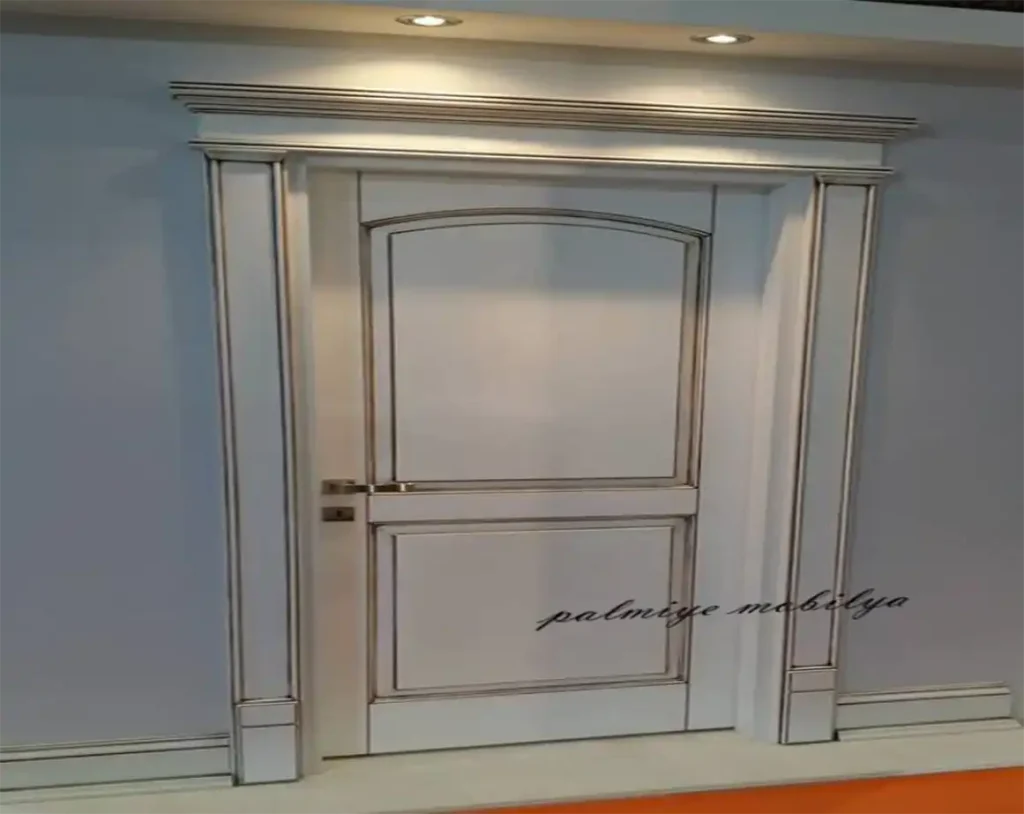
- Aesthetic: Replicates traditional stile-and-rail timber joinery through advanced depth routing or by bonding separate raised panels to the face sheet.
- Artisan Highlights: In premium factories, craftsmen hand-apply metallic leaf accents (gold, silver, or champagne) or dark patina glazing within the routed channels to highlight architectural detailing.
Country, Shaker, and Farmhouse Typologies
- Aesthetic: Characterized by straight, clean 90-degree recessed panels or simulated vertical beadboard plank lines. Pairs beautifully with matte black iron handles or visible sliding barn door track hardware.
6. Functional and Opening Mechanism Integration
Modern spaces require smart spatial planning. Doors sourced from an advanced Door Factory Turkey can be adapted to several functional opening mechanisms.
Standard Hinged (Swing) Systems
- Mechanical Setup: The classic configuration where the door panel is mounted to a wooden or composite frame and swings open along a single axis.
- Hardware Integration: Can be configured with traditional butt hinges or modern, fully concealed 3D adjustable hinges that hide from view when the door is closed.
Concealed Frame (Filomuro / Flush-with-Wall) Systems
- Mechanical Setup: The traditional wooden architrave is eliminated. An extruded structural aluminum frame is embedded directly into the plasterboard or brick wall before finishing. The door panel hangs on 3D hinges, sitting completely flush with the surrounding wall surface.
- Design Strategy: Creates a seamless, hidden door look. The door can be painted or treated in the exact finish of the wall to make it blend into the background.
Sliding and Pocket Systems
- Mechanical Setup: The door panel moves horizontally along a top-mounted aluminum rail system.
- Barn Door Type: The hardware track is mounted visibly on the wall surface, and the door slides parallel to the wall.
- Pocket Door Type: The door slides completely into a recessed metal cage built inside the drywall partition, clearing floor and wall space.
- Hardware Integration: The bottom rail of the door is routed with a guide channel to prevent swaying, and the side profile features integrated flush pull handles and hook locks.
Pivot Systems
- Mechanical Setup: Instead of side-mounted hinges, the door turns on heavy-duty top and bottom pivot pins anchored into the floor and upper lintel.
- Design Strategy: Designed for grand entrances and oversized architectural openings. This mechanism easily handles wide, heavy solid-core panels, allowing them to swing open smoothly with minimal effort.
7. Heavy-Duty Exterior Security Door Engineering
While interior models form a massive segment of the industry, an advanced Door Factory Turkey is often a global leader in the engineering of high-security residential entry doors. These exterior units are built to withstand physical attacks, extreme weather variations, and temperature differentials.
Core Steel Armor Plating
The internal structure of a Turkish security door is built around a heavy-duty steel core, abandoning simple wood frames.
- Monolithic Steel Sheet: A central structural plate of cold-rolled electro-galvanized steel (ranging from 1.5mm to 2.0mm in thickness) is reinforced with vertical and horizontal U-shaped steel ribs.
- Internal Insulation: The voids between the steel reinforcement ribs are packed with high-density rock wool or injected polyurethane foam, which provides exceptional thermal insulation and fire retardancy.
Multi-Point Locking Systems
Exterior doors from a premium Door Factory Turkey utilize high-security locking mechanisms (such as Kale Kilit or ISEO hardware) that anchor the door panel into the steel frame at multiple strategic points.
- Locking Mechanism: Turning a single high-security key drives thick steel deadbolts horizontally into the hinge jamb, vertically into the upper lintel, and downward into the floor threshold.
- Defensive Details: The lock cylinder is protected by integrated anti-drilling manganese alloy steel plates and rotating defender caps, which shield the mechanism against picking, drilling, and forceful extraction attacks.
Weatherproof Exterior Cladding Panels
Because entry doors are exposed to direct sunlight, rain, and freezing temperatures, their outer faces are clad in durable, weather-resistant materials:
- Marine Plywood Panels: Multi-layered wood veneers bonded with water-resistant phenolic resins and coated in exterior-grade UV-stable polyurethane stains.
- Sintered Ceramic or Compact Laminate Plates: High-performance architectural faces that are entirely scratch-proof, waterproof, and completely resistant to color fading from intense solar exposure.
8. Integrated Frame, Architrave, and Gasket Systems
An interior door functions as a complete system. When evaluating a Door Factory Turkey, global buyers should focus on the quality of the matching frame and architrave components. Premium factories supply pre-hung systems that match the door panel’s finish and performance properties.
Laminated Blockboard Wood Frames
- Engineering Construction: Formed by edge-gluing solid wood timber strips together, sandwiched between thin outer layers of structural MDF.
- Performance Benefit: This configuration delivers exceptional resistance to bending and warping under high humidity, while providing a solid substrate for anchoring heavy hidden hinges and lock strike plates.
Wood-Plastic Composite (WPC) Waterproof Frames
- Engineering Construction: Extruded using an advanced blend of organic wood flour and high-density polymer resins.
- Performance Benefit: 100% waterproof and highly resistant to moisture wicking, making it an excellent choice for bathroom entries, humid coastal projects, and tropical climates.
Telescopic Architrave Systems
Turkish door manufacturers utilize adjustable telescopic casing profiles. The architrave features an extended tongue that slides smoothly into a matching groove on the door frame core. This allows installers to compensate for variations in wall thickness on-site without cutting or planing timber.
9. Hardware Engineering and Precision CNC Mortising
To ensure trouble-free operation on site, a high-capacity Door Factory Turkey uses automated machinery to pre-cut holes and mortises for various hardware systems based on client specifications.
+-------------------------------------------------------+

| Hinge Jamb Plumb Alignment Check                      |
|  ├── Vertical Axis Laser Tolerance: ±0.5mm           |
|  └── 3D Concealed Hinge Hex Key Cavity Verification   |
+-------------------------------------------------------+

| Perimeter Margin Verification                         |
|  ├── Left Reveal Gap: 3.0mm (±0.5mm)                  |
|  └── Right Reveal Gap: 3.0mm (±0.5mm)                 |
+-------------------------------------------------------+

| Silent Lock Assembly Integration                      |
|  └── Magnetic Deadbolt Recess Depth: Flush Fit       |
+-------------------------------------------------------+

| Automatic Bottom Draft Isolation                      |
|  └── Drop-Down Neoprene Seal Plunger Travel Check     |
+-------------------------------------------------------+
3D Adjustable Hidden Hinges
Standard side-mounted butt hinges disrupt the clean lines of modern interior doors. Premium Turkish factories pre-cut mortises for hidden 3D adjustable hinges (such as Simonswerk Tectus or Otlav systems). These hinges hide completely inside the door edge when closed and allow installers to fine-tune the door across three axes using a simple hex key to ensure uniform reveal gaps.
Magnetic Silent Locks
Traditional spring-loaded mechanical latches can scratch the frame and make loud clicking noises. Magnetic silent locks use a spring-loaded magnetic bolt that remains flush inside the door profile when open. It only snaps forward into the strike plate when the door closes completely, ensuring quiet, reliable operation and a clean look along the edge of the door.
Drop-Down Automatic Acoustic Seals
To improve sound isolation without installing an awkward, raised floor sill, an automatic mechanical drop seal can be routed into the bottom rail of the door panel. When the door closes, a small plunger presses against the frame jamb, lowering a neoprene acoustic seal down onto the floor to block noise, dust, and drafts.
10. Rigorous Quality Control and Testing Protocols
To maintain credibility in international markets, a premier Door Factory Turkey must run an internal quality assurance lab that tests products against strict European product standards.
Mechanical Strength Testing (EN 1192)
Doors are subjected to vertical loading, static torsion, hard body impact, and soft body impact tests. High-quality solid-core and tubular-core models routinely clear Class 3 (Medium Duty) and Class 4 (Heavy Duty/Severe Duty) ratings, ensuring they can withstand frequent slamming and heavy daily use.
Resistance to Liquid Testing (EN 12720)
The finished outer surface is exposed to common household liquids—including water, coffee, fruit juices, fats, and mild cleaning detergents—for up to 24 hours. A passing grade requires zero permanent staining, softening, or color fading of the polymer coating or laminate film.
Cross-Cut Adhesion Testing (EN ISO 2409)
For coated items, a grid of lattice cuts is made through the lacquer coating down to the HDF substrate. Adhesion-testing tape is applied and pulled away firmly. A passing score (Class 0 or Class 1) ensures the surface layers are strongly bonded and will not peel or chip at corners and edges over time.
11. Technical Production Dimensions and Tolerance Matrix
To ensure a seamless fit during on-site installation, Turkish manufacturing plants adhere to precise metric tolerances.
| Structural Component | Standard Engineering Specification | Custom Architecture Limits | Permissible Tolerance |
|---|---|---|---|
| Panel Overall Thickness | 40 mm to 45 mm | 50 mm to 55 mm (Extra Heavy) | ±0.5 mm |
| Standard Heights | 1980 mm / 2050 mm / 2100 mm | Up to 2700 mm (Floor-to-Ceiling) | ±1.0 mm |
| Standard Widths | 700 mm / 800 mm / 900 mm | Up to 1100 mm (Wide Pivot) | ±1.0 mm |
| Substrate Skin Depth | 6 mm HDF base | 8 mm thick (Deep-Carve Option) | ±0.2 mm |
| CNC Routing Depth | 2.5 mm to 4.0 mm groove depth | Up to 6.0 mm deep cuts | ±0.2 mm |
| Edge Lip Profiling | Rebated or Non-Rebated | Flush European Profile | ±0.3 mm |
12. Comprehensive On-Site Installation Manual
The durability and performance of a premium interior door depend heavily on the quality of its installation. Because high-end factory finishes can be sensitive to mechanical scuffs, installers must follow a systematic process.
Phase 1: Pre-Installation Environmental Assessment
- Moisture Stabilization: All wet trades on site—including concrete screeds, wall plastering, and tiling—must be fully cured. The subfloor moisture content must measure below 2.0% before doors are unboxed.
- Climate Control: The building’s HVAC system should be operational, stabilizing internal relative humidity between 40% and 60% and ambient temperatures between 15°C and 25°C to prevent the engineered timber cores from absorbing excess moisture.
Phase 2: The Step-by-Step Installation Process
- Rough Opening Verification: Measure the structural wall opening to ensure it is vertical, plumb, and square across both diagonal corner axes.
- Frame Assembly: Lay out the three-sided matching telescopic frame onto a clean, padded workbench. Assemble the miter joints using internal alignment screws and wood glue.
- Placing the Frame: Lift the assembled frame into the rough opening, securing it temporarily with non-marring plastic adjustment wedges.
- Alignment Verification: Use a 3D cross-line laser level to ensure the hinge jamb is aligned on both horizontal and vertical planes.
- Structural Anchoring: Secure the frame to the wall studs by driving structural fasteners through hidden areas, such as behind the hinge plates and inside the strike plate cutout.
- Insulation Foam Injection: Inject a low-expansion, single-component polyurethane foam into the gap between the wall and the frame. Use temporary wooden cross-braces inside the frame to prevent the expanding foam from bowing or warping the wood frame.
- Hanging the Panel: Mount the door panel onto the hinges. Adjust the 3D hinge screws to set a uniform 3mm reveal gap along the top and sides.
- Architrave Trim Fitting: Apply thin beads of low-modulus construction adhesive inside the frame groove. Slide the telescopic architrave tongue into place, adjusting it until it sits flush against the finished wall surface.
13. Product Maintenance and Finish Preservation
Modern surfaces are highly durable, but they require proper care to protect the outer clearcoat or foil layers from micro-scratching and chemical degradation.
Approved Cleaning Procedures
- Routine Dusting: Wipe the door surface regularly with a clean, dry, lint-free microfiber cloth to remove dust.
- Deep Cleaning: For light smudges or fingerprints around the handle, use a microfiber cloth lightly dampened with lukewarm water and a drop of pH-neutral soap. Wipe the surface clean, then dry it immediately with a second soft towel.
- Prohibited Materials: Never use abrasive scrubbing pads, steel wool, or harsh chemicals like acetone, ammonia, bleach, or solvent-based thinners. These materials will dissolve, dull, or cloud the protective finishes.
Field Repair of Minor Scratches and Scuffs
- Surface Preparation: Clean the scratched area thoroughly using isopropyl alcohol to remove surface oils and dust.
- Color Layer Infill: For deep scratches that reach the primer or substrate layer, fill the groove using an acrylic touch-up pen or a soft wax repair stick matched to the door’s original RAL color code or veneer tint.
- Levelling: Gently remove excess filler using a plastic edge scraper to level the repair with the surrounding surface.
- Polishing (Gloss Surfaces): For high-gloss finishes, apply a dab of fine-cut polishing compound to the area. Buff gently in circular motions with a clean microfiber cloth or a mini wool pad to restore the mirror-like shine.
14. B2B Sourcing Framework and Global Trade Logistics
When entering a procurement contract with a premier Door Factory Turkey, international project managers must navigate structured financial and logistical procedures to ensure a smooth transaction.
Container Packaging and Protection Standards
Premium finishes are sensitive to friction and moisture damage during transit. Export contracts generated by a Door Factory Turkey should mandate the following packaging protocols:
- Every door panel must be wrapped in a protective layer of polyethylene micro-foam or a non-scratch film pocket.
- High-density expanded polystyrene (EPS) foam or heavy-duty reinforced cardboard corner guards must be fitted around the edges to absorb impacts during transit.
- Pallets must be packed with silica gel desiccant bags to absorb moisture and prevent mold or surface clouding from sea-freight humidity changes.
- Cargo must be secured on heavy-duty, heat-treated ISPM-15 compliant wooden pallets, stacked flat to prevent panels from warping under uneven weight.
Strategic Financial Terms and Incoterms
- Incoterms Allocation: FOB (Free on Board) at major ports like Ambarlı, Izmir, or Mersin is standard for large distributors managing their own vessels. For real estate developers seeking direct site delivery, DDP (Delivered Duty Paid) shifts the entire logistical risk—including customs entry and local transport—to the manufacturer.
- Payment Framework: Factories typically require a 30% advance deposit via Telegraphic Transfer (T/T) to fund raw material procurement and launch CNC processing, with the remaining 70% balance payment due against the presentation of the certified Bill of Lading (B/L) and export customs documents before final container release. For larger, multi-million-dollar commercial project tenders, an Irrevocable Letter of Credit (L/C) at Sight provides secure financial protection for both parties.
Customs Regulations and Duty-Free Advantages
- The European Union Market: Under the Turkey-EU Customs Union agreement, shipments accompanied by an A.TR Movement Certificate enter the EU at a 0% customs duty rate, leaving importers responsible only for local Value Added Tax (VAT) clearance.
- The United Kingdom Market: Following the post-Brexit Turkey-UK Free Trade Agreement, doors accompanied by a valid EUR.1 Certificate or a conforming origin declaration enter the UK duty-free.
- The North American Market: Importers must ensure that the composite wood products (MDF/HDF) used by the factory are certified fully compliant with TSCA Title VI regulations regarding formaldehyde emissions.
By matching your project’s performance codes with the right core configurations, custom profiles, surface chemistries, and hardware systems, you can secure an interior or exterior door system from a premier Turkish supplier that balances architectural luxury with long-term industrial durability.

Butik Otel Mobilyaları

Şunları da sevebilirsiniz

Distressed Furniture Turkey

Lacquered Furniture Turkey