
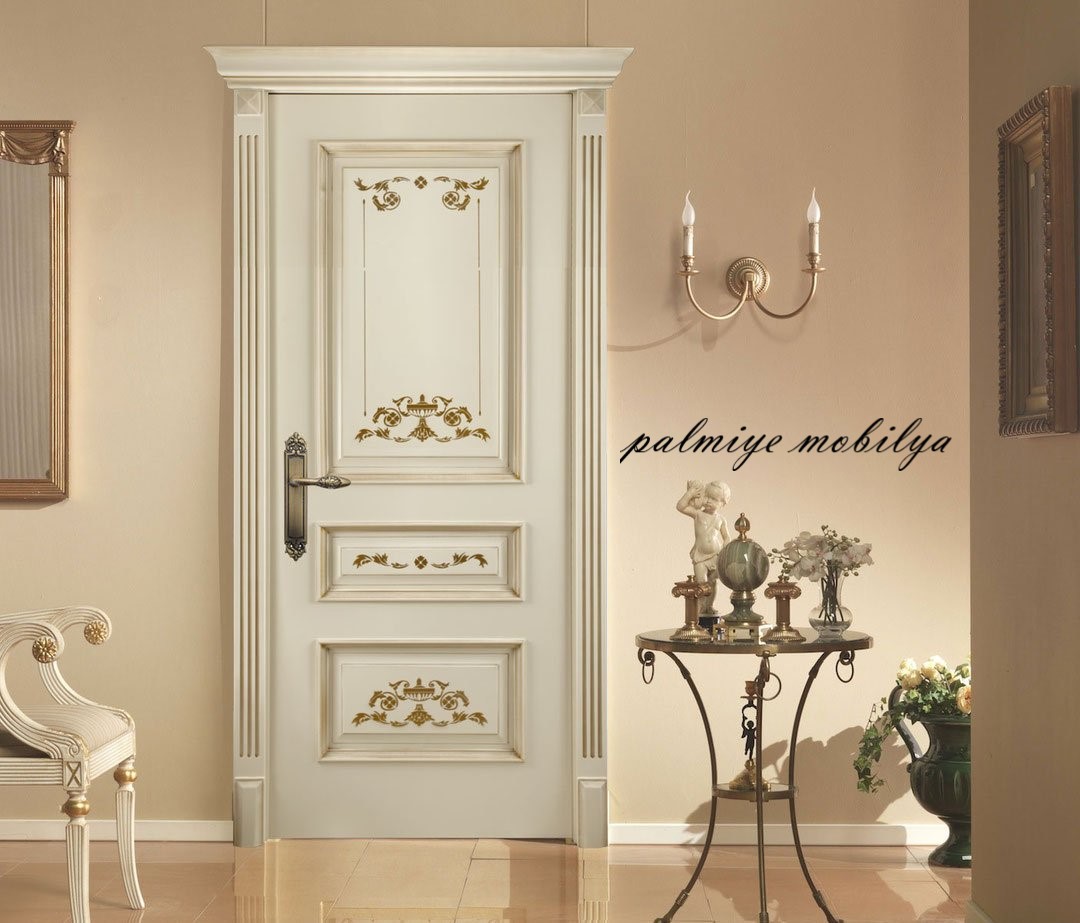
Hornbeam Wood Doors Turkey
The material engineering, mechanical properties, and structural optimization of heavy-duty interior and exterior architectural openings play a critical role in contemporary high-end construction. Within the international architectural procurement and luxury development sectors, the phrase Hornbeam Wood Doors Turkey has emerged as a premium benchmark for installations requiring extreme impact resistance, high cellular density, and advanced structural joinery engineering. Turkey has successfully positioned its manufacturing sector at the intersection of automated European machinery and dense regional timber supply chains.
By leveraging the unique physical properties of European Hornbeam (Carpinus betulus) harvested from the microclimates of the Black Sea and Marmara regions, Turkish industrial factories provide global developers with high-utility, reliable, and sophisticated door assemblies. This technical guide provides an exhaustive engineering breakdown of the material anatomy, seasoning physics, core configurations, industrial fabrication lines, performance metrics, and site management protocols that govern the manufacturing and implementation of a premium Hornbeam Wood Doors Turkey.
1. Botanical Material Classifications and High-Density Material Physics
The architectural performance and operational lifecycle of a premium Hornbeam Wood Doors Turkey are established at the molecular and cellular stages of the timber. Hornbeam, historically referred to as “ironwood” due to its exceptional resistance to mechanical wear, presents a unique set of cellular characteristics that distinguish it from standard commercial hardwoods like Oak, Beech, or Walnut. Understanding these physics is critical for architects and structural engineers evaluating wood openings for high-traffic or specialized high-security environments.
The Cellular Matrix and Density Profile of Carpinus betulus
European Hornbeam is a diffuse-porous hardwood featuring an incredibly tight, dense, and interlocked cellular structure.
- Oven-Dry Density Metrics: While standard European Oak typically exhibits an average seasoned oven-dry density range of \(720\text{ kg/m}^3\) to \(760\text{ kg/m}^3\), Hornbeam boasts an extraordinary average seasoned density profile ranging from \(800\text{ kg/m}^3\) to \(850\text{ kg/m}^3\). This high density indicates a minimal volume of internal cellular air cavities and a massive concentration of thick-walled structural fibers (libriform fibers).
- Tactile and Visual Properties: The wood features a remarkably uniform, fine texture with an off-white, pale cream, or ivory chromatic profile. Its grain is typically straight but frequently exhibits a heavily interlocked or irregular configuration. This structural configuration creates an incredibly tough surface that resists splitting along grain boundaries, providing an exceptional foundation for heavy-duty structural frames and leaf facings.
Comprehensive Mechanical Strength Profiles
To quantify why a Hornbeam Wood Doors Turkey delivers superior physical performance under commercial stress, it is necessary to examine its standard wood-mechanics parameters against conventional architectural hardwoods:
| Mechanical Performance Parameter | European Hornbeam (Carpinus betulus) | European Oak (Quercus robur) | European Beech (Fagus sylvatica) |
|---|---|---|---|
| Janka Side Hardness Rating (N) | \(16,010\text{ N}\) | \(4,980\text{ N}\) | \(5,820\text{ N}\) |
| Modulus of Rupture (Bending Strength) | \(145.0\text{ MPa}\) | \(97.0\text{ MPa}\) | \(110.0\text{ MPa}\) |
| Modulus of Elasticity (Stiffness Index) | \(16,500\text{ MPa}\) | \(12,500\text{ MPa}\) | \(14,000\text{ MPa}\) |
| Compressive Strength (Parallel to Grain) | \(71.0\text{ MPa}\) | \(46.3\text{ MPa}\) | \(53.0\text{ MPa}\) |
The mechanical data reveals that Hornbeam possesses more than three times the surface indentation hardness of standard Oak and significantly higher bending strength (Modulus of Rupture). This makes a Hornbeam Wood Doors Turkey uniquely suited for high-impact commercial environments, such as luxury hotel service paths, psychiatric facilities, educational institutions, public buildings, and high-security residential entry points where resistance to blunt-force physical breach or heavy equipment collision is required.
Anisotropic Shrinkage and Volumetric Dynamics
The primary engineering challenge when working with Hornbeam is its high shrinkage coefficient. Wood is an anisotropic material, meaning its dimensional movement varies depending on the directional plane of its fibers. Hornbeam exhibits a radial shrinkage coefficient of approximately \(6.8\%\), a tangential shrinkage coefficient of \(11.5\%\), and a total volumetric shrinkage index of \(18.4\%\) when transitioning from a green state to completely oven-dry.
Because tangential movement is nearly double radial movement, unconditioned or poorly engineered solid Hornbeam planks are prone to severe warping, checking, and twisting. Turkish industrial manufacturers mitigate these natural tendencies through precise thermodynamic seasoning and advanced multi-layer cross-lamination engineering.
2. Thermodynamics of Timber Seasoning and Microclimatic Moisture Stabilization
Because of Hornbeam’s dense cellular fiber matrix and high volumetric shrinkage coefficients, the drying and seasoning stage is the most critical phase in the fabrication of a high-performance Hornbeam Wood Doors Turkey. If a manufacturer attempts to machine raw Hornbeam timber that has not achieved an exact state of Equilibrium Moisture Content (EMC), the completed door leaves will warp, pull out of alignment, split at the joints, and damage surface finishes as soon as they encounter climate-controlled interior HVAC systems.
The Physics of the Fiber Saturation Point (FSP)
In green timber, water exists in two primary states: free water held within the open cell cavities, and bound water chemically bonded within the cell walls. During the initial drying phases, free water is evaporated first. This loss of liquid water does not impact the mechanical or dimensional properties of the wood.
The structural transformation begins at the Fiber Saturation Point (FSP), which for Hornbeam occurs at approximately \(28\%\) moisture content. At this threshold, the cell cavities are completely empty, but the cell walls remain fully saturated with bound water. As drying continues below the FSP, bound water is pulled out of the cell walls. This causes the wood fibers to contract, initiating volumetric shrinkage and significantly increasing the mechanical hardness and stiffness of the timber.
Computerized Progressive Kiln Drying Schedules
To dry a wood as dense and sensitive as Hornbeam without causing severe internal defects, Turkish factories utilize state-of-the-art computerized conventional steam or specialized vacuum kiln drying chambers. The conditioning schedule requires precise, gradual adjustments to dry-bulb temperatures, wet-bulb depression values, and relative humidity over an extended cycle:
[Green Timber Extraction: ~60% MC]
       ↓
[Air-Drying Pre-Conditioning under Ventilated Sheds: Down to ~25% MC]
       ↓
[Computerized Kiln Stage 1: Mild Thermal Introduction (40°C - 45°C), High Relative Humidity]
       ↓
[Computerized Kiln Stage 2: Progressive Moisture Evaporation (50°C - 55°C), Controlled Depression]
       ↓
[Computerized Kiln Stage 3: Core Equalization and Desorption (60°C)]
       ↓
[High-Humidity Steam Stress-Relief Conditioning Cycle]
       ↓
[Target Export Equilibrium Moisture Content Verified: Interior 8% ±2% / Exterior 12% ±2%]
- Mild Thermal Starters: The computerized kiln controls the cycle over several weeks, starting at a conservative temperature of \(40^{\circ }\text{C}\) to \(45^{\circ }\text{C}\) with a high relative humidity. This setup ensures that the rate of moisture evaporation from the outer surface matches the rate of moisture migration from the deep interior core of the wood block.
- Prevention of Case Hardening: If the surface dries too quickly, a defect known as “case hardening” occurs. The outer shell of the timber sets into a rigid, shrunk state while the interior core remains wet. As the interior eventually dries and shrinks, it pulls against the rigid outer shell, creating massive internal tensile stresses that cause internal split fractures (honeycombing) or severe structural warping.
- Target Export Parameters: For premium international projects, Turkish factories dry Hornbeam down to a strict target moisture content of \(8\%\pm2\%\) for interior architectural doors and \(12\%\pm2\%\) for specialized exterior assemblies.
- Steam Stress Equalization: At the conclusion of the kiln schedule, high-humidity steam conditioning cycles are injected into the chamber. This steps re-wets the outer micro-layers slightly, equalizing moisture levels across the entire cross-section of the wood block and neutralizing any residual internal stresses before the lumber is unstacked.
3. Structural Core Engineering and Multi-Layer Lamination Architecture
In professional commercial woodworking, a premium Hornbeam Wood Doors Turkey is rarely manufactured from a single solid monolithic plank of wood. Due to the high anisotropic shrinkage metrics of Carpinus betulus, a wide single-slab timber door will continuously move in response to seasonal changes in relative humidity, resulting in operational binding, perimeter frame gaps, and finish delamination. To overcome these natural material limits, Turkish factories utilize advanced multi-layer timber lamination and composite core engineering.
Cross-Laminated Timber (CLT) Core Physics
To maximize the exceptional hardness and impact resistance of Hornbeam while ensuring absolute dimensional straightness, manufacturers apply a multi-layer engineered sandwich configuration:
[Wear Face Layer: 4mm to 6mm Structural Solid Hornbeam Lamella]
------------------------------------------------------------------
[Engineered Substrate: Cross-Laminated Finger-Jointed Timber Scantlings]
------------------------------------------------------------------
[Wear Face Layer: 4mm to 6mm Structural Solid Hornbeam Lamella]
- Finger-Jointed Core Scantlings: Kiln-dried timber planks are ripped into narrow structural strips (\(40\text{ mm}\) to \(65\text{ mm}\) wide). During this process, any wood defects, large knots, or grain irregularities are cut out. The remaining premium segments are machined with interlocking micro-teeth at their ends and bonded together via high-tensile adhesives to form continuous structural framing lines.
- Alternating Grain Configuration: These core framing bars are placed side-by-side and face-laminated under massive hydraulic pressure. Crucially, adjacent timber strips are oriented with their growth rings and natural grain vectors running in alternating directions. This grain reversal means that if one timber segment attempts to cup or warp in one direction due to a localized microclimatic shift, the adjacent segment exerts an equal and opposite mechanical force, neutralizing internal movement and keeping the door leaf flat.
- Structural Veneer/Lamella Face Bonding: This stable engineered core is then face-laminated on both sides with a thick, structural solid wood wear layer or micro-lamella (typically \(4\text{ mm}\) to \(6\text{ mm}\) thick) of premium plain-sawn or quarter-sawn Hornbeam timber. The thick face lamella provides the exact visual appearance, substantial physical weight, and solid feel of a single block of wood, while the internal cross-laminated core ensures the door remains stable over a multi-decade operational lifespan.
High-Performance Commercial Core Hybrid Matrix Variations
Depending on the specific architectural placement and building code requirements across a luxury property development, Turkish factories customize the internal core matrix of a Hornbeam Wood Doors Turkey:
Solid Laminated Hornbeam Blocks
- Internal Layout: Continuous interlocking cross-laminated Hornbeam bars throughout the entire core cavity.
- Performance Profile: Delivers maximum physical weight (\(exceeding 45\text{ kg/m}^2\)), ultimate impact resistance, and maximum screw-holding capacity. This layout is heavily specified for high-security residential entry doors, executive bank offices, and psychiatric care facilities.
Extruded Tubular Core Matrix
- Internal Layout: A perimeter frame of solid finger-jointed Hornbeam enclosing a dense, extruded particleboard core with parallel longitudinal hollow tubes running throughout its length.
- Performance Profile: Provides an exceptional balance of mechanical structural strength and weight efficiency. The hollow tubes reduce the overall mass of the door leaf by up to 35%, minimizing stress on the hinge hardware and preventing structural sag while maintaining excellent acoustic insulation.
Insulated Solid Core Hybrid
- Internal Layout: Alternating layers of high-density sound-dampening composites, mineral wool, or fire-resistant silicate materials sandwiched between solid Hornbeam structural ribs.
- Performance Profile: Engineered for premium hospitality environments and luxury multi-family residential projects requiring specialized decibel attenuation and fire containment certifications.
4. Multi-Axis CNC Industrial Manufacturing and Joint Engineering Precision
The worldwide market competitive advantage of the Hornbeam Wood Doors Turkey sector stems from significant capital investments in European automated woodworking machinery. Because seasoned Hornbeam possesses an exceptionally high Janka hardness rating (\(16,010\text{ N}\)), it is highly resistant to manual cutting, carving, and routing. Attempting to machine Hornbeam with standard carpentry tools can cause friction overheating, wood scorching, and tool dulling. Turkish manufacturing facilities overcome this through heavy-duty, computer-guided automation.
Automated 4-Axis and 5-Axis CNC Processing Centers
Raw laminated Hornbeam door blanks progress into high-velocity multi-axis computer numerical control (CNC) machining centers.
- Liquid-Cooled Diamond Tooling: Due to the dense, hard nature of the wood fibers, Turkish CNC systems utilize specialized polycrystalline diamond (PCD) router bits equipped with internal liquid cooling or compressed-air micro-jets. These systems prevent thermal discoloration and scorching of the pale wood face during high-speed cutting.
- Simultaneous Structural Milling: The CNC machine reads digital architectural CAD files to execute precision profiling across the door leaf. It cuts classic recessed panels, crisp linear modern grooves, or complex geometric textures into the face lamella with an accuracy tolerance of \(\pm0.1\text{ mm}\).
- Hardware Preparation: Simultaneously, the multi-axis CNC machine drills deep internal lock mortises, cuts faceplate recesses for heavy electronic card locksets, machines wire routing paths for smart home entry sensors, and mills out hidden three-dimensional pocket recesses for concealed commercial hinges. Completing all hardware cuts in a single automated pass ensures perfect spatial alignment between the door leaf and its corresponding frame components.
High-Performance Mechanical Joint Engineering
The long-term resistance of a Hornbeam Wood Doors Turkey against downward sag, structural twist, and joint separation depends heavily on the mechanical connections joining the vertical stiles to the horizontal rails. Turkish factories utilize two primary high-performance joinery methods:
[ stile and rail joinery matrices ]
Method A: Heavy-Duty Pinned Mortise and Tenon
          [Stile Cavity] ⇦ Receive ⇦ [Precision Machined Rail Tenon] + Pinned Locking Rods
Method B: Multi-Spindle Deep Fluted Dowel Matrix
          [Stile Bored Matrix] ⇦ Interlock ⇦ [Fluted Hardwood Beech Dowels (16mm x 120mm)]
Heavy-Duty Pinned Mortise and Tenon Connections
This represents the traditional benchmark of timber joinery, optimized via modern machinery. A precisely machined male tenon projecting from the horizontal rail is driven into a matching female mortise milled deep into the vertical stile. In modern production, this is combined with automated gluing systems that inject high-performance polyurethane adhesives into the cavity, followed by mechanical pinning to form a connection that easily withstands heavy vertical sagging forces.
Multi-Spindle Deep Doweling Matrices
For high-speed automated production, manufacturers utilize high-capacity multi-spindle boring lines that drill deep, parallel alignment holes into the joints. Fluted solid hardwood dowels—typically crafted from kiln-dried Beechwood with a diameter of \(12\text{ mm}\) to \(16\text{ mm}\) and lengths up to \(120\text{ mm}\)—are injected with D4-grade adhesive and hydraulically pressed into the frame. The flutes on the dowels allow air and excess adhesive to escape evenly, preventing hydrostatic air pockets and ensuring an absolute mechanical bond.
5. Surface Finishes, Polymeric Coating Chemistry, and Chromatic Protection
Because of its uniform pale ivory hue and lack of heavy dark grain configurations, a finished Hornbeam Wood Doors Turkey provides a versatile canvas for diverse finish design schemes. However, its fine cellular structure requires specialized chemical preparation to guarantee uniform stain absorption and prevent surface discoloration over a multi-decade operational lifespan.
Pre-Treatment, Sanding Calibration, and Pore Isolation
Before receiving any liquid coatings, the completed door leaf passes through multi-head automated calibration and wide-belt orbital sanding machines.
- Sanding Progression: Due to the wood’s high density, sanding lines utilize precise abrasive sanding progressions—moving from stiff P120 zirconium belts up to ultra-fine P320 orbital silicon-carbide pads. This meticulous sanding avoids creating cross-grain scratch marks, which are highly visible on Hornbeam’s smooth, light surface.
- Pore Isolation Primer Seals: Hornbeam is highly diffuse-porous, meaning it absorbs solvents rapidly and can exhibit uneven coloring if stains are applied directly to the raw wood. To counter this, Turkish paint facilities apply a low-viscosity, deep-penetrating polyurethane isolation coat. This layer penetrates the outer micro-layers of the wood tissue, sealing the pores uniformly and providing a consistent surface for the application of color pigments or clear topcoats.
High-Performance Industrial Coating Formulations
Turkish manufacturing plants offer three primary chemical finishing families tailored to different project criteria:
Transparent Polyurethane and Acrylic Stains (Natural Finish)
To maintain the natural, pale tone of the timber while highlighting its fine grain, manufacturers use two-component acrylic lacquers. These systems cross-link polyacrylate resins with aliphatic polyisocyanate hardeners. The aliphatic chemistry is essential; standard aromatic hardeners degrade when exposed to sunlight, turning clear coats into a yellowed or cloudy layer. Aliphatic acrylic systems remain optically clear, ensuring the Hornbeam maintains its clean color profile.
Saturated Colored Lacquers (Pigmented Finish)
For projects requiring solid colors (such as pure white, charcoal gray, or deep corporate tones), Hornbeam serves as an excellent substrate. Its high hardness prevents the denting that causes standard painted MDF doors to chip and show cracks over time. Two-component high-solid polyurethane colored lacquers are applied in multiple cross-spray layers, creating an exceptionally tough, elastic shell with a pencil hardness rating of 3H to 4H.
High-Build Polyester Mirror Gloss Finishes
For luxury residential or upscale corporate settings, Hornbeam can be finished with a striking mirror-gloss look. Multiple layers of high-build polyester coatings are applied to achieve a cumulative Dry Film Thickness (DFT) exceeding \(220\text{ microns}\). Once cured, the surface undergoes a multi-stage mechanical polishing sequence using rotary buffers with descending abrasive compounds (from 2000-grit micro-abrasive pads up to ultra-fine liquid compounds). This creates an optically flat surface with high light-reflectivity, measuring between \(92\text{ GU}\) and \(98\text{ GU}\) (Gloss Units).
Photolytic Prevention Additives
To prevent the natural wood from yellowing or darkening due to UV exposure from large windows or interior lighting, Turkish lacquer formulations incorporate an array of protective additives:
- Hindered Amine Light Stabilizers (HALS): These additives function as free-radical scavengers that interrupt the photo-oxidative degradation of the polyurethane or acrylic polymer backbone.
- Ultraviolet Light Absorbers (UVA): These compounds act as chemical filters, absorbing harmful UV wavelengths and dissipating them as low-grade thermal energy before they can break down the molecular bonds of the wood’s underlying lignin tissue or the finish pigments.
6. Regulatory Performance Metrics and Building Code Certifications
In contemporary international real estate development, a building component cannot be selected solely on its visual or tactile appeal; it must be backed by quantifiable performance certificates from accredited third-party testing institutions. A high-specification Hornbeam Wood Doors Turkey is designed and certified according to these specific metrics.
Fire Resistance and Flame Containment Certification
Due to its high physical density and low internal air volume, solid Hornbeam features an inherently low charcoal carbonization rate when exposed to open fire, burning much slower than standard low-density softwoods.
- International Standards Compliance (EN 1634-1 / BS 476-22 / UL 10C): Complete Turkish door assemblies—comprising the cross-laminated leaf, engineered subframe, commercial hinges, and heavy-duty latching mechanisms—are tested inside certified vertical furnaces. The assemblies are subjected to an intense thermal curve exceeding \(1000^{\circ }\text{C}\) to evaluate flame containment, structural integrity, and thermal insulation values over time.
- Life-Safety Classification: Turkish manufacturing lines supply certified 30-minute (FD30), 60-minute (FD60), and 90-minute (FD90) fire-rated door assemblies.
- Intumescent Strips: These assemblies feature specialized intumescent graphite gaskets concealed beneath the face lamella or set into recessed grooves along the frame edge. When temperatures cross \(150^{\circ }\text{C}\), these intumescent elements expand up to 25 times their original size. This expansion fills the structural air gaps between the leaf and frame, creating an airtight barrier that blocks lethal smoke, toxic gases, and thermal energy from entering critical evacuation paths.
Acoustic Isolation and Sound Transmission Metrics
Acoustic comfort is a vital component of luxury residential and commercial design. The combination of core density and advanced perimeter sealing allows Turkish Hornbeam doors to serve as effective sound barriers.
- Acoustic Decibel Tiering: In compliance with EN ISO 10140-2 standards, a certified Hornbeam Wood Doors Turkey can be configured across distinct soundproofing performance brackets:
[ Acoustic Soundproofing Configurations ]
- Bracket 1 (32 dB - 35 dB): Laminated Core + Single Perimeter Thermo-Plastic Elastomer (TPE) Seal
- Bracket 2 (36 dB - 40 dB): Multi-Layer Core Matrix + Dual Silicone Seals + Automatic Drop Bottom Seal
- Bracket 3 (41 dB - 45 dB): Heavy Acoustic Composite Core + Triple Compression Gaskets + Twin Drop Seals
- Automated Mechanical Threshold Seals: To eliminate the acoustic flanking paths present underneath a door leaf, doors are equipped with mortised, spring-loaded mechanical drop seals. When the door leaf closes against the frame jamb, a plunging button mechanical actuator deploys a neoprene or silicone gasket down against the floor finish, blocking sound waves without dragging on the floor during the opening cycle.
Mechanical Endurance and Lifecycle Cycling
- Cycle Testing Norms (EN 1191 / EN 12400): Interior doors must maintain smooth, effortless alignment over a long lifecycle. Turkish commercial doors are certified to EN 12400 Class 5 standards, meaning the complete assembly (including the door leaf, frame, hinges, and locksets) has successfully completed a minimum of \(200,000\) continuous opening and closing cycles without suffering permanent structural deformation, frame sagging, or latch failure.
7. Architectural Configurations and Customization Potentials
The high structural strength and uniform texture of Hornbeam allow Turkish manufacturers to adapt the wood into a wide variety of architectural design styles, ensuring seamless integration into both contemporary and classical projects.
Modern Minimalist and Urban Design Styles
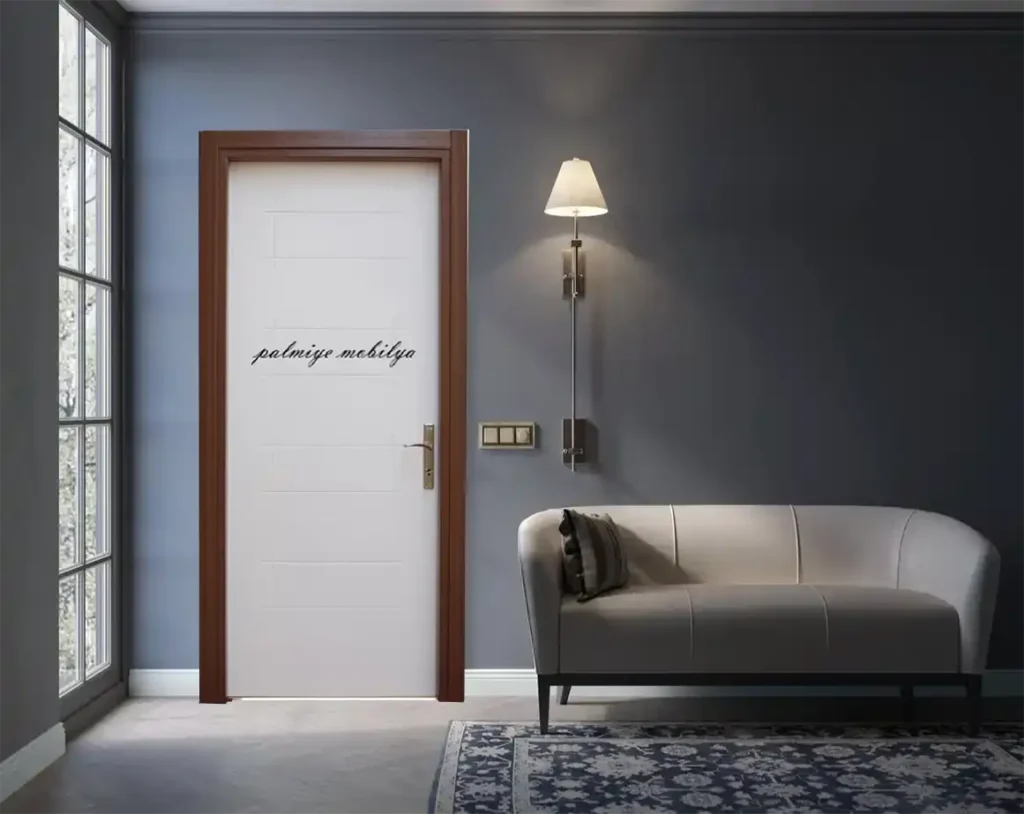
In contemporary design, interior doors are frequently treated as clean architectural planes integrated directly into expansive wall surfaces.
- Concealed Aluminum Casing Systems: Turkish factories supply custom doors engineered to mount flush into hidden aluminum frames anchored directly inside the drywall construction. The high stiffness of the cross-laminated Hornbeam leaf allows for large dimensions while maintaining a crisp, minimal \(3\text{ mm}\) uniform shadow gap around the door perimeter.
- Oversized Architectural Pivot Openings: For grand entrances, traditional side hinges can be replaced with heavy-duty structural pivot hardware offset into the floor and header substrates. Because Hornbeam’s high density can result in heavy door leaves, these pivot systems are carefully engineered to support weights up to \(400\text{ kg}\) and heights up to \(3800\text{ mm}\), allowing massive statement entries to glide open smoothly with minimal physical effort.
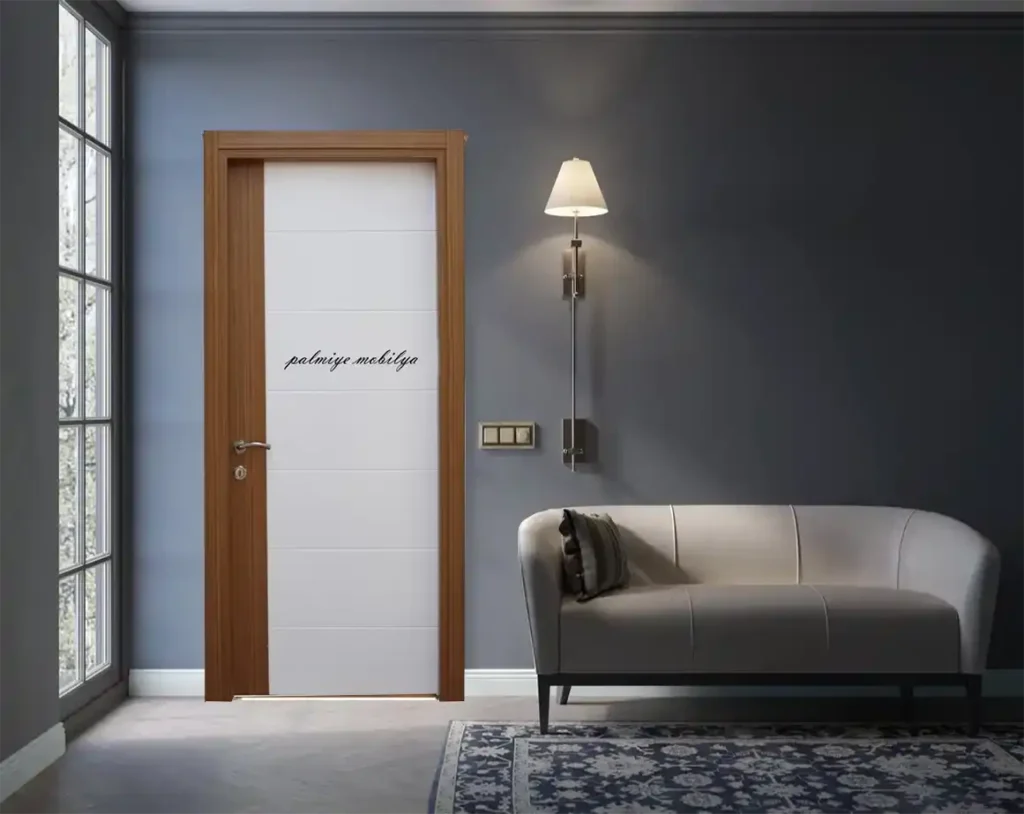
- Geometric CNC Line Art: Minimalist layouts frequently incorporate subtle, V-shaped or U-shaped routed lines (\(2\text{ mm}\) to \(5\text{ mm}\) wide and \(1.5\text{ mm}\) deep) that create striking linear patterns across the door surface without breaking its sleek, contemporary profile.
Neoclassical and Heritage Architectural Formats
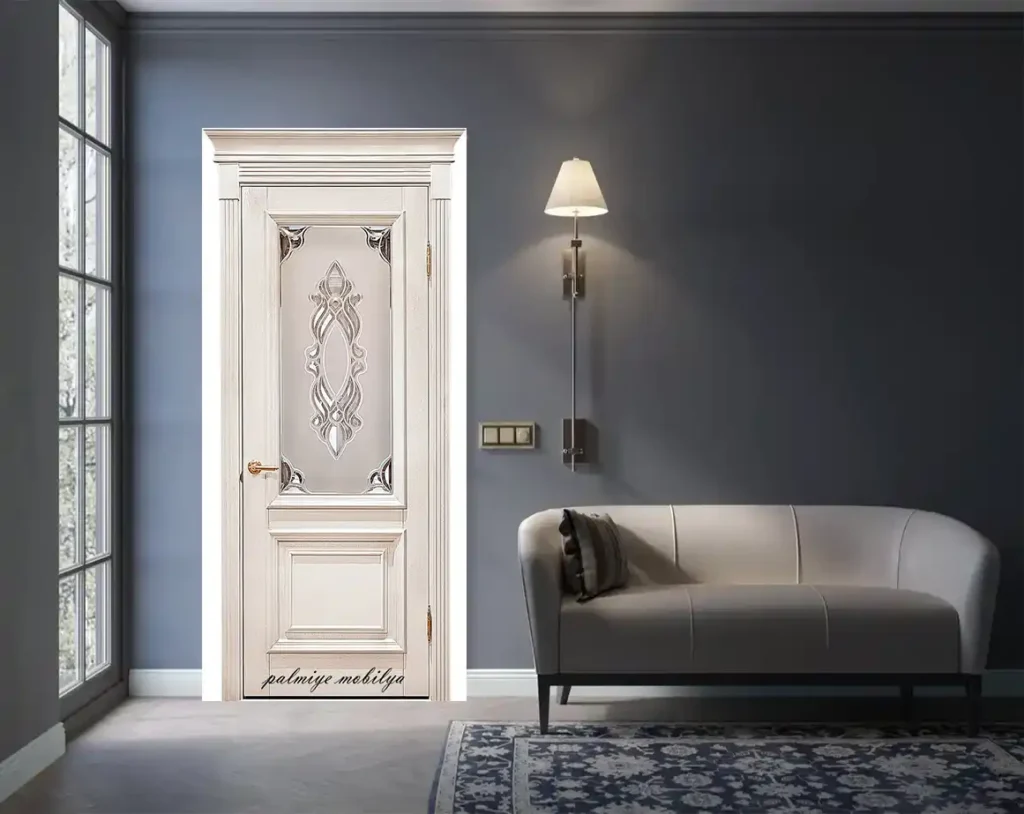
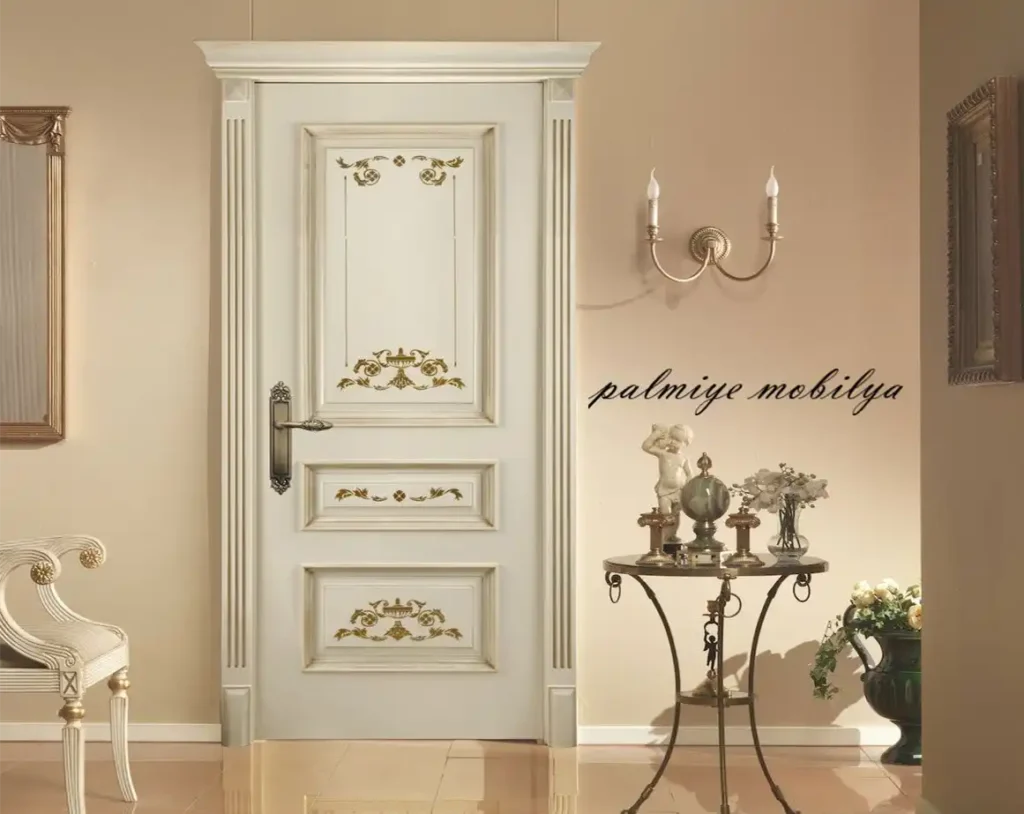
- Deep Architectural Panel Reliefs: The tight, interlocked grain structure of Hornbeam allows multi-axis CNC routers to cut complex, deep-stepped traditional panels into the door face without tearing the wood fibers. This replication of classic stile-and-rail joinery avoids the structural joints that can split or crack due to changing seasonal humidity.
- Inlaid Metallic Accents: For high-end art deco or modern neoclassical styles, manufacturers cut clean channels into the door face, into which satin brass, polished chrome, or brushed copper metallic inlay strips are flush-fitted before the final clear protective coats seal the complete assembly.
8. Technical Procurement, Commercial Logistics, and Site Management
Successfully incorporating a premium Hornbeam Wood Doors Turkey contract into an international construction project requires clear communication, detailed shop drawing approvals, and strict adherence to correct onsite installation protocols.
The Technical Engineering Submittal Process
Prior to initiating factory production for a project contract, the manufacturer’s technical engineering division works closely with the project’s main contractor to develop detailed shop drawings. This technical review phase ensures precision across several variables:
- Structural Openings (Rough Openings): Verifying the plumb, level, and squareness tolerances of the rough wall openings across every floor of the property.
- Variable Wall Profiles (Telescopic Jambs): Since finished wall thicknesses can vary between bedrooms, bathrooms, and corridors due to different tile or stone finishes, Turkish frames are engineered with telescopic architraves. These adjustable casings can typically expand or compress by \(\pm15\text{ mm}\) to \(\pm25\text{ mm}\), accommodating minor variations while ensuring a clean finish against the wall.
- Hardware Integration Mapping: Reviewing the precise physical layouts, wiring paths, and power requirements for the electronic locks, automatic door operators, concealed door closers, and magnetic hold-open devices.
Industrial Packaging Systems for Long-Distance Export
Hornbeam wood components are sensitive to sudden environmental and moisture changes during international transport. Turkish factories use multi-layered packing methods to protect the product:
[Finished Solid Timber Door Leaf]
  ↓ Wrapped in Multi-Layer Polyethylene Anti-Scratch Cushioning Foam
  ↓ Fitted with Rigid, Heavy-Duty Molded Cardboard Edge and Corner Protectors
  ↓ Vacuum-Sealed inside a Heavy Thermoplastic Shrink-Wrap Moisture Barrier
  ↓ Secured into ISPM-15 Heat-Treated Heavy Solid Wooden Crates or Pallet Racks
This heavy-duty packaging system protects the finished lacquer surfaces from moisture ingress, maritime salt air exposure, and physical vibration during multi-modal sea container shipping or overland freight transit.
Onsite Installation Readiness and Environmental Stabilization
Lacquered interior doors are premium architectural finishing elements and must be treated with care. They should never be brought onto a construction site during rough-in or wet-work phases.
- Climate Enclosure Mandate: The building envelope must be fully enclosed, with all external windows and curtain walls completely installed. All high-moisture interior trades—including concrete subfloor pouring, gypsum plastering, drywall taping, and primary bathroom tiling—must be 100% complete and fully cured.
- Relative Humidity Controls: The building’s HVAC systems must be operational, with internal relative humidity stabilized between 40% and 60% and ambient temperatures maintained consistently between \(16^{\circ }\text{C}\) and \(24^{\circ }\text{C}\). Introducing dry, engineered wood components into an unconditioned, high-humidity building environment can cause the doors to absorb excess moisture, leading to structural swelling, frame distortion, and micro-fissures in the lacquer finish.
Technical Installation Execution Steps
- Laser Alignment Precision: Installers use high-accuracy multi-line digital laser levels to align the door frame within the structural opening. The maximum allowable diagonal deviation across the frame assembly is limited to a strict tolerance of \(\pm1.0\text{ mm}\).
- Controlled Polyurethane Foam Application: Fixers secure the frame using professional-grade, low-expansion polyurethane foam applied at designated structural anchor points behind the jamb. Standard high-expansion retail foams exert excessive lateral pressure as they cure, which can bow the jamb inward and disrupt the operational clearances of the door leaf.
- Concealed Hardware Commissioning: Premium installations utilize multi-axis adjustable concealed commercial hinges countersunk into both the leaf and the frame. These systems allow field installers to adjust the door leaf’s position across three spatial dimensions (height, lateral reveal, and gasket compression pressure) using simple hex key adjustments, ensuring a uniform \(3\text{ mm}\) perimeter reveal and reliable acoustic seal compression.
9. Facility Management Maintenance and Surface Longevity
To protect the aesthetic value and structural performance of a Hornbeam Wood Doors Turkey over decades of heavy operations, facility management teams must adhere to a structured, preventative maintenance schedule.
Standard Cleaning Protocols
- Routine Dust Removal: Surface dust should be removed using ultra-soft microfiber cloths. Facility teams must avoid dry wiping with coarse or dirty rags, as trapped dust particles can act as a fine abrasive, creating micro-scratches or dull patches on both high-gloss and soft-matte finishes over time.
- Soiled Surface Remediation: For standard smudges or greasy fingerprints around locksets, the surface should be wiped gently with a microfiber cloth slightly dampened with a highly diluted, pH-neutral, non-abrasive commercial detergent. The area must be dried immediately with a separate microfiber cloth to prevent moisture film from remaining on the finish.
Chemical Restrictions and Protective Guidelines
- Prohibited Cleaning Solvents: Cleaning staff must never use products containing high-concentration alcohols, ammonia, acetone, chlorinated compounds, abrasive scouring powders, or heavy alkaline solutions. These aggressive chemical compounds will break down the polyurethane acrylic cross-linked topcoat, causing high-gloss finishes to become cloudy and matte finishes to become sticky and susceptible to permanent staining.
- Localized Finish Remediation: For superficial scuffs or fine surface scratches on high-gloss doors, the optical finish can be restored using specialized silicone-free fine automotive polishing compounds. The compound is applied carefully with a low-speed rotary polisher equipped with a soft foam pad to restore the reflective profile of the topcoat. Deep scratches that penetrate past the primer layers into the HDF substrate require localized spot-filling and professional re-spraying by an experienced joinery repair technician.
Conclusion: The Strategic Value Proposition
Specifying a Hornbeam Wood Doors Turkey for a contemporary architectural project represents a sound financial investment that balances capital expenditure with long-term asset value. By combining advanced European automation lines, certified sustainable timber foundations, robust mechanical engineering, and high-performance acoustic isolation, Turkish manufacturing delivers high-grade doors that easily fulfill the requirements of modern premium projects.
For architects, interior designers, and global procurement professionals, partnering with certified Turkish door manufacturers ensures access to highly customizable design options capable of fulfilling the most demanding project specifications. Whether integrated into a modern high-rise via flush concealed frame configurations or dressing a luxury residence with detailed neoclassical millwork, the engineered Hornbeam Wood Doors Turkey provides a reliable, high-performance, and elegant solution for contemporary spaces.

Şunları da sevebilirsiniz
Distressed Furniture Turkey

Lacquered Furniture Turkey