

Lacquered Door Factory Turkey
The Definitive Industrial Manual to Partnering with a Lacquered Door Factory Turkey: Engineering, Automated Manufacturing, Quality Control Systems, and Global Sourcing Logistics
Introduction to the Turkish Industrial Joinery and Export Landscape
The global landscape of premium interior architecture has undergone a radical structural shift over the past two decades. Interior doors are no longer specified as passive, commodity-grade barriers designed merely to partition spaces. Instead, contemporary construction projects treat these elements as critical architectural features that must align perfectly with sleek wall planes, deliver precise acoustic attenuation, fulfill rigorous international fire containment standards, and offer a flawless, high-end tactile feel. Within this demanding global market, a premier Lacquered Door Factory Turkey represents the absolute intersection of sophisticated surface chemistry, state-of-the-art European automated woodworking machinery, and cost-effective transcontinental supply chain engineering.
The Turkish woodworking and advanced joinery sector has secured a highly dominant competitive advantage by establishing comprehensive industrial ecosystems across the Anatolian and Marmara regions. While low-tier mass production facilities globally rely on thin vinyl PVC wraps, paper micro-laminates, or low-pressure melamine films that feature a synthetic aesthetic and high delamination rates, an export-grade Lacquered Door Factory Turkey bases its competitive edge on multi-layered liquid polymer formulations applied over ultra-high-density composite wood substrates. This highly industrialized approach creates a monolithic, flawless, seamless surface shield that completely eliminates edge bands, surface joints, and raw corners—the primary failure points of standard interior doors.
For international general contractors, commercial developers, real estate procurement officers, and bulk wholesale distributors, establishing a successful factory partnership requires an analytical approach that goes far beyond reviewing product catalogs. Sourcing professionals must master the technical mechanics of timber kiln drying, high-pressure substrate calibration, robotic cleanroom coating chemistry, and international trade law. This comprehensive industrial manual serves as the definitive reference guide to the operational matrix of a top-tier Lacquered Door Factory Turkey, providing the deep technical metrics, engineering diagrams, and structural frameworks needed to execute world-class procurement operations.
1. Substrate Engineering, Core Density, and Dimensional Warp Mitigation
The fundamental law of high-performance architectural woodworking states that a liquid polymer coating is only as stable as the hidden structural core beneath it. Because contemporary architectural trends prioritize perfectly flat flush surfaces, minimal shadow gaps, or crisp, geometric CNC-routed channels, the slightest micro-movement, twisting, or moisture-induced bowing within the core panel will instantly damage the outer lacquer layers. This structural stress manifests as visible surface cracking, hairline crazing, or localized blistering. To eliminate these critical structural vulnerabilities, an advanced Lacquered Door Factory Turkey deploys a highly engineered, multi-tiered structural wood substrate matrix.
+--------------------------------------------------------------------------+

|  CROSS-SECTIONAL STRUCTURAL PROFILE OF AN EXPORT-GRADE FLUSH DOOR LEAF   |
+--------------------------------------------------------------------------+

|                                                                          |
|  [ LAYER 1 ]  4-Layer Liquid Polymer Coating (Acrylic/UV Clear Shield)   |
|  [ LAYER 2 ]  10mm / 12mm Ultra-High-Density Fiberboard (HDF) Skin       |
|  [ LAYER 3 ]  Automated Hot-Pressed D4 Polyurethane (PUR) Water-Block    |
|                                                                          |
|  [ LAYER 4 - INTERNAL CORES ENGINEERED FOR REGULATORY OCCUPANCY ]        |
|   +--------------------------+----------------------------------------+  |
|   | (A) Sauerland Extruded   | (B) Solid Mineral Composite Core       |  |
|   |     Tubular Core         |     (High-Acoustic / Fire Rated)       |  |
|   +--------------------------+----------------------------------------+  |
|                                                                          |
|  [ LAYER 5 ]  Automated Hot-Pressed D4 Polyurethane (PUR) Water-Block    |
|  [ LAYER 6 ]  10mm / 12mm Ultra-High-Density Fiberboard (HDF) Skin       |
|  [ LAYER 7 ]  4-Layer Liquid Polymer Coating (Acrylic/UV Clear Shield)   |
|                                                                          |
+--------------------------------------------------------------------------+

|  [ FRAME SKELETON ] Kiln-Dried, Finger-Jointed Solid Engineered Pine     |
+--------------------------------------------------------------------------+
The Engineered Perimeter Skeleton (Longitudinal Stress Neutralization)
The internal framework of an export-grade door leaf begins with a high-strength perimeter wood skeleton. A premium Lacquered Door Factory Turkey primarily sources raw Nordic Pine (Pinus sylvestris) or high-altitude Turkish Red Pine (Pinus brutia). The timber is subjected to a rigorous, computer-monitored multi-stage kiln drying process that drives internal moisture content down to a highly precise window of 8% to 10%. This moisture optimization is critical; it ensures that the wood fiber matrix enters a state of permanent equilibrium with typical indoor climate-controlled environments, eliminating the risk of subsequent shrinkage or expansion.
To strip the wood of its natural directional memory and internal growth stresses, the solid timber is ripped into narrow structural strips and reassembled using an automated finger-jointing process combined with high-strength Polyurethane (PUR) D4 waterproof structural adhesives. This engineering step ensures that the grain directions of adjacent wood segments run opposite to one another. Consequently, any micro-forces attempting to warp or twist the timber are structurally neutralized. This engineered wood skeleton typically features a minimum width of 40mm to 55mm around the entire perimeter of the door leaf, with massive reinforced internal lockblocks strategically positioned to accommodate heavy commercial mortise locksets and heavy-duty concealed architectural hinges.
Sourcing Ultra-High-Density Fiberboard (HDF) Skins
Directly bonded to this finger-jointed solid wood skeleton are the outer face panels, which serve as the direct canvas for the liquid coating lines. In the production of an export-grade door, standard Medium-Density Fiberboard (MDF) is systematically replaced or supplemented by ultra-premium High-Density Fiberboard (HDF).
The technical specifications of these substrate skins dictate the ultimate mechanical performance of the door:
- Density Profiles: Standard MDF typically exhibits a density range of 600 to 730 kg/m³. Premium HDF utilized in top-tier Turkish export facilities features a minimum density of 850 to 950 kg/m³.
- Impact Resistance: The tightly packed fiber structure of HDF delivers exceptional resistance to perpendicular mechanical impacts, making the door face significantly less susceptible to surface denting from everyday handling, transport, or operational impacts.
- Surface Porosity and Solvent Absorption: HDF panels are pressed under significantly higher pressure and temperature parameters, resulting in an incredibly tight, uniform, and low-porosity surface fiber structure. When liquid primer coats are applied to an HDF surface, the absorption rate is highly uniform and minimal. This prevents the substrate from unevenly drawing in the lacquer solvents, which can cause microscopic surface dimpling, fiber raising, or “orange peel” textures.
- Thickness Metrics: While budget doors utilize thin 4mm or 6mm skins, a premium Lacquered Door Factory Turkey deploys 8mm, 10mm, or even 12mm thick HDF skins. This substantial thickness allows for deep, intricate CNC architectural routings directly into the face panel without breaching the substrate or compromising the structural integrity of the internal core.
Internal Core Typologies and Structural Dynamics
The space enclosed by the finger-jointed solid wood frame and the thick HDF skins is filled with an internal stabilizing core. The selection of the core material directly determines the weight, structural rigidity, acoustic insulation profile, and fire-resistance classification of the door leaf.
Tubular Particleboard Core (Sauerland Spanplatte System)
The absolute industry standard for premium commercial and high-end residential projects in Turkey is the tubular or extruded particleboard core, frequently sourced from specialized European manufacturers such as Sauerland Spanplatte. This core features a series of continuous horizontal cylindrical tubes engineered throughout the thickness of the particleboard matrix.
- Weight Optimization: The hollow tubular structures remove unnecessary mass, reducing the overall weight of the door leaf by up to 40% compared to a solid wood core. This significantly decreases the static load exerted on the hinge assemblies, preventing door sagging over time and ensuring effortless user operation.
- Compressive Strength: Despite the internal voids, the vertical structural walls of the tubular particleboard provide exceptional resistance to perpendicular compressive forces (up to 20 N/cm²), ensuring the door remains perfectly flat under severe pressure differentials.
- Acoustic Base: The combination of solid mass and air voids naturally dampens sound transmission, providing a baseline acoustic attenuation of approximately 28 dB to 32 dB when combined with proper perimeter acoustic seals.
Solid Core (High-Density Particleboard or Solid Wood Laminate)
For environments requiring maximum durability, security, and a reassuringly heavy tactile hand-feel, a fully solid core is specified. This core consists of continuous, solid multi-layered compressed particleboard or laminated solid wood strips block-bonded together.
- Mass-Induced Performance: The high physical mass acts as an exceptional acoustic barrier and offers formidable resistance to forced entry.
- Application Environments: Solid core options are universally specified for luxury hotel guestroom entrance doors, executive boardrooms, and high-traffic public institutions where durability is paramount.
Mineral Wool and Fire-Rated Composite Cores
When regulatory building codes mandate strict fire containment and high-performance acoustic isolation, Turkish factories deploy advanced mineral composites, high-density rock wool layers, or proprietary fire-rated boards (such as calcium silicate matrices) encased within specialized intumescent perimeter bands. These materials do not support combustion and exhibit exceptionally low thermal conductivity, allowing the door to maintain structural integrity under extreme heat.
2. Chemical Finish Technologies and Polymer Chemistry of Factory Coating Lines
The defining characteristic that sets an elite Lacquered Door Factory Turkey apart from general woodworking shops is the deployment of industrial liquid finishing lines engineered at a molecular level. Achieving a flawless matte, satin, or mirror high-gloss finish requires advanced polymer chemistry, strict mixing stoichiometry, and tightly controlled environmental parameters during curing.
+--------------------------------------------------------------------------+

|  POLYMER RESIN DEPLOYMENT SCHEMATIC (MICRON-LEVEL SPECIFICATION)         |
+--------------------------------------------------------------------------+

|                                                                          |
|  [ TOPCOAT ]     Non-Yellowing Aliphatic Acrylic / UV-Cured Clear (40µm) |
|  [ COLOR LAYER ] Polyurethane (PU) High-Pigment Formulation (50µm)       |
|  [ ISOLATOR ]    Polyurethane Sealer / Grain Blocker Barrier Layer (30µm) |
|  [ PRIMER 2 ]    High-Solid Polyester / Polyurethane Base Primer (60µm)   |
|  [ PRIMER 1 ]    Penetrating Equalizing Undercoat Primer (60µm)          |
|                                                                          |
|  ======================================================================  |
|  [ SUBSTRATE ]   Ultra-High-Density Fiberboard (HDF) Core Surface        |
+--------------------------------------------------------------------------+
Two-Component (2K) Polyurethane Finishing Systems
Two-Component (2K) solvent-based Polyurethane finishes represent the foundational workhorse of high-end Turkish door manufacturing. This chemical system relies on a precise cross-linking reaction between a polyol base resin and an isocyanate hardening agent.
- Chemical Cross-Linking: Once mixed and applied, the two components undergo an exothermic chemical reaction that forms a highly dense, cross-linked polymer network. This is not a simple solvent-evaporation drying process; it is a permanent structural cure.
- Performance Profile: The resulting polyurethane film exhibits extraordinary mechanical elasticity combined with surface hardness. It easily absorbs the micro-movements of the door substrate caused by seasonal humidity shifts without cracking. Furthermore, PU lacquers provide exceptional resistance to moisture infiltration, household chemical spills, and localized impacts.
Non-Yellowing Aliphatic Acrylic Lacquer Coatings
For pure white, ultra-bright white, or delicate pastel-colored doors, high-end Turkish manufacturers specify Aliphatic Acrylic Lacquer systems. Standard polyurethane coatings contain aromatic chemical compounds that inevitably degrade and turn yellow when exposed to the Ultraviolet (UV) radiation present in natural sunlight.
- UV Stability: Acrylic lacquers are formulated with aliphatic compounds that are completely impervious to UV-driven oxidation. A pure white acrylic lacquered door manufactured in Turkey will retain its exact chromatic value and color rendering index over decades of direct exposure to sunlight.
- Visual Properties: Acrylic systems provide unparalleled optical clarity, allowing for the deep “piano-gloss” mirror effects or the hyper-smooth, velvety anti-fingerprint matte finishes that are highly sought after in contemporary European minimalist architecture.
Industrial UV-Cured (Ultraviolet) Liquid Lines
In high-capacity, state-of-the-art automated manufacturing facilities across Turkey, traditional air-dry or thermal-cure processes are replaced by high-velocity UV-curing lines.
- The Chemistry of Photoinitiators: UV lacquers are formulated with specialized oligomers, reactive monomers, and targeted photoinitiators. When the liquid-coated door passes through an industrial UV curing tunnel, it is subjected to intense, concentrated ultraviolet light wavelengths.
- Instantaneous Cross-Linking: The photoinitiators instantaneously trigger a radical polymerization reaction, converting the liquid coating into a completely solid, fully cross-linked polymer film within a fraction of a second.
- Industrial Advantages: This process eliminates the risk of airborne dust contamination during a protracted drying phase. It yields an incredibly hard, scratch-resistant surface finish that is instantly ready for industrial packaging and transport.
Water-Borne Eco-Lacquers (Low-VOC Formulations)
Driven by stringent European environmental legislation and the global demand for green building certifications (such as LEED, BREEAM, and DGNB), Turkish door factories have invested heavily in advanced water-borne lacquering technologies.
- VOC Reductions: Traditional solvent-based lacquers release significant quantities of Volatile Organic Compounds (VOCs) during application and curing. Water-borne lacquers utilize water as the primary carrier medium, reducing VOC emissions by up to 90%.
- Advanced Polyurethane Dispersions (PUDs): Modern water-borne lacquers engineered in Turkey utilize high-performance Polyurethane Dispersions. These systems achieve mechanical durability, scratch resistance, and chemical stain resistance profiles that are fully comparable to traditional solvent-based finishes, completely debunking the historical misconception that eco-friendly coatings are structurally inferior.
3. Industrial Manufacturing Processes and Cleanroom Environmental Control
The internal workflow of an advanced Lacquered Door Factory Turkey relies on strict linear automation. A premium lacquer finish cannot be achieved in an un-isolated environment; the presence of even a single microscopic dust particle or airborne fiber during the spraying sequence will create an un-repairable surface defect. Leading Turkish exporters deploy fully automated, climate-controlled cleanroom manufacturing lines.
Substrate Preparation and Calibration Sanding
The manufacturing process begins with the rigorous calibration of the raw HDF-skinned door leaf. The assembled door blanket is passed through industrial, heavy-duty multi-head wide-belt sanding machines (such as Costa Levigatrici or Heesemann).
- Precision Tolerances: These computer-controlled machines utilize advanced electronic segmented sanding pads to sand the HDF surfaces to a thickness tolerance of within ±0.1mm.
- Grit Progression Sequence: The sanding sequence is strictly regulated, moving systematically from aggressive coarse grits to ultra-fine profiles: P120 → P180 → P240 → P320. This precise progression removes all micro-ridges, surface imperfections, and pressing residues, creating a perfectly flat, uniform macro-topography ready for primer acceptance.
The Multi-Stage Primer and Isolator Application Loop
Once calibrated and mechanically dedusted using specialized ionizer air-jet bars that neutralize static electricity, the door enters the liquid application sequence.
- The Isolator / Barrier Layer: For certain wood species or specific core combinations, an ultra-thin chemical isolator layer is applied. This layer acts as a molecular shield, preventing any natural wood resins, tannins, or residual manufacturing oils from migrating upward into the lacquer layers, which could cause surface discoloration or localized chemical delamination.
- First Primer Application: The door is coated with a high-solid content polyester or polyurethane base primer coat. This is typically applied via automated reciprocating spray robots or high-efficiency roll-coasters, achieving a wet film thickness of approximately 100 to 120 microns.
- Thermal Gelling and Curing: The door passes through a multi-zone linear drying tunnel where infrared (IR) heating elements combined with controlled laminar hot air extraction drive off volatile carriers and cure the primer matrix.
- Intermediate Sanding (The Key to Monolithic Finish): This is perhaps the most critical step. The cured primer coat is completely sanded down using specialized orbital denibbing and sanding machines equipped with P320 to P400 grit media. This step intentionally removes up to 50% of the primer thickness, leaving the primer strictly within the microscopic valleys and pores of the substrate.
- Second Primer Application and Re-Sanding: A second heavy layer of primer is applied and subsequently sanded. This double-primer, double-sanding loop guarantees an absolute zero-porosity, optically flat surface plane. The door leaf at this stage resembles a smooth sheet of polished synthetic stone, completely devoid of any grain telegraphing or fiber patterns.
Automated Cleanroom Robotic Spraying
The application of the final color and topcoat lacquer layers takes place inside positive-pressure, HEPA-filtered cleanroom enclosures.
- Laminar Flow and Positive Pressure: The air inside these spray cabins is completely exchanged up to 40 times per hour. It passes through extensive multi-stage filtration banks that eliminate all airborne particles down to 1 micron. The internal air pressure is maintained at a higher level than the surrounding factory floor (positive pressure). Consequently, when a cabin access door is momentarily opened, air rushes outward, mechanically preventing any factory dust from entering the clean zone.
- Multi-Axis CNC Spray Robots: The doors are conveyed through the cabin while multi-axis CNC spray robots (such as those engineered by CMA Robotics or Giardina Group) execute highly optimized, pre-programmed spray trajectories. The spray guns utilize High-Volume Low-Pressure (HVLP) or air-assisted airless atomization technologies. This allows for the precise regulation of paint flow, fluid pressure, and atomization air, ensuring an absolutely uniform wet film deposition across flat faces, intricate CNC grooved valleys, and vertical outer edges simultaneously.
Gloss Calibration Metrics (Matte to Mirror High Gloss)
The final aesthetic character of the door is governed by the gloss calibration of the chemical topcoat formulation, measured via precision multi-angle glossmeters at a standardized 60-degree incidence angle:
| Aesthetic Designation | Gloss Units (GU) Range | Technical Characteristics & Light Reflection Dynamics |
|---|---|---|
| Deep Velvet Matte | 1 GU – 5 GU | Zero specular reflection; formulated with high-performance silica or organic matting agents that scatter incident light uniformly; exhibits an ultra-soft tactile feel and exceptional anti-fingerprint properties. |
| Elegant Satin / Matte | 10 GU – 20 GU | The definitive standard for classic and contemporary residential architecture; soft, subdued sheen that highlights CNC architectural routings without harsh glare. |
| Semi-Gloss | 35 GU – 50 GU | Moderate light reflection; high surface washability; preferred for commercial corridors, medical clinics, and hospitality common areas. |
| Mirror High Gloss (Piano Finish) | 85 GU – Up to 95+ GU | Absolute specular reflection; requires specialized clear-coat overlays applied over the color lacquer, followed by a multi-stage mechanical compounding, polishing, and buffing sequence using lambskin pads and progressive diamond-grit polishing pastes. |
4. Architectural Taxonomy and Factory Manufacturing Options
A modern Lacquered Door Factory Turkey operates high-speed, multi-axis industrial CNC machining centers that carve intricate graphic patterns directly into the thick HDF face skins prior to the lacquering sequence. This allow factories to offer an extensive architectural taxonomy, ensuring that regardless of whether a project demands extreme ultra-modern minimalism or sleek geometric patterns, a precisely engineered product typology exists.
=========================================================================================
                          ARCHITECTURAL TAXONOMY OF FACTORY OPTIONS
=========================================================================================
       |
       +---> I. MINIMALIST FLUSH PROFILES (Concealed Alu Frames, Inswing/Outswing Mechanics)
       |
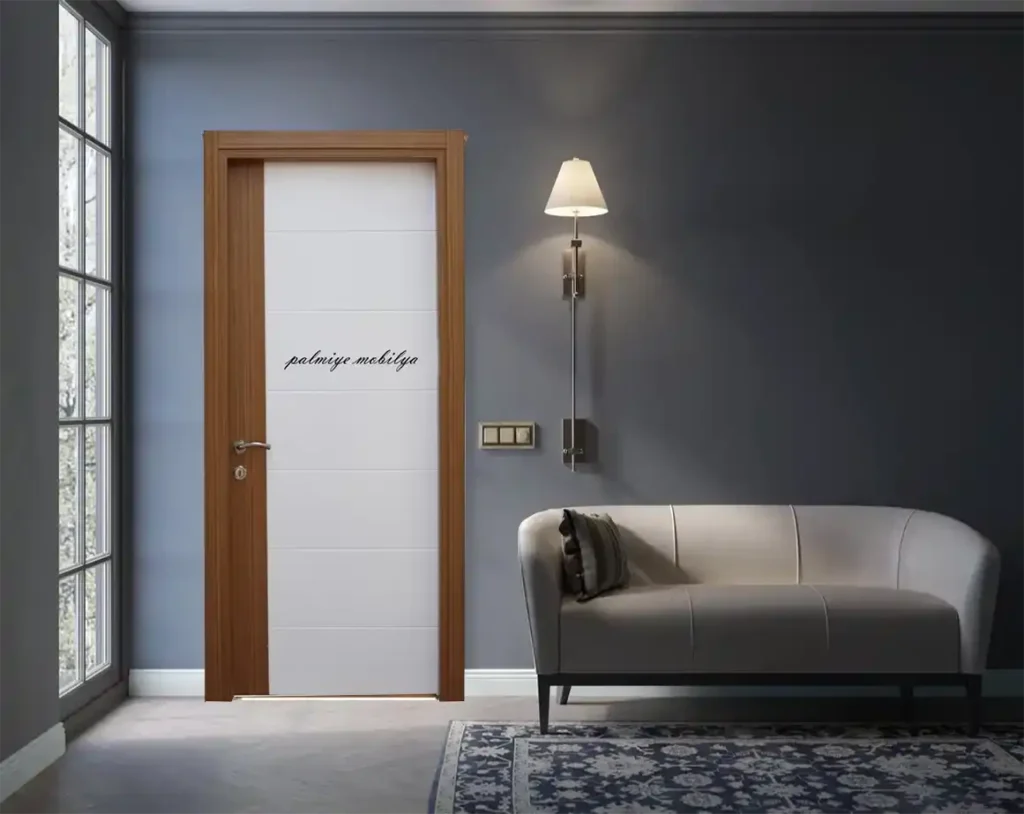
       +---> II. PRECISION CNC-GEOMETRIC DESIGNS (V-Grooves, U-Grooves, Deep Accent Lines)
       |
       +---> III. INTEGRATED CONTEMPORARY METALLIC & WOOD INLAYS (Flush Inlay Engineering)
       |
       +---> IV. ARCHITECTURAL GLASS-INTEGRATED DESIGNS (CNC Glazing Cassettes, Flush Profiles)
I. Minimalist Flush Profiles and Invisible System Innovations
In contemporary high-end architecture, the dominant design trend centers on absolute structural minimalism. This has led to the immense popularity of flush-to-wall modern lacquered doors, frequently classified as “Invisible Frame” or “Concealed Frame” systems within the export portfolio of Turkish factories.
Concealed Aluminum Sub-Frames
Instead of traditional architraves and casing headers that project outward from the wall plane, these models utilize an extruded architectural aluminum sub-frame. This frame is designed to be structurally embedded directly into the perimeter wall construction during the rough plastering or drywall installation phases.
- Visual Integration: Once the wall is finished, painted, or papered up to the inner boundary of the aluminum profile, the frame becomes entirely invisible. The lacquered door leaf sits perfectly co-planar with the surrounding wall surface.
- Zero Architrave Aesthetics: The traditional wood casing is completely eliminated. The resulting architectural expression features a clean, continuous wall line interrupted only by a precise 3mm shadow-gap outlining the perimeter of the lacquered door leaf.
- Push / Pull Versatility: These systems are engineered in two distinct structural configurations: Inswing (Push) and Outswing (Pull). This allows architects to maintain a perfectly continuous, uninterrupted wall plane along an entire corridor, even if individual doors open into different interior rooms.
Monolithic Flush Designations
The door leaves for these minimalist installations are universally finished in ultra-matte or high-gloss acrylic lacquers with zero surface ornamentation. The edges are perfectly square, and all functional hardware is completely recessed out of sight. This transforms the door from a visible piece of furniture into an integrated, stealth architectural element that blends seamlessly into the spatial envelope.
II. Precision CNC-Geometric Routed Designs
For projects requiring subtle visual textures without breaking the clean lines of modern design, CNC-routed modern lacquered doors represent the ideal typological solution.
Profile Geometries (V-Groove vs. U-Groove Profiles)
- V-Groove Engineering: A sharp, 90-degree or 45-degree V-shaped routing tool plunges into the HDF skin, cutting crisp, deep, linear channels. The sharp angles of a V-groove create high-contrast shadow lines, adding a distinct architectural rhythm to the door face.
- U-Groove Engineering: A radiused, ball-nose routing tool creates smooth, semi-circular U-shaped channels. U-grooves deliver a much softer, subtle aesthetic transition, capturing and diffusing incident ambient light gently across the door surface.
Geometric Patterns and Typographies
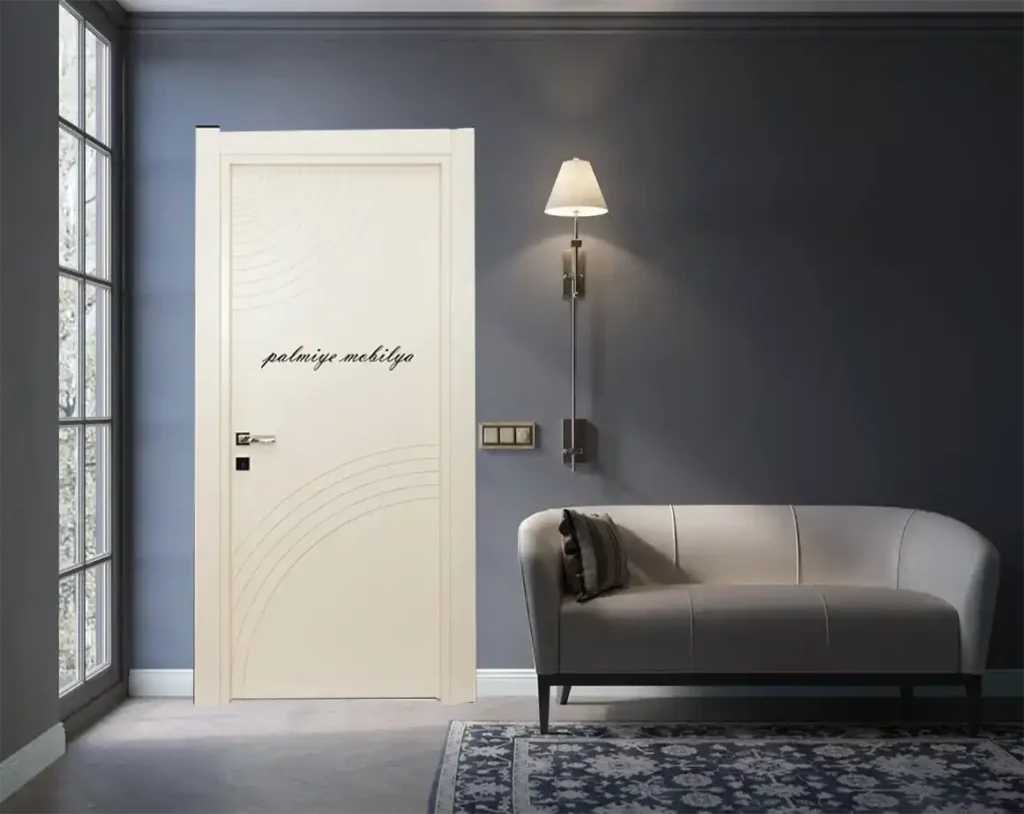
The programming flexibility of modern CNC centers allows Turkish designers to offer a near-infinite array of surface patterns. These range from simple, single vertical offset accent lines to complex horizontal ladder motifs, intersecting asymmetric grids, chevron layouts, and custom wave profiles. Because the lacquer application occurs after the CNC routing process, the interior walls of every groove are coated with the exact same millimetric precision, film thickness, and gloss level as the flat face of the door. This achieves a flawless, continuous polymer shield entirely free of raw edges or exposed wood fibers.
III. Integrated Contemporary Metallic and Rare Wood Inlays
For luxury residential towers and high-end corporate headquarters, a premium Lacquered Door Factory Turkey often features integrated material inlays that add a sophisticated tactile and visual contrast to the solid lacquer field.
Flush Inlay Engineering
Turkish manufacturers have mastered the micro-milling processes required to combine disparate materials with different thermal expansion coefficients. CNC routers machine highly precise, shallow tracks into the HDF skin. Strips of solid brass, brushed stainless steel, anodized matte black aluminum, or natural exotic wood veneers (such as American Walnut or Smoked Oak) are permanently bonded into these tracks using high-performance industrial epoxy or PUR structural adhesives.
- Monolithic Sanding Pass: Following the embedding phase, the entire door blank is passed through wide-belt sanding calibration lines. This critical step sands the lacquer substrate and the metal/wood inlay strips perfectly flush with one another. When the final lacquer coating is applied (with clear-coat masking protocols protecting the natural wood or metal surfaces), the user can glide their hand across the transition line without feeling a single microscopic ridge or height variance.
5. Architectural Hardware Pre-Milling and Frame Integration Engineering
A premium lacquered door leaf can only perform flawlessly if it is integrated with an equally high-performance frame, architrave, and hardware infrastructure. Advanced Turkish manufacturing operations treat the door leaf, the structural casing frame, the adjustable architraves, and the precision hardware as a single, unified, factory-engineered acoustic and mechanical system.
+--------------------------------------------------------------------------+

|  FACTORY PRE-MILLING HARDWARE ARCHITECTURE (EXPLODED PLAN VIEW)         |
+--------------------------------------------------------------------------+

|                                                                          |
|     [ WALL CASING FRAME ]                                                |
|            |                                                             |
|            +---> Factory-Routed Pocket for 3D Concealed Hinge           |
|            |                                                             |
|     ======================= [ 3mm Controlled Air Shadow-Gap ] =========  |
|            |                                                             |
|     [ DOOR LEAF EDGE ]                                                   |
|            |                                                             |
|            +---> Micro-Rebated Hinge Plate Cavity                        |
|            +---> Magnetic Mortise Lockset Core Chamber                   |
|            +---> Euro-Profile Cylinder / Privacy Thumbturn Bore          |
|                                                                          |
|     ======================= [ CONTINUOUS ACOUSTIC REBATE ] ============  |
|            |                                                             |
|            +---> Co-Extruded Cellular EPDM / TPE Perimetric Gasket       |
|                                                                          |
+--------------------------------------------------------------------------+
Advanced Factory CNC Pre-Milling Execution
The practice of arriving at a luxury construction project with raw door leaves and attempting to cut hinge pockets or lockset chambers by hand using manual routers on the job site is completely obsolete. This field-cutting method inevitably tears, chips, and fractures the brittle outer lacquer finish, exposing the raw underlying substrate to immediate moisture infiltration and destroying the visual perfection of the joinery.
In the premium export market, all architectural hardware preparation is executed 100% at the factory prior to the lacquer application sequence. Multi-axis CNC routing aggregates mill out the exact, three-dimensional engineering cavities required for every hinge, lock, latch, flush bolt, and drop-seal based on hardware submittals approved during the shop drawing phase.
Because the milling occurs before the door enters the cleanroom spray booths, the entire interior of every hardware pocket is coated with the same multi-layer primer and protective lacquer coats. This provides total sealing against atmospheric humidity and prevents raw wood swelling inside the hidden hardware chambers.
High-Performance Concealed 3D Adjustable Hinge Systems
Modern minimalist and high-end contemporary doors reject the use of traditional, visible barrel or flag hinges. Instead, they specify advanced, fully concealed 3D adjustable hinge systems sourced from leading global hardware brands like Anselmi, Simonswerk, or Otlav.
- Total Invisibility: When the door leaf is in its closed position, the hinge mechanism is completely retracted inside heavy-duty zinc-alloy or aluminum die-cast housings embedded deep within the frame timber and the door leaf skeleton. From either side of the wall, the hinge is entirely invisible.
- Three-Axis Independent Calibration: These hardware components allow field installation teams to calibrate the position of the heavy door leaf across three independent spatial axes using simple hex keys:
- Vertical Adjustment (Y-Axis): Up/down alignment to set precise top and bottom clearances (±2.0mm).
- Horizontal Adjustment (X-Axis): Side-to-side alignment to calibrate the perimeter shadow-gap perfectly (±1.5mm).
- Depth / Compression Adjustment (Z-Axis): In/out adjustment to regulate the exact compression force exerted by the door leaf against the frame’s acoustic gasket, ensuring a tight, rattle-free acoustic seal (±1.0mm).
Silent Magnetic Mortise Locksets and Latch Technology
To match the premium tactile feel of a high-end lacquer finish, the mechanical operation of the latch must be smooth and silent. Turkish export doors are standardly configured with advanced magnetic mortise locksets (such as AGB Mediana Polaris or Bonaiti).
- The Magnetic Principle: In a traditional mechanical lock, a spring-loaded strike latch permanently protrudes from the door edge. When the door closes, this metal latch violently strikes the protruding strike-plate on the wooden frame, causing significant clicking noise and causing localized mechanical wear on the lacquer finish over time. Magnetic locks completely eliminate this point of friction. The latch bolt is constructed from a high-strength magnetic polymer and remains completely retracted, sitting perfectly flush with the vertical edge of the door leaf while the door is open.
- Silent Engagement: Only when the door leaf reaches its precise closing position within the frame structure does the powerful internal permanent magnet embedded inside the frame strike-plate draw the magnetic bolt outward into engagement. The process is completely silent, smooth, and prevents any scraping or impacting of metal components against the finished lacquered surfaces of the frame.
Drop-Down Automated Mechanical Acoustic Bottom Seals
The structural gap beneath the bottom edge of an interior door leaf (typically 5mm to 10mm to allow for floor finish clearances) is the primary path through which acoustic energy and thermal drafts escape. To seal this gap without installing a permanent raised floor threshold timber, Turkish engineers incorporate automated mechanical drop-down seals (such as Schall-Ex or Ellen systems) inside a deep channel routed out along the bottom edge of the door leaf.
- Mechanical Actuation: A spring-loaded plunger projects outward slightly from the hinge-side edge of the door leaf. The moment the door leaf reaches its final millimeter of closure against the frame jamb, this plunger strikes the frame jamb, mechanically triggering an internal scissor-link mechanism.
- Drop Dynamics: The mechanism instantly forces a heavy-duty, co-extruded silicone or cellular neoprene sealing profile straight down onto the finished floor surface (parquet, marble, or carpet).
- Instant Retraction: The moment the door handle is turned and the leaf moves a single millimeter open, the internal spring instantly retains the gasket upward into the hidden bottom slot, preventing any dragging across the floor finish and preserving the smooth operation of the door.
6. Comparative Technical Performance Matrix
To provide procurement officers, project managers, and trade specifiers with absolute technical clarity, it is necessary to compare premium products from a top-tier Lacquered Door Factory Turkey against the alternative interior door surface finishes widely available in the global construction marketplace.
| Engineering Performance Criteria | Premium Lacquered Doors (Turkey Industrial Grade) | PVC / PP Membrane Vacuum Wraps | High-Pressure Laminates (HPL) | Natural Wood Veneer (PU Cleared) |
|---|---|---|---|---|
| Monolithic Continuity and Seaming Profile | Absolute Excellence. 100% seamless liquid application covers faces and edges concurrently; zero edge-bands or joint seams visible anywhere on the leaf. | Poor to Moderate. Vinyl film is vacuum-pressed over faces; requires distinct trimming lines or secondary edge banding on vertical profiles. | Poor. Rigid sheets require distinct edge banding strips; creates a permanent micro-visible dark seam line along every corner edge. | Good. Veneer sheets are stitched; however, edge joins are mechanically butt-aligned and can separate under extreme thermal shifts. |
| Micro-Scratch and Mechanical Abrasion Resistance | High. Advanced 2K Polyurethane and UV-Cured Acrylics achieve a high pencil hardness rating (3H to 5H depending on formulation). | Moderate to Low. Soft thermoplastic films scratch easily under fingernail or key pressure; susceptible to scuff marks. | Exceptional. Highly compressed melamine-impregnated papers offer market-leading resistance to severe scratches. | Low to Moderate. Thin natural wood cell structures rely entirely on thin clear-coat layers; highly prone to indentation. |
| Delamination Risk under Thermal / Humidity Shifts | Zero. The liquid lacquer chemically bonds and cross-links directly with the HDF fibers; there is no adhesive layer to fail or melt. | High. The thermoplastic adhesive glue-line can soften when exposed to direct sunlight, radiator heat, or moisture, causing edge peeling. | Low. Industrial hot-pressing with urea resins provides high bond strength; however, edge band separation can occur over time. | Moderate. Variances in wood expansion coefficients compared to the substrate can trigger localized veneer blistering. |
| Field Repairability and Surface Restoration | Excellent. Scratches or deep dents can be filled, block-sanded, spot-lacquered, and mechanically buffed back to 100% factory perfection. | Impossible. Any tear or puncture in a plastic membrane requires the complete stripping and disposal of the entire vinyl skin. | Very Poor. Cannot be seamlessly sanded or filled; deep gouges require complete replacement of the face panel sheet. | Moderate. Superficial clear-coat scratches can be re-sprayed; deep breaks through the thin wood veneer cannot be masked. |
| Chromatic Long-Term UV Stability | Exceptional (Acrylic/Aliphatic). Zero color shifting, fading, or yellowing even when subjected to intense, direct daily solar exposure. | Moderate. Budget PVC formulations degrade under UV radiation, leading to noticeable color fading or embrittlement over time. | High. Industrial decorative print inks contain advanced UV stabilizers that maintain long-term color value. | Poor. Natural wood species naturally oxidize, darken, or fade dramatically when exposed to sunlight over time. |
| Tactile and Visual Premium Perception | Ultra-Premium. Delivers a heavy, substantial, perfectly flat liquid polymer finish with immense depth of color and zero artificial sheen. | Low to Medium. Exhibits a distinct plastic hand-feel and characteristic synthetic glare; lacks crisp architectural definition. | Medium. Excellent flat rendering, but feels cold and clinical; lacks the deep luxury resonance of authentic custom liquid joinery. | High-End. Provides authentic, organic wood warmth and grain texture, but is limited strictly to natural timber aesthetics. |
7. Performance Indices, Structural Certifications, and Quality Metrics
When specifying doors from a Lacquered Door Factory Turkey for high-density public infrastructure, luxury high-rise hospitality projects, or multi-family residential towers, compliance with international building codes and performance standards is a mandatory legal prerequisite. Reputable Turkish manufacturers subject their door assemblies to rigorous testing protocols at accredited third-party laboratories (such as EFECTIS, Warringtonfire, or IFT Rosenheim) to secure international structural certifications.
Acoustic Attenuation Performance (EN ISO 10140-2 / ASTM E90)
Acoustic isolation is a critical parameter for modern luxury hotels and residential master suites. The acoustic performance of an interior door assembly is quantified via the Sound Reduction Index (\(R_{w}\)) or Sound Transmission Class (STC).
Turkish lacquered door assemblies are engineered to fulfill the following strict performance tiers:
- Standard Residential Tier (\(R_{w}\) 28 dB – 32 dB): Achieved via standard HDF skins combined with a high-density Sauerland tubular particleboard core and a single perimeter silicone frame gasket. This tier effectively dampens standard domestic speech and low-volume background noise.
- Premium Hospitality / Executive Tier (\(R_{w}\) 35 dB – 38 dB): Utilizes a heavy solid-core particleboard matrix or a dual-layer acoustic board configuration, supplemented by a factory-integrated mechanical drop-down bottom seal and a secondary compression frame gasket. This configuration completely isolates normal conversation and media playback volumes.
- High-Performance Specialized Tier (\(R_{w}\) 40 dB – 44 dB+): Deploys a specialized multi-layered acoustic sandwich core consisting of alternating high-mass mineral composite plates and acoustic decoupling foam layers. The frame architecture incorporates a double-rebate profile outfitted with three independent perimeter EPDM acoustic gaskets alongside a high-performance heavy-duty drop-down seal. This tier is specified for luxury hotel interconnecting doors, recording studios, and confidential executive courtrooms.
Fire Containment and Thermal Integrity (BS 476 Part 22 / EN 1634-1 / UL 10C)
Fire door assemblies are critical life-safety elements designed to compartmentalize fire, smoke, and toxic gases within a specific zone, protecting egress paths for building occupants. Turkish factories have heavily industrialized the production of certified fire-rated lacquered doors.
- FD30 (30-Minute Integrity): The door leaf thickness is typically increased to a minimum of 44mm to 50mm. The internal core features high-density, fire-retardant particleboard or specialized mineral fibers. The perimeter framework is lined with a hidden, factory-recessed intumescent graphite-based strip. In the event of a fire, this intumescent material expands up to 25 times its original volume under thermal exposure. This creates a highly dense carbonaceous foam seal that completely chokes off the air gap between the door leaf and the frame, arresting the passage of flames and hot gases for a minimum of 30 minutes.
- FD60 (60-Minute Integrity): The door leaf thickness is advanced to 54mm to 60mm, utilizing ultra-high-density calcium silicate composite cores and dual-line perimeter intumescent gaskets. The structural frame timber is replaced by high-density, fire-treated hardwood or engineered steel profiles hidden beneath premium lacquered architrave facings. All internal hardware components—including mortise lock casings and concealed hinges—must be fully lined with specialized intumescent jacket pads to prevent localized thermal bridging.
Mechanical Endurance and Cycling Reliability (EN 1191 / EN 12400)
To prove their suitability for high-traffic commercial environments, premium Turkish doors undergo mechanical endurance cycling tests on automated rig setups.
- Class 5 / Class 6 Endurance Certification: The door assembly is subjected to continuous, automated opening and closing cycles under full mechanical load at a controlled velocity. Premium Turkish doors successfully pass 200,000 to 500,000 continuous cycles without experiencing any structural frame sagging, loose hinge seats, mechanical latch failures, or surface lacquer cracking around stress concentration points. This performance profile ensures a maintenance-free operational lifespan spanning decades in high-traffic corporate offices and hospitality projects.
8. Environmental Integrity, Sustainability, and Green Building Compliance
The global architectural community places immense emphasis on the ecological footprint and chemical safety of interior building products. The modern manufacturing ecosystem for a Lacquered Door Factory Turkey has undergone a comprehensive green transformation to ensure full compliance with the most stringent international ecological benchmarks.
Formaldehyde Emission Control (E1, CARB Phase 2, and EPA TSCA Title VI)
Historically, the composite wood industry relied heavily on urea-formaldehyde resins to bind wood fibers together within MDF, HDF, and particleboard cores. These resins slowly break down over time, outgassing free formaldehyde into the indoor air, which presents a significant indoor air quality hazard.
- E1 and CARB 2 Compliance: Turkish tier-one manufacturers source their HDF and particleboard substrates exclusively from certified eco-conscious suppliers (such as Kastamonu Entegre or Yıldız Entegre) whose products strictly comply with European E1 standards, California Air Resources Board (CARB Phase 2), and the US Environmental Protection Agency (EPA TSCA Title VI) mandates.
- Ultra-Low Formaldehyde: These boards utilize advanced polymeric MDI (pMDI) or ultra-low-formaldehyde (ULEF) resin formulations, ensuring that formaldehyde emission levels remain below 0.05 ppm, making them completely safe for installation in highly sensitive environments like children’s hospitals, schools, and luxury residential developments.
Chain of Custody Certifications (FSC and PEFC)
The wood fibers, pine frameworks, and plywood cores deployed within the construction of Turkish lacquered doors are tracked via strict international sustainability regimes.
- FSC (Forest Stewardship Council): Guarantees that the timber used is harvested exclusively from responsibly managed forests that preserve biodiversity, protect water resources, and respect the legal rights of local forest workers.
- PEFC (Program for the Endorsement of Forest Certification): Promotes sustainable forest management through independent third-party certification across the entire timber processing chain. Procurement officers can request valid FSC or PEFC Chain of Custody (CoC) certificates for every door shipment, satisfying the rigorous data verification requirements of green building frameworks such as LEED and BREEAM.
Indoor Air Quality and VOC Reduction Certification (Eurofins Indoor Air Comfort Gold)
The multi-layer liquid coatings applied to premium Turkish doors are strictly audited for volatile organic outgassing after the manufacturing process is complete.
- Indoor Air Comfort Gold: By deploying advanced UV-cured chemistry and state-of-the-art water-borne polyurethane dispersions, premium Turkish manufacturers achieve the prestigious Eurofins Indoor Air Comfort Gold certification. This designation confirms that the finished, fully cured door leaf exhibits virtually zero VOC emissions within the indoor residential environment. This ensures that the indoor air quality remains clean, healthy, and entirely free of toxic outgassing or chemical odors immediately post-installation.
9. Global Sourcing Logistics, Industrial Hubs, and Factory Audit Operational Sequence
To build a highly reliable, risk-mitigated supply pipeline with a Lacquered Door Door Factory Turkey, procurement managers should implement a structured, five-stage engineering audit checklist. Quality verification must not be delayed until ocean containers arrive at their global destination ports; it must be systematically embedded directly onto the active factory floor.
=========================================================================================
                      FACTORY PARTNERSHIP OPERATIONAL BLUEPRINT
=========================================================================================
       |
       +---> STAGE 1: Technical Shop Drawing Engineering & Hardware CNC Mapping
       |
       +---> STAGE 2: Golden Sample Manufacturing & Third-Party Lab Verification
       |
       +---> STAGE 3: Cleanroom Spray Cab Zone Climate & Positive Pressure Monitoring
       |
       +---> STAGE 4: Pre-Shipment Quality Inspections (AQL 1.5/4.0 Standards)
       |
       +---> STAGE 5: Container Volumetric Stabilization & Preferential Trade Documentation
Stage 1: Shop Drawing Engineering and Hardware CNC Mapping
The sourcing workflow begins with the conversion of architectural concept sheets into factory-executable production blueprints. Importers must supply the factory with precise data regarding clear wall openings, structural frame depths, finished floor thickness clearances, and detailed hardware specification submittals.
All hardware placements—including concealed 3D hinges, silent magnetic mortise locksets, and drop-down automated mechanical seals—must be mapped out via CNC toolpath programming prior to activating the liquid spray lines. Cutting or routing hardware cavities manually on an active construction site will chip and fracture the brittle outer lacquer finish, exposing the raw underlying substrate to atmospheric moisture.
By executing all hardware pre-milling via automated multi-axis factory CNC routers before the doors enter the cleanroom spray booths, the entire interior cavity of every hardware pocket receives identical primer and lacquer coats, ensuring complete protection against wood swelling.
Stage 2: The Golden Sample Protocol
Before authorizing mass industrial production runs, the importer must institute a formal “Golden Sample” protocol. The chosen Turkish factory manufactures a limited run of complete door assemblies matching the exact technical dimensions, CNC profiling toolpaths, color paint codes, and gloss metrics designated for the overall contract.
- Independent Evaluation: These sample units undergo thorough structural testing. The importer evaluates color rendering under varying architectural light sources, checks the precision of the hardware pre-milling, and tests the compression fit against the frame gaskets. Bulk manufacturing begins only after the formal sign-off of the certified golden sample.
Stage 3: Cleanroom Zone Climate and Positive Pressure Monitoring
During active manufacturing cycles, quality control protocols must monitor every stage of production:
- Substrate Moisture Tracking: Industrial pinless moisture meters must audit the incoming finger-jointed timber framework and HDF panels, verifying that moisture levels remain strictly within the 8% to 10% window.
- Sanding Calibration Controls: Wide-belt calibration sanding operations must be audited to ensure flat face topographies within a ±0.1mm tolerance, preventing subsequent lacquer distortion or fiber raising.
- Cleanroom Climate Management: The HEPA-filtered robotic spray booths must maintain continuous positive air pressure and precise climate metrics (20°C to 22°C temperature and 50% to 55% relative humidity). This prevention setup ensures optimal liquid atomization, uniform film self-leveling, and total elimination of airborne dust contamination.
Stage 4: Pre-Shipment Quality Inspections (AQL 1.5/4.0 Standards)
Before final packaging and container loading, the completed order must pass a formal Pre-Shipment Inspection (PSI). Importers can deploy internal quality engineers or retain independent international testing bodies (such as SGS, Bureau Veritas, or TÜV SÜD) to execute the audit based on a defined Acceptable Quality Limit (AQL 1.5/4.0 framework):
- Visual Surface Evaluation: Doors are placed under high-intensity inspection lights to verify total absence of surface dimpling, runs, orange-peel textures, micro-scratches, or airborne dust inclusions.
- Gloss Uniformity Checks: Multi-angle digital glossmeters verify that surface gloss levels remain within specified tolerances across all door leaves (e.g., maintaining a strict 10 to 15 GU window for satin finishes).
- Dimensional Tolerance Assessments: Precision calipers measure critical dimensions—including total height, structural width, leaf thickness, and rebate depths—verifying alignment with approved shop drawings within strict millimetric bounds:
+--------------------------------------------------------------------------+

|  EXPORT-GRADE MILLIMETRIC FACTORY TOLERANCE LIMITATIONS                  |
+--------------------------------------------------------------------------+

|                                                                          |
|  * Leaf Thickness Tolerance: ........................... ±0.5 mm          |
|  * Overall Height / Width Variance: .................... ±1.0 mm          |
|  * Diagonal Warping / Bowing Maximum Bound: ............. ≤2.0 mm          |
|  * Shadow-Gap Uniformity Window: ....................... 3.0 mm (±0.5mm)  |
|                                                                          |
+--------------------------------------------------------------------------+
Stage 5: Container Volumetric Stabilization and Preferential Trade Documentation
The final stage of the trade sequence covers container loading and documentation verification. The independent inspector monitors the loading process to ensure the ISPM-15 wooden crates are properly handled, stacked flat, and secured with dunnage bags and heavy-duty tie-down straps.
Concurrently, the export compliance officer confirms that all international shipping documents match perfectly. This step ensures the commercial invoice, packing list, ocean bill of lading, certificates of origin, and preferential trade certificates contain identical weights, volume metrics, and HS tariff classifications, guaranteeing a smooth and efficient customs clearance process at the destination port.
For shipments bound for the European Union or the United Kingdom, the factory must issue valid A.TR. or EUR.1 certificates, allowing importers to utilize duty-free trade pathways and significantly optimizing landing-cost calculations.
10. Conclusion and Proactive Procurement Blueprint
Navigating the extensive world of a Lacquered Door Factory Turkey reveals an industrial sector that seamlessly bridges the gap between advanced polymer chemistry, high-precision automated woodworking engineering, and sophisticated contemporary architectural expression. Sourcing from this market offers international project developers a rare combination of premium craftsmanship, strict compliance with European and global performance standards, and highly compressed logistical timelines.
To ensure absolute success when managing a bulk procurement or custom architectural specification for lacquered doors from Turkey, project stakeholders should adhere to the following systematic blueprint:
- Define Core Metrics Early: Clearly establish the acoustic insulation (\(R_{w}\)/STC) and fire-containment (FD30/FD60) requirements dictated by your project’s local building codes before requesting manufacturer submittals.
- Match Project Scope to the Correct Hub: Guide the procurement order to the industrial cluster that aligns with your specific volume and design needs—Istanbul for bespoke custom luxury, İnegöl for mid-to-large flexible residential projects, or Kayseri for massive volume and rapid-turnaround standardization.
- Mandate Factory Hardware Pre-Milling: Never compromise on field-cutting. Require 100% factory CNC pre-milling for concealed 3D hinges, silent magnetic locksets, and drop-down acoustic seals to protect the integrity of the premium liquid lacquer finish.
- Enforce Comprehensive Pre-Shipment Inspections: Retain an independent testing body (SGS, Bureau Veritas) to verify surface gloss uniformity, dimensional tolerances, and color matching before the crates are loaded into the containers.
- Leverage Preferential Customs Union Protocols: For shipments bound for the European Union or the United Kingdom, ensure your documentation pipeline includes valid A.TR. or EUR.1 certificates to legally utilize duty-free trade entry pathways, significantly optimizing your landing-cost matrix.
By leveraging the deep technical engineering and industrial capabilities detailed throughout this manual, architectural professionals can confidently source high-end interior joinery that elevates the spatial experience, guarantees structural longevity, and delivers exceptional value to modern international real estate developments.



Şunları da sevebilirsiniz
Modern Lacquered Door Turkey

Rustic Lacquered Door Manufacturing Turkey