
Lacquered Door Types Turkey
Lacquered Door Types Turkey: The Comprehensive Engineering, Design, and Sourcing Directory
The global interior design landscape has witnessed a significant paradigm shift toward high-performance, seamless architectural elements, placing lacquered door types Turkey at the center of premium residential and commercial developments. Turkish industrial doors represent a sophisticated marriage of advanced chemical engineering, automated manufacturing, and deep-rooted woodworking craftsmanship. Sourcing from Turkey allows architects, developers, and interior designers to access a massive matrix of door configurations that meet strict European quality standards while maintaining a highly competitive price-to-quality ratio.
This technical, encyclopedic guide provides an exhaustive analysis of the structural compositions, chemical topcoats, functional opening mechanisms, and architectural styles that define the world of lacquered door types Turkey. By exploring this manual, B2B buyers and luxury homeowners will gain the precise technical insights needed to specify, source, and maintain these premium interior openings.
1. Structural Engineering: The Core Compositions of Lacquered Door Types Turkey
A common misconception in the interior design sector is that a lacquered door is defined solely by its paint finish. In reality, the performance, durability, and warp-resistance of lacquered door types Turkey depend heavily on the engineering hidden beneath the liquid coating. Turkish manufacturers utilize three primary structural core compositions, each tailored to specific budgetary, structural, and performance requirements.
Honeycomb Core Lacquered Doors (Standard Duty)
The honeycomb core configuration is the most lightweight and cost-effective option within the ecosystem of lacquered door types Turkey.
- Internal Architecture: The interior framework consists of a finger-jointed softwood perimeter (typically kiln-dried pine or fir). The void inside this frame is filled with a high-density, resin-impregnated kraft paper cell structure resembling a natural honeycomb.
- Substrate Skins: The structural frame and honeycomb core are sandwiched between two layers of 6mm or 8mm Medium-Density Fiberboard (MDF) or High-Density Fiberboard (HDF).
- Performance Metrics: This type offers excellent structural stability against twisting because the hexagonal cells distribute surface tension evenly. However, it provides modest acoustic insulation (approximately 22–26 dB). It is ideal for standard residential bedrooms and closets where heavy acoustic isolation is not a priority.
Tubular Chipboard Core Lacquered Doors (Acoustic & Heavy Duty)
For upscale hospitality projects, premium residential villas, and commercial offices, Turkish factories utilize tubular chipboard—frequently sourced from industry-leading European suppliers like Sauerland Spanplatte or engineered in high-tech local Turkish mills.
- Internal Architecture: The core consists of a solid, engineered wood particle board that features continuous cylindrical voids running horizontally or vertically through the slab.
- Substrate Skins: Wrapped in extra-thick 8mm to 12mm premium MDF/HDF skins to facilitate deep, intricate CNC routing patterns.
- Performance Metrics: Tubular chipboard radically shifts the performance profile of lacquered door types Turkey. It increases the door leaf weight significantly, giving it a solid, luxury feel when swinging. More importantly, it delivers outstanding sound attenuation (ranging from 28 dB to 34 dB or higher when paired with drop-down acoustic acoustic seals) and enhances impact resistance.
Solid Wood Composite Core Lacquered Doors (Ultra-Luxury & Custom)
The pinnacle of structural integrity among lacquered door types Turkey is the solid wood composite or blockboard core.
- Internal Architecture: The entire interior core is packed tightly with parallel strips of finger-jointed solid wood (usually pine, spruce, or Alnus). This eliminates large voids completely.
- Substrate Skins: Multi-layered HDF sheets are laminated over the solid wood block core to create an absolutely stable, flat surface that isolates the natural micro-movements of the solid wood from the outer paint layers.
- Performance Metrics: These doors offer maximum mechanical strength, high screw-holding capacity for heavy architectural hardware, and premium durability. They are highly favored for luxury main entrance partition doors, master suites, and high-traffic executive boardrooms.
2. Chemical Coating Matrix: The Science of the Finish
The defining characteristic of all lacquered door types Turkey is a liquid coating that cures into a flawless, non-porous protective shell. The chemical formulation of the lacquer dictates how the door responds to sunlight, physical impacts, and chemical cleaning agents over decades.
Polyurethane Lacquered Doors
Polyurethane (PU) remains the historical industry workhorse for premium Turkish joinery lines. It is a two-component chemical system consisting of alkyd or polyester resins cross-linked with polyisocyanate hardeners.
- Application Method: Applied via automated reciprocating spray robots within pressurized, dust-free cleanrooms.
- Technical Properties: PU coatings provide an incredibly dense, thick paint film with phenomenal chemical resistance against common household spills and detergents. It offers a smooth surface feel. However, standard PU requires specialized UV-stabilizer additives to prevent pale white finishes from turning slightly yellow under long-term exposure to direct sunlight.
Acrylic Lacquered Doors (The Non-Yellowing Standard)
When architects specify bright white, alabaster, or ultra-light pastel tones for modern minimalist projects, Turkish factories transition to acrylic-polyurethane formulations.
- Application Method: Applied in highly calibrated, automated lines, often utilizing advanced UV-curing tunnels.
- Technical Properties: Acrylic resins possess absolute aliphatic stability, meaning they are completely impervious to UV-induced degradation and yellowing. Acrylic lacquered doors exhibit superior surface hardness and scratch resistance compared to standard PU, combined with higher film elasticity that prevents micro-cracking at structural joints.
Water-Based Eco-Lacquered Doors
Driven by the global demand for sustainable construction materials and compliance with green building certifications like LEED, BREEAM, and DGNB, the market for water-borne lacquered door types Turkey has expanded exponentially.
- Application Method: Applied using state-of-the-art European water-based spraying and forced-drying systems that meticulously control humidity and airflow during cross-linking.
- Technical Properties: These coatings substitute organic solvents with water, resulting in ultra-low Volatile Organic Compound (VOC) emissions. They are completely odorless and non-toxic, making them the default choice for modern healthcare facilities, luxury hotels, schools, and eco-conscious residential developments.
3. Style Classifications of Lacquered Door Types Turkey
The aesthetic flexibility offered by combining high-speed CNC routing with liquid lacquering allows Turkish manufacturers to produce an endless array of visual styles. Today, lacquered door types Turkey are categorized into four dominant design movements.
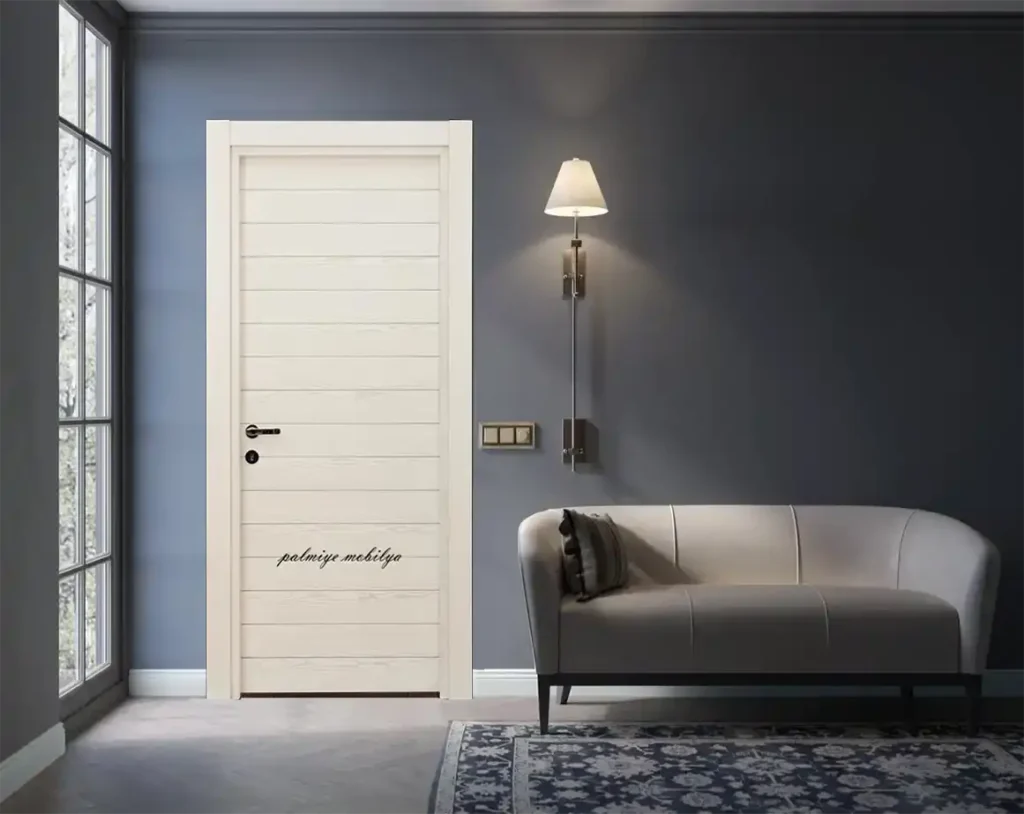
1. Minimalist Flush (Flat Panel) Doors
The hallmark of modern, Scandinavian, and industrial interior architecture. These doors feature a completely flat, monolithic surface without any structural indentations or decorative moldings.
- Design Aesthetics: Focuses entirely on the purity of the color and the precision of the gloss level. It is highly popular in super-matt finishes for a velvety, light-absorbing appearance, or high-gloss piano finishes for a dramatic, reflective look.
- Structural Integration: Frequently paired with concealed aluminum frames and invisible hinges to allow the door to sit perfectly flush with the wall surface, mimicking a continuous wall panel.
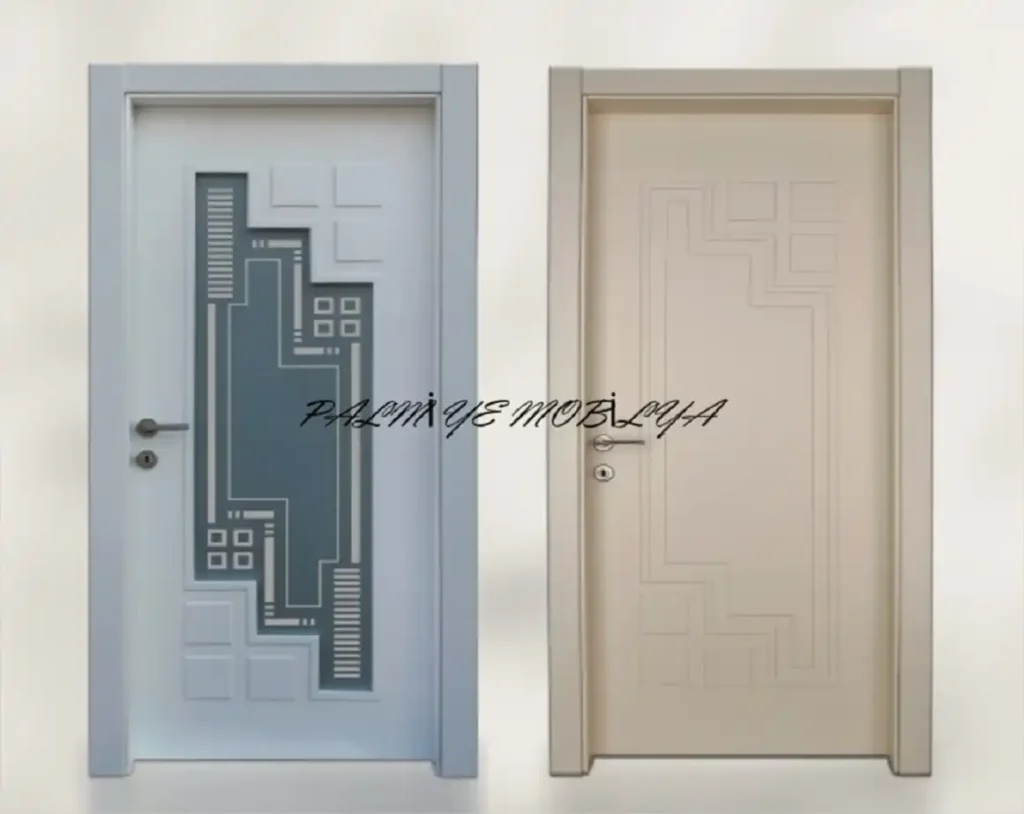
2. CNC Routed & Engraved Doors
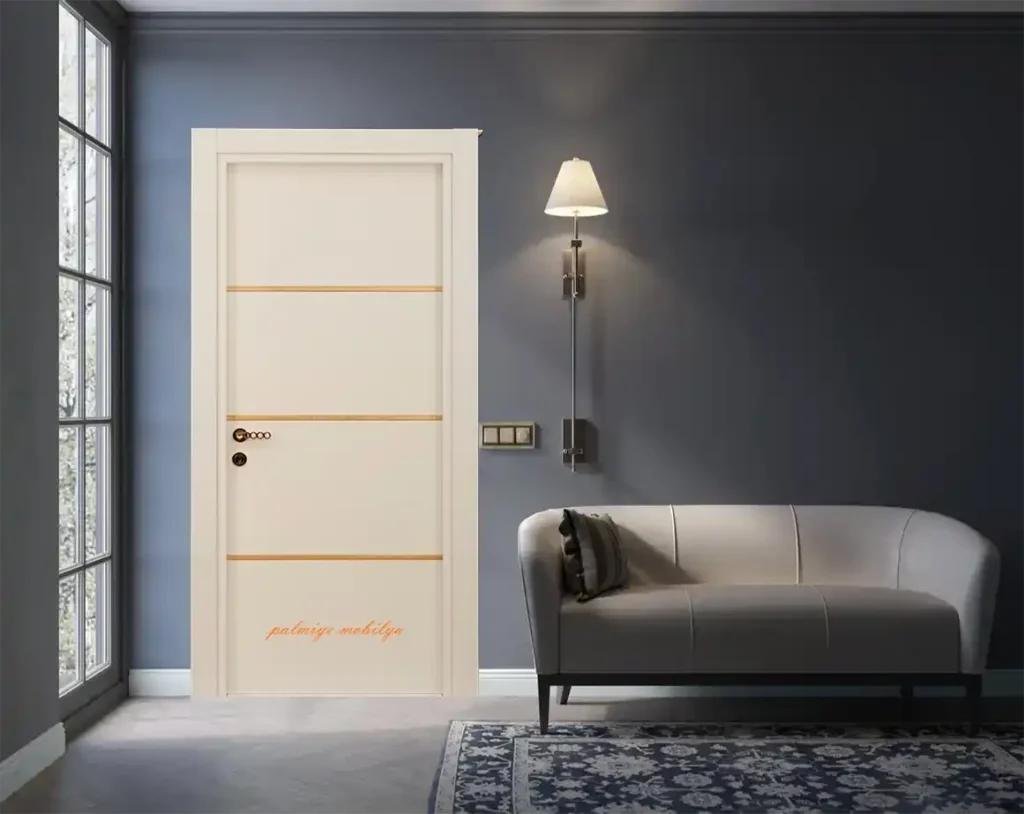
By utilizing multi-axis CNC machining, Turkish designers cut precise lines, geometric grids, curved waves, or asymmetrical grooves directly into the dense HDF skin before the painting process begins.
- Design Aesthetics: Provides subtle, contemporary visual depth. Vertical linear grooves can make a room feel taller, while horizontal lines create an illusion of expansive width in narrow corridors.
- Technical Integrity: Because the spraying process occurs after the CNC engraving is completed, the liquid lacquer flows seamlessly into the grooves, ensuring that no raw fiberboard edges are left exposed to atmospheric humidity.
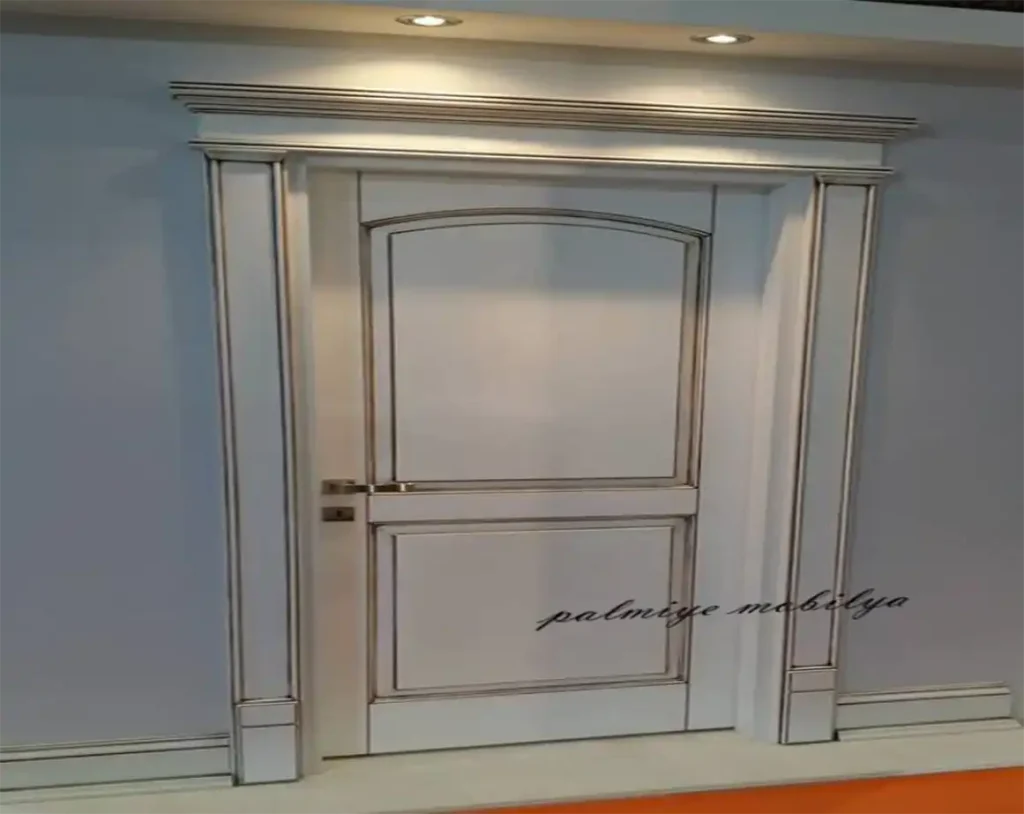
3. Neo-Classical & Shaker Paneled Doors
For timeless estates, luxury penthouses, and classic European-style apartments, lacquered door models Turkey offer deep, multi-tiered dimensional panels.
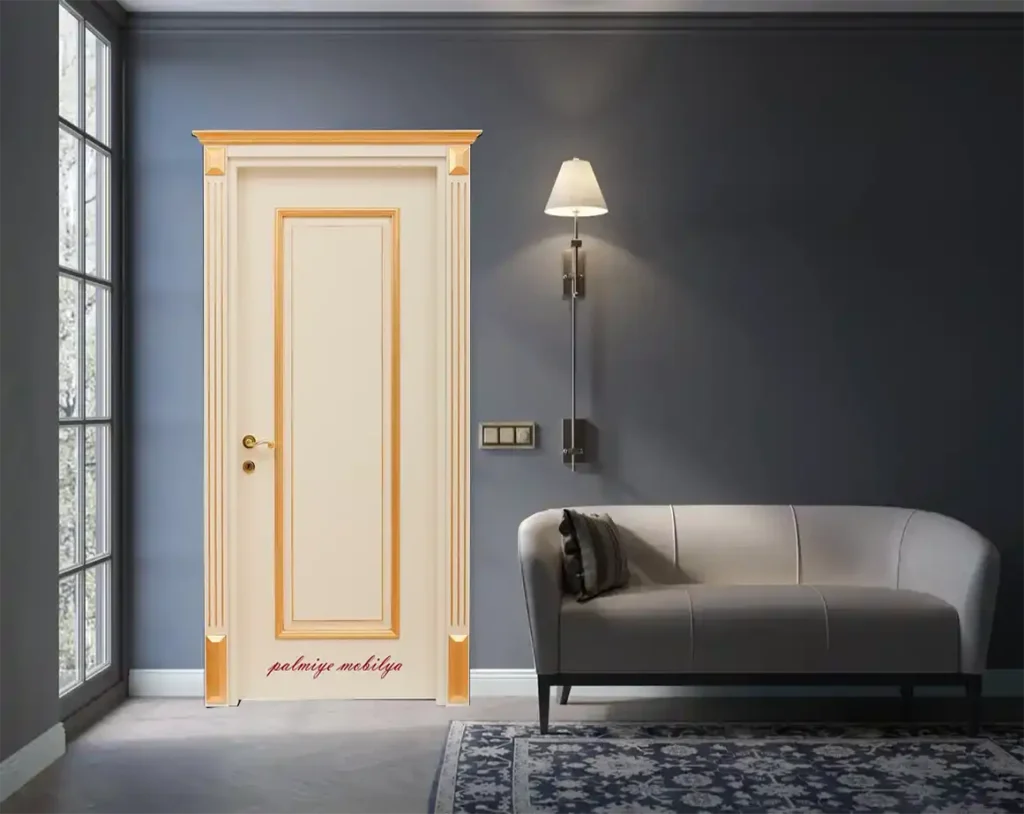
- Design Aesthetics: Includes traditional 2-panel, 3-panel, or classic Shaker configurations characterized by clean 90-degree step-profiles.
- Craftsmanship Enhancements: High-end Turkish workshops offer hand-applied patina finishes (such as antique gold, silver, or champagne leafing) embedded within the routed profile steps to accentuate the depth and historical prestige of the woodwork.
4. Glazed (Integrated Glass) Lacquered Doors
Turkish factories seamlessly unite lacquered timber frames with high-performance glass inserts to enhance natural light transmission throughout interior spaces.
- Design Aesthetics: Ranging from a single minimalist vertical vision strip to complex French-door multi-lite grids. Glass options include frosted satin, smoked bronze, wired industrial glass, and trendy fluted (ribbed) textures.
- Engineering Quality: Specialized, non-reactive EPDM rubber gaskets and CNC-machined matching glass stops ensure the glass is structurally anchored without rattling or leaking air, keeping the door’s perimeter completely seamless.
4. Gloss Architecture: Specifying the Perfect Reflective Index
When navigating different lacquered door types Turkey, specifying the correct gloss level is critical to achieving the intended architectural ambiance. Gloss is scientifically quantified using “Gloss Units” (GU) measured at a standard 60-degree reflection angle.
| Gloss Specification | Gloss Unit (GU) Value | Visual Characteristics | Best-Suited Interior Applications |
|---|---|---|---|
| Super-Matt / Deep Matt | 1 – 10 GU | Absorbs almost all incident light; creates a smooth, velvety, modern aesthetic. | Minimalist lofts, high-traffic commercial spaces, and bedrooms exposed to intense natural light. |
| Satin / Silk / Eggshell | 15 – 35 GU | Reflects a soft, diffused glow; exhibits excellent balance between depth and practicality. | The most widely specified finish across Turkey for residential bedrooms, living rooms, and hospitality corridors. |
| Semi-Gloss | 40 – 60 GU | Distinctly reflective; highlights structural contours and CNC millings cleanly. | Transitional homes, corporate offices, kitchen partitions, and coastal-themed interiors. |
| High-Gloss (Piano Finish) | 85 – 95+ GU | Mirror-like, crisp reflections; requires specialized multi-stage compounding and polishing lines. | Luxury penthouses, executive boardrooms, walk-in dressing rooms, and high-fashion retail boutiques. |
5. Functional Typologies: Engineering the Opening Mechanism
Modern spatial design requires versatile configurations that maximize usable square footage. The manufacturing sector for lacquered door types Turkey excels in producing specialized functional variants far beyond the standard side-hinged door.
Concealed Frame (Invisible) Lacquered Doors
An absolute favorite among high-end interior architects globally.
- The Hardware Matrix: Instead of traditional wooden casing, architraves, and jambs, the door leaf is hung within a structural aluminum sub-frame that is embedded directly into the plaster or drywall during the rough construction phase.
- The Visual Outcome: When closed, the lacquered door rests perfectly flush with the wall. By ordering the door lacquered in the exact RAL or NCS color code of the wall paint, the opening virtually disappears into the architecture, punctuated only by a sleek designer handle.
Sliding and Pocket Lacquered Doors
To solve space constraints in compact urban apartments, luxury en-suite bathrooms, or walk-in closets, Turkish factories adapt their premium lacquered slabs for sliding systems.
- Wall-Mounted Sliding (Barn Style): The lacquered slab glides smoothly on an exposed upper aluminum or matte-black steel architectural track.
- Pocket Doors: The lacquered leaf slides completely into a recessed metallic cage hidden inside the drywall framework. Turkish manufacturers pre-mill the top edges of the door leaves to accept heavy-duty, smooth-gliding nylon rollers with soft-closing dampers, ensuring silent operation over thousands of cycles.
Full-Height (Floor-to-Ceiling) Lacquered Doors
Standard internal doors traditionally measure 2100mm in height. However, modern luxury architecture demands majestic openings that stretch from the floor completely to the ceiling, reaching heights of 2700mm, 3000mm, or even 3200mm.
- The Engineering Challenge: A 3-meter-tall wooden slab is highly vulnerable to warping over time due to vertical temperature gradients and seasonal humidity fluctuations.
- The Turkish Solution: To mitigate this risk, premium producers of lacquered door types Turkey integrate internal adjustable steel tension rods (tensioners) deep within the core matrix of the door leaf. These tension rods can be calibrated via micro-adjustment access points at the top or bottom of the door, allowing the installer to counteract any minor bowing and keep the massive slab perfectly planar indefinitely.
Oversized Pivot Lacquered Doors
For grand transitional spaces between expansive living areas, entry foyers, or formal dining rooms, pivot systems offer an unmatched sense of luxury. Supported by heavy-duty hydraulic floor springs and upper ceiling pivots rather than traditional wall-mounted hinges, these colossal lacquered slabs rotate effortlessly on a shifted vertical axis, behaving as functional kinetic partition walls.
6. Sourcing Intelligence: Turkey’s Major Industrial Clusters
Turkey’s unique geopolitical position as a logistical bridge between Europe, Central Asia, and the Middle East, combined with its massive industrial zones, has allowed it to scale its production capacity tremendously. When importing lacquered door types Turkey, B2B buyers generally operate within three dominant manufacturing hubs:
The Istanbul Cluster (İkitelli, Dudullu, Tuzla Industrial Zones)
- Core Focus: High-end boutique custom orders, complex architectural projects, and fast-tracked premium prototyping.
- Strategic Advantage: Close proximity to international airport hubs, ease of on-site inspection, and immediate access to top-tier European chemical suppliers and cutting-edge hardware distributors.
The Kayseri Organized Industrial Zone (OIZ)
- Core Focus: Mega-scale automated mass production, high-volume contract manufacturing, and large residential development orders.
- Strategic Advantage: Kayseri is home to some of the largest, fully integrated, multi-acre woodworking and door manufacturing complexes in Europe. It is the premier hub for sourcing thousands of uniform, high-quality lacquered doors under tight timelines for master-planned communities, massive hotels, and public infrastructure projects.
The Inegöl & Bursa Furniture Cluster
- Core Focus: Trend-forward contemporary designs, avant-garde concepts, and fully integrated interior joinery packages.
- Strategic Advantage: Inegöl operates as a globally recognized furniture epicenter. Sourcing doors from this cluster allows commercial buyers to seamlessly match the lacquer colors, timber veneers, and structural details of their interior doors with built-in wardrobes, kitchen cabinetry, and decorative wall claddings under a single consolidated shipping contract.
7. Comparative Technical Evaluation: Lacquer vs. Alternative Surfaces
To understand the long-term return on investment (ROI) associated with specifying premium lacquered door types Turkey, it is essential to compare them directly against alternative industrial finishes common in the global construction market:
| Quality and Performance Parameter | Lacquered Finish (Turkey) | PVC / Vinyl Membrane Foil | Melamine / CPL Laminate | Natural Wood Veneer |
|---|---|---|---|---|
| Edge Continuity | 100% Seamless. Liquid paint completely wraps every face, recess, and edge without a break. | Visually smooth, but vulnerable to edge peeling if exposed to continuous steam or heat. | Features sharp, visible lines where the surface face meets the plastic edge-banding tape. | Smooth wood continuity, but grain breaks are visible at the corner joints. |
| Color Customization | Infinite. Can be color-matched to any global RAL, NCS, or Pantone code. | Strictly restricted to the pre-printed stock color catalogs of vinyl film manufacturers. | Limited to the specific printed décor paper collections of laminate factories. | Limited to natural tree species and compatible wood stains. |
| On-Site Repairability | Excellent. Surface scratches and structural dents can be sanded down, puttied, and spot-lacquered cleanly on-site. | Impossible to repair if punctured or torn; requires stripping the entire film or replacing the leaf. | Highly difficult to patch; repair waxes rarely match the original synthetic grain texture perfectly. | Good repairability using professional wood stains, shellac sticks, and clear topcoats. |
| Moisture Resistance | Superior. The hardened multi-layer lacquer shell acts as a completely non-porous, waterproof shield. | High on the face, but moisture can compromise the adhesive backing at the edges over time. | Moderate. The edge-banded seams are highly vulnerable to water ingress, leading to substrate swelling. | Vulnerable to intense humidity swings; requires continuous clear sealing to prevent wood rot. |
| Aesthetic Prestige | Ultra-Premium. Delivers a high-end luxury look that elevates the real estate value of a property. | Budget to Mid-Range. Can look artificial or synthetic under intense, direct light. | Practical and Utility-Oriented. Lacks the tactile richness of premium liquid coatings. | High Premium. Provides a warm, organic, prestigious ambiance, though highly subject to natural variations. |
8. Rigid Technical Quality Standards and International Certifications
One of the primary reasons global procurement managers trust lacquered door types Turkey is the manufacturing sector’s compliance with rigorous European Norms (EN) and international testing protocols. When vetting a Turkish supplier, ensure they possess the following technical credentials:
- ISO 9001 (Quality Management Systems): Verifies that the factory operates under strict, standardized, and repeatable manufacturing guidelines from raw material inspection to export packaging.
- EN 14351-2: The definitive European standard governing the performance, safety characteristics, and mechanical strength of interior pedestrian doorsets.
- EN 1634-1 (Fire Resistance Certification): For commercial projects requiring high safety criteria, top-tier Turkish factories produce specialized fire-rated lacquered doorsets capable of withholding flames and blocking smoke for 30, 60, or 90 minutes (FD30, FD60, FD90). These doors incorporate advanced intumescent graphite seals concealed beneath the frame lacquer that expand violently under extreme heat to seal the opening completely.
- E1 or E0 Formaldehyde Compliance: Guarantees that the resins, binders, and HDF/MDF boards used in the door’s construction emit zero or negligible amounts of formaldehyde gas, strictly preserving indoor air quality (IAQ).
9. Structural Installation Protocol and Site Calibration
Even a flawless, masterfully produced door can experience premature failure or structural issues if installed incorrectly. Because lacquered door types Turkey are highly finished luxury architectural products, the installation phase requires strict adherence to professional joinery standards.
Phase 1: Pre-Installation Environmental Vetting
- Moisture Cure Stabilization: The building’s rough wet trades—including interior plastering, floor screeding, wall tiling, and priming—must be 100% complete and fully dried. The relative humidity inside the structure must stay stably between 40% and 60%, and the room temperature should be maintained between 15°C and 25°C. Forcing finished doors into a damp, uncured concrete structure will cause the wooden frame cores to absorb moisture, leading to structural swelling that can crack the outer lacquer skin.
- Wall Opening Orthogonality: Installers must measure the rough structural openings using high-precision laser levels. The opening must be perfectly square, vertical, and level. Wall thicknesses must be cross-checked at multiple points (top, center, base) to properly configure the adjustable telescopic architraves characteristic of Turkish door frames.
Phase 2: Frame Assembly and Fixing Protocols
- Protective Assembly Buffers: Turkish door casings utilize intelligent telescopic mitered frame components. These frames must be laid out and assembled on a completely flat, heavily padded surface (such as dense foam sheets or clean corrugated cardboard) to prevent any abrasive concrete dust or gravel from scratching the lacquered edges.
- Controlled Polyurethane Foam Application: The assembled frame is dry-fitted into the wall opening using temporary plastic or soft wood adjustment wedges. Low-expansion polyurethane (PU) foam must be injected carefully into the structural cavity between the wooden frame and the wall. Standard high-expansion construction foam must be strictly avoided, as its massive expansion pressure can bow the jambs inward, permanently throwing the door leaf out of alignment.
- Hidden Mechanical Anchoring: Relying solely on expanding foam is insufficient for heavy tubular or solid-core doors. Installers must deploy hidden mechanical screw anchors behind the removable rubber strike strips or underneath the concealed hinge plates, securely locking the frame into the brickwork or drywall studs without exposing unsightly screw heads on the pristine lacquered surface.
10. Long-Term Maintenance, Care, and Preservation Matrix
To ensure that the radiant, uniform finish of lacquered door types Turkey remains immaculate across decades of intensive daily operation, a structured, chemically safe maintenance routine must be practiced.
The Mandatory Maintenance Protocols (“Do’s”)
- Routine Dry Dusting: Use an ultra-soft, static-charging microfiber cloth to lift away airborne dust particles regularly. Dust accumulation can act as a micro-abrasive if rubbed harshly against a finished surface.
- Gentle Damp Cleaning: For stubborn smudges, grease marks, or oily fingerprints, use a clean microfiber cloth slightly dampened with lukewarm water mixed with a few drops of a pH-neutral, non-ionic liquid dish soap. Always follow up immediately by wiping the area dry with a separate, soft towel to eliminate water spots.
- Hardware Calibration: Once a year, inspect and lubricate the internal mechanisms of the magnetic lock cases, latch bolts, and concealed 3D adjustable hinges using a drop of high-performance, non-staining silicone-based dry lubricant spray to ensure fluid, frictionless mechanical action.
The Strict Prohibitions (“Don’t’s”)
- Banish Harsh Chemical Solvents: Never allow cleaning agents containing ammonia, chlorine bleach, acetone, spirit vinegars, or strong alkaline compounds to touch the door. These aggressive solvents will chemically break down, melt, or permanently dull the polyurethane or acrylic topcoats, leading to incurable clouding, patchiness, or peeling.
- Avoid Abrasive Materials: Scouring pads, steel wool brushes, coarse paper towels, or abrasive cleaning powders will micro-scratch the lacquer layer, permanently destroying the smooth reflection of high-gloss styles or modifying the intended look of super-matt designs.
- Manage High-Heat Proximity: Ensure that uninsulated portable space heaters, high-powered radiators, or professional commercial steam cleaners are never positioned directly adjacent to a lacquered door leaf. Intense, concentrated thermal exposure can induce localized thermal shock, which can result in micro-cracking along the mitered joints of the door frame.
11. B2B Procurement and Logistical Advantages of Sourcing from Turkey
For international volume buyers, corporate real estate developers, and global supply chain managers, importing lacquered door types Turkey is a highly strategic commercial decision backed by concrete economic and geographical advantages.
Unparalleled Value Engineering
Operating with lower manufacturing overhead costs relative to Western Europe, while simultaneously deploying the exact same high-tech German and Italian automated machinery, Turkish factories produce internal doorsets that match or exceed the quality criteria of premium European brands at a highly competitive cost. This enables global real estate developers to elevate the luxury profile of their interior spaces while keeping project budgets optimized.
Logistical Velocity and Strategic Proximity
Turkey’s geographical position provides a tremendous turnaround-time advantage over distant Asian manufacturing alternatives:
- Overland Transit to Europe: Full truckload (FTL) or less-than-truckload (LTL) shipments can depart from industrial zones in Istanbul, Bursa, or Kayseri and arrive directly at construction sites across Germany, France, the UK, or the Netherlands within 5 to 9 days.
- Maritime Routes to the Americas and MENA: Deep-water mega-ports such as Ambarlı (Istanbul), Mersin, and İzmir provide frequent, direct container shipping lines, ensuring highly reliable, predictable supply chain timelines across the Atlantic and throughout the Middle East.
Massive Scalability Coupled with Customization Flexibilities
A significant challenge in global sourcing is that many manufacturing markets are split into either hyper-rigid, mass-production facilities that refuse custom details, or small-scale artisanal joineries that lack volume capacity. The Turkish door sector bridges this gap seamlessly. A single enterprise-grade Turkish factory can manage a highly customized run of 50 complex, hand-patinated classic doors for a luxury resort palace, while running a parallel automated production line churning out 3,000 minimalist, super-matt flush doors for a multi-tower mixed-use commercial development.
12. Conclusion: Selecting the Perfect Architectural Opening
As global interior design trends continue to emphasize clean transitions, tactile richness, and structural longevity, the market for lacquered door types Turkey remains at the absolute forefront of the modern building components sector. Sourcing successfully from this vibrant manufacturing hub requires a clear understanding of the project’s exact technical demands—balancing the acoustic dominance of a tubular chipboard core against the budget efficiency of a honeycomb core, and selecting between the crisp reflections of a high-gloss piano lacquer or the understated elegance of an ultra-matt acrylic finish.
By pairing the correct structural substrate with an appropriate chemical topcoat and ensuring strict adherence to professional, low-expansion installation protocols, architects and developers receive an interior architectural element that transcends simple utility. Turkish lacquered doors transform basic room transitions into profound statements of permanent luxury, environmental safety, and structural mastery.
Etiket:Colored Lacquered Doors Turkey, Economic Lacquered Door Manufacturing Turkey, Flat Lacquered Door Manufacturing Turkey, Hornbeam Wood Doors Turkey, Lacquered Hotel Doors Turkey, Lacquered Room Door Turkey, Luxury Solid Wood Doors Turkey, Natural Wood Doors Turkey, Rustic Solid Wood Doors Turkey, Solid Wood Door Manufacturing Turkey, Solid Wood Door Turkey, Solid Wood Hotel Doors Turkey, Solid Wood Interior Doors Turkey, Solid Wood Room Doors Turkey

Şunları da sevebilirsiniz
Wood Window Production Turkey
Solid Furnitures Turkey