

Lacquered Room Door Turkey
Lacquered Room Door Turkey: The Ultimate Guide to Premium Manufacturing, Technical Specifications, and Architectural Integration
When selecting interior doors for high-end residential or commercial projects, the choice of finish and core construction dictates both long-term durability and visual impact. The phrase Lacquered Room Door Turkey has become synonymous in the global construction and interior design sectors with premium craftsmanship, high-density substrate core engineering, and advanced surface coating technologies. Turkey has established itself as a leading global hub for interior door manufacturing, combining Italian finishing machinery with robust regional timber supply chains and rigorous quality control protocols.
This technical guide provides an exhaustive analysis of the engineering principles, material compositions, manufacturing standards, and architectural integration methods that define a premium Lacquered Room Door Turkey. It serves as an authoritative resource for architects, structural engineers, procurement managers, and discerning property developers seeking to understand the precise mechanics behind these high-performance architectural elements.
1. Material Anatomy and Core Substrate Engineering
A common misconception in interior joinery is that a lacquered door is defined solely by its paint layer. In architectural-grade manufacturing, the substrate material beneath the lacquer is critical; it prevents warping, telegraphing, and structural failure over decades of use. Turkish manufacturers utilize an engineered composite matrix to ensure dimensional stability under varying humidity and temperature conditions.
High-Density Fiberboard (HDF) vs. Medium-Density Fiberboard (MDF)
The outer skins of a premium Lacquered Room Door Turkey are crafted using High-Density Fiberboard (HDF) or specialized moisture-resistant MDF.
- Density Metrics: Standard MDF ranges from \(600\text{ kg/m}^3\) to \(750\text{ kg/m}^3\). Premium Turkish lacquered doors utilize HDF skins with a minimum density of \(850\text{ kg/m}^3\) to \(950\text{ kg/m}^3\), or ultra-refined routing-grade MDF. This high density is crucial because the routing process—creating recessed panels, grooves, or classic motifs—exposes the core fibers. A lower-density board results in a fuzzy, porous surface that absorbs lacquer unevenly, leading to micro-fissures and dull spots in the final finish.
- Telegraphing Prevention: The high tensile strength of \(8\text{ mm}\) to \(12\text{ mm}\) thick HDF skins prevents “telegraphing”—the visual manifestation of the internal core framework on the smooth exterior surface of the door leaf.
Internal Core Configurations
The internal core of a Lacquered Room Door Turkey determines its acoustic attenuation, thermal insulation, weight, and impact resistance. Manufacturers offer three primary core structures tailored to project specifications:
[HDF Outer Skin - 8mm to 12mm]
------------------------------------------------------
[Core Options: Tubular Chipboard / Solid Timber / Honeycomb]
------------------------------------------------------
[HDF Outer Skin - 8mm to 12mm]
Tubular (Honeycomb-Cored) Chipboard
- Engineering Structure: Extruded particleboard featuring parallel longitudinal tubes running throughout the length of the door leaf.
- Technical Performance: This configuration balances weight and structural mass perfectly. It provides exceptional acoustic insulation, typically achieving a Sound Transmission Class (STC) rating between \(28\text{ dB}\) and \(34\text{ dB}\).
- Mechanical Advantage: The hollow tubes reduce the overall weight of the door leaf by up to 40% compared to solid timber. This minimizes structural stress on the hinges and frame assemblies, preventing sagging over time.
Solid Timber Core (Blockboard / Finger-Jointed Pine)
- Engineering Structure: Constructed using interlocking, finger-jointed lengths of kiln-dried softwood (typically Siberian Pine or local Turkish Red Pine). The finger-jointing process removes natural knots and reverses the grain direction of alternating wood segments.
- Technical Performance: This engineering technique neutralizes the natural internal stresses of the wood, rendering the door completely resistant to warping, twisting, or bowing caused by environmental shifts.
- Application: Ideal for heavy-duty, high-traffic installations where maximum physical impact resistance is mandatory.
Kraft Honeycomb Core
- Engineering Structure: A hexagonal cell matrix fabricated from heavy-duty kraft paper bonded between the structural frame rails and HDF skins.
- Technical Performance: This option is engineered for cost-effective residential projects requiring lightweight doors. While offering lower acoustic insulation (\(18\text{ dB}\) to \(22\text{ dB}\)), the hexagonal geometry provides surprising compressive strength (\(up to 4\text{ kg/cm}^2\)) across the door surface.
Frame and Architrave Framework
A premium door leaf is only as reliable as its supporting framework. In Turkish manufacturing, door frames (jambs) and architrave casings are rarely made of raw solid wood or simple MDF alone. Instead, they feature an engineered sandwich construction:
- Composite Layout: A multi-layer configuration consisting of an MDF-encapsulated finger-jointed timber core.
- Moisture Defense: The solid timber core provides the necessary structural rigidity and screw-holding capacity for the hinges, while the outer MDF layers provide an ultra-smooth, moisture-resistant substrate for the lacquer application.
- Expansion Management: This composite configuration limits thermal expansion and contraction to negligible levels, ensuring that the alignment between the frame and the door leaf remains perfect throughout changing seasons.
2. Chemical Composition and Multi-Layer Coating Physics
The defining feature of a premium Lacquered Room Door Turkey is the depth, clarity, and resilience of its surface coat. Achieving a flawless, non-yellowing, mirror-smooth or rich matte finish requires a multi-stage chemical application process governed by strict temperature and dust-filtration parameters.
Primer Formulation and Sealing Layers
Before any color pigment or topcoat is applied, the routed HDF substrate must undergo absolute sealing. HDF is naturally hygroscopic and porous; unsealed wood fibers will continuously absorb solvents, resulting in an uneven surface profile.
- Polyurethane (PU) Primers: Turkish factories utilize high-solid Polyurethane primers. These formulations consist of hydroxyl-bearing acrylic resins cross-linked with polyisocyanate hardeners.
- Application Mechanics: The primer is applied in two to three distinct coats, with a dry film thickness (DFT) of approximately \(60\) to \(80\text{ microns}\) per coat. The PU primer penetrates the upper fiber matrix of the HDF, creating an impermeable barrier against atmospheric moisture and preventing the migration of natural wood resins that could cause surface discoloration.
- Inter-Coat Sanding: After curing, each primer layer is sanded using automated wide-belt sanding machines equipped with progressive grits (P240 to P400) to eliminate surface imperfections and create a mechanical key for subsequent layers.
Pigment Chemistry and Color Calibration
The color layer of a Lacquered Room Door Turkey is formulated using premium pigments suspended in an acrylic or polyurethane matrix.
- UV Stability and Non-Yellowing Agents: Standard white and light-colored lacquers are prone to yellowing over time due to exposure to ultraviolet (UV) radiation from sunlight and indoor lighting. To counter this chemical degradation, premium Turkish manufacturers formulate their lacquers with Hindered Amine Light Stabilizers (HALS) and specialized UV absorbers. These additives intercept free radicals generated by UV exposure, ensuring the door maintains its pristine chromatic purity (e.g., pure RAL 9010 or RAL 9016) for decades.
- Color Matching Precision: Computerized spectrophotometers calibrate color consistency across manufacturing batches, achieving a Delta E (\(\Delta E\)) variance of less than 0.5—imperceptible to the human eye.
Topcoat Engineering: Gloss Levels and Scratch Resistance
The final topcoat defines the tactile feel, light-reflective properties, and scratch resistance of the door. Turkish manufacturers utilize two primary premium topcoat technologies:
| Topcoat Attribute | Premium Matte Finish (Polyurethane/Acrylic) | High-Gloss Mirror Finish (Polyester/UV-Cured) |
|---|---|---|
| Gloss Level (Gloss Units – GU) | \(5\text{ GU}\) to \(10\text{ GU}\) | \(90\text{ GU}\) to \(98\text{ GU}\) |
| Dry Film Thickness (DFT) | \(40 – 50\text{ microns}\) | \(120 – 150\text{ microns}\) |
| Pencil Hardness Rating | 2H to 3H | 4H to 5H |
| Tactile Texture | Soft-touch, anti-fingerprint, velvety | Ultra-smooth, glass-like, non-porous |
| Curing Mechanism | Thermal / Chemical Cross-linking | High-Intensity Ultraviolet (UV) Radiation |
High-Gloss Polyester Processing
Achieving a true mirror finish requires a complex chemical workflow. Multiple layers of high-build polyester or polyurethane lacquer are applied to the door. Once fully cured, the surface undergoes a multi-stage mechanical polishing sequence using rotary buffers with descending abrasive compounds (from 2000-grit micro-abrasive pads up to ultra-fine liquid polishing compounds). This process generates enough frictional heat to slightly reflow the outer surface molecules, eliminating orange peel textures and producing an optically flat, high-gloss surface.
3. The Industrial Manufacturing Process in Turkey
The global market dominance of the Lacquered Room Door Turkey stems from the integration of automated European machinery with highly skilled artisanal detailing. This synthesis ensures that high-volume production lines can maintain the custom tolerances required by bespoke architectural projects.
Step 1: Automated CNC Routing and Profiling
The manufacturing process begins with raw HDF-skinned door blanks entering high-speed, multi-axis computer numerical control (CNC) machining centers.
- Precision Machining: The CNC machines route classical panels, modern linear grooving, or complex geometric patterns into the HDF skin with an accuracy tolerance of \(\pm0.1\text{ mm}\).
- Hardware Preparation: Simultaneously, the CNC router cuts the deep lock mortises, faceplate recesses, and hinge pockets into the structural timber frame components. Machining these hardware elements prior to the lacquering phase ensures that the exposed internal edges of the cuts are fully sealed during the painting process, protecting the door’s core from moisture ingress during installation.
Step 2: Calibrating and Orbital Sanding
Once routed, the door leaves pass through automated calibration and orbital sanding lines.
- Surface Correction: These multi-head machines feature oscillating sanding pads that conform precisely to the routed 3D profiles of the door panels.
- Fiber Eradication: This step removes loose wood fibers and levels out variations in panel thickness, preparing a uniform surface for the priming stage.
Step 3: Cleanroom Spraying Applications
The application of the liquid lacquer takes place inside cleanroom environments featuring positive atmospheric pressure and multi-stage HEPA air filtration systems. This setup prevents airborne dust particles from settling on the wet lacquer, which would otherwise cause micro-bumps and surface defects.
[CNC Profiling] ➔ [Orbital Sanding] ➔ [HEPA Cleanroom Spraying] ➔ [UV / Linear Curing]
- Reciprocating Automatic Spray Robots: For flat and standard profiled doors, dual-arm reciprocating spray robots apply the coatings with perfect uniformity. These robots adjust their spray angle, nozzle pressure, and fluid flow rate based on the exact 3D geometry of the door panel, maintaining a uniform wet film thickness across horizontal planes and vertical routed profiles.
- Artisanal Hand-Spraying: For deeply recessed, intricate classical carvings or custom bespoke sizes, master painters use air-assisted airless spray guns to apply the lacquer, ensuring uniform coverage in hard-to-reach crevices without pooling or sagging.
Step 4: Curing and Tunnel Drying
Once sprayed, the door leaves enter computerized linear drying tunnels.
- Temperature Zoning: The tunnels utilize progressive heating zones (ranging from \(35^{\circ }\text{C}\) to \(60^{\circ }\text{C}\)) combining infrared (IR) heating elements with high-velocity laminar airflow. This gradual temperature ramp-up allows volatile organic solvents to evaporate safely from the lacquer film before the outer skin seals over, eliminating the risk of solvent trapping and pinhole blistering.
- UV Curing Technology: For specialized high-volume production lines, ultraviolet (UV) curable coatings are employed. When exposed to high-intensity UV lamps, photoinitiators in the lacquer trigger an instantaneous polymerization reaction, curing the liquid coating into a rock-hard solid film in seconds.
4. Architectural Design Styles and Customization Potentials
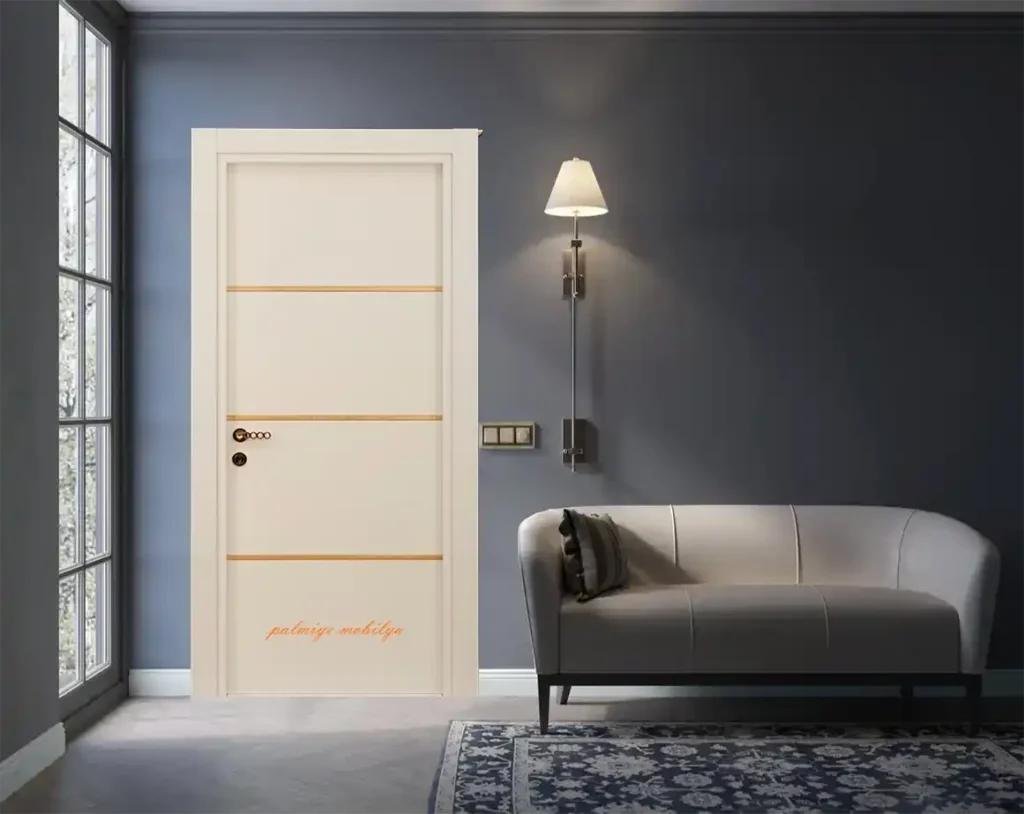
A major factor driving the specification of the Lacquered Room Door Turkey across international hospitality, commercial, and luxury residential projects is its vast aesthetic versatility. Lacquer finishes eliminate unsightly wood grain variations and joint lines, providing a clean canvas for diverse design philosophies.
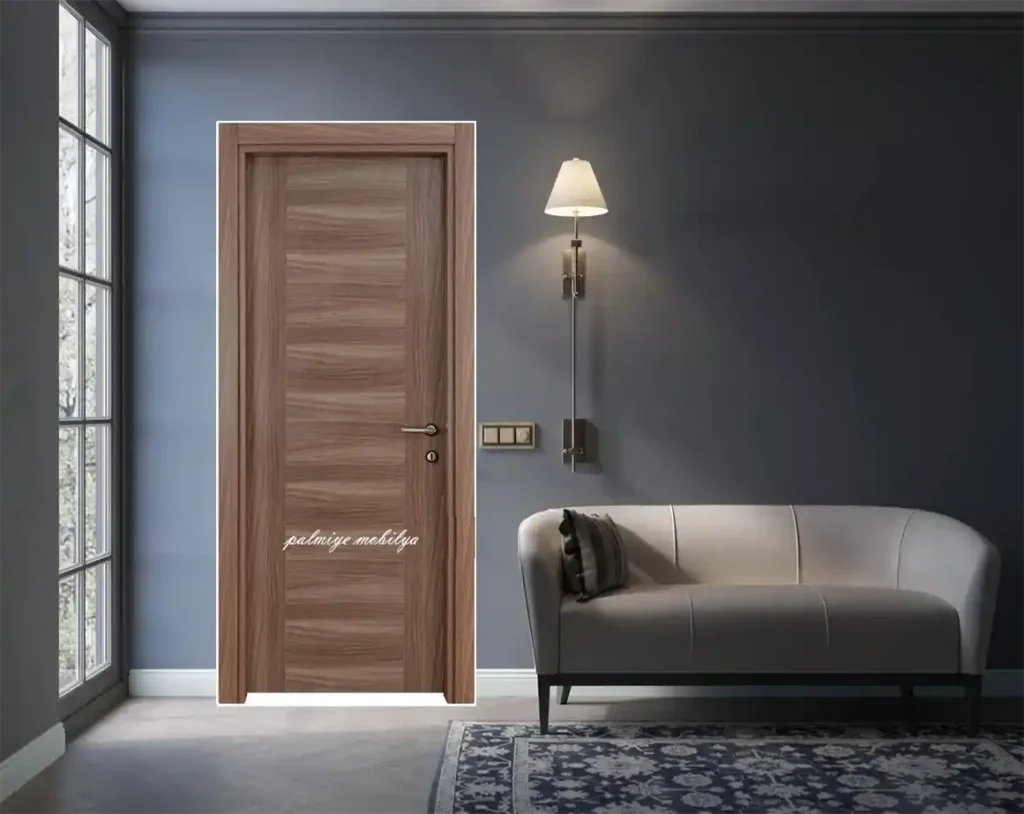
Contemporary and Minimalist Manifestations
In modern architectural design, the door is conceived as an integrated structural plane rather than a separate operational element.
- Flush-to-Wall (Invisiframe) Systems: Turkish manufacturers excel in engineering lacquered doors that sit perfectly flush with the drywall surface. These systems utilize concealed structural aluminum frames embedded directly within the wall construction. The Lacquered Room Door Turkey is manufactured with absolute dimensional straightness, allowing for a consistent, minimal \(3\text{ mm}\) shadow gap around the entire perimeter of the door leaf.
- Monochromatic Matte Palettes: Modern minimalist interiors rely heavily on super-matte lacquer finishes (\(under 10\text{ GU}\)) in custom architectural shades, including muted charcoal, warm taupe, industrial slate gray, and ultra-pure architectural white.
- Geometric Grooving (CNC Line Art): Minimalist designs frequently incorporate subtle, V-shaped or U-shaped routed lines (\(2\text{ mm}\) to \(5\text{ mm}\) wide and \(1.5\text{ mm}\) deep) that create striking linear patterns across the door surface without breaking its sleek, contemporary profile.
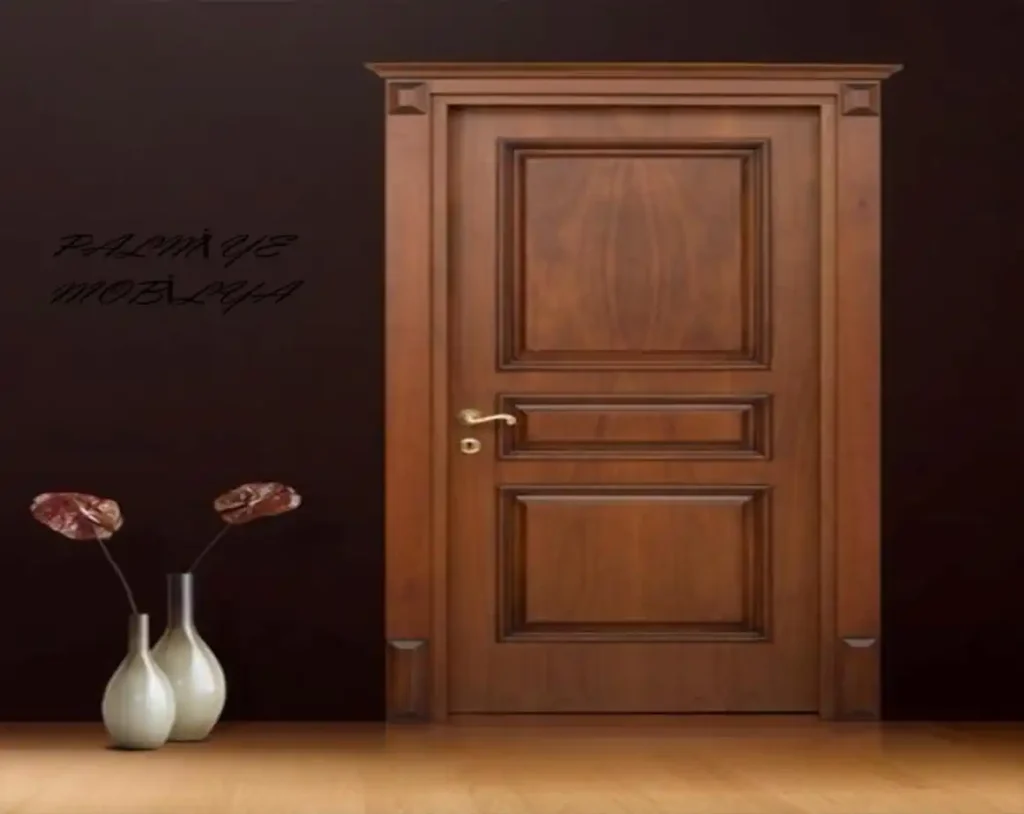
Neoclassical and Timeless Elegance
For luxury residences, grand hotels, and upscale diplomatic estates, classic and neoclassical panel layouts remain highly sought after.
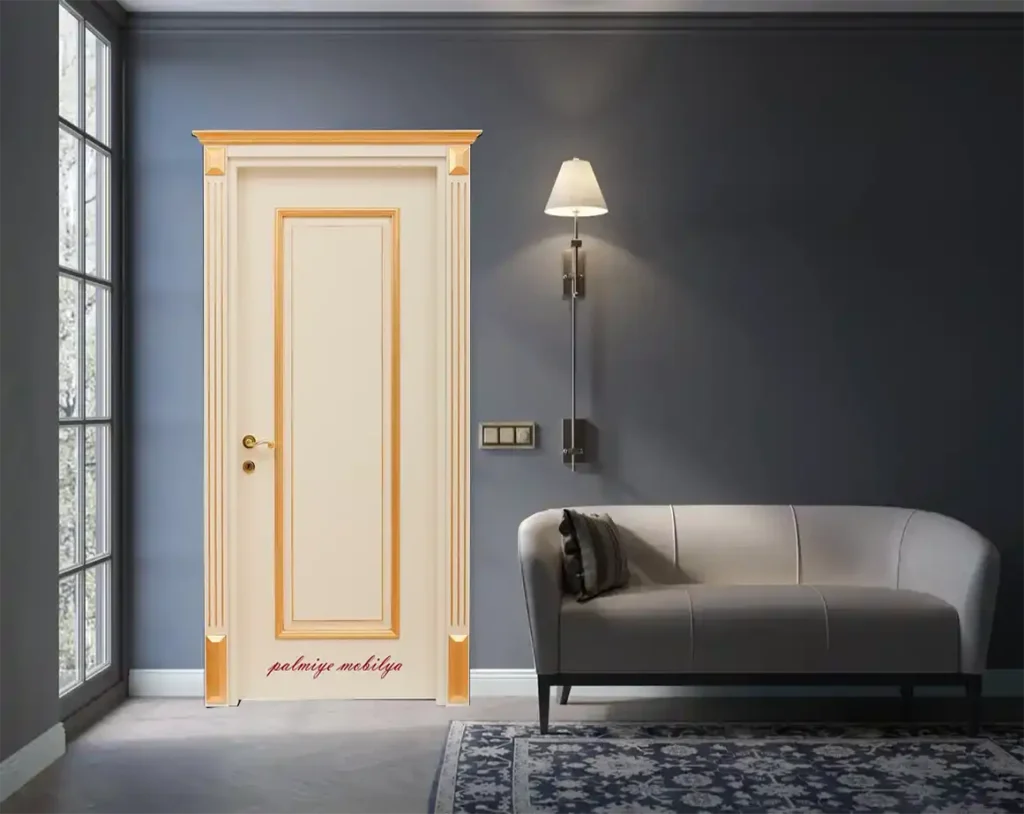
- Deep-Step Routing Profiles: Utilizing heavy \(12\text{ mm}\) HDF skins allows Turkish manufacturers to carve deep, multi-tiered step profiles into the door surface. These profiles mimic the traditional stile-and-rail joinery of solid timber doors while maintaining the superior dimensional stability of engineered composites.
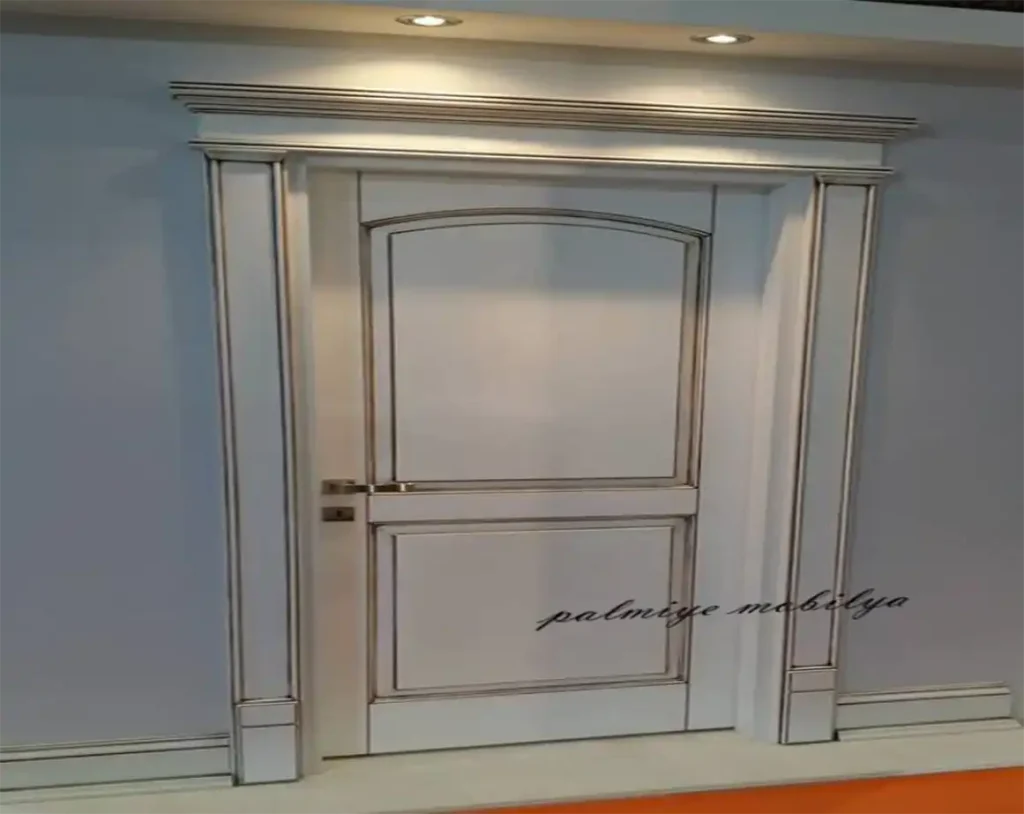
- Boisserie and Raised Molding Integration: Advanced manufacturing lines can bond solid, CNC-profiled decorative moldings directly onto the HDF face prior to the lacquering process. The entire assembly is then seamlessly coated, creating a continuous, monolithic surface free of joint separations or hairline paint cracks where the molding meets the door face.
- Gold and Silver Leaf Patina Accents: For opulent traditional designs, artisan craftsmen apply gold, silver, or bronze leaf details by hand into the routed panel recesses. A protective, clear protective topcoat is then applied over the leafing to prevent oxidation and peeling.
Integrated Architectural Elements
To create a unified interior design language, Turkish manufacturers produce coordinated trim systems alongside the primary door leaf:
- Over-Sized Custom Dimensions: Modern production facilities easily accommodate custom oversized openings, manufacturing door leaves up to \(3000\text{ mm}\) in height. These grand doors incorporate internal steel tension bars to allow fine calibration of the door’s flatness post-installation.
- Matching Transom and Wall Paneling: Doors can be built with matching top transoms or integrated directly into expansive lacquered wall paneling complexes (Boisserie systems), turning entire wall expanses into a seamless, continuous architectural statement.
5. Technical Performance Metrics and Testing Standards
For professional procurement and architectural specification, aesthetic appeal must be validated by quantifiable mechanical and environmental performance data. A high-grade Lacquered Room Door Turkey is manufactured and certified in compliance with European Norms (EN) and International Organization for Standardization (ISO) protocols.
Mechanical Endurance and Impact Resistance
Interior doors must withstand hundreds of thousands of operational cycles without functional failure or aesthetic degradation.
- Cycle Testing (EN 1191 / EN 12400): Premium Turkish doors are engineered to achieve Class 4 or Class 5 compliance under the EN 12400 standard. This performance tier certifies that the door assembly (leaf, frame, and hardware integration) can successfully complete over \(100,000\) to \(200,000\) continuous open-and-close cycles without suffering structural deformation, hinge sagging, or latch misalignment.
- Soft and Hard Body Impact Resistance (EN 949 / EN 950): The high density of the underlying HDF skin (\(>850\text{ kg/m}^3\)) provides superior resistance to localized impacts. Testing involves impacting the door face with a steel ball and a soft sagging load to measure surface indentation. Premium lacquered finishes resist cracking or chipping under these mechanical stresses due to the high elasticity of their polyurethane cross-linked resin matrices.
Environmental Resilience and Moisture Defense
Interior doors are routinely exposed to microclimatic variations, especially when dividing conditioned living spaces from high-humidity areas like bathrooms or unconditioned corridors.
- Climatic Testing (EN 1121): This protocol tests the door leaf’s structural stability by exposing its opposite faces to different climate conditions simultaneously (e.g., \(23^{\circ }\text{C}\) / 30% Relative Humidity on one side, and \(13^{\circ }\text{C}\) / 85% Relative Humidity on the other). A certified Lacquered Room Door Turkey maintains its flatness within Class 3 tolerances, meaning any lateral bowing or twisting is restricted to less than \(2.0\text{ mm}\) across the entire length of the door leaf.
- Adhesion Strength Testing (ISO 2409): To ensure the lacquer layers will never delaminate from the substrate, manufacturers perform a cross-cut adhesion test. A grid of incisions is cut into the finished lacquer film, and a standardized adhesive tape is applied and removed. Premium Turkish doors routinely score a Class 0 classification, indicating that the edges of the cuts remain completely smooth with no detachment of the lacquer flakes.
Acoustic Attenuation Performance
Acoustic comfort is a vital component of luxury residential and commercial design. The combination of core density and advanced perimeter sealing allows Turkish lacquered doors to serve as effective sound barriers.
[Acoustic Performance Breakdown]
- Standard Honeycomb Core:  18 dB to 22 dB (Basic Residential)
- Tubular Chipboard Core:   28 dB to 34 dB (Premium Residential / Office)
- Solid Acoustic Core:      35 dB to 42 dB (Hotel / Conference Rooms)
To maximize these acoustic ratings in field installations, doors are outfitted with continuous, multi-finned thermoplastic elastomer (TPE) or silicone drop-down acoustic seals integrated into the bottom rail of the door leaf. These seals deploy automatically when the door closes, sealing the gap between the leaf and the floor finish without scratching the floor surface.
6. Sustainable Production and Environmental Compliance
The modern global construction market places a major emphasis on environmental sustainability and indoor air quality. Leading manufacturers of the Lacquered Room Door Turkey have invested heavily in green production technologies to meet strict international environmental regulations.
Low-VOC Coating Technologies
Historically, liquid lacquered coatings were associated with high volatile organic compound (VOC) emissions, which present environmental concerns and can degrade indoor air quality.
- Water-Based Lacquer Formulation: Turkish manufacturers are leading the transition toward advanced water-borne polyurethane and acrylic lacquer systems. These coatings replace volatile petroleum solvents with water as the primary carrier medium.
- Indoor Air Quality Certification: Premium doors comply with European standard EN 71-3 (safety of toys, indicating zero toxic heavy metal migration) and have achieved French VOC A+ or Eurofins Indoor Air Comfort Gold certifications. This guarantees that the installed doors emit negligible amounts of formaldehyde or volatile chemicals, making them fully suitable for green building initiatives like LEED, BREEAM, and WELL certification projects.
Sustainable Timber Sourcing
The wood fibers and solid timber cores utilized in Turkish factories are subject to strict chain-of-custody tracking.
- FSC and PEFC Certification: Sustainable manufacturers source their raw timber and wood composites exclusively from suppliers certified by the Forest Stewardship Council (FSC) or the Programme for the Endorsement of Forest Certification (PEFC). This certification ensures that the timber is harvested from responsibly managed forests that preserve biodiversity, protect indigenous ecosystems, and ensure long-term forest regeneration.
7. Procurement, Installation Logistics, and Site Management
Successfully incorporating a Lacquered Room Door Turkey into an international construction project requires clear communication, detailed shop drawing approvals, and strict adherence to correct onsite installation protocols.
The Engineering Shop Drawing Process
Prior to production, manufacturers work closely with the project’s architectural team to generate detailed, multi-layered shop drawings. These technical submittals specify:
- Clear Wall Openings (Rough Openings): The precise width, height, and structural plumb tolerances of the wall openings.
- Finished Wall Thickness (Jamb Depth): Since Turkish architraves feature telescopic adjustment capabilities (typically adjusting \(\pm15\text{ mm}\) to accommodate minor wall thickness variances), the base jamb width must be calculated to match the finished wall profile (including plaster, paint, or tiling).
- Handing and Swing Configuration: Specifying European standard handing directions (DIN Left / DIN Right) to ensure correct lockset and hinge prep machining.
Site Readiness and Environmental Conditions
Lacquered doors are high-grade finish elements; they must never be brought to a construction site during rough-in or wet-work phases.
- Moisture Stabilization: The building envelope must be fully enclosed with all windows and exterior doors installed. All wet trades—including structural concrete pouring, floor self-leveling, plastering, and primary tiling works—must be 100% complete and fully dried out.
- Relative Humidity Windows: The indoor relative humidity must be stabilized between 40% and 60%, and the ambient temperature maintained between \(15^{\circ }\text{C}\) and \(25^{\circ }\text{C}\). Introducing premium lacquered doors into a building with high residual construction moisture can cause the engineered frames to absorb moisture from the air, causing swelling and compromising the lacquer finish.
Installation Best Practices
- Pre-Fit Verification: Before applying polyurethane expanding foam or mechanical anchor fixings, the structural frame must be placed in the opening and checked for plumb, level, and squareness across three spatial axes using precision digital laser levels. The maximum allowable diagonal deviation across the frame assembly is \(\pm1.0\text{ mm}\).
- Low-Expansion Polyurethane Foam: Fixers utilize professional-grade, low-expansion polyurethane foam applied at designated structural anchoring points behind the jamb. High-expansion DIY foams exert excessive lateral pressure as they cure, which can bow the jamb inward and disrupt the operational clearances of the door leaf.
- Hardware Commissioning: High-end projects utilize 3D adjustable concealed hinges (such as Simonswerk Tectus or Otlav systems) countersunk into the door leaf and frame. These hinges allow installers to fine-tune the door leaf’s position across three dimensions (height, lateral clearance, and compression sealing pressure) using simple hex key adjustments, ensuring a flawless \(3\text{ mm}\) uniform reveal around the door.
8. Preventative Maintenance and Long-Term Surface Preservation
While a premium Lacquered Room Door Turkey features a highly durable chemical topcoat, protecting its aesthetic value over a multi-decade operational lifespan requires adherence to specific preservation guidelines.
Routine Cleaning Protocols
- Dust Accumulation: Dust should be removed using an ultra-soft micro-fiber cloth. Avoid dry wiping with coarse cloths, as trapped micro-dust particles can act as an abrasive, creating fine swirl marks or micro-scratches on both high-gloss and deep-matte finishes over time.
- Soiled Surfaces: For minor fingerprints or localized smudges, dampen a microfiber cloth with water and a highly diluted, pH-neutral, non-abrasive liquid detergent. Wipe the door face gently, then dry the surface immediately with a separate dry microfiber towel.
Chemical Contamination and Damage Control
- Strict Chemical Exclusions: Never use cleaning products containing ammonia, acetone, high-strength alcohols, chlorinated solvents, or scouring powders. These aggressive chemicals will chemically break down the polyurethane acrylic cross-linked topcoat, causing high-gloss finishes to become dull and cloudy, or turning matte finishes sticky and prone to staining.
- Micro-Scratch Remediation: In the event of minor superficial surface scuffs on a high-gloss lacquered door, the finish can be restored using specialized silicone-free automotive fine-finishing compounds. The compound is applied sparingly with a variable-speed rotary polisher equipped with a soft foam pad, which carefully restores the optical flatness and gloss depth of the polyester topcoat. Deep scratches that penetrate through the primer layers to the HDF substrate require spot-repair filling and re-spraying by an experienced professional joinery technician.
Conclusion: The Strategic Value Proposition
Specifying a Lacquered Room Door Turkey for a contemporary architectural project represents a strategic investment that balances capital expenditure with long-term asset value. By combining automated European processing lines, sustainable wood fiber matrices, and advanced non-yellowing chemical topcoats, Turkish manufacturers deliver interior doors that meet the highest international standards for mechanical endurance, acoustic performance, and environmental compliance.
For architects, interior designers, and global procurement professionals, partnering with certified Turkish door manufacturers ensures access to highly customizable design options capable of fulfilling the most demanding architectural intents. Whether integrated into a sleek minimalist high-rise via flush-to-wall frame structures or dressing an international luxury hotel with detailed neoclassical panel work, the engineered Lacquered Room Door Turkey provides a high-utility, reliable, and premium solution for modern interior spaces.

Şunları da sevebilirsiniz
Distressed Furniture Turkey

Lacquered Furniture Turkey