

Mass Production Solid Doors
Mass Production Solid Doors: The Definitive Industrial Guide to Sourcing, Advanced Engineering, and Supply Chain Scalability
The global construction, real estate development, and commercial architecture sectors are undergoing an unprecedented restructuring. As developers, municipal contract specifiers, and wholesale distributors face the compounding pressures of volatile material costs, strict building code compliance, and compressed project schedules, the search for a reliable production model has become an essential strategy. The answer increasingly points to Mass Production Solid Doors.
Historically, the premium structural door market was divided into two distinct sectors: low-cost, low-durability hollow-core doors produced at an industrial scale, or high-performance, aesthetically premium solid doors restricted to small-scale artisanal wood shops. Today, advanced Industry 4.0 automation, automated high-pressure hydraulic pressing lines, and multi-axis computer numerical control (CNC) timber calibration setups have bridged this gap. Mass Production Solid Doors now represent a sophisticated manufacturing workflow that delivers exceptional physical mass, acoustic insulation, and fire-containment properties across tens of thousands of continuous units per month, completely redefining the cost-to-performance equation for large-scale construction.
This comprehensive industrial guide provides an exhaustive review of material science, sub-surface leaf engineering, chemical finishing lines, mechanical hardware automation, testing certifications, and international supply-chain logistics that define Mass Production Solid Doors. It is engineered to give international procurement directors, commercial architects, and project managers the deep empirical data required to accurately write millwork specifications, evaluate factory technical capabilities, and optimize large-scale procurement portfolios.
1. Macro-Economic Dynamics and Scale Economics of Mass Production Solid Doors
To evaluate the true return on investment (ROI) of a Mass Production Solid Doors program, an international procurement officer must analyze the industrial framework and automated cluster economics that allow modern high-capacity factories to drive down per-unit manufacturing costs while maintaining strict dimensional tolerances.
The Power of Automated Industrial Clusters
The cost efficiency of Mass Production Solid Doors is driven by specialized industrial clustering rather than a reduction in raw material weights or construction quality. Leading factories are situated within highly capitalized Organized Industrial Zones (OSB) where shared material access lowers raw overhead:
- Direct Supply Integration: High-capacity door manufacturing plants are located next to major domestic wood-composite board lines, structural lumber processing hubs, and synthetic chemical resin refineries. This geographic grouping minimizes raw material transport delays, cuts out regional freight premiums, and secures volume-based bulk discounts.
- Retooling Downtime Minimization: Traditional workshops lose valuable operating hours adjusting machinery lines for varying architectural specs. A modern factory optimized for Mass Production Solid Doors integrates smart data pipelines. By executing uniform, high-volume production batches (ranging from 10,000 to over 50,000 complete door sets per project run), machines adjust dynamically, keeping line throughput high and reducing manual labor costs per unit to near-zero.
Strategic Logistics and Trade Efficiency
Sourcing high-volume structural doors requires smooth cross-border shipping protocols and highly responsive transit networks:
- Intermodal Connectivity and Lead Times: High-capacity production centers positioned near deep-water maritime ports and international trucking corridors allow shipping containers to reach distribution hubs within highly compressed delivery windows. Compared to fragmented, non-automated manufacturers that face extended lead times, an enterprise facility running a dedicated Mass Production Solid Doors framework can move orders from CAD blueprint approval to on-site port loading in 4 to 6 weeks. This accelerated delivery schedule significantly lowers holding costs and prevents field installation delays on fast-track commercial infrastructure developments.
2. Advanced Material Science: The Sub-Surface Core Architecture
A common structural misconception among novice specifiers is that a premium solid door is sliced as a single monolithic timber slab from a giant log. In reality, a monolithic wood panel is inherently hygroscopic; it absorbs and desorbs ambient moisture from the surrounding air, which can cause internal dimensional movement, warping, bowing, or structural cracking over time. Therefore, the core of high-performance Mass Production Solid Doors is engineered as a balanced, multi-layered composite matrix designed to ensure absolute flat-plane stability across variable thermal zones.
[Bespoke Mass Production Solid Leaf Structural Matrix]
┌────────────────────────────────────────────────────────┐
│ Polyurethane / Acrylic Topcoats (UV-Cross-Linked Film) │
├────────────────────────────────────────────────────────┤
│ Protective Isolation Filler / Pores Sealer Layers      │
├────────────────────────────────────────────────────────┤
│ Calibrated High-Density Fiberboard Skin Shield (HDF)   │
├────────────────────────────────────────────────────────┤
│ Internal Core Vector: Extruded Tubular vs. Mineral Matrix│
├────────────────────────────────────────────────────────┤
│ Sub-Frame Perimeter: 3-Layer Alternating Glulam Timber │
└────────────────────────────────────────────────────────┘
Substrate Sizing: Calibrated High-Density Fiberboard (HDF)
The exterior face of a solid door leaf dictates its visual flatness and mechanical puncture resistance. If the underlying board face is too porous or uneven, liquid finishes or veneers will sink irregularly into the wood fibers, resulting in surface imperfections, fine structural cracks, or an unacceptable wavy finish.
- Density Profile Calibration: Top-tier factories select premium High-Density Fiberboard (HDF) over standard retail MDF for their primary manufacturing lines. This dense substrate features a density profile exceeding 820 kg/m³, providing exceptional surface impact resistance and exceptionally clean edges when routed by high-speed CNC machinery.
- Hydrophobic Moisture-Resistant (MR) Resins: For installations specified in damp zones like luxury hotels, commercial restrooms, or coastal properties, the Mass Production Solid Doors workflow integrates MR-HDF. These panels utilize advanced melamine-urea-formaldehyde or polymeric MDI hydrophobic resins, limiting thickness swelling to less than 4% when exposed to humid environments or repeated floor mopping.
Internal Frame Construction: Cross-Laminated Glulam Timber
To prevent door stiles and rails from bowing due to differences in air pressure and temperature between corridors and room interiors, the internal perimeter chassis of the door leaf is built using engineered timber:
- Automated Defect Removal Scanners: Structural softwoods (such as Siberian Pine, European Spruce, or native Fir) are kiln-dried to an exact moisture content of 8% to 10% inside fully automated, sensor-driven kiln rooms. Automated optical scanners read the dried timber planks, instantly detecting and cutting out natural defects like loose knots, structural fissures, or pitch pockets.
- PUR Finger-Interlocking Precision: The remaining clear wood blocks are machined with precise interlocking finger profiles on their ends and joined using high-strength structural polyurethane (PUR) adhesives under multi-ton hydraulic pressure.
- Alternating Grain Orientation Lamination: The individual timber layers are laminated together with their grain directions alternating at 90-degree angles. This cross-grain configuration cancels out internal hygroscopic stresses, ensuring that the door frame remains flat over decades of operation.
Internal Core Configurations and Mass Physics
The internal filling of a door leaf dictates its mechanical durability, acoustic attenuation capacity, and fire containment properties. Procurement officers managing a Mass Production Solid Doors contract can specify three primary internal core categories based on project budgets and performance metrics:
+───────────────────────────────+───────────────────────────────+───────────────────────────────+

| Core Variant Typology         | Density & Structural Matrix   | Performance Target Metrics    |
+───────────────────────────────+───────────────────────────────+───────────────────────────────+

| Extruded Tubular Board Core   | 260 - 320 kg/m³ Core Profile  | Residential Baseline Standard |
| Solid Flaxboard Core Matrix   | 550 - 680 kg/m³ Solid Core    | High-Traffic Severe Duty      |
| Solid Mineral Composite Core  | Compressed Vermiculite Sheet  | Certified Fire Containment    |
+───────────────────────────────+───────────────────────────────+───────────────────────────────+
1. Extruded Tubular Particleboard (Sauerland Core)
- Composition: Extruded composite timber featuring continuous horizontal or vertical cylindrical voids running through its mass.
- Mechanical Properties: High impact resistance and built-in acoustic dampening. The tubular voids reduce weight while maintaining excellent flat-panel crush resistance, preventing hardware stress on hidden hinge setups. This core serves as the baseline structural filling for premium residential interior projects.
2. Solid Flaxboard and Particleboard Matrices
- Composition: A solid, continuous sheet of compressed flax fibers or high-density wood particleboards.
- Mechanical Properties: Provides high mechanical impact resistance, extreme torsional stiffness, and excellent structural mass. This setup is frequently specified for institutional common areas, school entrances, and high-traffic commercial zones.
3. Solid Mineral Fire Cores
- Composition: A dense, solid matrix of compressed vermiculite or volcanic mineral glass fibers bound with organic silicate resins.
- Mechanical Properties: Non-combustible, extremely dense, high structural weight, and exceptionally low thermal conductivity. This core is mandatory for certified fire door assemblies (FD30 to FD120) protecting exit corridors.
3. Industrial Face Options: High-Pressure Laminates, Veneers, and Lacquers
The versatility of a Mass Production Solid Doors line allows developers to select from a broad spectrum of architectural finishes applied on the same automated machinery base.
High-Pressure Laminate (HPL) Facings
For heavy-duty commercial projects, schools, and healthcare environments, high-pressure laminates offer an exceptionally durable surface:
- The High-Pressure Fusing Process: Multiple layers of kraft paper impregnated with phenolic resins are combined with a decorative paper sheet and a translucent melamine protective overlay. These elements are fused inside multi-daylight hydraulic presses operating at temperatures exceeding 140°C and pressures greater than 9 MPa.
- The Non-Porous Structural Shield: This chemical reaction cures the resins into an inseparable, non-porous solid composite sheet ranging from 0.8mm to 2.0mm in thickness. The resulting surface possesses high structural density, rendering it completely impervious to moisture, water ingress, scratches, and graffiti.
Automated Wood Veneer Processing
When project aesthetics require the multi-tonal depth of natural timber, the Mass Production Solid Doors workflow deploys automated veneer splicing and pressing technology:
- Precision Guillotine Trimming: Natural log sheets (such as Walnut, Oak, or Mahogany) are sliced and cut cleanly on electronic guillotines.
- Invisible Hot-Melt Splicing Lines: Individual veneer leaves pass through automated longitudinal splicing lines where they are joined edge-to-edge using invisible fiberglass threads or thin polyurethane hot-melt lines. The large combined veneer sheet is then fused to the HDF face skins in automated daylight hot presses using low-emission urea-formaldehyde resins, creating a seamless, natural wood face.
Robotic Coating and Curing Tunnels
For premium painted interior doors, achieving a smooth lacquer coat over thousands of successive units requires advanced chemical coatings applied inside controlled cleanrooms:
- Opaque Formulation Control: Factories mix high-grade aliphatic acrylic and polyurethane composite paints. These formulations provide exceptional surface hardness (3H to 5H on the pencil scale) to resist scratches, while maintaining enough flexibility to prevent cracking along panel corner borders.
- Reciprocating Spray Robots: The door leaves move on continuous conveyors into an enclosed, positive-pressure cleanroom cabin supplied with HEPA-filtered air. Dual-arm reciprocating spray robots track the door geometry via optical light curtains, adjusting fluid delivery to coat flat faces, CNC grooves, and outer edges with absolute uniformity.
- High-Speed UV Cross-Linking Radiators: The doors enter the UV curing chamber, passing under high-intensity mercury and gallium lamps. The UV radiation activates photo-initiators in the coating matrix, instantly cross-linking the polymers into a hard coat within seconds, allowing the door to be packed immediately.
4. Gloss Architecture and Custom Color Matching
A significant commercial benefit of sourcing a Mass Production Solid Doors contract is the ability to integrate custom color matching with precision gloss level management across vast production runs.
[Gloss Unit (GU) Level Calibration at 60° Angle]
 0 - 5 GU    --> Dead Matte / Super Matte (Anti-Fingerprint Nano-Film)
 10 - 25 GU  --> Satin / Eggshell (Classic Sourcing Baseline Standard)
 30 - 50 GU  --> Semi-Gloss Velvet (High-Traffic Institutional Standard)
 85+ GU      --> Piano High Gloss (Artisanal Mirror Buffer Polish)
Matte and Super-Matte Finishes
- Design Trend: Contemporary European and American architecture heavily favors low-gloss, velvety matte profiles.
- Technical Engineering: Achieving a high-quality matte finish requires adding specialized silica-based matting agents to the topcoat formulation. Sourcing from an enterprise optimized for Mass Production Solid Doors ensures that these agents scatter light rays evenly across the surface. This technique completely masks minor wall misalignments and small structural imperfections on-site, providing a sleek, anti-reflective appearance that resists fingerprint oils and smudges.
Color Customization Systems
Industrial factories connect computerized paint-kitchen mixing modules directly to their automated finishing lines. This configuration allows for rapid color shifts and exact matching across major international color frameworks:
- The RAL Classic Framework: The standard color index for European manufacturing (e.g., RAL 9003 Signal White, RAL 7016 Anthracite Grey).
- The NCS (Natural Colour System): Frequently specified by global interior designers for precise color harmony based on human color perception (e.g., NCS S 4005-Y50R).
- Digital Spectrophotometry Matching: Sourcing teams can provide a raw material sample (such as a tile or metallic trim). The factory’s lab scans it with a spectrophotometer to adjust the automated paint valves, delivering a custom colored batch with a color deviation factor (\(\Delta E\) value) below 0.5, rendering differences invisible to the human eye.
5. CNC Machining, Surface Routing Patterns, and Casing Joinery
Mass production does not mean a lack of design variety. Advanced Industry 4.0 software systems allow modern factories to run diverse design configurations consecutively on the same automated line, matching custom design schedules without requiring retooling downtime.
Multi-Axis CNC Surface Routing Patterns
By linking digital computer-aided design (CAD) programs directly to high-capacity industrial milling lines, an enterprise running Mass Production Solid Doors lines can apply a wide variety of architectural surface details:
- Minimalist V-Grooves: Sharp, narrow linear incisions (typically 2mm to 4mm wide and 1.5mm deep) that create clean geometric accents for modern spaces.
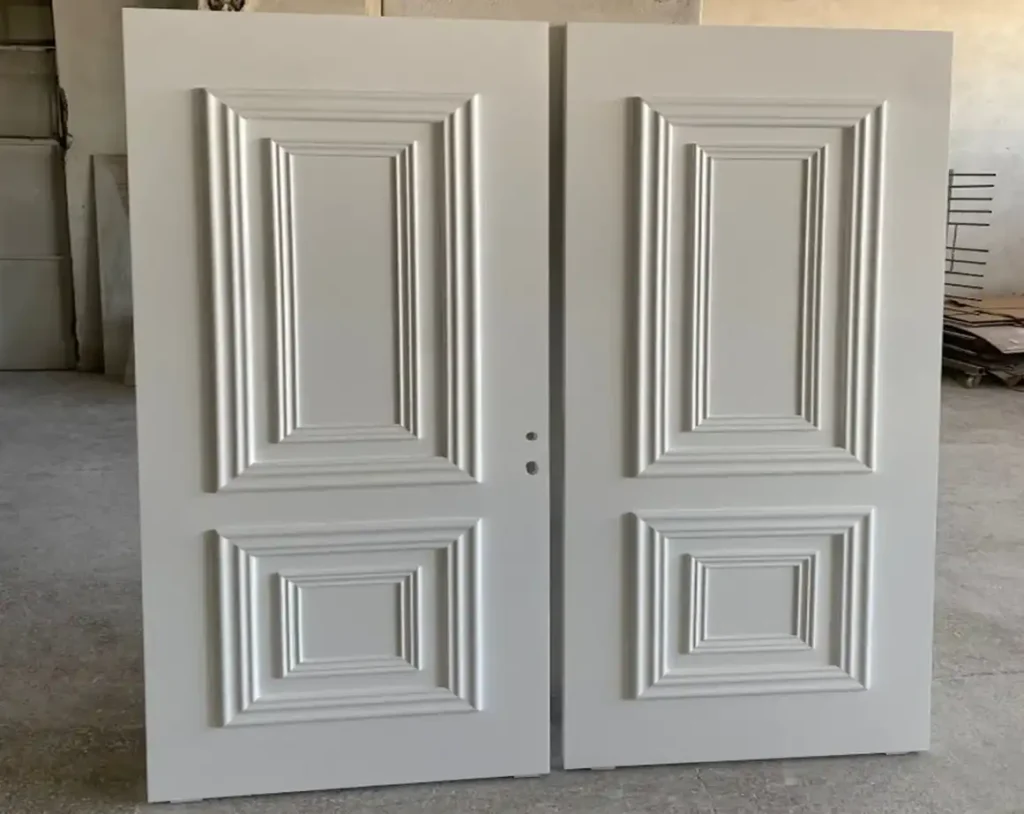
- Neo-Classical Panels: Deeper, wider profiles that simulate traditional stile-and-rail panel joints, providing a classic traditional look at a fraction of the cost of multi-piece manual assembly.
- Flush Metallic Inlays: Precision CNC routing lines cut narrow tracks into the HDF skin to insert decorative metal profiles—such as brushed brass, satin chrome, or dark anodized copper—completely flush with the lacquered surface for a sleek look.
Telescopic Adjustable Framing Systems
A high-performance door system relies on its surrounding frame and hidden mechanical components to operate smoothly. Mass production lines fabricate matching adjustable frame profiles concurrently with the door leaves:
[Adjustable Telescopic Frame Cross-Section]
┌────────────────────────────────────────────────────────┐
│  Architrave / Casing Profile (Adjustable Tongue)       │
├────────────────────────────────────────────────────────┤
│  Wall Structure (Variable Thickness: 100mm - 300mm)     │
├────────────────────────────────────────────────────────┤
│  Main Frame Body (MDF/Solid Wood Composite)             │
│  └── Integrated TPE Acoustic Gasket Groove             │
└────────────────────────────────────────────────────────┘
- MDF-Wood Core Composites: The main frame body is constructed by laminating finger-jointed softwoods with outer layers of dense MDF. This composite structure provides excellent structural stability and high screw-holding strength for heavy doors.
- Telescopic Adjustability: Sourcing within a structured Mass Production Solid Doors program provides access to telescopic adjustable casings. The architrave features an extended tongue that slides smoothly into a dedicated groove in the main frame body. This allows a single frame type to adapt to variable wall thicknesses on site (e.g., adjustable from 120mm up to 180mm), which hides structural wall imperfections and eliminates the need for expensive custom framing or on-site trimming.
- Waterproof Composite Bases: Frame bases are often fabricated from wood-plastic composites (WPC) or fully wrapped in hydrophobic polymers before lacquering. This protects the bottom of the frame from swelling or rotting due to floor washing.
6. Pre-Machined Hardware Layouts and Zero-Joint Precision
On-site cutting of hinge pockets and lock bores is labor-intensive and can lead to costly alignment errors. To prevent this, a progressive factory integrates hardware preparations directly into its automated production cycle.
Standardized Mortise CNC Prep
High-speed multi-axis CNC routers machine precision pockets based on standardized international hardware templates (such as European DIN or American ANSI frameworks):
- 3D Adjustable Hidden Hinges: Hidden hinge pockets are mortised flush into the door leaf and frame casing. These heavy-duty hinges allow for precise alignment adjustments across three independent axes (\(\pm 3mm\) Height, \(\pm 2mm\) Side, \(\pm 1mm\) Depth) using a simple hex wrench, helping installers maintain flawless 3mm gaps around the door border.
- Magnetic Silent Mortise Locks: Pockets are pre-cut to accept quiet magnetic locks. The latch bolt stays completely flush within the door leaf face while open, extending silently into the frame strike plate only when the door is fully closed.
- Biometric Access Control and Wire Chase Routing: For high-volume hotel or corporate office orders, automated drilling spindles pass through the entire internal width of the core matrix before final assembly. This routes hidden wire chases completely inside the door body, allowing electrical lines to travel cleanly to RFID card scanners or smart locksets without visible surface wiring.
Zero-Joint Edge-Banding Technology
Where the surface finish meets the vertical side edges of the door leaf, traditional glue lines can create a dark joint that can collect moisture and degrade over time. Advanced automated lines resolve this challenge through Laser or Hot-Air Fusion Technology:
- Functional Fusion Polymer: Instead of using traditional wet adhesives, the factory applies specialized edge-band tape fitted with a pre-applied polymer layer on its back.
- Invisible Hermetic Seal: A high-intensity laser or targeted hot-air jet vaporizes this backing layer instantly as the tape is pressed onto the door edge under high pressure. The melted backing fuses directly with the substrate fibers, creating a seamless joint that is completely invisible and hermetically sealed against water ingress, preventing edge delamination in damp environments.
7. Technical Performance Standards and Testing Certification Compliance
International building codes require strict verification of door performance metrics through formal empirical testing. Reputable factories specializing in Mass Production Solid Doors assemblies subject their entire integrated arrays to rigorous testing against European (EN) and American (UL) standards to provide verified documentation for public tenders and building inspectors.
[Performance Standard Compliance Array]
├── Mechanical Cycle Fatigue  --> EN 1191 / EN 12400 (Class 5 Severe Duty Quality)
├── Surface Abrasion & Heat   --> EN 12720 / EN 438-2 (High-Load Chemical Resistance)
├── Acoustic Sound Shield     --> EN ISO 10140-2 (Certified 32 dB to 44 dB Performance)
└── Fire Resistance Rating    --> EN 1634-1 / UL 10C (Certified 30 to 120 Minute Barriers)
Fire Resistance Testing Compliance (EN 1634-1 / UL 10C)
Certified solid doors must act as fire-retardant barriers to contain fire outbreaks within a single room zone, keeping building escape routes safe:
- Intumescent Perimeter Defense: Fire-rated assemblies incorporate graphite-based intumescent seals inside a routed channel around the leaf perimeter. When subjected to temperatures exceeding 150°C during standard testing, these compounds expand up to 25 times their original thickness, sealing all air gaps between the leaf and frame to prevent toxic fumes and fire from passing. Sourcing through a trusted Mass Production Solid Doors program provides access to fully certified FD30 (30 minutes), FD60 (60 minutes), or FD120 (120 minutes) containment options, verified by international testing bodies like BM TRADA or Intertek.
Mechanical Endurance Testing (EN 1191 / EN 12400)
Doors in busy commercial spaces like hotels or offices undergo thousands of operations annually.
- Rigid Testing Rig Proving: Complete assemblies are mounted in automated testing frames that mechanically open and close the door leaf 100,000 to 200,000 times under continuous structural loads.
- Severe Duty Classification: High-quality mass-produced doors achieve Class 4 or Class 5 (Severe Duty) mechanical performance ratings, confirming that the hinges remain aligned, the lock latch operates smoothly, and the door leaf shows no structural sag or joint cracking over extended lifecycles.
Acoustic Isolation Compliance (EN ISO 10140-2)
Acoustic insulation is a critical requirement for occupant privacy in multi-family housing, corporate offices, and hospitality developments.
- System Component Sync: To achieve high Weighted Sound Reduction Index (\(R_{w}\)) ratings, factories combine dense, solid particleboard or tubular cores with high-performance Thermoplastic Elastomer (TPE) or continuous dual-gasket EPDM perimeter seals inside the frame casing track.
- Automatic Mechanical Drop Seals: Automated CNC routing lines cut a deep recess into the bottom edge of the door leaf to house a mechanical drop seal. When the door closes, a plunger activates against the frame, lowering a neoprene acoustic profile to seal the gap with the floor. This setup allows mass-produced door systems to achieve certified acoustic reduction values from 32 dB up to 44 dB.
8. Sourcing Logistics, Procurement Optimization, and Incoterms Engineering
Sourcing custom solid doors at an industrial scale requires managing detailed structural specifications, packaging parameters, and global commercial trade terms effectively.
Developing a Technical Sourcing Door Schedule
To secure accurate factory quotes and prevent production errors, project procurement teams should create an architectural door schedule covering these essential parameters for their Mass Production Solid Doors orders:
- Structural Wall Metrics: Finished Wall Thickness, Clear Opening Height, Clear Opening Width.
- Core Matrix Selection: Extruded Tubular Core vs. Solid Particle Matrix vs. Mineral Fire Core.
- Face Skin Specification: High-Pressure Laminate (HPL) vs. Natural/Engineered Spliced Veneer vs. Robotic Lacquering.
- Color and Gloss Profiles: RAL or NCS Color Code, Target Gloss Index (Matte vs Semi-Gloss vs Piano Gloss).
- Framing and Hardware Code: Telescopic Adjustable Casing, Concealed 3D Hinge Routing, Magnetic Lock Prep, Core Wire Passages.
Financial Planning and Incoterms Management
When drawing up supply contracts for a Mass Production Solid Doors run, select the appropriate International Commercial Term (Incoterm) based on your team’s freight and logistics setup:
- FOB (Free On Board): The factory manages production, domestic transport to an export maritime port, and export customs clearance. Risk and freight costs transfer to the buyer once the container is loaded onto the ocean vessel. This is an excellent option for buyers with established global freight forwarding partnerships.
- CIF (Cost, Insurance, and Freight): The manufacturer arranges and pays for ocean shipping and maritime insurance to the buyer’s designated destination port. This model simplifies logistics for mid-sized import distributors.
- DDP (Delivered Duty Paid): The manufacturer manages the entire shipping process, including international ocean transit, import customs clearance, local tariffs, and final delivery to the construction site. This model provides maximum cost certainty for large-scale real estate developers without internal logistics teams.
Packaging Engineering for Deep Ocean Freight
Finished surface faces are highly sensitive to humidity shifts, friction marking, and impact forces during long ocean transit windows. Industrial facilities utilize multi-layer automated packaging lines:
┌────────────────────────────────────────────────────────┐
│  Heavy-Gauge Double-Wall Corrugated Outer Carton Box   │
├────────────────────────────────────────────────────────┤
│  High-Density EPS (Styrofoam) Edge & Corner Protectors  │
├────────────────────────────────────────────────────────┤
│  Polyethylene Protective Stretch-Film Moisture Barrier  │
├────────────────────────────────────────────────────────┤
│  Peelable Low-Tack Protective Surface Masking Film     │
└────────────────────────────────────────────────────────┘
- Volumetric Pallet Optimization: Door leaves are packed flat on heavy wooden pallets, while un-assembled frame components and architrave casings are packed in long boxes and stacked along the container sides. This loading configuration allows a standard 40-foot High Cube (40′ HC) shipping container to hold approximately 350 to 450 complete door sets, lowering per-unit transit costs.
9. Sustainability and Green Building Regulatory Compliance
Modern commercial and high-density residential developments operate under strict ecological performance metrics, often targeting premium certifications like LEED (Leadership in Energy and Environmental Design) or BREEAM (Building Research Establishment Environmental Assessment Method). Sourcing through the Mass Production Solid Doors industrial sector provides verified pathways to secure these green building credits.
Certified Sustainable Wood Sourcing (FSC and PEFC)
Leading automated factories operate under strict FSC (Forest Stewardship Council) and PEFC (Programme for the Endorsement of Forest Certification) Chain of Custody tracking systems. This certification guarantees that all wood-composite core sheets, fiberboards, and solid timber frames are harvested from responsibly managed forests that preserve regional biodiversity, avoid illegal logging, and support local forestry communities.
Low-VOC Formulations and Indoor Air Quality
Because residents spend hours inside closed living or corporate environments, minimizing volatile organic compounds (VOCs) and chemical emissions is a critical health requirement.
- E1 and E0 Environment Standards: Core resins, fiberboards, and surface bonding adhesives meet strict European E1 or E0 emission standards. This classification guarantees ultra-low formaldehyde off-gassing, protecting occupants’ respiratory health and contributing toward valuable green building credits under the Indoor Environmental Quality (IEQ) sections of LEED and BREEAM.
10. Comprehensive Project Timeline and Milestone Management
To align industrial manufacturing schedules with active site installation deadlines, a global procurement team should operate on a structured milestone matrix. Below is the typical 12-week operational workflow for a large-scale project order (e.g., 2,500 complete door sets) within an optimized factory setup:
[Mass Production Solid Doors Operational Timeline]
├── Phase 1 (Weeks 1 - 2): CAD Technical Drawing Reviews & Hardware Template Freeze
├── Phase 2 (Week 3)     : Physical Prototype Fabrication & Laboratory Test Sign-Off
├── Phase 3 (Weeks 4 - 7): High-Speed Core Pressing & Multi-Axis CNC Profile Milling
├── Phase 4 (Week 8)     : Face Skin Lamination, Robotic Spraying & Quality Inspections
└── Phase 5 (Weeks 9 -12): Pallet Carton Wrapping, Container Customs, Ocean Transit, & Site Delivery
- Weeks 1 to 2 (Blueprints & Technical Freeze): Sourcing teams submit complete CAD drawings and door schedules. The factory’s engineering department verifies clear wall openings, latch offsets, and hinge depths, freezing all machining parameters before cutting core substrates.
- Week 3 (Prototype & Testing Validation): The factory fabricates a complete sample door assembly. Quality assurance inspectors confirm color matching, edge-banding seamlessness, and hardware functionality under direct load, signing off for full line release.
- Weeks 4 to 7 (Core Fabrication & CNC Milling): Finger-jointed timber sub-frames are assembled around the selected core matrix (tubular or solid particleboards). High-speed automated sizing machines trim the blanks, and multi-axis CNC lines cut hidden hinge pockets, lock case recesses, and internal wire chases.
- Week 8 (Finishing & Inline Quality Inspections): Blanks pass through automated hot presses for HPL or wood veneer bonding, or are routed into robotic cleanroom spray cabins for lacquer application and fast UV drying. Integrated digital glossmeters and flatness scanners check every face, routing components onto packing lines.
- Weeks 9 to 12 (Pallet Wrapping & Freight Transit): Assemblies are flat-packed in corrugated box segments, loaded onto ISPM-15 certified wooden pallets, cleared through customs, and dispatched via intermodal freight shipping corridors directly to the building project site.
Conclusion: Securing Supply Chain Success via Automated Industrial Precision
Sourcing through an enterprise cluster optimized for Mass Production Solid Doors provides international real estate developers, hospitality groups, and public works contractors with an effective way to balance budget limits with reliable performance. By moving away from labor-intensive manual methods and utilizing high-speed robotic spray booths, Industry 4.0 CNC machining centers, and zero-joint edge-banding technology, modern manufacturing bases deliver high-performance interior and exterior doors tailored to the strict schedules and high quality demands of global construction projects. Understanding these material choices, performance criteria, and logistical options helps global procurement teams secure their supply chains and deliver durable, aesthetically premium interior spaces on schedule and on budget.
Butik Otel Mobilyaları
Butik Otel Mobilyaları

Butik Otel Mobilyaları




Şunları da sevebilirsiniz

Mass Production Wood Doors
School Doors Turkey