

Rustic Solid Wood Doors Turkey
The physical durability, botanical selection, and mechanical stabilization of heritage-grade timber elements represent a highly specialized intersection of material science and traditional joinery. Within the international architectural landscape—spanning high-end alpine chalets, Mediterranean estates, custom hospitality resorts, and biophilic residential developments—the demand for a premium Rustic Solid Wood Doors Turkey has expanded into a major manufacturing vertical. Turkey’s unique position as a premier global hub for high-end woodwork is driven by its access to diverse forest ecosystems (including Anatolian oaks, ancient chestnuts, and sub-alpine softwoods) combined with heavy capitalization in multi-axis European CNC machinery and thermal kilns.
This technical manual provides an exhaustive engineering guide into the material physics, wood seasoning, structural core layout, surface texturing chemistry, life-safety performance, and installation logistics that define a premium Rustic Solid Wood Doors Turkey. It serves as an authoritative specification reference for project architects, structural engineers, commercial procurement managers, and master joiners.
1. Botanical Material Selections and Material Physics
The manufacturing of a high-performance Rustic Solid Wood Doors Turkey presents unique structural challenges compared to standard flush or clean-grade contemporary doors. In rustic design, natural timber variations such as sound knots, unique grain figurations, bark pockets, and color variations are embraced as core aesthetic features rather than being discarded. However, because wood is inherently an anisotropic, highly hygroscopic cellular material, these natural features can introduce localized physical stresses that must be managed through engineering.
[anisotropic axis vector mechanics]
       Tangential Axis: Highest Dimensional Movement (Shrinkage/Swell)
       Radial Axis: Intermediate Stability Vector
       Longitudinal Axis: Negligible Elongation Profile
Because wood moves at different rates across its tangential, radial, and longitudinal axes, any variation in grain direction can cause localized twisting or splitting if the timber is not selected and treated properly.
Premium Hardwood Species Specifications
Anatolian and European Oak (Quercus robur / Quercus cerris)
- Mechanical Profile: Features a seasoned oven-dry density range between \(720\text{ kg/m}^3\) and \(810\text{ kg/m}^3\) and an average Janka side hardness rating of approximately \(4,980\text{ N}\).
- Structural Attributes: Oak delivers exceptional bending and compressive strength. Its prominent medullary ray tissue produces a visually striking grain pattern when quarter-sawn.
- Chemical Profile: The heartwood contains high concentrations of natural tannic acid. This chemistry provides an organic, permanent shield against wood-rotting fungi and subterranean insects, making it an exceptional choice for prominent exterior entryways and heavy-use public spaces.
Sweet Chestnut (Castanea sativa)
- Mechanical Profile: Exhibits a lower average oven-dry density of \(580\text{ kg/m}^3\) to \(640\text{ kg/m}^3\) but possesses high natural stability.
- Structural Attributes: Chestnut features exceptionally low tangential and radial shrinkage coefficients, meaning it undergoes minimal dimensional movement when exposed to fluctuating microclimates.
- Chemical Resilience: Like oak, its fiber matrix is naturally saturated with tannins, giving it excellent weatherability for rustic exterior doors exposed to harsh maritime or variable mountain environments.
Old-Growth European Walnut (Juglans regia)
- Mechanical Profile: Features an ultra-stable, medium-dense composition averaging \(640\text{ kg/m}^3\) to \(710\text{ kg/m}^3\).
- Structural Attributes: Highly valued for its deep color and intricate grain patterns, walnut undergoes minimal volumetric shrinkage post-machining. This high dimensional stability makes it the ideal material for high-end, tight-tolerance minimalist interior doors where shadow gaps must remain uniform over decades.
Premium Softwood Species Specifications
Siberian Larch (Larix sibirica)
- Mechanical Profile: A highly dense softwood averaging \(590\text{ kg/m}^3\) to \(660\text{ kg/m}^3\).
- Structural Attributes: Larch grows in harsh, cold climates, resulting in dense, tightly packed annual growth rings. Its high natural resin content provides a natural waterproof matrix within the cellular structure, making it highly durable for exterior architectural installations without requiring aggressive chemical preservation treatments.
Cedar of Lebanon (Cedrus libani)
- Mechanical Profile: A lightweight yet highly stable timber averaging \(480\text{ kg/m}^3\) to \(530\text{ kg/m}^3\).
- Structural Attributes: Famous for its aromatic scent and unique grain variations, cedar exhibits exceptional resistance to rot and decay. Its low density helps reduce the overall weight of massive rustic door leaves, minimizing physical stress on commercial hinge assemblies.
2. Thermodynamics of Timber Seasoning and Moisture Stabilization
Raw timber contains massive amounts of water held within the cell cavities (free water) and chemically bound within the cell walls (bound water). If a Rustic Solid Wood Doors Turkey is manufactured from wood that has not been properly seasoned, the subsequent loss of moisture in a climate-controlled building will cause cellular shrinkage, resulting in severe warping, splitting along grain boundaries, and joint delamination.
The Fiber Saturation Point (FSP)
During the initial drying phases, free water evaporates from the cell cavities. This does not alter the physical or mechanical properties of the timber. The critical threshold in drying mechanics is the Fiber Saturation Point (FSP)—typically occurring between 28% and 30% moisture content. At this point, the cell cavities are completely empty, but the cell walls remain fully saturated with bound water. Any further drying below the FSP removes bound water from the cell walls, causing the wood fibers to contract and inducing volumetric shrinkage across the timber.
Computerized Kiln Drying Protocols
To prevent internal structural stresses, Turkish manufacturers use advanced computerized conventional steam or vacuum kiln systems.
- Thermodynamic Scheduling: The drying schedule controls dry-bulb temperatures, wet-bulb depression values, and equilibrium moisture content (EMC) over several weeks. Temperatures start at a conservative \(40^{\circ }\text{C}\) to \(45^{\circ }\text{C}\) to prevent “case hardening”—a defect where the outer skin of the timber dries too quickly, trapping moisture in the core and causing internal checking or honeycombing cracks.
- Final Target Metrics: For high-end export applications, the timber is dried down to a strict target moisture content of \(8\%\pm2\%\) for interior doors and \(12\%\pm2\%\) for exterior assemblies.
- Stress-Relief Conditioning: At the conclusion of the kiln cycle, high-humidity steam conditioning cycles are introduced to equalize moisture levels across the entire cross-section of the wood, neutralizing any residual drying stresses before the timber leaves the kiln.
Knot Stabilization via Structural Resin Encapsulation
In rustic lumber grades, large sound knots present a significant mechanical challenge because their dense grain runs perpendicular to the main wood fibers, creating localized stress points. To prevent these knots from loosening or cracking over time, Turkish factories use advanced polymer stabilization methods. The timber is placed in a vacuum-chamber system where deep knots and micro-fissures are injected with high-penetration structural epoxy or polyurethane resins. These resins cure to match or complement the wood tone, locking the rustic details permanently into the wood matrix and reinforcing the board’s structural strength.
3. Structural Core Engineering: Laminated Solid Wood vs. Monolithic Joinery
A critical engineering distinction within the premium Rustic Solid Wood Doors Turkey industry is the choice between traditional monolithic timber layouts and modern multi-layer laminated timber engineering. While consumers often request a “100% solid single-piece wood door,” architectural specifications typically mandate engineered solid wood lamination to ensure long-term dimensional stability.
The Vulnerability of Monolithic Timbers
A wide, single piece of solid wood will continuously expand and contract across its tangential and radial axes in response to relative humidity fluctuations. Over a wide door leaf surface, this movement can cause severe warping or bowing, preventing the door from sealing properly against its frame.
Laminated Engineered Core Mechanics
To solve this structural challenge, Turkish production lines employ multi-layer solid wood lamination techniques:
[Premium Hardwood Veneer Wear Layer - 4mm to 6mm Thick]
------------------------------------------------------------------
[Engineered Core: Cross-Laminated Finger-Jointed Timber Scantlings]
------------------------------------------------------------------
[Premium Hardwood Veneer Wear Layer - 4mm to 6mm Thick]
- Finger-Jointed Scantlings: Kiln-dried timber planks are ripped into narrower strips (\(40\text{ mm}\) to \(60\text{ mm}\) wide). Any natural defects, such as large knots or pitch pockets, are cut out. The remaining wood segments are finger-jointed end-to-end to create continuous structural rails.
- Cross-Lamination Layout: These core strips are grouped together and laminated face-to-face under high hydraulic pressure using D4-rated moisture-resistant polyurethane or polyvinyl acetate (PVA) adhesives. Crucially, adjacent strips are oriented with their growth rings running in alternating directions. This grain reversal means that if one strip attempts to cup or warp in one direction, the adjacent strip exerts an equal and opposite mechanical force, neutralizing the internal movement of the door leaf.
- Thick Hardwood Wear Layers: This cross-laminated core is then face-laminated with a thick, structural solid wood wear layer or micro-lamella (typically \(4\text{ mm}\) to \(6\text{ mm}\) thick) of the selected finish timber (e.g., solid European Oak or Walnut). This configuration delivers the visual appearance, weight, and solid feel of a single timber block while providing the superior dimensional stability of an engineered composite.
4. Multi-Axis CNC Fabrication and Mechanical Joint Engineering
The mass-production precision of a premium Rustic Solid Wood Doors Turkey relies on massive capital investments in automated European woodworking machinery. The integration of computer-aided design (CAD) with multi-axis computer numerical control (CNC) machining centers allows factories to achieve tight manufacturing tolerances, which are critical for the functionality of heavy solid wood architectural elements.
CNC Multi-Axis Milling Operations
Raw laminated door blanks pass into automated 4-axis or 5-axis CNC processing centers.
- Precision Profiling: The CNC machinery utilizes digital architectural files to machine complex 3D panel molding details, classic raised-panel profiles, or crisp minimalist linear channels directly into the solid timber with an accuracy tolerance of \(\pm0.1\text{ mm}\).
- Hardware Mortising: Simultaneously, the CNC center mills out deep internal mortises for mortise locks, electronic card locksets, wiring channels for door access control systems, faceplate recesses, and hidden 3D adjustable hinge pockets. Executing these mechanical cuts in a single automated setup ensures perfect alignment between the door leaf hardware and the frame components.
Structural Joinery Connections
The structural strength of a Rustic Solid Wood Doors Turkey depends heavily on the mechanical connections between the vertical stiles and horizontal rails. Turkish factories employ two primary commercial joinery methods:
Heavy-Duty Mortise and Tenon Joinery
This represents the traditional benchmark of timber joinery. A precisely machined male tenon projecting from the horizontal rail is driven into a female mortise milled into the vertical stile. In modern production, this is combined with automated gluing systems that inject high-performance polyurethane adhesives into the cavity, followed by mechanical pinning to form a connection that easily withstands heavy vertical sagging forces.
Multiple Deep Doweling Matrix
For streamlined, high-speed automated production, manufacturers utilize high-capacity multi-spindle boring lines that drill deep, parallel alignment holes into the joints. Fluted solid hardwood dowels—typically crafted from kiln-dried Beechwood with a diameter of \(12\text{ mm}\) to \(16\text{ mm}\) and lengths up to \(120\text{ mm}\)—are injected with D4-grade adhesive and hydraulically pressed into the frame. The flutes on the dowels allow air and excess adhesive to escape evenly, preventing hydrostatic air pockets and ensuring an absolute mechanical bond.
5. Mechanical Texturing and Advanced Surface Coating Chemistry
The defining feature of a premium Rustic Solid Wood Doors Turkey is its tactile surface texturing, which highlights the wood’s natural grain and character without sacrificing structural cleanability. This combination of deep textures and high-performance protective coats requires a multi-stage finishing process.
Mechanical Distressing and Grain Enhancement
Turkish factories employ various automated and hand-guided texturing techniques to create authentic rustic finishes:
- Industrial Wire-Brushing Processing: Door planks pass through automated texturing lines equipped with high-speed oscillating steel and abrasive nylon wire-brush rollers. These brushes strip away the softer springwood fibers from the annual growth rings while leaving the dense summerwood intact, creating a three-dimensional surface texture that accentuates the timber’s natural growth pattern.
- Hand-Scraped Artisanal Detailing: For high-end projects, craftsmen use hand-drawknives and specialized chisels to create irregular surface contours, soft scraped pillowed edges, and simulated aging details that give each door unique individual character.
High-Performance Industrial Coating Architectures
Turkish coating facilities offer three primary high-performance finishing systems tailored to different architectural styles:
Two-Component Polyurethane (PU) Acrylic Lacquers
Formulated by cross-linking polyacrylate resins with aliphatic polyisocyanate hardeners, this system delivers an exceptionally durable surface shell. It achieves a pencil hardness rating of 3H to 4H, providing superior resistance to daily scratches, impacts, and scuffing. Aliphatic hardeners ensure the finish remains completely UV-stable, preventing the clear film from yellowing when exposed to sunlight through large windows.
Eco-Friendly Water-Borne Micro-Porous Varnishes
For projects requiring strict environmental compliance, water-borne acrylic topcoats are utilized. These micro-porous finishes create a flexible skin that allows internal moisture vapor to escape while blocking liquid water droplets from penetrating. These finishes contain very low levels of Volatile Organic Compounds (VOCs), making them ideal for green building initiatives.
Natural Monocoat Oils and Polyurethane Waxes
To emphasize the natural, biophilic texture of the wood grain, manufacturers use deep-penetrating natural oils. These oils bond directly with the cellulose fibers on a molecular level rather than forming a thick plastic layer on top. This approach preserves the natural matte texture and feel of the wood grain while providing excellent fluid spill resistance in compliance with EN 12720 standards.
6. Structural Life-Safety Certifications and Performance Standards
Modern commercial architecture requires all open building assemblies to present verifiable technical performance data. A certified Rustic Solid Wood Doors Turkey is designed, tested, and labeled in compliance with European Norms (EN), British Standards (BS), and international testing protocols.
Fire Resistance Ratings and Thermal Insulation
Because of their high natural mass, dense solid wood doors function as effective natural fire barriers when enhanced with proper life-safety components.
- Testing Criteria (EN 1634-1 / BS 476-22): The complete door assembly—including the laminated timber leaf, engineered frame, hinges, and latch systems—is mounted into a high-temperature test furnace. The assembly is exposed to a controlled thermal curve exceeding \(1000^{\circ }\text{C}\) to evaluate structural integrity, flame containment, and insulation performance over time.
- Performance Tiering: Turkish manufacturers supply certified 30-minute (FD30) and 60-minute (FD60) fire-rated solid timber configurations.
- Intumescent Seals: Fire-rated configurations incorporate concealed intumescent graphite or sodium-silicate strips recessed into the perimeter edges of the door leaf or frame. When exposed to temperatures above \(150^{\circ }\text{C}\), these strips expand to multiple times their original volume, sealing the gaps between the door leaf and frame to contain lethal smoke, toxic gases, and flames.
Acoustic Attenuation and Decibel Verification
The high density and internal mass of a Rustic Solid Wood Doors Turkey make it an inherently effective sound barrier, which is essential for privacy in luxury hotel guestrooms, boardrooms, and private residential master suites.
| Structural Configuration | Core Mass Index | Gasket System Layout | Certified Acoustic Rating |
|---|---|---|---|
| Engineered Pine + Oak Lamella | Intermediate Mass (\(\sim35\text{ kg/m}^2\)) | Single Perimeter TPE Compression Seal | \(28\text{ dB}\) to \(32\text{ dB}\) |
| Laminated Solid Hardwood Oak | High Mass (\(\sim48\text{ kg/m}^2\)) | Dual Perimeter Silicone Seals + Drop Seal | \(34\text{ dB}\) to \(38\text{ dB}\) |
| Solid Timber-Mineral Core Hybrid | Ultra-High Mass (\(\sim60\text{ kg/m}^2\)) | Multi-Finned Acoustic Perimeter + Twin Drop Seals | \(40\text{ dB}\) to \(44\text{ dB}\) |
- Mechanical Automatic Drop Seals: To eliminate the acoustic flanking path present underneath a door leaf, doors are equipped with mortised, spring-loaded mechanical drop seals. When the door leaf closes against the frame jamb, a plunging button mechanical actuator deploys a neoprene or silicone gasket down against the floor finish, blocking sound waves without dragging on the floor during the opening cycle.
Mechanical Classification and Cycle Testing
- Operational Endurance (EN 1191 / EN 12400): Commercial doors are tested up to EN 12400 Class 5 performance benchmarks. This certification confirms that the structural frame joints, hinge mortises, and door assembly can successfully withstand \(200,000\) continuous operational cycles without experiencing structural sag, joint loosening, or alignment distortion.
7. Architectural Styling, Design Typologies, and Custom Ironmongery
The flexibility of timber processing allows a Rustic Solid Wood Doors Turkey to be adapted to a wide range of regional architectural styles, balancing country aesthetics with high-performance mechanical operation.
Key Architectural Variations
Alpine Chalet and Lodge Styles
- Design Features: This design features massive multi-layered construction incorporating wide vertical planks, exposed surface-applied cross-bracing (Z-braces or X-braces), and deep grain textures.
- Application Strategy: These doors are typically crafted from highly figured European Oak or Cedar of Lebanon, finished with deep matte oils to accentuate the natural wood color and bring warmth to the space.
Mediterranean and Spanish Revival Formats
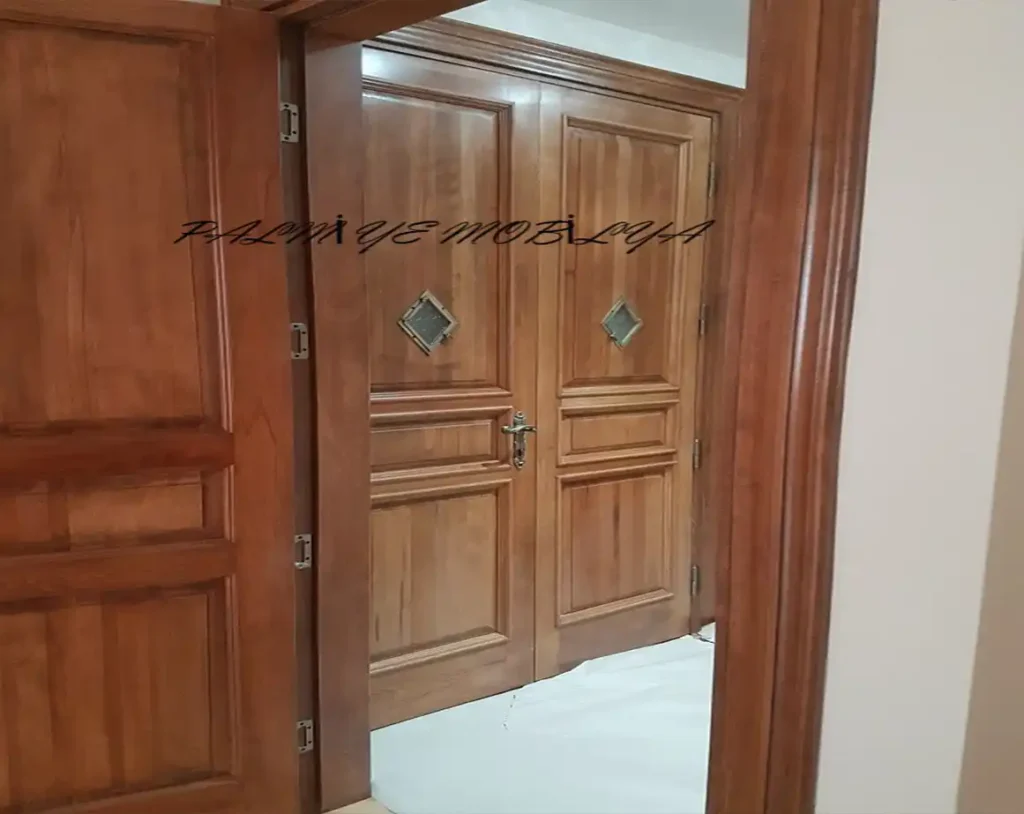
- Design Features: Characterized by heavy square-set raised panels, deeply carved frame details, and integrated iron trim elements.
- Application Strategy: These configurations utilize rich Chestnut or Larch timbers finished with dark, transparent earth-tone stains that protect the wood while showcasing its deep grain characteristics.
Contemporary Rustic Fusion
- Design Features: Designed to complement modern biophilic architecture, this style combines heavily textured rustic wood slabs with clean, minimalist frame geometries.
- Application Strategy: The door leaf showcases distinct rustic features like sound knots and dramatic grain variations, but it is cut with clean, sharp edges and mounted flush into concealed aluminum frames with hidden hinges, creating a striking contrast between raw organic texture and modern precision.
Custom Forged Ironmongery and Hardware Integration
To complete the historic aesthetic, Turkish manufacturers cooperate directly with specialized regional metal foundries to build custom hardware packages:
- Artisanal Wrought Iron Grilles: Exterior entry doors can be configured with insulated double-glazed window ports protected by hand-forged, matte-black iron safety grilles.
- Clavos and Structural Strap Hinges: Decorative surface clavos (iron studs) and matching heavy-duty surface strap hinges are chemically oxidized to provide deep corrosion resistance, ensuring long-term performance in high-humidity or coastal areas.
8. Procurement Logistics, Commercial Packaging, and Site Management
To successfully incorporate a premium Rustic Solid Wood Doors Turkey into an international project, careful planning is required during procurement, shipping packaging, and onsite installation management.
Detailed Shop Drawing Submittals
Before factory manufacturing begins, the engineering team creates detailed architectural shop drawings to verify all installation dimensions:
- Rough Openings: Checking that the structural masonry or steel studs are plumb, level, and square within a strict tolerance of \(\pm2\text{ mm}\).
- Variable Finished Wall Profiles: Measuring the final wall thicknesses, including plaster, paint, marble cladding, or ceramic tiling. Turkish frames are typically constructed with telescopic architraves that can adjust by \(\pm15\text{ mm}\) to \(\pm25\text{ mm}\) to ensure a clean fit against minor wall variances.
- Hardware Clearance Coordination: Mapping out exact tolerances for flush-mounted lock plates, concealed overhead door closers, and electronic hardware wire drops.
Industrial Packing Systems for Long-Distance Export
Solid wood components are sensitive to sudden environmental and moisture changes during international transport. Turkish factories use multi-layered packing methods to protect the product:
[Finished Solid Timber Door Leaf]
  ↓ Wrapped in Multi-Layer Polyethylene Anti-Scratch Cushioning Foam
  ↓ Fitted with Rigid, Heavy-Duty Molded Cardboard Edge and Corner Protectors
  ↓ Vacuum-Sealed inside a Heavy Thermoplastic Shrink-Wrap Moisture Barrier
  ↓ Secured into ISPM-15 Heat-Treated Heavy Solid Wooden Crates or Pallet Racks
This heavy packaging workflow protects the kiln-dried timber and its finish from physical vibrations, rough handling, maritime humidity, and salty air during ocean freight or overland transport.
Onsite Installation Readiness and Environmental Controls
Solid wood doors are high-grade finishing elements and must be treated with care. They should never be brought onto a construction site during rough-in or wet-work phases.
- Climate Enclosure Mandate: The building envelope must be fully enclosed, with all external windows and curtain walls completely installed. All high-moisture interior trades—including concrete subfloor pouring, gypsum plastering, drywall taping, and primary bathroom tiling—must be 100% complete and fully cured.
- Relative Humidity Controls: The building’s HVAC systems must be operational, with internal relative humidity stabilized between 40% and 60% and ambient temperatures maintained consistently between \(16^{\circ }\text{C}\) and \(24^{\circ }\text{C}\). Introducing dry, engineered wood components into an unconditioned, high-humidity building environment can cause the doors to absorb excess moisture, leading to structural swelling, frame distortion, and micro-fissures in the lacquer finish.
Technical Installation Execution Steps
- Laser-Guided Subframe Calibration: Installers use multi-line digital laser levels to align the door frame within the structural opening. The maximum allowable diagonal deviation across the frame assembly is limited to a strict tolerance of \(\pm1.0\text{ mm}\).
- Controlled Polyurethane Foam Application: Fixers secure the frame using professional-grade, low-expansion polyurethane foam applied at designated structural anchor points behind the jamb. Standard high-expansion retail foams exert excessive lateral pressure as they cure, which can bow the jamb inward and disrupt the operational clearances of the door leaf.
- Concealed Hardware Commissioning: Premium installations utilize multi-axis adjustable concealed commercial hinges countersunk into both the leaf and the frame. These systems allow field installers to adjust the door leaf’s position across three spatial dimensions (height, lateral reveal, and gasket compression pressure) using simple hex key adjustments, ensuring a uniform \(3\text{ mm}\) perimeter reveal and reliable acoustic seal compression.
9. Facility Maintenance and Preservation Strategies
While a premium Rustic Solid Wood Doors Turkey features a highly durable chemical finish, maintaining its appearance and performance over a multi-decade operational lifespan requires adherence to specific preservation guidelines.
Standard Cleaning Protocols
- Routine Dust Removal: Surface dust should be removed using ultra-soft microfiber cloths. Because rustic doors feature deep, wire-brushed textures, facility teams should use soft vacuum brush attachments or soft-bristled dusters to clear dust from grain recesses without catching on the wood fibers.
- Soiled Surface Remediation: For standard smudges or greasy fingerprints around locksets, the surface should be wiped gently with a microfiber cloth slightly dampened with a highly diluted, pH-neutral, non-abrasive commercial detergent. The area must be dried immediately with a separate microfiber cloth to prevent moisture film from remaining on the finish.
Chemical Restrictions and Protective Guidelines
- Prohibited Cleaning Solvents: Cleaning staff must never use products containing high-concentration alcohols, ammonia, acetone, chlorinated compounds, abrasive scouring powders, or heavy alkaline solutions. These aggressive chemical compounds will break down the polyurethane acrylic cross-linked topcoat, causing high-gloss finishes to become cloudy and matte finishes to become sticky and susceptible to permanent staining.
- Localized Finish Remediation: For doors finished with natural oils or polyurethane waxes, surface preservation is straightforward. Minor scuffs or dried zones can be spot-repaired by cleaning the area and lightly reapplying a matching touch-up oil with a soft cotton cloth. The oil integrates directly into the existing finish, restoring the wood’s deep appearance and moisture protection without requiring a full sanding or refinishing of the door.
Conclusion: The Strategic Value Proposition
Specifying a Rustic Solid Wood Doors Turkey for a contemporary architectural project represents a sound financial investment that balances capital expenditure with long-term asset value. By combining advanced European automation lines, certified sustainable timber foundations, robust mechanical engineering, and high-performance acoustic isolation, Turkish manufacturing delivers high-grade doors that easily fulfill the requirements of modern premium projects.
For architects, interior designers, and global procurement professionals, partnering with certified Turkish door manufacturers ensures access to highly customizable design options capable of fulfilling the most demanding project specifications. Whether integrated into a modern high-rise via flush concealed frame configurations or dressing a luxury residence with detailed neoclassical millwork, the engineered Rustic Solid Wood Doors Turkey provides a reliable, high-performance, and elegant solution for contemporary spaces.

Şunları da sevebilirsiniz
Distressed Furniture Turkey

Lacquered Furniture Turkey