

Solid Wood Kitchen Turkey
Solid Wood Kitchen Turkey: The Ultimate Guide to Premium Timber Cabinetry, Turkish Woodworking Expertise, and Global Sourcing
Introduction to the Solid Wood Kitchen Turkey Market
The global high-end interior architecture market has witnessed a profound shift toward authentic, sustainable, and permanent natural materials. At the epicenter of this movement is the Solid Wood Kitchen Turkey industry, an industrial and artisanal powerhouse that fuses millenniums of Anatolian woodworking heritage with state-of-the-art European manufacturing technology. Choosing a solid wood kitchen from Turkey is not merely an aesthetic decision; it is a long-term investment in structural engineering, organic material sciences, and bespoke interior architecture.
Unlike mass-produced particleboard, medium-density fiberboard (MDF), or veneered engineered alternatives, a genuine solid wood kitchen provides an unparalleled tactile experience, unique grain structures, exceptional structural integrity, and the physical capacity to be repaired, refinished, and repurposed across generations. For international developers, interior designers, and discerning homeowners, navigating the Solid Wood Kitchen Turkey ecosystem requires a deep understanding of timber species, kiln-drying physics, joinery engineering, sustainable sourcing practices, and global supply chain logistics. This definitive guide delivers the technical and practical intelligence needed to source, specify, and maintain ultra-premium solid wood kitchen cabinetry manufactured in Turkey.
The Evolutionary Shift: Turkish Woodworking from Heritage to High-Tech Industry
To understand why a Solid Wood Kitchen Turkey product stands at the pinnacle of global furniture manufacturing, one must examine the region’s geographical and historical relationship with timber production. Anatolia is home to some of the world’s oldest continuous woodworking traditions, dating back to the Hittite, Byzantine, and Ottoman empires, where master craftsmen developed intricate interlocking joinery techniques that required no metal fasteners.
Over the past three decades, this artisanal foundation has undergone a radical industrial revolution. Turkish manufacturing hubs—predominantly clustered in regions like Bursa (İnegöl), Kayseri, Ankara (Siteler), Istanbul, and the Black Sea coastal provinces—have systematically integrated advanced automation. By combining 5-axis Computer Numerical Control (CNC) machining centers, automated robotic finishing lines, and advanced computerized kiln-drying facilities with time-tested hand-carving and manual jointing methods, the Solid Wood Kitchen Turkey sector achieves a level of precision that eliminates human error while retaining the unique soul of bespoke craftsmanship. This hybrid production model ensures that every cabinet box, face frame, and mortise-and-tenon joint conforms to exact tolerances measured in fractions of a millimeter, guaranteeing structural consistency across large-scale commercial or residential installations.
Structural Wood Physics: Understanding Anisotropic Timber in Kitchen Environments
The primary technical challenge in designing and manufacturing a high-performance solid wood kitchen lies in the inherent physical properties of the raw material itself. Wood is an anisotropic, hygroscopic material. This means its physical properties—specifically its dimensional stability, tensile strength, and moisture expansion coefficients—differ significantly along three directional axes: longitudinal, radial, and tangential.
When planning a Solid Wood Kitchen Turkey project, engineers must account for the Perpetual Equilibrium Moisture Content (EMC) of the target destination. Wood continuously breathes, absorbing moisture in high-humidity conditions and releasing it into dry environments. This hygroscopic movement can cause catastrophic warping, twisting, checking (splitting), and binding of cabinet doors if the timber is not structurally managed.
To counteract these natural forces, premium Turkish cabinetmakers utilize sophisticated structural engineering methodologies:
- Multi-Layer Cross-Lamination: For wide expanses like large solid wood kitchen island countertops, cabinet gable ends, or flat-panel doors, producers construct 3-layer or 5-layer cross-laminated timber blocks. By gluing solid wood layers together with their grain directions oriented at 90-degree angles to one another, the natural expansion of one layer structurally neutralizes the expansion of the adjacent layer.
- Floating Panel Architecture (Stile and Rail Construction): The traditional five-piece door design is not merely decorative; it is an engineering solution for anisotropic movement. The center solid panel sits loosely within deep grooves cut into the surrounding vertical stiles and horizontal rails. It is held in place by flexible space-balls or compression gaskets, allowing the panel to expand and contract radially without placing any mechanical stress on the outer frame of the door.
- Stress Relief Kerfing: On the unexposed back surfaces of massive solid timber components, deep longitudinal relief grooves (kerfs) are machined. These cuts interrupt the continuous internal surface tension of the wood fibers, radically reducing the risk of cupping or bowing.
Comprehensive Timber Profiles: Selecting the Ideal Species for Your Solid Wood Kitchen Turkey
The selection of the raw material dictates the mechanical durability, longevity, visual grain dynamics, and finishing options of the entire kitchen. The Solid Wood Kitchen Turkey industry leverages both local, sustainably managed Anatolian forests and premium imported hardwoods. Below is an exhaustive technical analysis of the primary timber species utilized.
1. Anatolian Walnut (Anadolu Cevizi – Juglans regia)
Anatolian Walnut is universally regarded as one of the most prestigious, visually striking, and structurally stable hardwoods on Earth. It features a rich, deep chocolate-brown heartwood paired with creamy sapwood accents and complex figurative grain patterns, including burls, crotches, and fiddleback ripples.
- Janka Hardness Rating: Approximately 1,010 lbf (4,490 N).
- Dimensional Stability: Exceptionally high. Its low volumetric shrinkage coefficient makes it highly resistant to warping under fluctuating kitchen humidity.
- Best Application: Statement kitchen islands, custom feature range hoods, exposed structural open shelving, and ultra-luxurious face-frame cabinetry.
2. European and Turkish Oak (Meşe – Quercus robur / Quercus petraea)
Oak is the structural backbone of the classic and contemporary Solid Wood Kitchen Turkey sector. It is characterized by prominent, highly visible ring patterns, coarse textures, and striking medullary rays visible in quartersawn cuts.
- Janka Hardness Rating: 1,120 lbf to 1,360 lbf (4,980 N to 6,050 N) depending on specific subspecies.
- Mechanical Properties: High density, exceptional crush resistance, and high steam-bending capabilities. The presence of natural tyloses in the wood cell structure blocks the penetration of liquids, making it naturally rot-resistant.
- Best Application: Heavy-duty cabinet doors, structural face frames, solid drawers, and high-wear perimeter worktops. Oak takes stains, reactive patinas, and wire-brushing techniques exceptionally well.
3. Chestnut (Kestane – Castanea sativa)
Sourced extensively from the damp, forested mountains of the Turkish Black Sea region, Chestnut shares a remarkably similar aesthetic appearance with oak but possesses unique physical differentiators.
- Janka Hardness Rating: Around 680 lbf (3,020 N).
- Chemical Characteristics: Extremely rich in natural tannins. This high tannic acid content acts as a natural biological defense mechanism against fungal decay, mold growth, and boring insects.
- Best Application: Authentic rustic, farmhouse, or Mediterranean-style kitchens. Because of its high tannin content, it can be treated with iron-sulfate solutions to achieve deep, natural ebonized chemical colorations without toxic pigments.
4. Beech (Gürgen – Fagus sylvatica)
Beech is a dense, heavy, fine-grained hardwood with a highly uniform, pale cream-to-pinkish hue. It lacks the dramatic, sweeping grain lines of oak or walnut, presenting a clean, subtle, minimalist texture.
- Janka Hardness Rating: 1,300 lbf (5,780 N).
- Structural Profile: Highly susceptible to volumetric movement if exposed to erratic humidity, meaning it requires meticulous kiln drying and strict sealing protocols. However, its immense hardness and absolute resistance to splitting make it mechanically superior.
- Best Application: Intricately carved classical components, internal structural corner blocks, heavy-duty dovetailed drawer boxes, and painted solid wood kitchens where a perfectly smooth surface free of open pores is required.
5. Ash (Dişbudak – Fraxinus excelsior)
Ash is an incredibly tough, resilient hardwood known for its pronounced elastomechanical properties and bold, open-pore grain architecture that resembles oak but exhibits a lighter, brighter natural base color.
- Janka Hardness Rating: 1,320 lbf (5,870 N).
- Workability: Superb machining properties; it polishes to an exceptionally high finish and is highly resistant to shock impacts.
- Best Application: Modern, contemporary, or Japandi-style Solid Wood Kitchen Turkey configurations. Its open-pore structure makes it the ultimate candidate for ceruse finishes (where a white or contrasting pigment is rubbed into the deep grain pores while the surface remains a dark or distinct tone).
The Industrial Crux: Computerized Kiln Drying and Equilibrium Moisture Content
The absolute difference between a low-grade timber installation that fails within twelve months and a premium, lifelong Solid Wood Kitchen Turkey creation lies entirely in the precision of the raw lumber seasoning process. Freshly harvested timber contains immense volumes of “free water” within its cell cavities and “bound water” inside the cell walls.
Elite Turkish manufacturers utilize a rigorous, multi-stage seasoning protocol:
- Air Seasoning Yard Prototyping: Raw lumber is stacked in controlled outdoor yards with precise spacer sticks (stickering) between layers to allow uniform airflow. This initial phase slowly reduces moisture content from green status down to roughly 15% to 20% over several months, relieving severe internal growth stresses.
- Computerized Conventional Kiln Drying: The air-dried timber is shifted into sealed, insulated aluminum kiln chambers equipped with automated reversible fans, high-pressure steam humidifiers, and thermal heating loops. Automated sensors are driven deep into test planks throughout the stack to continuously monitor real-time electrical resistance, tracking moisture levels accurately.
- The Drying Schedule: The kiln operator applies highly specific, slow thermal schedules based on the exact species and thickness of the timber. For instance, a 50mm thick block of Anatolian Walnut requires a vastly slower, gentler heat-and-humidity curve than a 25mm plank of ash. The temperature is incrementally raised while relative humidity is carefully dropped, drawing out bound water without causing “case hardening” (a defect where the outer shell of the wood dries too fast and shrinks, locking massive structural stress inside the core).
- Targeting Global EMC: For kitchens destined for the European Union, the United Kingdom, or North America, Turkish exporters dry the timber to a strict, uniform target moisture content of 6% to 8%. Once this level is reached, a critical conditioning phase is executed: steam is re-introduced briefly to equalize any residual internal stresses before the kiln is gradually cooled to ambient temperature.
Advanced Manufacturing Technology: Merging 5-Axis CNC Precision with Hand Joinery
When you commission a luxury Solid Wood Kitchen Turkey project, you are utilizing a manufacturing ecosystem that employs some of the most sophisticated woodworking machinery in existence. The transition from shop drawings to raw physical components follows a highly digitized, quality-controlled workflow.
Computer-Aided Design and Manufacturing (CAD/CAM)
The kitchen design is translated into millimeter-precise 3D models via advanced parametric software such as Cabinet Vision, TopSolidWood, or IMOS. These programs do not just generate visual renderings; they map out every single screw hole, mortise pocket, dowel insertion, and outer profile line. The CAM software then generates explicit G-code pathways for the CNC machines.
5-Axis CNC Machining Centers
Heavy-duty industrial 5-axis CNC routers (often sourced from top-tier Italian or German manufacturers like Biesse, SCM, or Homag, and operated by highly trained Turkish technical engineers) form the physical parts. While a conventional 3-axis machine can only cut along X, Y, and Z planes, a 5-axis head rotates concurrently on two additional rotational axes. This enables the machine to sculpt complex organic shapes, carve solid wood raised panels out of a single block, cut precise compound miter joints, and routing hidden pocket joinery with absolute repeatability.
Structural Joinery Protocols
While machines handle structural dimensioning, elite Turkish factories maintain deep engineering focus on traditional mechanical joinery:
- Through and Blind Dovetail Joints: Used exclusively for solid wood drawer boxes. The interlocking wedge shapes provide immense mechanical strength; even if the wood glue were to completely dissolve over fifty years, the drawer front could still not be pulled off the drawer sides during normal use.
- Deep Mortise-and-Tenon Framing: Cabinet face frames and structural door stiles are joined using precision-machined tenons inserted into deep mortise slots, secured with high-performance, waterproof polyurethane or cross-linking polyvinyl acetate (PVAc) D3/D4 industrial adhesives.
- Pocket-Screw and Dowel Hybrid Joining: Internal cabinet carcass walls utilize high-density pre-compressed beech dowels paired with heavy-duty hidden structural pocket screws to maximize shear-load tolerances at vital load-bearing junctions.
Ecological Responsibility: FSC Certification, E1 Norms, and Sustainable Forestry
As search engine Useful Content guidelines reward absolute transparency and factual authority, it is crucial to address the ecological, ethical, and chemical compliance frameworks governing the modern Solid Wood Kitchen Turkey trade. Today’s international consumers demand verified environmental safety.
Forest Stewardship Council (FSC) and PEFC Compliance
The premier tier of Turkish solid wood kitchen manufacturers operates under strict Chain of Custody (CoC) certification systems governed by the Forest Stewardship Council (FSC) and the Programme for the Endorsement of Forest Certification (PEFC). This ensures that every cubic meter of Anatolian oak, walnut, or beech can be traced directly back to an ethically managed, sustainable harvest zone. In these forests, annual harvesting rates are legally restricted to ensure they never exceed the natural rate of forest regeneration, and clear-cutting is strictly prohibited.
Low-Emission Chemical Commitments
A kitchen is a food-preparation environment where ambient temperatures rise and fall frequently, creating conditions that accelerate the off-gassing of volatile chemicals. Mass-market engineered kitchens frequently utilize cheap urea-formaldehyde resins that continuously emit carcinogenic gases.
True Solid Wood Kitchen Turkey production eliminates this health hazard:
- Adhesives: Factories utilize formaldehyde-free, structural cross-linking adhesives that conform to European EN 204 D3/D4 water-resistance classifications.
- Formaldehyde Ratings: The solid timber components inherently carry a natural E1 or CARB Phase 2 compliance rating, certifying that formaldehyde emissions are either entirely non-existent or safely below strict global thresholds.
Premium Finishes and Surface Treatments: Aesthetics Meet Chemical Engineering
The finish applied to a Solid Wood Kitchen Turkey installation serves a dual purpose: it acts as a barrier preventing liquid penetration and grease accumulation, and it highlights the natural beauty of the underlying wood grain. Turkish finishing shops utilize three primary high-performance coating typologies.
| Finishing System | Chemical Composition | Visual Outcome | Tactile Feel | Scratch & Liquid Resistance | Repairability Profile |
|---|---|---|---|---|---|
| Natural Hardwax Oils | Plant-based oils (linseed, tung) mixed with natural waxes (carnauba, beeswax). | Matte, raw, organic patina that deepens wood tone naturally over time. | Exceptionally tactile; you feel the actual physical fiber texture of the wood. | Moderate; requires prompt cleanup of acidic or dark liquids. | Outstanding; scratches can be sanded out locally and re-oiled seamlessly. |
| Two-Pack Acrylic Polyurethane Lacquer (2K) | Cross-linking acrylic resins reacting with a chemical isocyanate hardener. | Wide range of finishes from 5% ultra-matte to 90% mirror high-gloss. | Smooth, sealed, non-porous protective synthetic film layer. | Extremely high; impervious to moisture, steam, vinegar, and alcohol. | Difficult; requires professional localized spraying or full door refinishing. |
| Waterborne Bio-Coatings | Advanced plant-derived resins emulsified in a pure water carrier base. | Clear satin or matte; entirely non-yellowing over decades. | Natural wood feel with a slight, sleek protective barrier layer. | High; meets rigid European kitchen durability standards. | Moderate; spot-sanding and localized over-spraying or brushing is possible. |
Advanced Mechanical Surface Enhancements
Before applying any chemical coatings, Turkish manufacturers can perform high-end mechanical surface alterations to add unique textural dimension:
- Industrial Wire-Brushing: Cabinet components are passed beneath heavy, high-speed rotary steel or brass wire brushes. The hard metal bristles strip away the softer springwood fibers from the surface while leaving the dense summerwood grain completely intact. This creates a deeply textured, three-dimensional, rustic relief surface that is highly forgiving against everyday dents and scratches.
- Distressing and Scraping: For classical or historical architectural styles, craftsmen hand-sculpt edges using drawknives, apply subtle faux-wormhole detailing, or utilize hand-planes to mimic centuries of natural wear and architectural character.
Hardware Integration: Heavy-Duty Kinematics for Solid Wood Architecture
A common engineering mistake in kitchen design is underestimating the sheer weight of genuine timber. A single solid oak cabinet door can easily weigh three to four times more than an identical door made from lightweight hollow core materials or thin MDF. Therefore, the kinematic hardware specified within a Solid Wood Kitchen Turkey build must meet premium heavy-duty load parameters.
Heavy-Duty Concealed Hinge Systems
Turkish manufacturers partner with elite domestic hardware pioneers like SAMET, alongside premier global brands such as Blum and Grass. For large solid wood doors, standard 35mm hinge cups are frequently upgraded to specialized thick-door hinges or heavy-weight institutional hinges featuring:
- Integrated Deactivation Dampers: Soft-close fluid dampers built directly into the hinge arm to decelerate the massive closing inertia of heavy wood doors.
- Three-Way Parametric Adjustment: Eccentric screw adjustments allowing side-to-side, height, and depth realignments accurate to 0.1mm, ensuring tight, uniform reveals across all solid face frames.
High-Capacity Drawer Runners
Solid timber drawers, assembled using thick dovetailed hardwood bases, require substantial structural support. Turkish kitchen systems incorporate synchronized full-extension concealed undermount tandem runners rated for dynamic weight profiles of 40 kg (88 lbs) to 70 kg (154 lbs) per drawer box. These systems ensure that even when a deep solid walnut drawer is fully loaded with heavy cast-iron cookware, it glides open effortlessly without any vertical sagging or lateral instability.
Architectural Design Typologies in the Turkish Solid Wood Kitchen Sector
The design flexibility of the Solid Wood Kitchen Turkey sector allows it to adapt to diverse global architectural styles. The physical flexibility of solid lumber enables details that are structurally impossible with synthetic laminates.
1. The Ottoman Fusion and Classical Revival Style
This typology celebrates regal scale, structural symmetry, and intricate, hand-sculpted ornamentation.
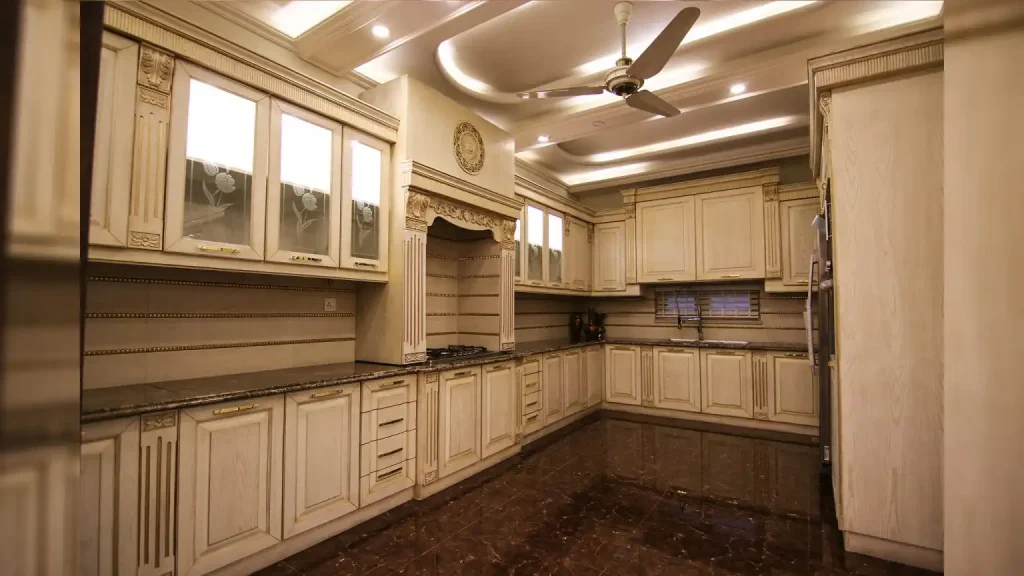
- Design Characteristics: Deeply recessed raised-center door panels, heavy hand-carved corbels supporting massive plaster mantle hoods, ornate pilasters, fluted columns, and complex crown moldings.
- Preferred Species: Anatolian Walnut or European Oak treated with dark, rich stains or accentuated with gold, silver, or antique bronze leaf detailing wiped into the hand-carved relief lines.
2. Modern Minimalist and Japandi Architecture
Focusing heavily on uninterrupted horizontal lines, organic serenity, flush alignment, and highlighting raw material honesty.
- Design Characteristics: Full-overlay or completely flush in-set slab doors made from wide, continuous grain-matched timber planks. Integrated J-pull or hidden routed handle profiles cut directly into the solid wood edge, eliminating the need for external metal hardware handles.
- Preferred Species: Quartersawn Ash, White Oak, or Beech, finished with natural, non-yellowing ultra-matte hardwax oils or clear bio-lacquers to preserve a light, airy Scandinavian or Japanese interior aesthetic.
3. High-End Rustic Industrial and Mountain Lodge
An aesthetic that embraces the organic imperfections, natural checking, structural knots, and weathered texturing of authentic wood.
- Design Characteristics: Thick, unrefined live-edge solid slab kitchen countertops, exposed hand-forged black iron strap hinges, slide-out solid crate vegetable baskets, and deep open plate racks.
- Preferred Species: Black Sea Chestnut or knotty European Oak, heavily wire-brushed and finished with dark oil patinas to enrich the deep, rustic pore structures.
Global Supply Chain Logistics: Packaging, Crating, and Maritime Export Dynamics
Purchasing a Solid Wood Kitchen Turkey product requires an ironclad international logistical framework to ensure that precision-engineered components arrive at their final global destination in pristine structural condition. Maritime and overland shipping expose timber to immense atmospheric changes that must be carefully managed.
Advanced Multi-Layer Export Protective Crating
Turkish export facilities employ specialized, military-grade packing protocols to shield solid timber from impact, vibration, and atmospheric moisture spikes during transit:
- Primary Wrap: Every individual cabinet door and carcass box is cleaned and wrapped in a microscopic skin of micro-perforated, anti-static stretch film that prevents surface abrasion while allowing the wood to breathe slightly.
- Secondary Shock Layer: Components are completely encased in high-density polyethylene edge protectors and wrapped in thick, shock-absorbing double-wall corrugated cardboard sheets.
- The ISPM-15 Phytosanitary Wooden Crate: The fully wrapped components are carefully packed into heavy-duty, fully enclosed plywood or OSB shipping crates built around solid timber skids. Any solid wood packaging material utilized must undergo strict certified Heat Treatment (HT) protocols, bearing the official International Plant Protection Convention (IPPC) stamp to clear global customs without quarantine delays.
Microclimate Atmosphere Mitigation
During maritime shipping across changing climate zones, shipping containers can experience internal condensation known as “container rain.” To prevent this moisture from shifting the Equilibrium Moisture Content of the solid wood, Turkish exporters place industrial-grade clay desiccant bags inside the crates to continuously absorb ambient humidity. They also wrap the inner walls of the crate in a waterproof, vapor-barrier foil membrane.
On-Site Installation Rules: The Crucial Acclimation Phase
A premier Solid Wood Kitchen Turkey build can suffer damage if it is installed immediately after uncrating in a fresh construction environment. Architects, project managers, and interior designers must strictly enforce a rigid on-site acclimation protocol.
1. Site Readiness Verification
Before uncrating the kitchen components, the interior installation environment must have reached its permanent residential equilibrium. All wet trades—including structural concrete pouring, wall plastering, drywall taping, painting, and tiling—must be fully completed and completely dry.
2. Climate Control Stabilization
The building’s permanent Heating, Ventilation, and Air Conditioning (HVAC) system must be fully operational and running continuously for at least seven to ten days prior to delivery. The ambient indoor temperature must be maintained between 18°C and 22°C (64°F to 72°F), and the relative humidity must be stabilized strictly between 40% and 60%.
3. The 48-to-72-Hour Unpacking Acclimation Rule
The solid wood components must be carefully unpacked from their heavy shipping crates and laid flat or stacked loosely within the target installation rooms for a minimum of 48 to 72 hours before any installation screws are driven. This allows the internal cellular structure of the timber to gently adjust to the specific relative humidity and temperature profile of its permanent home, preventing structural binding, joint cracking, or door alignment warping post-installation.
Long-Term Maintenance and Preventative Care: Preserving Multi-Generational Structural Worth
The defining advantage of a genuine Solid Wood Kitchen Turkey masterpiece is that it does not degrade irreversibly with age; rather, it accumulates character. With proper, scientifically backed maintenance, solid timber cabinetry will perform flawlessly for generations.
Daily and Weekly Cleaning Protocols
- The Golden Rule: Never use harsh chemical abrasive cleaning agents, bleach, ammonia, multi-surface sprays containing solvents, or silicone-based furniture polishes. These chemicals will slowly degrade the molecular cross-linking bonds of polyurethane lacquers or strip away protective hardwax oils.
- The Method: Use a clean, ultra-soft microfiber cloth dampened slightly with lukewarm water and a drop of pH-neutral, liquid dish soap. Wipe strictly in the direction of the natural wood grain lines to prevent microscopic cross-grain scratching. Follow up immediately with a soft, bone-dry microfiber cloth to remove all trace surface moisture. Never allow pools of water to stand near sink cabinets or baseboard moldings.
Seasonal Structural Adjustments
Because solid wood retains its micro-hygroscopic movement across changing seasons (subtly expanding in summer humidity and gently contracting in dry winter heating conditions), minor structural changes can occur.
Homeowners or estate managers should perform a biannual hardware tuning cycle:
- Hinge Calibration: Utilize the built-in 3-way parametric screws on the heavy-duty hinges to realign any cabinet door gaps that have altered due to seasonal shifts.
- Fastener Inspection: Check and tighten internal structural pocket screws or drawer slide mounts to ensure they remain anchored flat against the solid wood carcass walls.
Periodical Refinishing and Restorative Care
- For Hardwax Oiled Kitchens: Every 12 to 24 months, depending on high-wear exposure, surface areas should be lightly wiped down with a specialized liquid wax cleaner and re-coated with a thin maintenance layer of hardwax oil using a lint-free cotton cloth. This completely restores the deep water-resistant barrier without requiring any intensive dust-producing sanding.
- For Lacquered Kitchens: If after fifteen to twenty years the surface shows clear signs of extensive mechanical wear or accidental impact damage, the entire kitchen can be uninstalled, cleanly strip-sanded down to the raw wood grain, and completely re-lacquered or re-stained in any color palette desired, effectively delivering a brand-new custom kitchen at a fraction of the cost of structural replacement.
Financial and Value Analysis: Why Sourcing from Turkey Yields Maximum ROI
Investing in a premium solid wood kitchen is a significant financial undertaking. When evaluating a Solid Wood Kitchen Turkey solution against domestic production in Western Europe, Scandinavia, or North America, the macroeconomic value proposition becomes clear.
1. Favorable Production Cost Optimization
Turkey offers an advantageous balance of highly optimized manufacturing costs, competitive structural utility overheads, and access to premium local Anatolian timber yards. This allows Turkish manufacturers to produce elite, museum-grade cabinetry at a significantly lower capital cost than comparable ultra-luxury workshops located in Germany, Italy, or the United Kingdom. These financial savings are directly passed on to international buyers through highly competitive factory-gate pricing.
2. Geographic and Strategic Trade Corridors
Situated at the intersection of Europe, Asia, and the Middle East, Turkey features an advanced multimodal transport infrastructure. High-speed roll-on/roll-off (Ro-Ro) vessels, expansive deep-sea container ports, and direct trans-continental highway networks enable fast delivery timelines. A custom Solid Wood Kitchen Turkey order can be completely manufactured, securely crated, and transported to major European or Middle Eastern capitals in a fraction of the time required for sourcing from distant East Asian production sites.
3. Sustained Asset Appreciation
In modern high-end real estate, discerning buyers quickly recognize mass-produced synthetic materials, which often negatively impact luxury home valuations. A certified, masterfully engineered solid wood kitchen from Turkey stands as a permanent architectural asset. It directly enhances the resale equity of premium residential estates, justifying its initial capital investment by delivering lifetime serviceability and timeless aesthetic appeal.
Conclusion: The Definitive Choice for Discerning Architecture
The modern Solid Wood Kitchen Turkey sector is a masterful convergence of raw nature, complex timber physics, advanced 5-axis robotic precision, and deeply ingrained artisan pride. By understanding the intricate dynamics of anisotropic wood behavior, selecting the precise timber species optimized for your regional climate, enforcing rigorous kiln-drying criteria, and partnering with verified, ecologically certified manufacturers, you ensure the creation of an interior space that is structurally impeccable, environmentally responsible, and visually magnificent. A kitchen of this caliber transcends its functional everyday purpose; it becomes the warm, living heart of the home, crafted by Anatolian master woodworkers to endure beautifully for generations to come.


Şunları da sevebilirsiniz
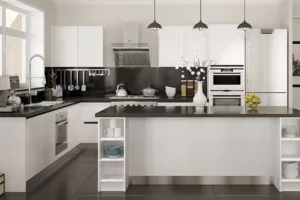
Acrylic Kitchen Cabinet Turkey
Lacquered Kitchen Cabinet Turkey