
Wood Veneer Kitchen Cabinets Turkey
Wood Veneer Kitchen Cabinets Turkey: The Master Guide to Engineering, Aesthetics, and Manufacturing Excellence
Introduction: The Architectural Ascent of Wood Veneer Cabinetry
In the landscape of high-end residential architecture, the kitchen has transitioned from a isolated service zone into the central social hub of the home. This shift requires cabinetry that delivers both long-term structural durability and high-end visual appeal. For interior designers, real estate developers, and discerning homeowners worldwide, sourcing
has emerged as a premier strategy to balance these goals.
Wood veneer represents an elegant marriage of natural material science and advanced industrial engineering. By slicing genuine premium hardwoods into thin, uniform sheets and bonding them under hydraulic heat and pressure to highly stable engineered substrates, manufacturers capture the grain beauty, tactile feel, and organic warmth of solid timber. Concurrently, they eliminate the structural vulnerabilities of solid wood, such as warping, cupping, split joints, and directional seasonal expansion.
Turkey’s modern furniture infrastructure has established itself as a global leader in this specialized sector, combining centuries of Mediterranean woodworking heritage with top-tier German and Italian computer-numeric-control (CNC) slicing and pressing technology. This comprehensive technical guide analyzes the botanical selections, slicing mechanics, pressing engineering, architectural layouts, and global procurement frameworks that define the premium market for Wood Veneer Kitchen Cabinets Turkey.
1. The Anatomy of Wood Veneer: Material Science and Slicing Mechanics
To understand the engineering value of Wood Veneer Kitchen Cabinets Turkey, one must look closely at the raw material preparation. Wood veneer is not a synthetic replication or a printed laminate; it is a thin layer of genuine hardwood sliced from a log, typically ranging in thickness from 0.5mm to 2.0mm.
+---------------------------------------------------------------+

|            LOG SLICING ORIENTATIONS & GRAIN RESULT            |
+---------------------------------------------------------------+

|  [Rotary Peel]   ---> Wide, sweeping, non-repeating wild grain|
|  [Plain Slicing] ---> Cathedral arches, classic wood aesthetic |
|  [Quarter Sawn]  ---> Straight, parallel lines; highly stable |
|  [Rift Sawn]     ---> Linear grain, minimizes medullary rays  |
+---------------------------------------------------------------+
Slicing Methodologies and Visual Geometry
The physical grain pattern seen on a finished kitchen panel is determined by the geometric angle at which the mechanical slicing blade cuts through the tree’s growth rings:
- Plain Slicing (Flat Slicing): The log log is cut parallel to its center axis. This technique produces a classic grain pattern characterized by a central “cathedral arch” design, framed by straight grain paths along the outer edges. It is a highly requested look for traditional and transitional kitchen layouts.
- Quarter Sawn: The log is cut into quarters before slicing, and the blade meets the growth rings at an approximate 90-degree angle. This configuration yields a clean pattern of straight, parallel lines. In oak logs, quarter sawing exposes medullary ray flakes, creating a shimmering effect prized in luxury cabinetry.
- Rift Sawn: The cutting angle is shifted slightly (between 30 and 60 degrees) relative to the growth rings. This approach produces a uniform, linear grain pattern while minimizing the appearance of medullary flakes, providing a clean, modern aesthetic for minimalist kitchen designs.
- Rotary Peeling: The log is mounted on a lathe and spun against a long knife blade, peeling off a continuous sheet. While efficient, rotary peeling creates a wide grain pattern that is generally reserved for inner structural plywood layers rather than visible exterior cabinet faces.
Botanical Selection Criteria
Turkish manufacturers source diverse domestic and international hardwoods to produce Wood Veneer Kitchen Cabinets Turkey, with each species selected for its specific density, cell structure, and stain receptivity:
- Anatolian Walnut (Ceviz): Famed for its deep, smoky chocolate tones, swirling grain lines, and warm appearance. Its medium density and natural oils make it highly dimensionally stable post-finishing.
- European White Oak (Meşe): A dense, ring-porous hardwood featuring high Janka hardness and prominent grain definition. It responds exceptionally well to modern surface treatments like wire-brushing, ceruse bleaching, and deep matte smoking.
- Nordic Ash (Dişbudak): An elastic, open-grained wood with a pale straw color. Its expressive grain variations make it an ideal choice for contemporary dark charcoal or jet-black reactive stains, where the deep wood texture needs to remain clearly visible through the color.
- Exotic Eucalyptus and Smoked Larch: For ultra-modern luxury projects, Turkish workshops import European larch and African eucalyptus, treating them with thermal smoking chambers to caramelize natural sugars, resulting in rich, dark coffee tones throughout the veneer sheet.
2. Core Substrate Engineering: The Foundation of the Cabinet
A wood veneer sheet is only as stable as the substrate beneath it. Turkish manufacturers reject cheap, low-density particleboards, relying instead on high-performance engineered cores that resist moisture and structural stress.
       CROSS-SECTION OF VENEERED FLUSH CABINET DOOR
 ┌───────────────────────────────────────────────────────────┐
 │ 0.6mm Premium Hardwood Face Veneer                        │
 ├───────────────────────────────────────────────────────────┤
 │ PUR Waterproof Cross-Link Adhesive Layer                  │
 ├───────────────────────────────────────────────────────────┤
 │ 18mm Moisture-Resistant Engineered Core (MR-MDF / Plywood)│
 ├───────────────────────────────────────────────────────────┤
 │ PUR Waterproof Cross-Link Adhesive Layer                  │
 ├───────────────────────────────────────────────────────────┤
 │ 0.6mm Balancing Backing Veneer (Prevents panel warping)   │
 └───────────────────────────────────────────────────────────┘
Moisture-Resistant Medium Density Fiberboard (MR-MDF)
For flat slab kitchen doors, MR-MDF is a widely used substrate. This material is made by blending fine wood fibers with hydrophobic wax emulsions and moisture-repellent polyurethane resins before hot-pressing. It features a dense, homogenous core profile (ranging from 720 to 800 kg/m³) that will not swell or degrade when exposed to the high humidity and steam typical of a residential kitchen.
Multi-Ply Marine Birch Plywood
For high-end structural cabinet boxes (carcasses), premium producers utilize marine-grade birch plywood. Built by laminating an odd number of thin birch veneers at alternating 90-degree grain angles with waterproof phenolic glue, this core provides superior screw-holding power and exceptional structural strength, allowing it to easily support heavy granite or engineered quartz countertops.
The Law of Symmetrical Balancing
A critical principle in the production of Wood Veneer Kitchen Cabinets Turkey is structural symmetry. If a manufacturer presses a premium veneer sheet onto only the front face of a substrate panel, the uneven surface tension will cause the door to cup and warp over time as humidity levels change.
To prevent this, factories follow a strict balance rule: whatever material, thickness, and grain direction is applied to the front face must be applied identically to the back face. This balanced composition neutralizes internal tension, ensuring the cabinet panel remains completely flat over decades of service.
3. Matching and Composition Artistry: Crafting the Visual Flow
When logs are sliced into sequential sheets of veneer, those sheets are compiled into bundles called flitches. Because the sheets are sliced consecutively, the grain pattern shifts minutely from one piece to the next. This continuity allows Turkish craftspeople to layout veneer configurations like an artistic mosaic.
       +-----------------------+-----------------------+

       |                       |                       |
       |     BOOK MATCHING     |    SLIP MATCHING      |
       |                       |                       |
       |  /\   Grain mirrors   |  //   Grain repeats   |
       |  \/   like an open    |  //   in parallel     |
       |       center book     |       slanted columns |
       |                       |                       |
       +-----------------------+-----------------------+
Architectural Veneer Matching Methods
- Book Matching: Every second sheet of veneer is flipped over like the page of a book. This alignment creates a mirrored grain pattern across the seam, highlighting the wood’s symmetry and natural geometry. It is a classic layout style for prominent kitchen islands and full-height pantry walls.
- Slip Matching: Veneer sheets are placed side-by-side sequentially without flipping. This arrangement creates a repeating grain pattern with a slanted visual flow across the face of the cabinets, popular in clean, contemporary designs.
- Random Matching (Plank Matching): Veneer sheets from different logs or different parts of the same flitch are deliberately mixed. This technique mimics the look of traditional solid wood planks, providing a rustic, un-manufactured appearance that works well in country or farmhouse kitchen designs.
Sequential Veneer Sequencing Across the Cabinet Facade
A key indicator of high-end millwork quality when evaluating Wood Veneer Kitchen Cabinets Turkey is full-facade grain sequencing. In standard production, doors are cut randomly, which breaks the visual flow of the wood grain across the kitchen fronts.
In contrast, custom Turkish workshops utilize a sequential cutting method: they press giant, multi-meter veneer tapestries first, and then use computerized CNC saws to slice the individual cabinet doors out of that single, continuous panel. This meticulous process ensures that the natural wood grain flows seamlessly and uninterrupted across every drawer front, door panel, and appliance panel down the entire length of the kitchen installation.
4. Advanced Bonding Chemistry and Hydraulic Press Technology
Adhering a delicate veneer sheet to an engineered substrate requires precise chemical controls and industrial press machinery to avoid delamination or glue bleed-through.
| Adhesive Variant | Chemical Synthesis Base | Heat Activation Range | Moisture Resistance | Formaldehyde Emission |
|---|---|---|---|---|
| Urea-Formaldehyde (UF) | Thermo-setting synthetic resin | 100°C – 120°C | Moderate | E1 Standard compliant |
| Polyurethane Hot-Melt (PUR) | Reactive cross-linking polymer | 120°C – 140°C | 100% Waterproof | Completely Zero (E0) |
| Polyvinyl Acetate (PVA) | Water-based emulsion | Room Temp to 60°C | Medium-High | Zero / Eco-friendly |
The Industrial Hot-Press Cycle
Premium factories utilize multi-daylight hydraulic hot-presses to bond the components securely:
- Glue Application: The core substrate passes through a mechanized roller coater that applies a precise, uniform film of adhesive (typically 80 to 120 grams per square meter) to eliminate pockets of excess glue.
- Layup Stage: The aligned face veneer, glued core, and balancing backing veneer are stacked together on loading trays.
- Pressure and Heat Cycle: The assembly enters the hydraulic press plates. The machine applies intense pressure (ranging from 4 to 8 kg/cm²) along with controlled heat for a calculated duration (usually 90 to 180 seconds). The combination of heat and pressure forces the glue to cross-link with the wood fibers, creating a strong, permanent bond.
- Conditioning and Rest: Post-pressing, the hot boards are stacked flat in an acclimatization zone for 48 hours to cool slowly and equalize their internal moisture content before any final machining begins.
5. Precision Machining and Edge-Banding Systems
Once a veneered panel is pressed and stabilized, it moves to the machining floor, where advanced technology is required to cleanly cut the wood fibers without splintering the delicate face veneer.
       +---------------------------------------------------------+

       |           LASER EDGE-BANDING FUSION PROCESS             |
       +---------------------------------------------------------+

       | [Laser Diode Source] ---> Melts Functional Polymer Layer|
       | [Solid Hardwood Band]---> Pressed Directly into Substrate|
       | [Resulting Interface]---> Zero-Joint, 100% Waterproof Seam|
       +---------------------------------------------------------+
CNC Panel Processing
Factories use automated 5-axis CNC routers equipped with diamond-tipped cutting heads to shape the doors. To prevent micro-chipping along the brittle edges of raw veneer sheets, saws use scoring blades that cut a shallow path ahead of the main blade, ensuring crisp, perfectly clean edge lines.
Zero-Joint Laser Edge-Banding
The perimeter edge of a veneered flush door must be sealed to protect the inner core from moisture entry. Traditional edge-banders use hot-melt EVA glue pots, which leave a faint, visible glue line that can collect dirt and weaken over time if exposed to steam.
High-end Wood Veneer Kitchen Cabinets Turkey production facilities utilize advanced laser or hot-air fusion edge-banding systems:
- The machine uses a concentrated laser beam to instantly melt a co-extruded polymer functional layer on the back of a thick, solid-hardwood edge-band (typically 1.0mm to 2.0mm thick).
- The edge-band is then pressed firmly against the panel edge, fusing the two components together at a molecular level.
- This process creates a seamless, zero-joint transition that is completely waterproof, heat-resistant, and visually indistinguishable from a solid block of wood.
6. Finishes and Surface Protection Coatings
Kitchen environments subject cabinetry surfaces to challenging everyday conditions, including grease splatters, boiling steam, impacts from cookware, and spilled acidic ingredients like citrus juices. Turkish manufacturers implement multi-stage finishing lines to protect the wood cells while highlighting its natural texture.
Catalyzed Acrylic Polyurethane Coatings
For clients who prefer a smooth satin or low-sheen look, factories use multi-coat catalyzed acrylic polyurethane systems. These finishes form an inert plastic barrier across the surface that blocks liquids and prevents ultraviolet (UV) rays from yellowing or bleaching the natural timber fibers beneath over time.
Organic Hardwax Oils
For contemporary, tactile, and raw-textured wood designs, craftspeople apply natural hardwax oils formulated from plant-based oils (such as linseed and sunflower oils) combined with carnauba and candelilla waxes:
- Deep Grain Penetration: Rather than forming a thick top surface film, hardwax oil penetrates deep into the open wood pores, bonding directly with the cellulose fibers while the waxes cure on top to repel moisture.
- Ease of Maintenance: If a door panel is scratched, the homeowner can sand and re-oil just that specific spot without needing to strip and refinish the entire kitchen front.
Automated UV-Cured Flat-Line Spraying
Top-tier industrial manufacturers invest in automated flat-line finishing systems equipped with high-intensity ultraviolet (UV) curing lamps:
- The veneered door panels are loaded onto a conveyor line where wide-belt sanders smooth the surfaces to a precise 240-grit profile.
- Automated reciprocating spray arms apply a uniform mil-thickness of UV-photo-reactive primer.
- The panels pass through a heated flash-off zone to evaporate carrier solvents before entering the UV tunnel.
- High-output ultraviolet lamps instantly cure the coating in seconds, trapping the finish in a hard, protective state that emits zero volatile organic compounds (VOCs) post-cure.
7. Core Kitchen Cabinet Configurations and Hardware Systems
The performance of Wood Veneer Kitchen Cabinets Turkey depends heavily on the internal cabinet box structure and mechanical motion hardware used to build the final modules.
       +---------------------------------------------------+

       |             VENEERED CABINET CARCASS HUB          |
       +---------------------------------------------------+

       | [Backing Sheet] -> 8mm Veneered MDF Slide Dado     |
       | [Top/Bottom]    -> 18mm Marine Plywood or MR-MDF   |
       | [Front Face]    -> Solid Wood Laser Edge-banded Seam|
       | [Concealed Leg] -> ABS Adjustable Heavy Weight Feet |
       +---------------------------------------------------+
Cabinet Box (Carcass) Engineering Options
- Veneered Marine Plywood: The premium option for luxury builds, offering excellent screw-holding strength, high water resistance, and structural stability under heavy stone tops.
- Veneered MR-MDF: A reliable, cost-effective mid-tier option that provides completely flat interior walls, uniform color matching, and dependable moisture protection.
- Melamine-Faced Chipboard (MFC): Often used for interior shelving and partitions in budget-conscious projects, featuring a linen or stone textured finish paired with genuine wood veneer doors on the exterior.
Premium Mechanical Hardware Integration
Turkish kitchen manufacturers cooperate with top-tier European hardware brands to complete their cabinetry configurations:
- Concealed Soft-Close Hinges: Blum Blumotion or Grass Tiomos hinges featuring 3D micro-adjustability (height, side, and depth alignment) rated for up to 200,000 opening cycles.
- Under-Mount Drawer Runners: Heavy-duty synchronized runner tracks capable of supporting dynamic weights up to 40kg or 70kg per drawer without sagging, equipped with integrated fluid dampers for silent closing.
- Space-Optimizing Storage Access: Motorized touch-to-open servo systems and smooth corner pullouts (such as Kesseböhmer LeMans tracks) are integrated into the cabinet frames to maximize accessibility in corner layouts.
8. Structural Comparison Matrix: Solid Wood vs. Wood Veneer vs. Laminate
To assist procurement managers and interior architects in evaluating material specifications for Wood Veneer Kitchen Cabinets Turkey, this matrix outlines how different construction options compare across key performance vectors:
| Engineering Dimension | 100% Solid Hardwood Timber | Premium Wood Veneer (MR Core) | High-Pressure Laminate (HPL Plastic) |
|---|---|---|---|
| Dimensional Stability | Low (Expands/contracts seasonally) | Extremely High (Core resists movement) | Perfect (Inert synthetic composite) |
| Authentic Wood Texture | 100% Genuine tactile wood grain | 100% Genuine tactile wood grain | Synthetic printed pattern repetition |
| Facade Design Control | Limited to timber width constraints | Infinite (Book-matching / Sequencing) | Rigid pattern repeats every few meters |
| Refurbishment Capability | Can be sanded down and refinished many times | Can be carefully sanded & restained | Cannot be sanded or repaired if damaged |
| Weight Profiles | High structural loading requirements | Moderate, stable weight metrics | Heavy composite core loading |
| Investment Lifecycle Asset | Luxury heirloom tier | Premium architectural tier | Functional budget tier |
9. Sustainability Frameworks and Eco-Compliance Standards
As sustainable building standards like LEED and BREEAM become common worldwide, the environmental credentials of furniture manufacturing are increasingly important. Turkish premium wood processing complies with rigorous European ecological safety regulations.
FSC (Forest Stewardship Council) Chain of Custody
High-end manufacturers maintain an FSC Chain of Custody certification. This tracking code certifies that all logs used in the cabinetry can be traced back to managed forest plots where replanting rates equal or exceed harvesting rates.
Zero-Formaldehyde E0 Glue Compliance
Particleboard kitchens often rely on urea-formaldehyde resins that off-gas toxic volatile compounds over time. A certified Wood Veneer Kitchen Cabinets Turkey build uses advanced polyvinyl acetate (PVA) or polyurethane-based structural glues that carry E0 or E1 certification. This choice keeps the home’s indoor air clean and completely free of toxic chemical emissions.
10. Procurement Logistics, Project Engineering, and Global Delivery
Sourcing custom Wood Veneer Kitchen Cabinets Turkey for international residential developments or private estates involves an organized, step-by-step production and logistical process to ensure success.
+-------------+      +-------------+      +-------------+      +-------------+

| 1. Design & | ---> | 2. Veneer   | ---> | 3. Precision| ---> | 4. Surface  |
| 3D CAD/CAM  |      | Matching    |      | CNC Machining|      | Coating Line|
+-------------+      +-------------+      +-------------+      +-------------+
                                                                      |
+-------------+      +-------------+      +-------------+             |

| 7. On-Site  | <--- | 6. Sea/Land | <--- | 5. Factory  | <------------+
| Installation|      | Container   |      | Assembly    |
+-------------+      +-------------+      +-------------+
- Design and 3D CAD/CAM Modeling: Technical designers convert architectural floor plans into millimeter-precise production blueprints using advanced software like IMOS or TopSolid Wood. This software maps out every joint, hinge boring, and panel boundary.
- Veneer Flitch Selection and Matching: Artisans inspect raw wood bundles, selecting sequential flitches to ensure consistent color and pattern matching across the entire kitchen layout.
- Pressing and CNC Machining: The veneer is bonded to moisture-resistant cores under hydraulic pressure, trimmed on computerized saws, and detailed on multi-axis CNC machines.
- Surface Coating Line: Panels pass through automated sanding machines, manual staining benches, and dust-free cleanrooms for lacquer application or hardwax oil rubbing.
- Factory Pre-Assembly Inspection: Cabinets are fully assembled on the shop floor. Quality control inspectors verify door gaps (held to a strict 1.5mm tolerance), structural squareness, hardware operation, and seamless grain continuity.
- Disassembly and Custom Export Crating: Components are wrapped in thick, anti-static polyethylene foam, reinforced with honeycombed corner guards, and enclosed in heavy-duty wooden crates or OSB boxes built to withstand international sea or land freight.
- On-Site Installation: Local installation teams or dispatched factory representatives assemble the modular cabinets on-site, securing them to structural wall systems.
11. Maintenance Protocols for Multi-Decade Preservation
To ensure a premium wood veneer kitchen maintains its finish sheen and structural balance for generations, homeowners should follow a structured maintenance routine.
- Indoor Environmental Control: Keep the home’s indoor relative humidity between 40% and 60% and maintain a consistent temperature. Drastic shifts (such as running high dry heat during sub-zero winters without a humidifier) can over-dry wood cells, potentially causing micro-cracking along joints.
- Cleaning Chemistry Restrictions: Never use cleaning agents that contain ammonia, chlorine bleach, or abrasive silicones. Silicones can penetrate the topcoat and complicate future refinishing work. Instead, clean surfaces using a damp microfiber cloth and a drop of pH-neutral dish soap, always wiping along the direction of the wood grain.
- Spill Mitigation: Wipe away water droplets that collect near sinks, dishwashers, or under-cabinet plinths immediately. Water allowed to sit on edges for long periods can eventually penetrate edge joints via capillary action, compromising the bond.
Conclusion: The Strategic Sourcing Choice
Investing in Wood Veneer Kitchen Cabinets Turkey blends the organic beauty of genuine hardwood with the reliable stability of engineered composite cores. By understanding the underlying material science, log slicing options, industrial pressing techniques, and finishing paths detailed in this guide, architects and homeowners can collaborate with top Turkish factories to build an elegant kitchen space that balances high-performance utility with timeless aesthetic appeal.
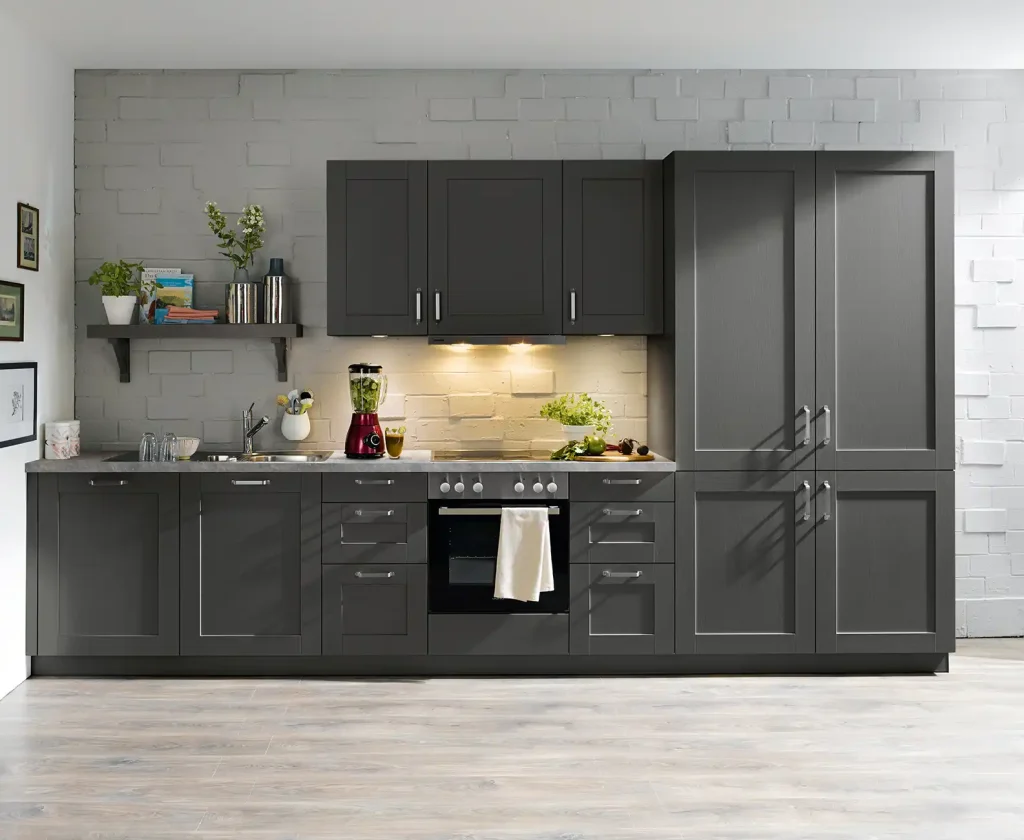
Etiket:Anthracite Kitchen Cabinet Turkey, Bathroom Cabinet Manufacturing Turkey, Grey Kitchen Cabinet Turkey, Lacquered Door Production Turkey, Louvered Door Kitchen Bathroom Manufacturing Turkey, Louvered Door Solid Wood Kitchen Cabinets Turkey, Mass Production Kitchen Bathroom Cabinets Turkey, Moisture-Resistant Kitchen Cabinet Turkey, Silk Matte Kitchen Cabinet Turkey, Solid Wood Door Production Turkey, Solid Wood Door Turkey, Solid Wood Door Window Production Turkey, Water-Resistant Bathroom Cabinet Turkey, White Kitchen Cabinet Turkey, Wooden Door Production Turkey

Şunları da sevebilirsiniz
Bathroom Cabinet Prices Turkey
Bathroom Cabinet Models Turkey