

Modern Lacquered Door Turkey
Modern Lacquered Door Turkey: The Definitive Technical Architecture, Manufacturing, and Global Specification Guide
The global landscape of interior architecture has undergone a radical transformation, accelerating toward minimalist, clean-lined, and technologically integrated design concepts. Within this high-end residential, premium commercial, and luxury hospitality market, the selection of interior openings has shifted from basic timber frames to highly engineered statement pieces.
Standing at the epicenter of this industrial evolution is the production and design of the modern lacquered door Turkey sector. Turkey has positioned its woodworking infrastructure as a premier global hub, successfully challenging traditional high-cost Western European joinery and low-quality, mass-produced alternatives.
By combining cutting-edge European automated machinery, advanced polymer and chemical engineering, and highly responsive logistics networks, Turkish manufacturers deliver interior doorsets that meet the strictest international building codes and design trends.
For international architects, real estate developers, wholesale distributors, and procurement officers, mastering the technical specifications, structural core physics, surface chemistry, and regulatory frameworks associated with a modern lacquered door Turkey is vital for establishing an efficient, high-performing, and structurally sound supply chain.
1. The Anatomy of a Modern Lacquered Door: Substrates and Material Science
To properly evaluate a modern lacquered door Turkey, it is necessary to move beyond surface aesthetics and analyze the composite materials that guarantee its decades-long structural lifespan. A modern industrial lacquered door is an advanced multi-layered engineered system, designed to resist the warping, bowing, and surface checking that plagues natural wood.
+-------------------------------------------------------------+

| THE MODERN LACQUER CHEMICAL AND CORE PROFILE                |
+-------------------------------------------------------------+

| [Top Finish]   Excimer Matte / High-Gloss Acrylic Topcoat   |
| [Color Layer]  Pigmented Polyurethane Base (RAL Balanced)   |
| [Pore Sealer]  Polyurethane Sanding Sealer Coating          |
| [Base Primer]  Dual-Layer High-Solid Polyester Primer       |
| [Face Skin]    Ultra-Flat 6mm - 8mm High-Density HDF        |
| [Inner Core]   Tubular Sauerland Board / Solid Wood Frame   |
+-------------------------------------------------------------+
High-Density Fiberboard (HDF) vs. Standard Medium-Density Fiberboard (MDF)
The quality of the exterior finish begins with the face skin. Lower-tier manufacturers utilize standard, low-density MDF, which absorbs liquid finishes unevenly and moves under atmospheric stress. Elite factories producing a modern lacquered door Turkey specify high-density fiberboard (HDF) or moisture-resistant, calibrated MDF panels with structural densities exceeding \(780 \text{ kg/m}^3\) to \(850 \text{ kg/m}^3\).
These panels are pressed using advanced thermo-hydro-polymeric processes, ensuring an isotropic substrate with uniform physical properties in all directions. This structural density prevents the absorption of environmental moisture through the edges of the door leaf. It also creates a perfectly flat plane, which is necessary to prevent surface waves or “orange-peel” distortion when applying high-gloss or ultra-matte finishes.
The Chemical Composition of Industrial Lacquers
The surface coating applied to a modern lacquered door Turkey is an engineered chemical matrix composed of specific primer, sealer, color, and protective top layers:
- Polyester Base Primers: Applied immediately after wood calibration, these high-solid coatings act as pore fillers. They create a non-porous chemical shield that prevents the volatile compounds within the wood fibers from off-gassing and disrupting the topcoat.
- Polyurethane (PU) Lacquer Colors: Formulated through the cross-linking reaction of multi-functional polyols with aliphatic polyisocyanates. Polyurethane represents the durability benchmark for modern interior doorsets, offering exceptional elasticity, impact resistance, and stone-like hardness.
- Acrylic Topcoats: Specified for high-exposure environments due to their absolute immunity to ultraviolet (UV) radiation. Acrylic polymers do not undergo the photochemical yellowing or color degradation that standard nitrocellulose or basic oil-based paints experience over time.
2. Core Engineering: Internal Configurations for Mechanical Performance
The longevity, safety, weight, and acoustic privacy of a modern lacquered door Turkey depend completely on the internal core matrix secured within the perimeter frame. Specifiers must choose the correct core configuration based on the intended acoustic and mechanical loads of each zone within the building layout.
Bored / Tubular Particleboard Core (Sauerland Spanplatte)
The global gold standard for premium modern interior doors is the tubular particleboard core, often referred to technically as bored particleboard.
- Physical Properties: Manufactured by compressing wood particles around horizontal cylindrical voids. It provides an optimized structural weight ranging from \(25 \text{ kg/m}^2\) to \(32 \text{ kg/m}^2\), paired with sound reduction values between 28 dB and 32 dB.
- Mechanical Performance: The horizontal tubes provide an integrated expansion chamber system. If a building experiences extreme shifts in relative humidity, the air pockets relieve internal structural pressures, ensuring that the external HDF skins do not bow or twist across the vertical axis.
- Target Application: High-end residential apartments, corporate executive offices, and luxury hotel guest enclosures.
Solid Wood Timber Blockboard Core
- Physical Properties: Formed by laminating kiln-dried, finger-jointed solid softwood strips (primarily maritime pine, spruce, or fir) side-by-side under heavy hydraulic pressure. This solid assembly is then capped with the primary HDF skin faces.
- Mechanical Performance: This core delivers an authentic, substantial weight (exceeding \(38\text{ kg}\) to \(45\text{ kg}\) per leaf) and a premium, solid closing impact sound. It features elite screw-retention capacity along its entire surface, making it necessary for mounting heavy, floor-to-ceiling architectural pull handles, pivot systems, and overhead magnetic door closers.
- Target Application: Main estate entrances, master bedroom suites, and luxury villas demanding premium weight and tactile feedback.
High-Tensile Kraft Honeycomb Core
- Physical Properties: Composed of an organic hexagonal cellular paper matrix expanded between a solid perimeter pine frame.
- Mechanical Performance: Exceptionally lightweight (\(12\text{ kg}\) to \(17\text{ kg}\) per leaf) with limited acoustic damping capacity (20 dB to 22 dB). The hexagonal grid layout distributes frontal impacts evenly, but it lacks structural mass.
- Target Application: Budget-conscious mass housing developments, interior walk-in closets, pantries, and secondary utility zones.
3. Surface Finish Innovations: Matte, High-Gloss, and Tactile Textures
The selection of surface finish for a modern lacquered door Turkey governs both its visual performance under architectural lighting and its resistance to daily wear in high-traffic commercial environments.
       LIGHT REFLECTION BEHAVIOR ACROSS FINISH TYPOLOGIES

      HIGH-GLOSS LACQUER (>95% Gloss)     EXCIMER ULTRA-MATTE (<5% Gloss)

         Specular Reflection                 Diffuse / Scattered Reflection
            \            /                        \       / / /
             \          /                          \     / / / /
   ___________v________/___________      ___________v_/_/_/_/______
   [Flawless Glass-Smooth Surface]       [Microscopic Topography Coating]
Excimer and Laser-Cured Ultra-Matte Finishes
Modern architectural styles have shifted strongly toward ultra-matte, non-reflective interior surfaces. Within the modern lacquered door Turkey production lines, this is achieved using advanced excimer laser curing technology:
- The final lacquer topcoat is subjected to short-wave UV excimer radiation in an oxygen-free nitrogen atmosphere.
- This process causes the top few nanometers of the liquid paint film to shrink and form a micro-textured, wrinkled topography prior to full curing.
- The Technical Result: This microscopic texture diffuses ambient light rays in all directions, yielding an absolute matte look (gloss retention level below 3% to 5% measured at a 60-degree angle) with a soft-touch texture.
- Anti-Fingerprint Advantage: The micro-surface limits the surface contact area available to human skin, making it highly resistant to oily hand smudges around the door handle zone.
Multi-Stage Polished High-Gloss Finishes
Achieving an authentic mirror finish on a modern lacquered door Turkey requires an intensive mechanical polishing process:
- The door leaf is coated with multiple layers of high-molecular-weight polyurethane or polyester lacquer, ensuring a thick coating film.
- Once fully cured, the door enters a sequential automated line where it is wet-sanded using fine orbital abrasives, progressing from 1500-grit up to 3500-grit to eliminate every trace of surface texture or microscopic ripple.
- The leaf passes beneath heavy-duty industrial buffing drums wrapped in fine lambskin wool pads. These drums apply progressive cutting compounds and polishing glazes at controlled speeds and temperatures.
- The Technical Result: A flawless finish with gloss retention parameters exceeding 95%, offering deep visual reflection that expands narrow hallways and corridors.
Textured Open-Pore Modern Hybrids
A major design trend within the modern lacquered door Turkey sector involves combining minimalist geometric paint colors with the organic texture of natural timber.
- Factories press a thick, genuine hardwood veneer (typically European White Oak, Exotic Ash, or American Walnut) onto the HDF face sheet.
- The panel is passed through heavy industrial wire-brushing cylinders, which strip away the soft earlywood fibers while leaving the dense latewood growth rings intact.
- The door is then coated with low-solid, highly elastic polyurethane lacquers. These coatings wrap tightly around the wire-brushed ridges without filling the pores.
- This preserves the tactile, three-dimensional grain of raw timber while sealing the door leaf against water spot damage, grease absorption, and environmental drying.
4. Architectural Design Typologies and Geometry
Modern design uses variations in surface milling, groove angles, and flush geometry to create distinct visual identities for interior doorsets.
Plain Monolithic Flush Models (Düz Lake Modelleri)
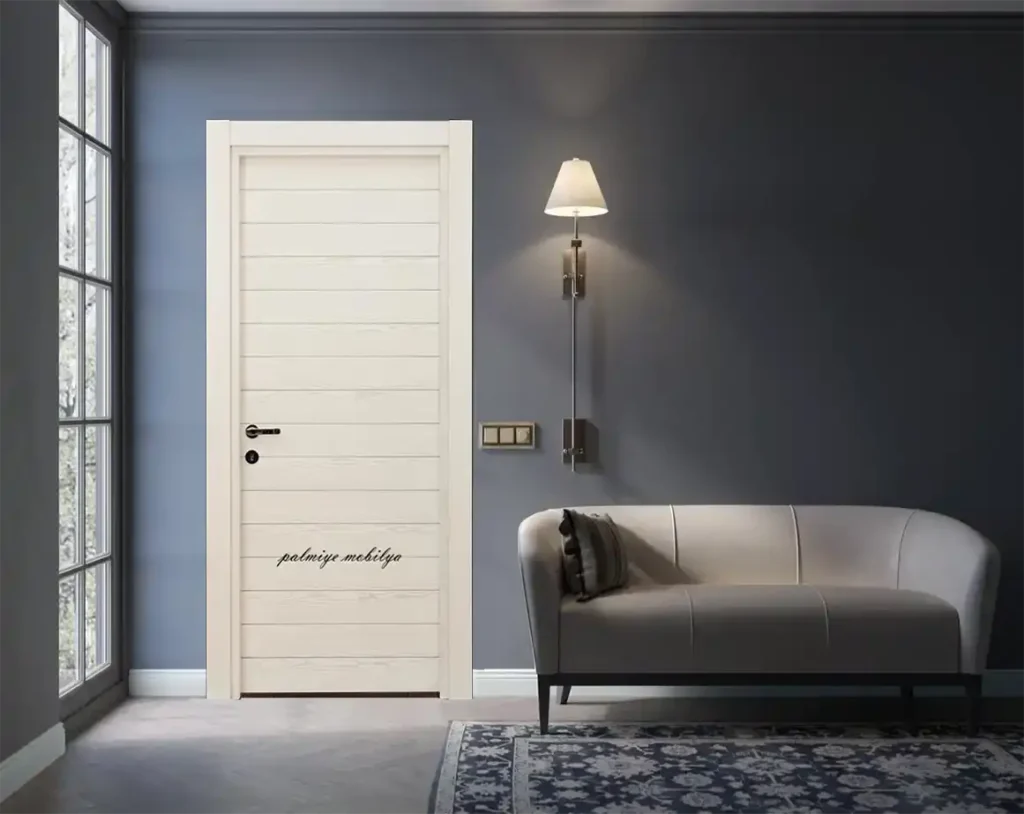
The plain flush model features a completely flat, unbroken, planar surface with zero routing, grooves, or surface relief.
- The Technical Challenge: This model represents the ultimate test of manufacturing discipline. Because there are no geometric lines to distract the eye, any dust particle contamination in the cleanroom or slight wave in the internal frame construction will be highly visible under directional ceiling spotlights.
- Architectural Application: Clean-lined modern interiors where the door is intended to match adjacent wall finishes exactly, functioning as a continuous, quiet plane within the space.
CNC Grooved Geometric Models (Derzli / Çizgili Modeller)
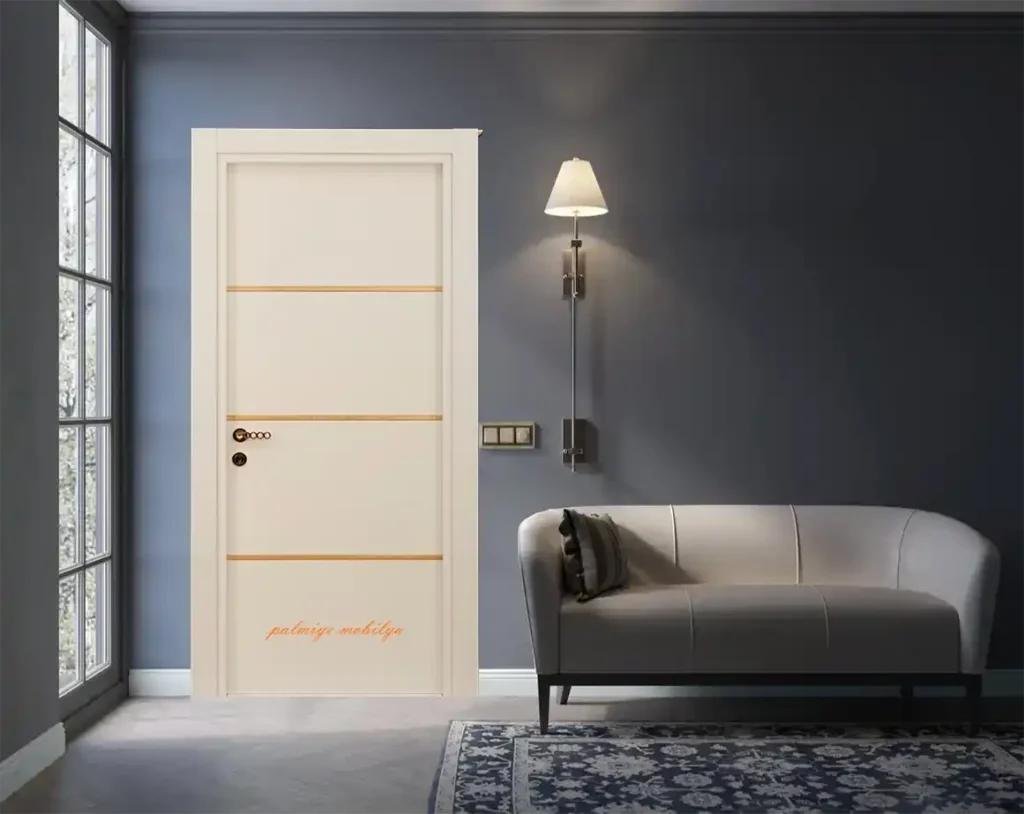
By leveraging 3-axis and 5-axis computer numerical control (CNC) routing machinery, manufacturers of the modern lacquered door Turkey lines can cut complex vector paths directly into the thick HDF face panel prior to the priming cycle.
       SHARP V-GROOVE GEOMETRY               ROUNDED U-GROOVE GEOMETRY
    +---------------------------+         +---------------------------+

    |                           |         |                           |
    |   \                   /   |         |   |                   |   |
    |    \                 /    |         |   |                   |   |
    |     \               /     |         |   |                   |   |
    |      \             /      |         |   |___________________|   |
    |_______\===========/_______|         |___________________________|
      (Provides High Contrast,              (Provides Soft, Diffused
       Sharp Architectural Shadows)          Scandinavian/Japandi Shadows)
- V-Groove Engineering: Carved using a sharp, V-shaped diamond-tipped router bit (typically 60-degree or 90-degree angles) at depths ranging from 1.5mm to 3.5mm. This incision creates sharp architectural lines and distinct contrast shadows when overhead ambient light hits the door surface.
- U-Groove Engineering: Carved using a rounded ball-nose router tool, creating a soft, concave trough ranging from 4mm to 12mm wide. This design softens shadow transitions, making it highly compatible with modern organic, Scandinavian, and Japandi design languages.
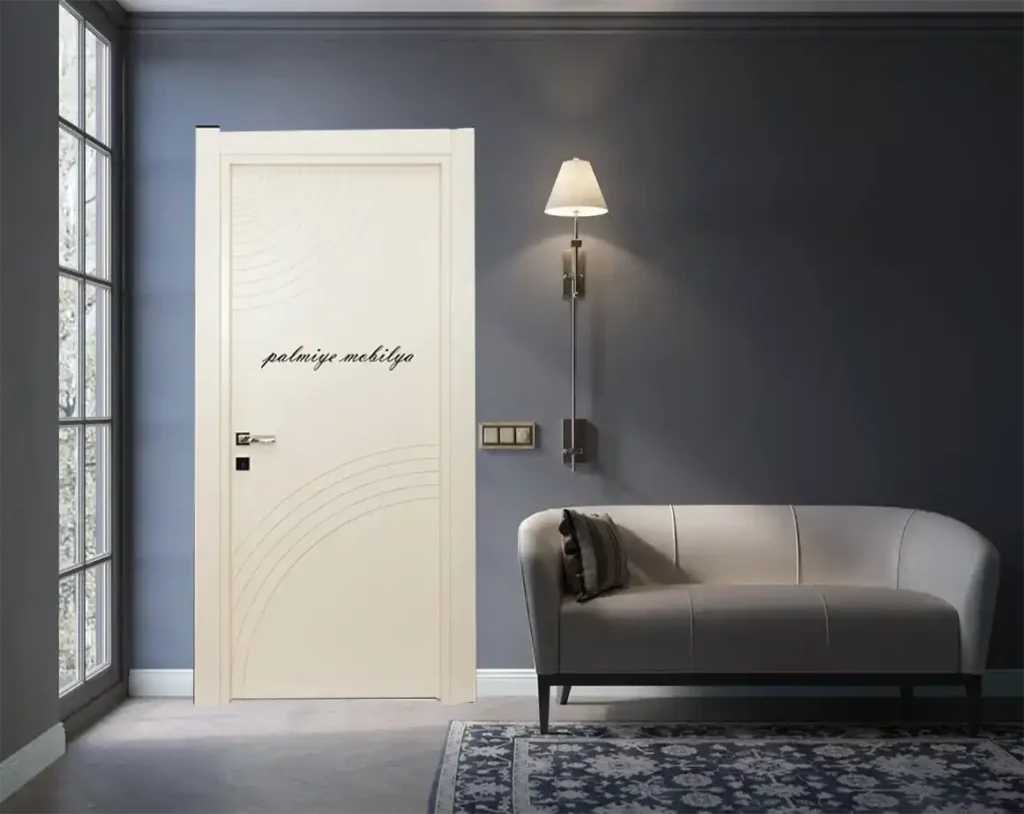
- Asymmetric Linear Layouts: Instead of standard horizontal patterns, modern layouts utilize single or triple offset vertical grooves running parallel to the handle side of the door, creating an elegant visual anchor point.
Minimalist Shaker and Modern Inset Panels
Modernizing traditional paneling involves stripping away complex colonial step profiles and decorative ogee moldings. Modern Turkish shaker variants utilize sharp, 90-degree square routing profiles. The recessed central panel drops down via a single clean step, creating deep shadows while maintaining crisp geometry that complements modern custom cabinetry.
5. Framing Systems and Flush-to-Wall Integration Architecture
A door leaf is only as functional as the framing platform supporting it. The modern lacquered door Turkey industry has engineered advanced framing systems that alter how doors integrate with interior walls.
Hidden / Concealed Frame Flush-to-Wall Systems (Görünmez Kasa / Filo Muro)
This represents the pinnacle of modern structural minimalism, eliminating visible casings, architraves, and protruding trims entirely.
      CONCEALED FRAME REBAR & WALL ALIGNMENT
===================+     +==================================
 Finished Plaster  |     | Door Leaf (Seamless Polyurethane)
===================|     |==================================
                 +-|-+   |

                 | | |   | <-- 3D Adjustable Invisible Hinge
              +--+-+-+---+

              |  | | |
              |  +---+ <-- Recessed Structural Aluminum Frame

              |  |
+-------------+--+-----------------------------------------+

| Drywall Metal Stud / Structural Masonry Core Wall         |
+----------------------------------------------------------+
- Mechanical Structure: Traditional wooden frames are replaced with a heavy-gauge, structural extruded aluminum sub-frame. This aluminum profile is mounted directly to the raw structural brickwork masonry or steel stud drywall framing before plastering.
- Integration Chronology: Once anchored, the aluminum frame is plastered over, making it invisible. The door leaf is then hung using three-dimensional adjustable concealed hinges.
- The Finished Aesthetic: When closed, the door sits completely flush with the wall plane, separated only by a clean 2mm perimeter shadow gap.
- Warp-Adjuster Engineering: Because a deviation of even 1.5mm would ruin the flush alignment of an invisible doorset, top Turkish manufacturers install internal steel tension rods (warp adjusters) along the length of the door core. Installers can adjust these hidden rods via a tensioning port at the top of the door to counteract any structural bowing caused by seasonal climate shifts between adjacent rooms.
Telescopic Adjustable Engineered Wood Frames
For standard modern designs that include architraves, Turkish factories use telescopic adjustable frame setups:
- Substrate Composition: Built using a high-stability sandwich structure: a core of finger-jointed solid timber bonded between thick outer layers of high-density MDF. This composite design provides excellent mechanical screw retention for heavy hinge hardware while ensuring a smooth surface for the lacquer finish.
- Telescopic Flexibility: The architrave features an integrated tongue extension that slots directly into a matching groove cut into the main frame body. This allows the frame to expand or contract to match varying wall thicknesses (e.g., smoothly adjusting from 120mm to 160mm walls) on site without custom cutting.
6. Technical Sourcing, Global Import-Export, and Logistics
Sourcing a large volume of modern lacquered door Turkey units for international commercial construction projects requires careful quality control, structured payment safeguards, and strict freight handling protocols.
Essential Quality Assurance (QA) Factory Inspections
When auditing a Turkish production line or receiving product samples, procurement teams should enforce specific material testing procedures:
- The Cross-Cut Adhesion Test (ISO 2409): Instruct the factory’s quality control team to perform a cross-cut grid test on a finished panel sample. A multi-blade cutter makes a lattice incision through the lacquer film down to the HDF substrate. High-tack test tape is applied firmly over the lattice and pulled away rapidly. A high-quality lacquer application will show zero flaking or square detachment, proving a permanent chemical bond.
- Digital Gloss-Meter Verification: Use a digital gloss-meter to measure surface reflectivity across multiple points on the door leaf face. The deviation across a single door panel, or across a batch of 500 doors, must not exceed \(\pm 1.5\%\) to guarantee visual consistency across the project site.
- Formaldehyde Emission Testing (EN 13986): Ensure all composite wood elements carry certified E1 or E0 emission ratings. This ensures the doorsets do not off-gas toxic formaldehyde vapors into tight, climate-controlled interior living spaces.
Packaging Engineering for Safe Shipping
The highly polished or smooth matte surface of a modern lacquered door is sensitive to transport vibration, corner impacts, and marine humidity. Elite Turkish exporters implement a multi-layer protective packaging system:
        PALLETIZATION STRATIFICATION AND PROTECTION
+-------------------------------------------------------------+

| [PET Banding]      High-Tensile Polyethylene Strapping Bands|
| [Buffer Plate]     Rigid 12mm MDF Top and Bottom Shield Board|
| [Edge Board]       High-Density V-Shaped Corner Guards       |
| [Cargo Wrapping]   Moisture-Proof Stretch Film Encapsulation |
| [Core Cargo]       Individual Corrugated Boxes + EPE Foam Sheets|
| [Pallet Base]      ISPM 15 Certified Heat-Treated Wood Pallet|
+-------------------------------------------------------------+
Container Volumetric Optimization Best Practices
For ocean freight container logistics originating from major Turkish ports (such as Ambarlı, Mersin, or Kocaeli), calculations must maximize cargo space without exceeding structural weight limits:
- 20ft Standard Container (20’GP): Accommodates approximately 160 to 210 complete doorsets (leaves, frames, and architraves packed on pallets), depending on frame dimensions.
- 40ft High Cube Container (40’HC): Accommodates approximately 420 to 520 complete doorsets. Pallets are engineered to be double-stacked safely inside a High Cube container, which provides an internal height of 2.70 meters.
- Horizontal Stacking Requirement: Doors must be packed flat horizontally on structural wooden pallets. Vertical stacking on edge is discouraged for long transit voyages, as constant transit vibrations can cause deep pressure marks along the bottom edge of the lacquered door leaf.
7. Comparative Performance Matrix: Lacquer vs. Substitute Industrial Coatings
To justify specifying a premium modern lacquered door Turkey over economical alternative finishes, architects and developers can evaluate how different surface treatments compare across key mechanical and aesthetic performance metrics:
| Performance Criterion | Modern Lacquered Doors | PVC / Vinyl Thermo-Wrapped | High-Pressure Laminate (HPL) | Polypropylene (PP) Eco-Foils |
|---|---|---|---|---|
| Edge Seam Integrity | Elite & Monolithic: Continuous liquid application ensures a 3D seamless wrap with zero tape lines or visible joint interfaces. | Vulnerable to Heat: Vinyl foils can peel back or delaminate when exposed to localized heat or moisture. | Visible Edge Bands: Requires ABS/PVC edge-taping, creating a visible line along all corner edges. | Wrapped Faces: Continuous wrapped face, but can tear or separate at sharp corner points. |
| Color Spectrum Customization | Infinite: Direct chemical matching to any global RAL Classic, NCS, or Pantone color index database. | Restricted: Limited to pre-manufactured foil rolls available in the film supplier’s inventory. | Rigid Collections: Restricted to standardized manufacturer catalog collections. | Fixed Prints: Limited to mass-market color lines and simulated grain prints. |
| On-Site Field Repairability | High: Surface scratches and dents can be filled, re-sanded, and spot-sprayed or buffed by a technician. | Zero: A torn, scorched, or punctured vinyl film wrap cannot be patched; leaf replacement is mandatory. | Extremely Low: Surface punctures or deep gouges require complete replacement of the face panel. | Low: Superficial scratches remain permanent; touch-up wax sticks offer only a temporary cosmetic fix. |
| Aesthetic Premium Feel | Elite Luxury: Soft-touch matte or mirror-gloss finishes that feel solid and premium. | Medium to Low: Surface texture can appear synthetic or plastic-like under bright architectural lighting. | Commercial / Rigid: Excellent structural density, but carries a hard, cold commercial surface feel. | Economy Functional: Designed for budget-conscious interior fit-outs; limited tactile depth. |
8. Specialty Configurations: Acoustic and Fire-Rated Modern Doorsets
Modern commercial developments—particularly in the hospitality, healthcare, and multi-family high-rise residential sectors—demand strict compliance with regional safety codes without compromising minimalist aesthetics.
Fire-Rated Modern Lacquered Systems (EN 1634-1 & BS 476)
Certified manufacturers within the modern lacquered door Turkey sector can produce fire-rated doorsets that look identical to standard non-rated interior doors.
- The Internal Fire Matrix: The standard particleboard core is replaced with a dense, non-combustible mineral core or specialized multi-layer fire-resistant fiberboard sheets.
- Intumescent Perimeter Seals: Hidden slots are routed along the inner edges of the door frame or leaf to house graphite-based intumescent strips.
- The Activation Mechanism: In the event of a fire, the extreme heat causes these intumescent strips to expand up to 25 times their original volume. This seals the perimeter gap between the leaf and frame, blocking toxic smoke, gases, and thermal energy from entering adjacent rooms for 30 minutes (FD30) or 60 minutes (FD60).
Acoustic Privacy Engineering (ISO 10140-2)
Achieving a high acoustic drop rating requires engineering the entire doorset assembly as a unified sound barrier system:
- The Core Weight: The door core must utilize extra-dense, multi-layered acoustic particleboard panels wrapped inside heavy HDF face skins.
- Dual Perimeter Gaskets: The frame rebate must incorporate twin channels fitted with high-elasticity EPDM or silicone rubber compression seals to eliminate perimeter air gaps when the door is latched.
- Automatic Drop-Down Bottom Seals (Guillotine Seals): A heavy-duty, spring-activated mechanical sealing device is mortised into a hidden channel running along the bottom edge of the door leaf.
      AUTOMATIC DROP-DOWN ACOUSTIC BOTTOM SEAL MECHANISM
+-------------------------------------------------------+

| Door Leaf Structure (Dense Particleboard Core)        |
|                                                       |
|   +-----------------------------------------------+   |
|   | Hidden Internal Mechanical Spring Actuator    |   |
|   +-----------------------------------------------+   |
+---|-------------------|---------------------------|---+

    |                   | (When Door Closes, Pin    |
    v                   v  Presses Frame Hinge Side)v
  =======================================================
  [Heavy EPDM Rubber Gasket Deploys Downward to Floor Plane]
  =======================================================
  -------------------------------------------------------
  Finished Ceramic / Timber Floor Level
- The Operation Principle: When the door closes completely, an exposed actuator button on the hinge side of the leaf presses against the frame casing. This activates an internal spring mechanism that drops a heavy EPDM rubber gasket downward against the floor plane. This seals the lower gap, blocking air and sound transmission while keeping the floor clear of bulky metal thresholds when the door is open.
9. Architectural Hardware Integration and CNC Prep
Modern interior architecture requires hardware to be as visually quiet as possible. This aesthetic demand relies on precision CNC machining at the factory level prior to the application of the final lacquer coating.
3D Adjustable Invisible Hinges
Standard butt hinges break the clean vertical lines of a modern frame casing. Modern minimalist installations specify invisible hinges that are recessed entirely into mortised pockets cut into both the door leaf edge and the inner frame rebate.
- The Adjustment Advantage: These precision components allow the site installation team to adjust the hanging door leaf across three independent axes (height, horizontal alignment, and compression depth) using a simple hex key. This makes it possible to establish clean, uniform 2mm perimeter margins around every door in the building.
- Factory Prep Requirement: Pockets must be routed with sub-millimeter precision using 5-axis CNC routers before the door enters the cleanroom painting cycle. This ensures that the interior of the routed cavities receives full primer and lacquer sealing, protecting the wood fibers from ambient moisture absorption.
Magnetic Mortise Lock Cases
Modern project specifications frequently feature advanced magnetic locks rather than traditional mechanical spring latches:
- The Visual Advantage: The magnetic latch bolt remains retracted flush within the door leaf profile while the door is in the open position. Only when the leaf closes completely does the integrated magnet inside the frame strike plate pull the latch bolt forward into the frame rebate pocket.
- The Functional Advantage: This system eliminates the protruding metal latch of traditional locks, preventing physical fabric snags, reducing closing noise, and maintaining clean visual lines along the edge of the open door leaf.
10. Technical Quality Auditing and On-Site Installation Protocols
Sourcing a high-quality product from the modern lacquered door Turkey network is only half the battle. Poor site management or incorrect installation sequencing can ruin a high-quality lacquered finish. Project managers must enforce strict on-site storage and assembly rules.
       CHRONOLOGICAL CONSTRUCTION SEQUENCING
+-------------------------------------------------------+

| PHASE 1: Complete All Structural Wet Works            |
| (Plastering, Concrete Screeding, and Tiling Dry Time) |
+-------------------------------------------------------+
                           |
                           v
+-------------------------------------------------------+

| PHASE 2: HVAC System Activation and Stabilization      |
| (Maintain Site RH between 40% and 60% for 7 Days)     |
+-------------------------------------------------------+
                           |
                           v
+-------------------------------------------------------+

| PHASE 3: Sub-Frame Fixing via Low-Expansion PU Foam   |
| (Avoid Structural Pressure Distortion on Casings)     |
+-------------------------------------------------------+
                           |
                           v
+-------------------------------------------------------+

| PHASE 4: Leaf Hanging and 3D Hinge Calibration        |
| (Calibrate Margins to Constant 2mm Clearance Gaps)    |
+-------------------------------------------------------+
On-Site Environmental Protection Rules
Lacquered finishes are refined architectural millwork products and must be handled with the same care as high-end custom kitchen cabinetry:
- Strict Wet Trades Prohibition: Doorsets must never be unboxed or installed while wet construction trades are active. All wall plastering, cement floor screeding, and ceramic wall tiling must be 100% dry. The building’s heating, ventilation, and air conditioning (HVAC) system must be fully operational for at least 7 days to stabilize interior conditions. Moisture trapped in a sealed building will migrate into doors through unsealed lock and hinge cutouts, causing the core to expand.
- Atmospheric Parameters: Maintain indoor relative humidity strictly between 40% and 60%, and ambient room temperatures between 15°C and 25°C.
- Low-Expansion Polyurethane Assembly Foam: When fixing the door frame into the wall opening, installers must use professional-grade, low-expansion polyurethane foam. High-expansion consumer foams generate significant curing pressure that can bow or distort even heavy timber sandwich frames, pulling the leaf out of alignment.
Conclusion
The market for a modern lacquered door Turkey provides global architects, real estate developers, and wholesale distributors with an engineered solution that balances high-end minimalism with robust mechanical performance. By utilizing high-density HDF substrates, selecting target core architectures like tubular particleboard for sound damping, mastering modern coatings like anti-fingerprint excimer matte, and engineering advanced integration options like hidden flush-to-wall frames, Turkish production centers deliver elite interior doorsets.
When backed by rigorous factory quality audits, accurate CAD pattern sign-offs, and correct chronological on-site installation protocols, these modern lacquered door systems function as durable, valuable architectural assets that elevate modern real estate developments worldwide.
Butik Otel Mobilyaları
Butik Otel Mobilyaları



Şunları da sevebilirsiniz
Rustic Lacquered Door Manufacturing Turkey
Lacquered Door Export Import Turkey