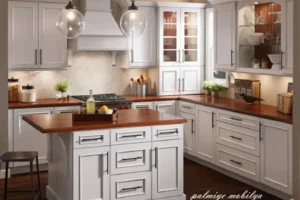

Solid Wood Kitchen Turkey
Solid Wood Kitchen Turkey: The Ultimate Guide to Luxury, Craftsmanship, and Material Science
Introduction to the Turkish Solid Wood Kitchen Industry
The global demand for high-end, sustainable kitchen furniture has placed a bright spotlight on Solid Wood Kitchen Turkey manufacturing. Turkey has emerged as a premier hub for bespoke cabinetry, blending centuries-old Mediterranean woodwork traditions with cutting-edge German and Italian machinery.
Unlike flat-pack alternatives made from particleboard or Medium-Density Fiberboard (MDF), a solid wood kitchen represents a lifetime investment. It delivers unmatched structural integrity, natural thermal insulation, and an organic aesthetic that matures beautifully over decades.
This comprehensive guide explores the material science, manufacturing techniques, timber species, design styles, and sourcing logistics that define the premium solid wood kitchen market in Turkey.
1. Timber Species Selection in Turkish Cabinetry
The backbone of any premium Solid Wood Kitchen Turkey project is the choice of wood species. Turkey’s unique geographic location spans multiple climate zones, providing access to diverse domestic forests alongside sustainably imported European and African hardwoods.
Turkish White Oak (Meşe)
- Density and Hardness: Oak features a Janka hardness rating of approximately 1,290 lbf, making it exceptionally resistant to dents and scratches.
- Grain Pattern: Characterized by prominent, open grain structures with striking medullary rays when quarter-sawn.
- Best Used For: Shaker-style doors, heavy-duty island worktops, and rustic or farmhouse aesthetics. Oak responds beautifully to wire-brushing and reactive stains.
Anatolian Walnut (Ceviz)
- Density and Hardness: Striking a balance at around 1,010 lbf on the Janka scale, walnut offers excellent dimensional stability.
- Color Palette: Renowned for its rich, deep heartwood ranging from light coffee brown to dark chocolate, often accented by creamy sapwood streaks.
- Best Used For: Modern minimalist slab doors, handleless premium kitchens, and high-contrast accent panels. Walnut is naturally oily, providing innate moisture resistance.
Nordic Beech (Akgürgen / Kayın)
- Density and Hardness: Clocking in at 1,300 lbf, beech is incredibly dense and shock-resistant.
- Grain Pattern: Features a fine, tight, uniform grain with inconspicuous growth rings, providing a remarkably smooth surface.
- Best Used For: Painted kitchen cabinetry. Its uniform texture prevents grain-ghosting through lacquer or polyurethane paint coats, ensuring a flawless matte or gloss finish.
Premium Ash Wood (Dişbudak)
- Density and Hardness: Highly resilient with a Janka rating of 1,320 lbf.
- Characteristics: Possesses elasticity similar to oak but with a distinctively brighter, whiter natural hue.
- Best Used For: Contemporary scandinavian-style kitchens or contemporary dark-stained designs where the dramatic grain structure needs to remain visible under a black or charcoal finish.
2. Engineering and Structural Anatomy of Solid Wood Kitchens
A common misconception is that a solid wood kitchen is carved out of single, massive planks of wood. In reality, raw timber is highly susceptible to hygroscopic movement—expanding and contracting with fluctuations in kitchen humidity and temperature.
To prevent warping, twisting, or cupping, Turkish master craftsmen utilize advanced timber engineering.
+---------------------------------------------------------+

|                  FIVE-PIECE SHAKER DOOR                 |
+---------------------------------------------------------+

|                       TOP RAIL                          |
|  +---------------------------------------------------+  |
|  |                                                   |  |
|  |                                                   |  |
|S |                                                   |S |
|T |                                                   |T |
|I |                  FLOATING PANEL                   |I |
|L |             (Housed in deeper grooves)            |L |
|E |                                                   |E |
|  |                                                   |  |
|  |                                                   |  |
|  +---------------------------------------------------+  |
|                      BOTTOM RAIL                        |
+---------------------------------------------------------+
Engineered Multi-Layer Core (Three-Ply Solid Board)
For modern slab doors, manufacturers create three-ply or five-ply solid wood blanks.
- The core layer consists of solid wood strips arranged vertically.
- The outer layers consist of solid wood elements running horizontally.
- This cross-lamination technique neutralizes the natural internal stresses of the wood, rendering the panel dimensionally stable across all axes.
The 5-Piece Mortise and Tenon Framework
For classic and Shaker-style doors, the traditional five-piece construction is utilized. This assembly consists of two vertical stiles, two horizontal rails, and a center floating panel.
- The panel is not glued tightly inside the frame; instead, it sits within deep grooves, allowing it to expand and contract freely behind the frame as seasons change, preventing structural cracking.
Dovetail Joinery for Drawer Boxes
Premium Turkish workshops reject staples, nails, or basic dowel joints for drawer construction. Instead, they employ English or French interlocking dovetail joinery. The wedge-shaped fingers lock together mechanically, creating a high-tensile bond that withstands decades of daily pulling forces without separating.
3. The Seasoning and Kiln-Drying Process
The longevity of a Solid Wood Kitchen Turkey relies heavily on the moisture management of the raw lumber before it ever touches a CNC machine. Freshly felled timber contains up to 50% water weight. Processing wood at this stage guarantees catastrophic warping post-installation.
Step 1: Air Drying (Pre-seasoning)
Lumber is stacked in open-air yards with spacer sticks between boards to maximize airflow. This gradual process takes anywhere from 6 to 24 months, reducing moisture content down to roughly 15-20%.
Step 2: Computerized Kiln Drying
The wood enters sealed kiln chambers where temperature, humidity, and airflow are strictly monitored via automated sensors. Over several weeks, the moisture content is precisely drawn down to 6% to 8%. This specific range matches the average indoor equilibrium moisture content (EMC) of residential homes globally, freezing the cellular structure of the wood into permanent stability.
Step 3: Stress Relieving (Conditioning)
Before machining, the kiln-dried timber is left to rest in a temperature-controlled acclimatization zone for 48 to 72 hours. This step equalizes any residual internal stresses between the core and the outer shell of the lumber.
4. Advanced Finishing and Surface Treatements
Kitchen environments subject wood surfaces to challenging conditions: grease, boiling water vapors, acidic citrus spills, and abrasive cleaning agents. Turkish manufacturers implement multi-stage chemical and organic coating lines to guarantee surface durability.
| Finish Type | Chemical Composition | Aesthetics | Maintenance Level | Repairability |
|---|---|---|---|---|
| Polyurethane Acrylic Lacquer | Synthetic cross-linked polymers | Ultra-smooth, matte to high gloss | Extremely Low | Difficult (Requires sanding & spraying) |
| Natural Hardwax Oils | Linseed/tung oil base with carnauba wax | Matte, tactile, organic wood feel | Medium (Requires re-oiling every 2 years) | Extremely Easy (Spot-repairable without stripping) |
| Water-Based Eco-Coatings | Low-VOC acrylic emulsions | Natural matte with slight grain texture | Low | Moderate |
The UV Curing Line Process
For high-volume, premium production, Turkish factories utilize automatic flat-line sprayers connected to UV curing tunnels.
- The solid wood components are sanded to 240-grit smoothness.
- A photo-reactive base coat is applied.
- High-intensity ultraviolet lamps instantaneously cure the finish, cross-linking the molecules into an impenetrable, scratch-resistant barrier.
5. Architectural Kitchen Design Styles Offered in Turkey
Turkish design houses cater to international markets, resulting in a highly versatile range of aesthetic treatments for Solid Wood Kitchen Turkey projects.
       +-----------------------+-----------------------+

       |                       |                       |
       |  TRADITIONAL COUNTRY  |   CONTEMPORARY SLAB   |
       |                       |                       |
       |  - Raised panels      |  - Continuous grain   |
       |  - Intricate corbels  |  - Handleless J-Pull  |
       |  - Distressed glaze   |  - Integrated LEDs    |
       |                       |                       |
       +-----------------------+-----------------------+
Traditional and Mediterranean Country Style
- Design Accents: Turned columns, crown moldings, corbels, fluted pilasters, and integrated plate racks.
- Surface Finishes: Antique glazing, distressing techniques, and patinas that emphasize the wood’s deep history and character.
The Modern Handleless Minimalist Style
- Design Accents: J-pull or true handleless profiles integrated directly into the solid wood edge using 5-axis CNC cutters.
- Surface Finishes: Sequential book-matching, where consecutive solid timber slabs are cut and laid out in order, ensuring the natural grain pattern flows uninterrupted across every drawer and door front.
Transitional Shaker Style
- Design Accents: Clean lines with crisp 90-degree internal steps, avoiding ornate profiles.
- Surface Finishes: Often paired with deep muted tones like navy blue, forest green, or charcoal grey paint finishes, showcasing just a subtle hint of the underlying wood grain texture.
6. Carcass Construction: Solid Wood vs. Premium Plywood
While clients focus primarily on the external door panels, the choice of material for the internal cabinet boxes (carcasses) dictates the ultimate longevity of the kitchen.
Option A: 100% Solid Finger-Jointed Carcasses
- Pros: Ultimate luxury value, homogenous material composition, high resale value for the property.
- Cons: Marginally heavier, demands strict humidity controls within the home.
Option B: Marine-Grade Birch Plywood Carcasses
- Pros: Cross-layered birch veneers bonded under extreme pressure with phenolic resins. Plywood is exceptionally stable and completely immune to warping. It offers superior screw-holding power compared to solid wood or MDF.
- Cons: Visible multi-ply edges (which are typically covered with solid hardwood edge-banding).
Turkish high-end manufacturers strongly recommend marine-grade plywood or blockboard carcasses finished with real wood veneer for the cabinet boxes, combined with completely solid wood for the face frames, drawers, and doors. This configuration offers the best performance against plumbing leaks and structural loads.
7. Integrating State-of-the-Art Functional Hardware
A luxury kitchen must function flawlessly. Turkish manufacturers cooperate with premium European hardware brands to complete their custom cabinetry builds.
- Concealed Hinges: Blum Blumotion or Grass Tiomos soft-close hinges with 3D micro-adjustability (height, side, and depth alignment) rated for 200,000 opening cycles.
- Drawer Runners: Under-mount heavy-duty synchronized runners capable of supporting dynamic weights up to 40kg or 70kg per drawer without sagging.
- Space Optimization: Magic corners, tandem larders, and motorized touch-to-open servo systems integrated directly into the solid wood drawer configurations.
8. Environmental Sustainability and Certifications
Modern consumers demand transparency regarding deforestation. The Turkish forestry and wood manufacturing sector operates under strict European Union equivalent ecological frameworks.
FSC (Forest Stewardship Council) Compliance
Reputable Solid Wood Kitchen Turkey providers source raw lumber from forests certified by the FSC. This ensures that for every tree harvested, a calculated number of saplings are planted, preserving biodiversity and forest health.
E0/E1 Formaldehyde Safety Ratings
Even when working with solid wood, adhesives are used for finger-joints and plywood backings. Turkish manufacturers utilize E0 or E1 certified non-toxic glues, ensuring zero volatile organic compound (VOC) off-gassing into the residential home environment.
9. Step-by-Step Production Process: Sourcing to Delivery
Understanding the logistics timeline when ordering a bespoke solid wood kitchen from Turkey ensures a smooth installation process.
+-------------+      +-------------+      +-------------+      +-------------+

| 1. Design & | ---> | 2. Material | ---> | 3. Precision| ---> | 4. Surface  |
| 3D Modeling |      | Accclimatize|      | CNC Cutting |      | Finishing   |
+-------------+      +-------------+      +-------------+      +-------------+
                                                                      |
+-------------+      +-------------+      +-------------+             |

| 7. On-Site  | <--- | 6. Sea/Land | <--- | 5. Factory  | <------------+
| Installation|      |   Freight   |      | Pre-Assembly|
+-------------+      +-------------+      +-------------+
- Design and 3D Modeling: Technical architects convert the kitchen floor plans into millimeter-precise CAD/CAM drawings.
- Material Acclimatization: Selected wood species are brought into the cutting workshop to adapt to local humidity levels.
- Precision CNC Cutting: Advanced 5-axis computer-numeric-control milling machines cut joints, mortises, and hinge locations with zero tolerance for error.
- Surface Finishing: Components pass through manual sanding, staining, base-coating, intermediate sanding, and top-coating.
- Factory Pre-Assembly: Cabinets are fully assembled on the factory floor to check tolerances, hardware alignment, and grain matching.
- Disassembly and Custom Crating: Modules are carefully packed into multi-layer bubble wrap, edge-protectors, and heavy-duty wooden crates designed for international sea or land freight.
- On-Site Installation: Local or dispatched factory teams assemble the custom modules on-site, securing them to structural wall systems.
10. Cost Matrix and Investment Valuation
Investing in a Solid Wood Kitchen Turkey balance sheet shows clear fiscal advantages when analyzed over a long-term property ownership timeline.
While the initial capital expenditure for a solid wood build is higher than modular laminated particleboard options, the total lifecycle cost is significantly lower. A laminated kitchen often requires full replacement within 7 to 10 years due to edge peeling, water damage, or sagging. In contrast, a solid wood kitchen can last well over half a century, with the ability to be sanded, repaired, and completely repainted multiple times to suit changing design trends.
Moreover, custom high-end solid wood millwork adds tangible equity value to luxury residential properties, yielding a strong return on investment (ROI) during property appraisals.
11. Maintenance Protocol for Multi-Decade Preservation
To guarantee that a solid timber kitchen retains its structural integrity and finish sheen for decades, owners should adhere to a strict care protocol.
- Humidity Calibration: Maintain indoor relative humidity levels between 40% and 60%. Drastic drops in humidity (common during peak winter heating) can cause wood cells to shrink and split, while excess humidity can cause swelling. Using a home humidifier/dehumidifier protects the woodwork.
- Cleaning Formulations: Avoid all cleaning products containing ammonia, bleach, silicone, or abrasive scrubbing powders. Use a soft, slightly damp microfiber cloth paired with a pH-neutral, diluted soap solution. Always wipe in the direction of the natural wood grain pattern rather than in circular motions.
- Spill Mitigation: Standing liquid near the sink or under a dishwasher must be dried immediately. Water allowed to sit on a wood joint for extended periods can eventually penetrate even premium polyurethane topcoats via capillary action.
Conclusion: Why Source Your Solid Wood Kitchen from Turkey?
The modern Solid Wood Kitchen Turkey sector represents a compelling synthesis of industrial capacity and artisanal dedication. Turkey offers access to top-tier, sustainably harvested European timber reserves, state-of-the-art CNC machining technology, and master joiners who possess deep generational knowledge of wood behavior.
By understanding the technical parameters outlined in this guide—from kiln-drying optimization to engineered cross-grain stabilization—architects, interior designers, and discerning homeowners can confidently navigate the custom sourcing process, yielding a kitchen space that serves as both a high-performance workspace and an enduring architectural centerpiece.

Şunları da sevebilirsiniz
Natural Wood Kitchen Turkey
Bathroom Cabinets Export Import Turkey