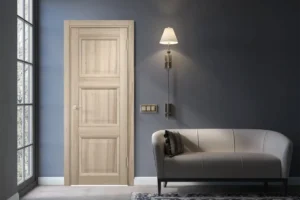

Door Models Turkey
Door Models Turkey: The Ultimate Guide to Premium Turkish Doors
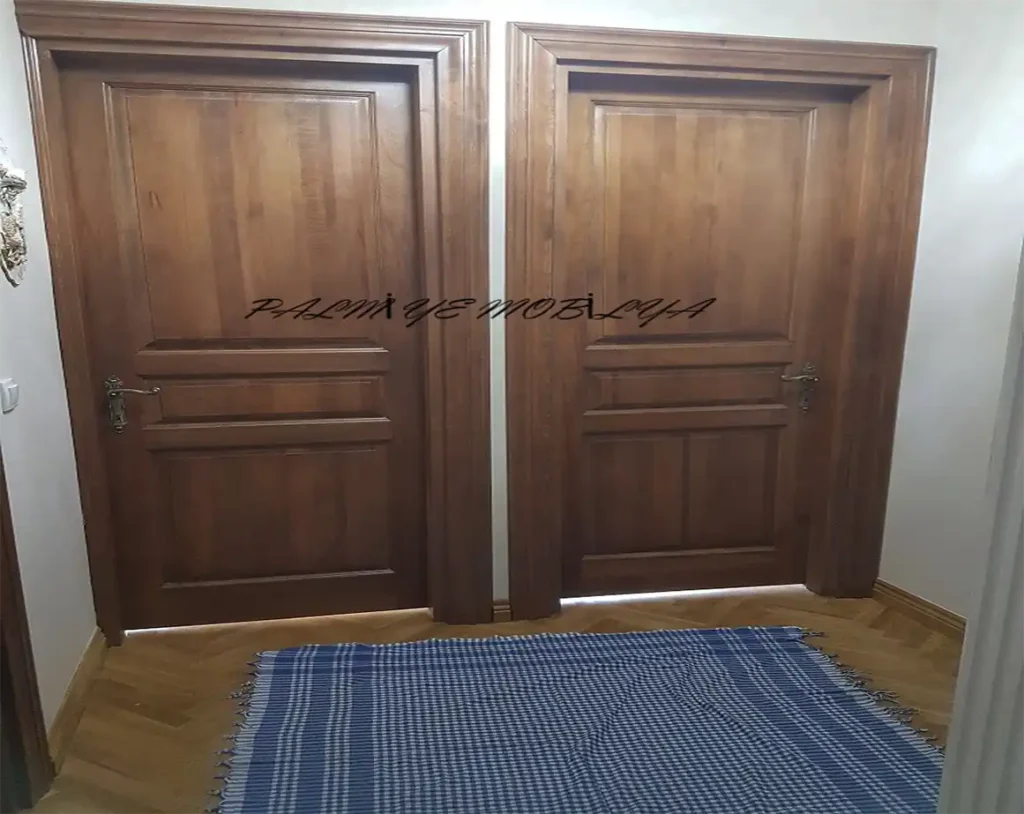
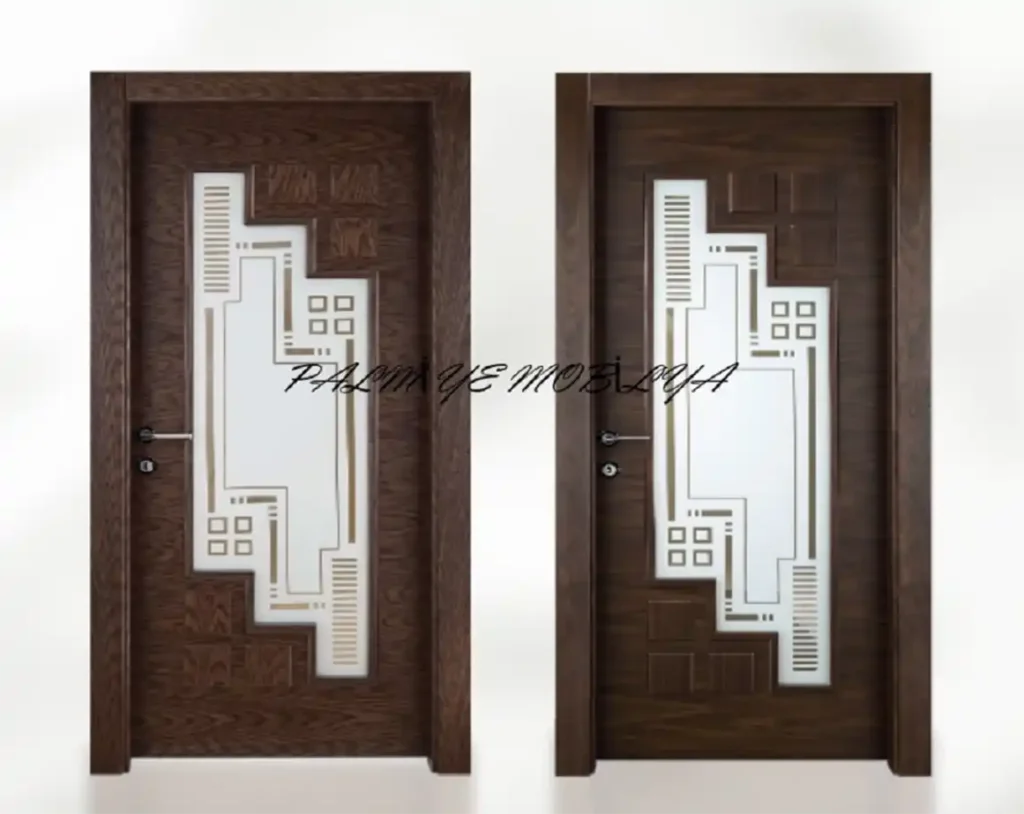
The global construction and interior design industries are increasingly turning their attention toward the Eurasian hub of manufacturing excellence. Door Models Turkey has transitioned from a regional manufacturing term into a global benchmark for architectural durability, security, and aesthetic sophistication.
Turkish door manufacturers have successfully harmonized centuries-old woodworking traditions with cutting-edge German and Italian automated machinery. The result is a massive production ecosystem capable of exporting high-performance residential, commercial, and industrial doors to over 150 countries.
This comprehensive technical guide explores the engineering, material sciences, design typologies, and supply-chain logistics that define modern Turkish doors. Whether you are an architect, real estate developer, or custom home builder, understanding the structural configurations and design possibilities of the Turkish door market will fundamentally change your approach to spatial openings.
1. The Global Rise of Turkish Door Manufacturing
The ascent of Turkey as a premier destination for architectural doors is driven by macro-economic factors, geographical advantages, and strict adherence to international engineering standards.
Strategic Geographical and Logistics Advantages
Situated at the crossroads of Europe, Asia, and the Middle East, Turkish manufacturers leverage unparalleled logistical networks.
- Maritime Shipping: Direct access to major ports such as Ambarlı (Istanbul), Mersin, and İzmir enables rapid container shipping across the Mediterranean, Atlantic, and Indian Oceans.
- Overland Freight: Robust trucking routes guarantee short transit times to continental Europe and Central Asia.
- Reduced Lead Times: Compared to East Asian competitors, Turkish factories can deliver custom-engineered architectural orders to Europe and North Africa in less than half the time. This drastically reduces on-site delays for large-scale construction projects.
Adherence to European and Global Testing Standards
Turkish doors are not merely designed for aesthetic appeal; they are engineered to meet rigorous international regulatory frameworks. Leading manufacturers subject their products to destructive and non-destructive testing at globally recognized laboratories such as IFT Rosenheim, Exova Warringtonfire, and Chiltern International Fire.
[International Standard Compliance Matrix]
├── EN 1627-1630         --> Burglar Resistance Categories (RC1 to RC5)
├── EN 1634-1            --> Fire Resistance Testing (30, 60, 90, 120 Minutes)
├── EN ISO 10140-2       --> Acoustic Airborne Insulation (Up to 45 dB)
└── EN 12210 / EN 12207  --> Wind Load Resistance & Air Permeability
2. Advanced Material Engineering in Turkish Doors
The structural integrity and lifespan of any door depend entirely on its core engineering and surface treatments. The Turkish manufacturing sector utilizes diverse raw materials optimized for specific structural loads and environmental exposures.
Engineered Solid Wood and Glued Laminated Timber (Glulam)
For premium classic and modern luxury door models, solid timber is rarely used in its raw, monolithic form due to its inherent tendency to warp, twist, or split when exposed to shifting relative humidity. Instead, Turkish factories utilize Glued Laminated Timber (Glulam) and finger-jointed structural cores.
- Species Selection: High-grade Siberian Pine, European Oak, Sapelli Mahogany, and African Iroko are dried in fully automated, computer-controlled kiln systems until they reach an optimal equilibrium moisture content (EMC) of 8% to 10%.
- Finger-Jointing Technology: Knots, shakes, and natural structural defects are mechanically excised from timber planks. The remaining clear wood segments are interlocked using high-tensile polyurethane (PUR) structural adhesives under multi-ton hydraulic pressure.
- Cross-Grain Lamination: Individual timber laminations are stacked with their grain directions alternating at 90-degree angles. This structural orientation cancels out internal hygroscopic stresses, ensuring that the door leaf remains flat over decades of operation.
High-Density Fiberboard (HDF) vs. Medium-Density Fiberboard (MDF)
In the realm of painted, veneered, and composite doors, the density of the substrate directly dictates the precision of the CNC routing patterns and the impact resistance of the door face.
+------------------------------------------+------------------------------------------+

| High-Density Fiberboard (HDF)            | Medium-Density Fiberboard (MDF)          |
+------------------------------------------+------------------------------------------+

| Density: > 800 kg/m³                     | Density: 650 - 800 kg/m³                 |
| Thickness: Typically 3mm to 6mm skins    | Thickness: 8mm to 25mm structural panels |
| Best for: High-pressure pressing,        | Best for: Deep 3D CNC carving,           |
| structural door skins, lacquered coats.  | structural internal framing elements.    |
+------------------------------------------+------------------------------------------+
Turkish factories emphasize moisture-resistant variants (MR-HDF and MR-MDF). These utilize specialized melamine-urea-formaldehyde or polymeric MDI resins to limit thickness swelling to less than 5% when submerged in water. This makes them highly suitable for humid maritime environments and high-moisture bathrooms.
Internal Core Configurations and Structural Physics
The interior structure of an internal flush or molded door determines its acoustic dampening, thermal insulation, and weight-to-strength ratio. Turkish manufacturers categorize internal cores into three primary engineering tiers:
[Door Leaf Cross-Section Framework]
├── Honeycomb Core (Cellular Kraft Paper) -> Lightweight, Residential Interior
├── Tubular (Sauerland) Particleboard  -> High Acoustic, Impact Resistant, Commercial
└── Solid Mineral Core                 -> Fire-Rated, Extreme Security Thermal Barrier
Honeycomb Core (Cellular Kraft Paper)
- Construction: Hexagonal cells made from 120-140 g/m² structural kraft paper.
- Mechanical Properties: Provides excellent compressive strength under flat loads while maintaining a lightweight profile (typically 12–15 kg per door leaf).
- Application: Standard budget-conscious residential interior developments.
Tubular (Sauerland Spanplatte) Particleboard
- Construction: Extruded particleboard featuring continuous horizontal or vertical cylindrical voids.
- Mechanical Properties: Exceptional weight reduction combined with high structural crush resistance. It provides inherent acoustic dampening of 28 dB to 34 dB without additional acoustic seals.
- Application: Premium residential suites, luxury hotels, and commercial offices.
Solid Mineral and Composite Cores
- Construction: A dense matrix of vermiculite, volcanic glass particles, and specialized structural binders.
- Mechanical Properties: Non-combustible, extremely high thermal mass, and high density.
- Application: Fire-rated openings (FD30 to FD120) and high-security installations.
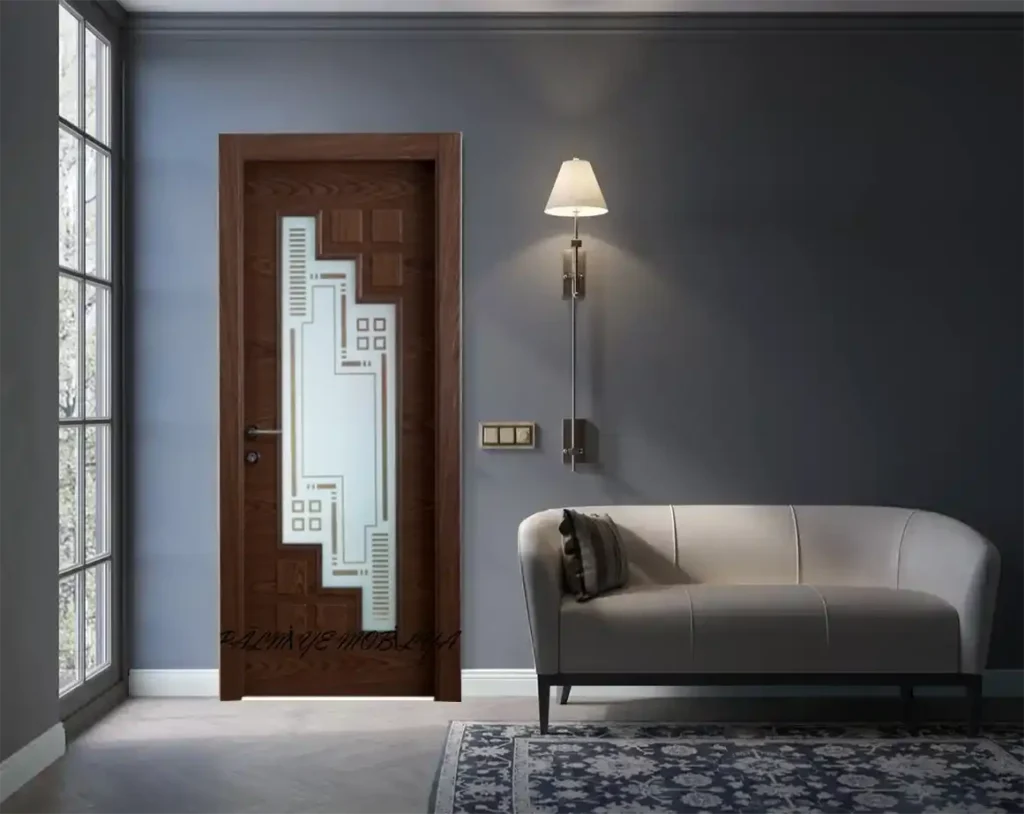
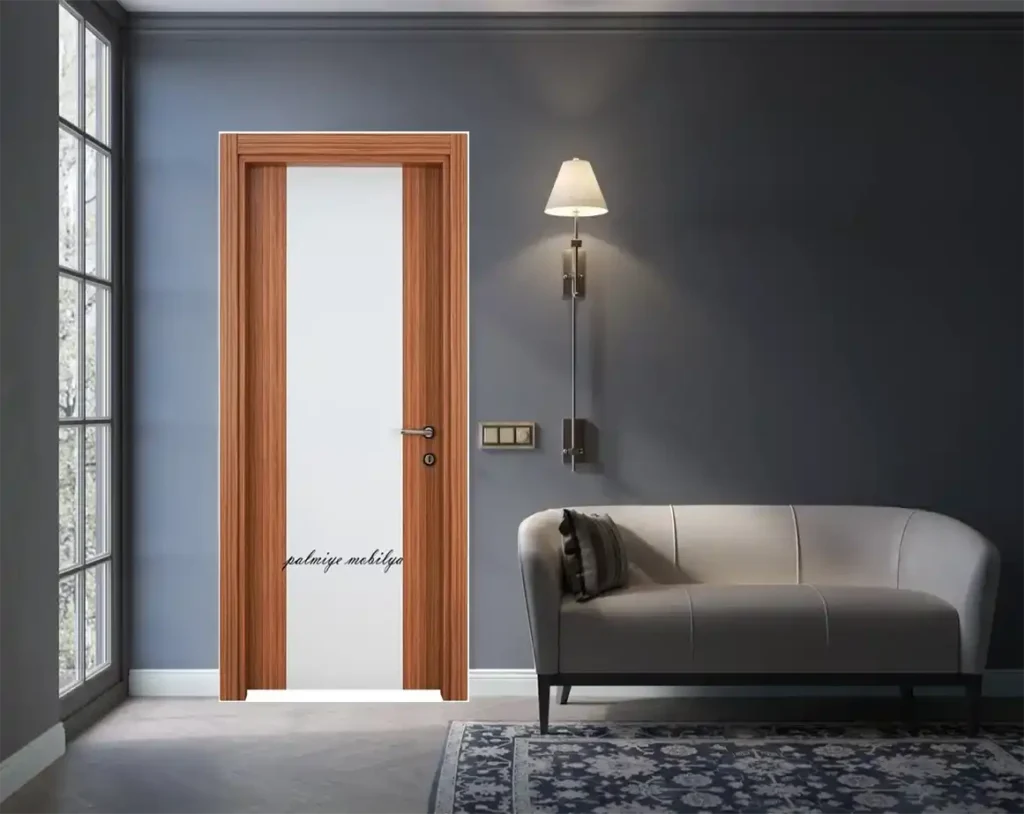
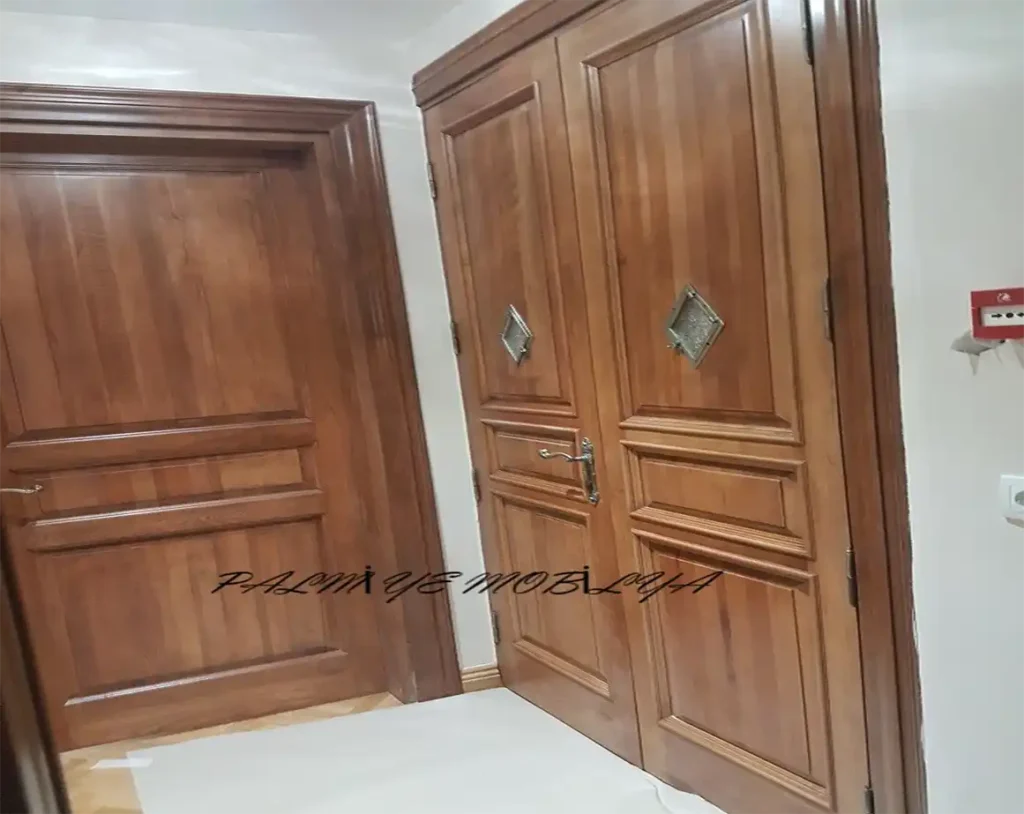
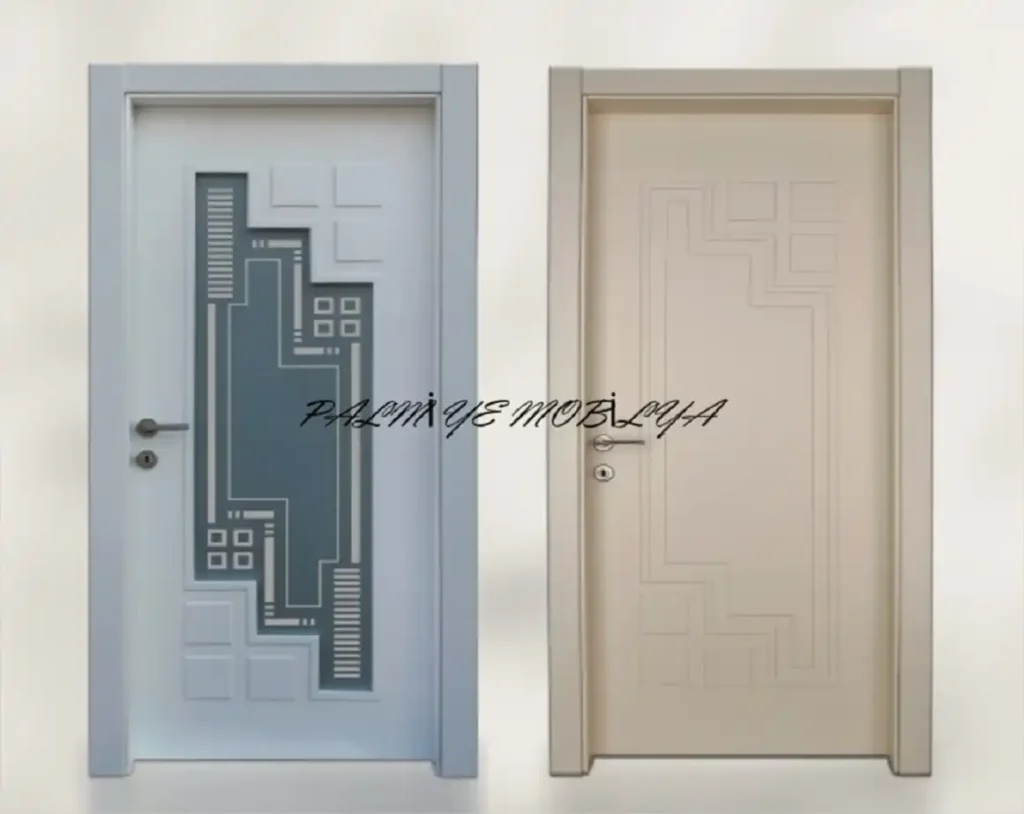
3. Interior Door Models Turkey: Architectural Typologies
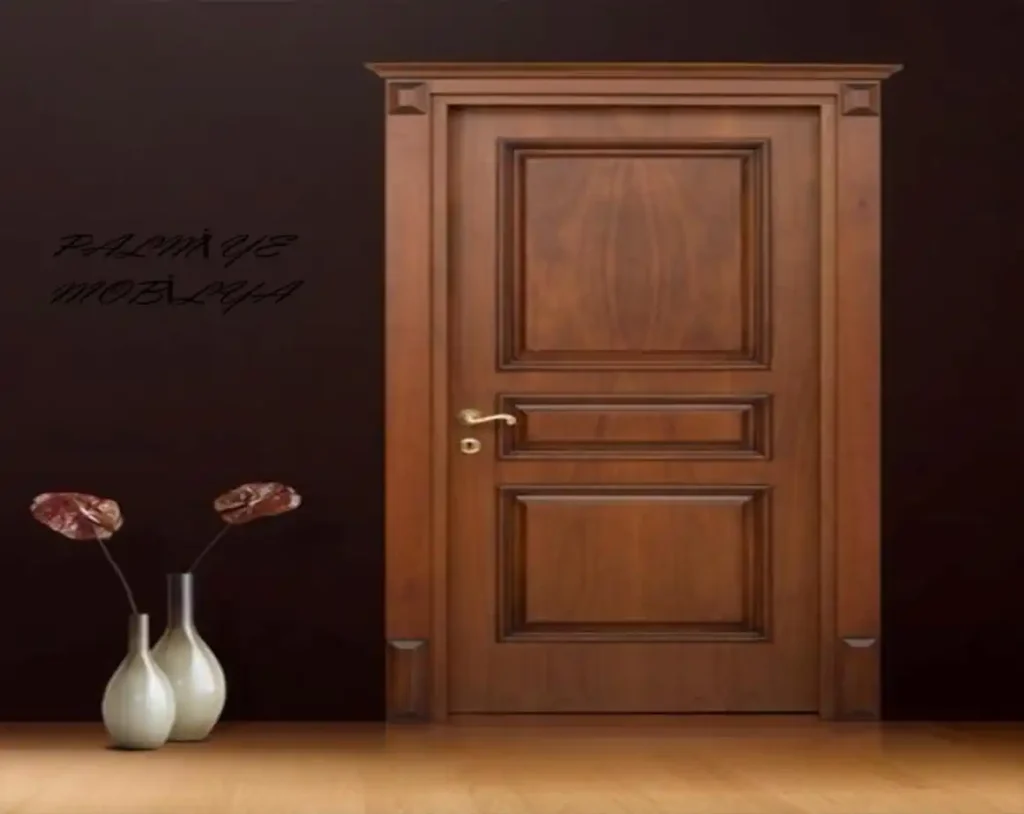
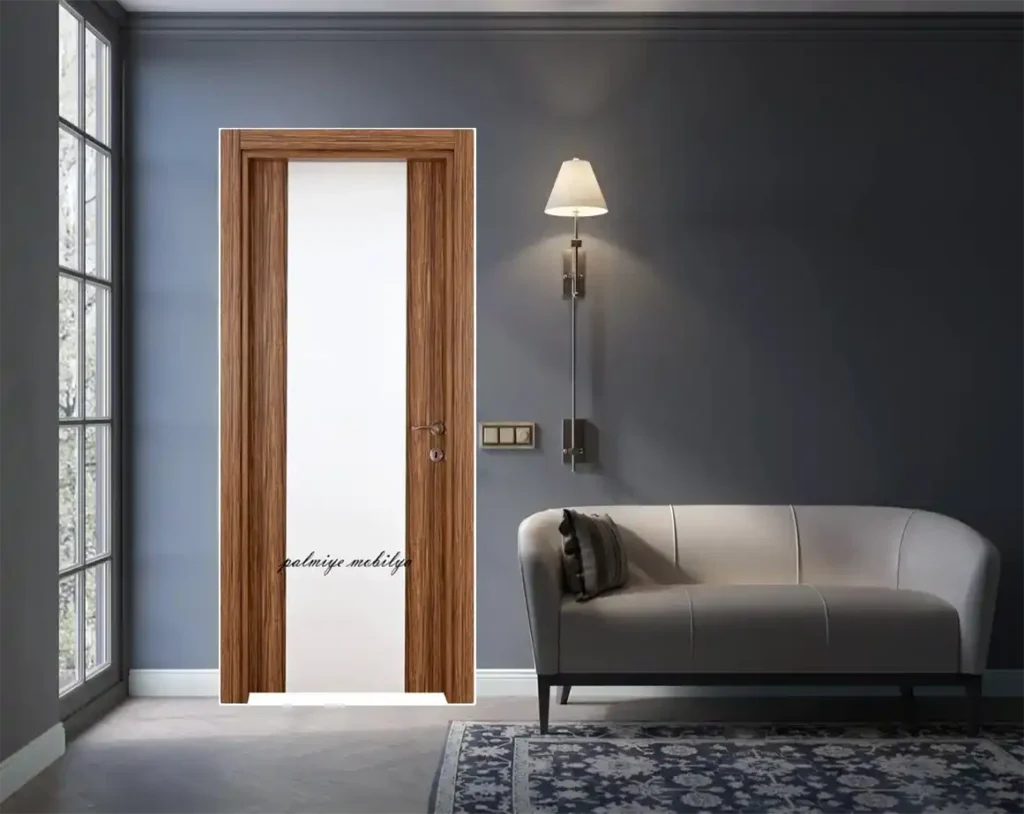
Interior doors in Turkey have evolved beyond mere functional partitions; they serve as central elements of interior architecture. Below are the definitive structural and aesthetic categories dominating contemporary Turkish production.
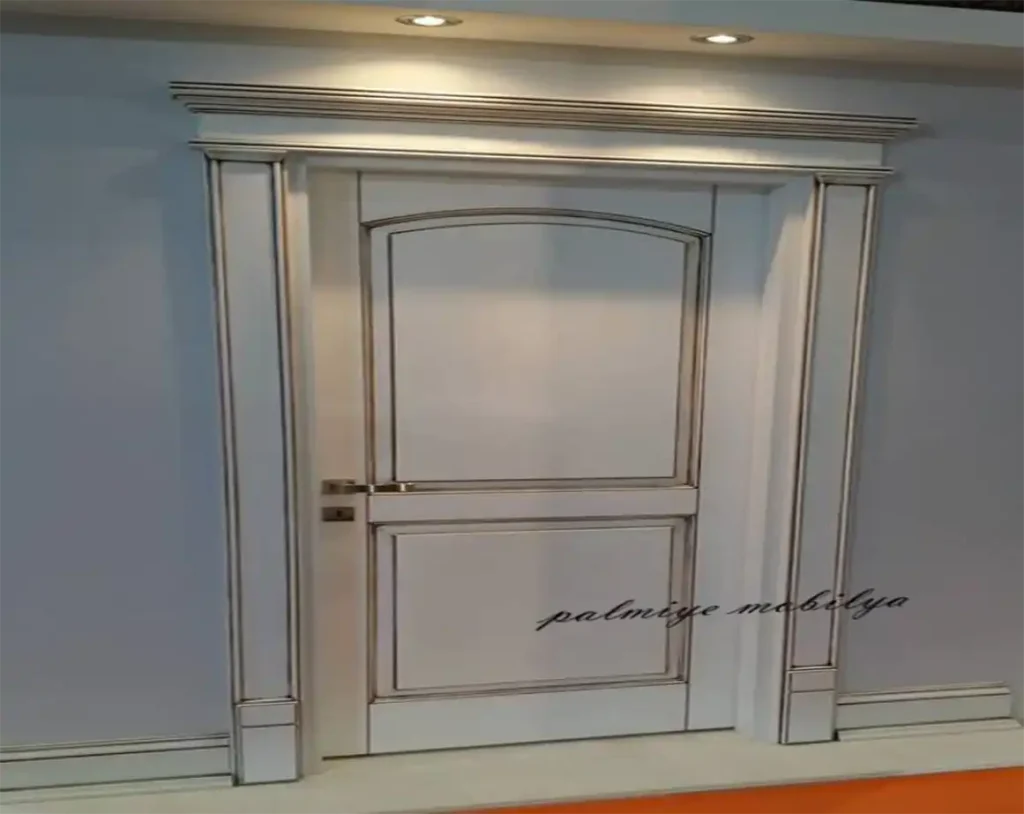
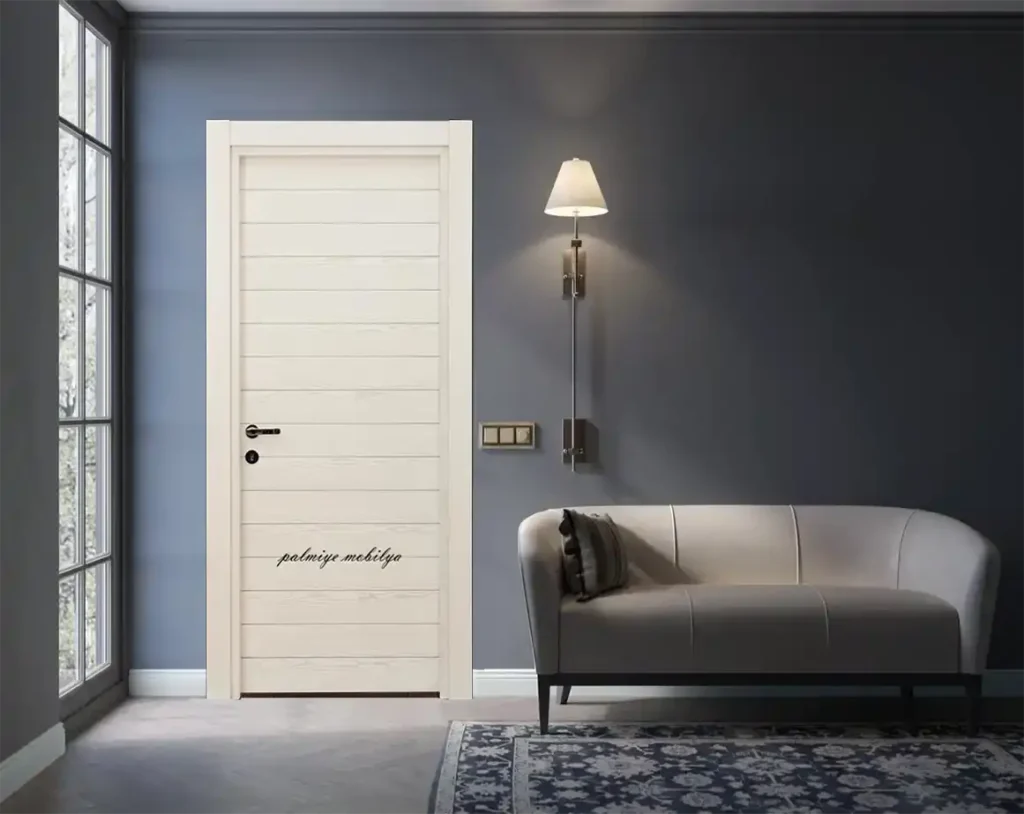
Lacquered Interior Doors
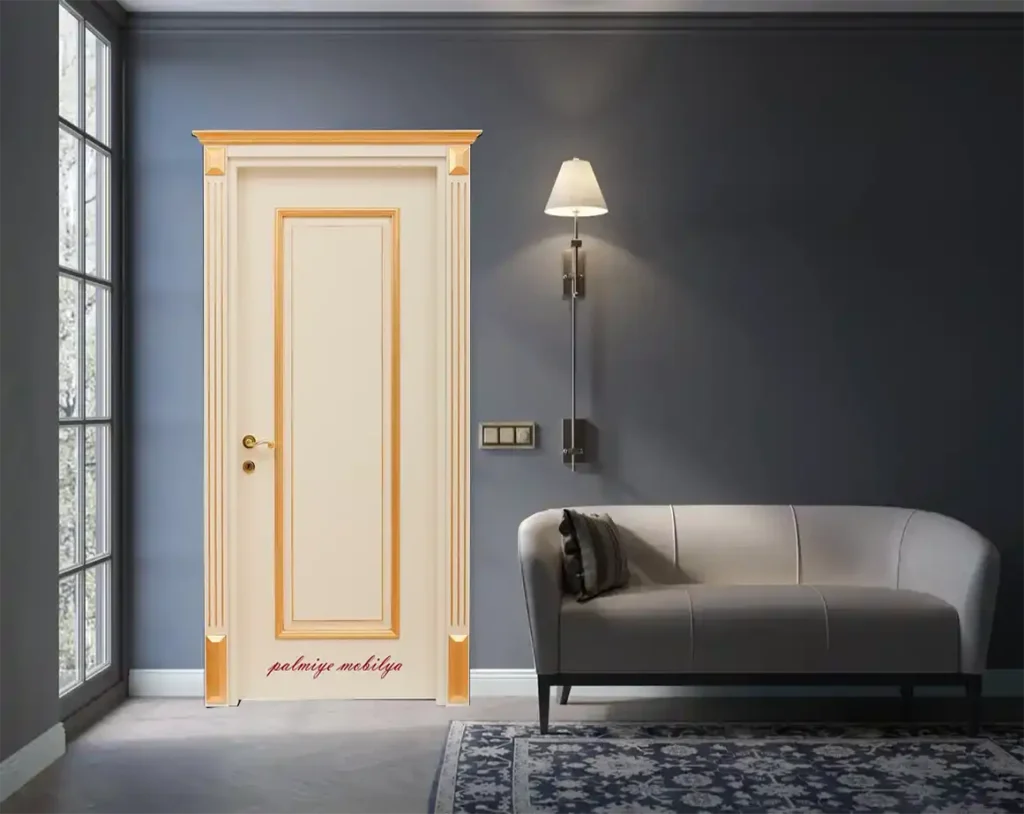
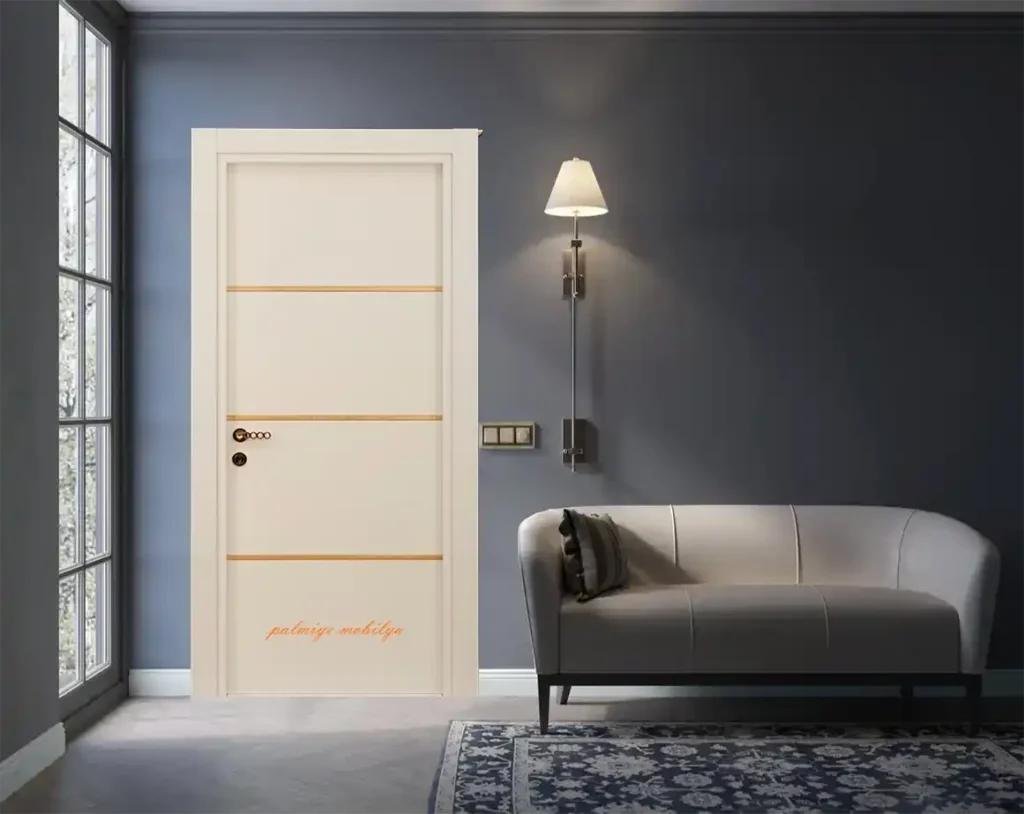
Lacquered models represent the absolute pinnacle of minimalist and modern luxury interior design. The quality of a Turkish lacquered door relies on a meticulous multi-layer fluid application process.
- Substrate Preparation: The MR-MDF face is sanded using multi-head wide-belt orbital sanders down to a surface roughness (\(Ra\)) approaching zero.
- Primer Insulation Layers: Two to three layers of white polyurethane or polyester isolation primers are applied via automated reciprocating spray robots. These layers seal the porous fiber matrix of the MDF, preventing the topcoats from sinking or showing orange-peel textures.
- Polyurethane Topcoats: High-solid polyurethane lacquers or acrylic non-yellowing topcoats are applied in ISO 7 cleanroom environments. Buyers can specify gloss levels ranging from dead matte (3-5 Gloss Units) to mirror high-gloss (above 90 Gloss Units).
- UV-Curing Lines: Premium factories pass the coated panels through ultra-violet curing tunnels, instantly cross-linking the polymer chains. This creates a surface resistant to scratching, chemical cleaners, and UV-induced discoloration.
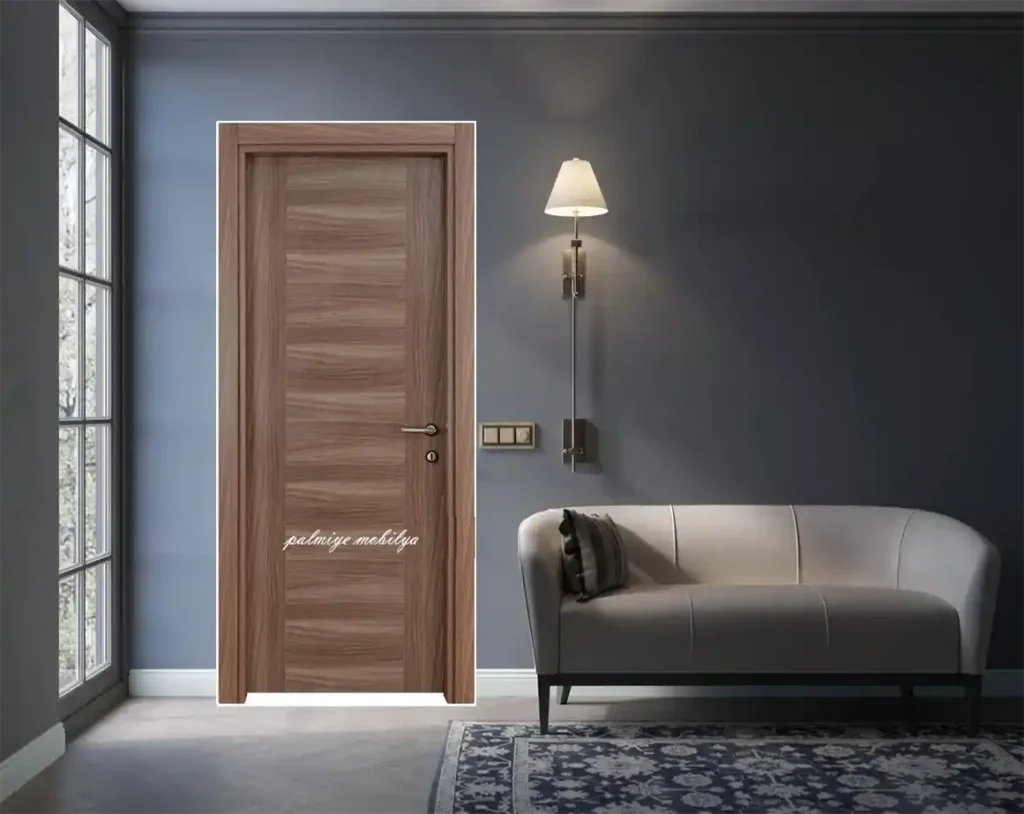
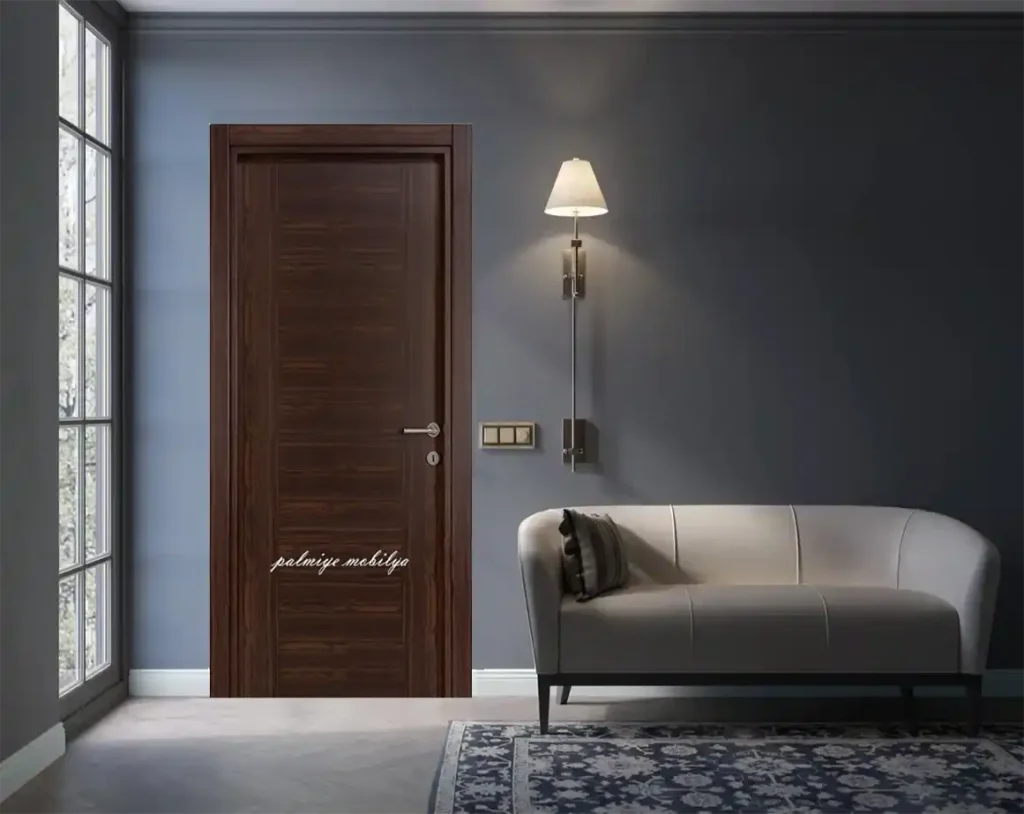
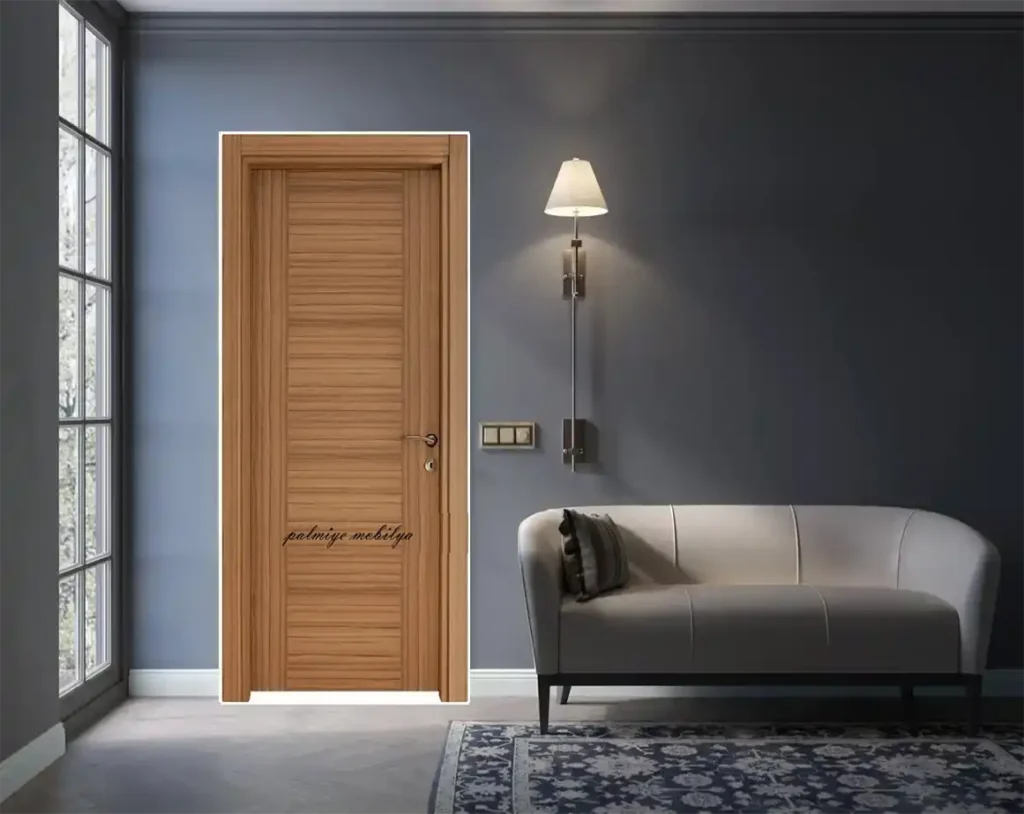
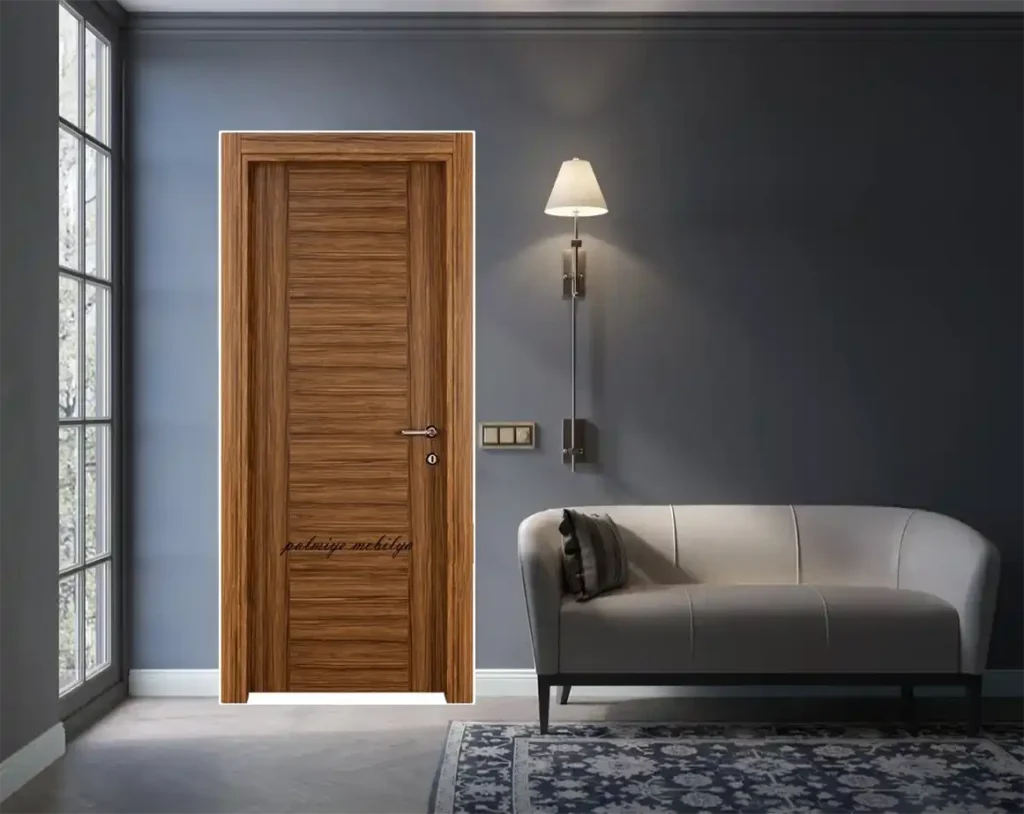
Natural Wood Veneered Doors
For projects requiring the organic warmth and prestige of real timber, Turkish manufacturers offer highly sophisticated natural wood veneered options.
- Veneer Slicing and Matching: Quarter-cut, crown-cut, or rotary-cut veneers (0.6mm to 2.0mm thick) are sourced globally. Master woodworkers arrange these veneers using specialized matching techniques:
- Book Matching: Alternating sheets are turned over like pages in a book, creating a symmetrical grain reflection.
- Slip Matching: Veneer sheets are joined side-by-side without flipping, resulting in a repeating, uniform grain flow.
- Random Matching: Intentionally mixing different logs to simulate a rustic, solid-plank effect.
- Splicing and Pressing: The veneer leaves are stitched together using specialized adhesive threads on longitudinal splicing machines. They are then fused to the HDF substrate under high pressure (typically 40 to 60 metric tons) using thermosetting urea-formaldehyde glues in multi-daylight hot presses.
- Finishing: Coated with eco-friendly water-based stains and open-pore acrylic varnishes that highlight the tactile three-dimensional texture of the natural wood grain.
PVC and Polypropylene (PP) Laminate Doors
Engineered for multi-family residential developments, social housing, and high-traffic hospitality projects, laminate doors offer extreme durability at a highly competitive price point.
- PVC Membrane Foils: Utilizing high-performance thermoforming vacuum presses, a flexible polyvinyl chloride foil (0.2mm to 0.45mm thick) is drawn over a 3D-routed MDF panel under intense vacuum pressure and thermal activation. The adhesive used is a high-spec polyurethane reactive (PUR) hot-melt, which prevents delamination even when exposed to high temperatures and humidity.
- Polypropylene (PP) Eco-Foils: The latest innovation in Turkish door manufacturing involves transitioning toward PP films. These are completely free of chlorine, plasticizers, and heavy metals. PP foils realistically replicate the tactile feel of wood pores, timber grain, and matte stone textures, while offering superior resistance to chemical scratching and domestic impact.
Melamine and CPL (Continuous Pressure Laminate) Doors
- CPL Engineering: Continuous Pressure Laminate is produced by bonding multiple layers of kraft paper impregnated with phenolic resins under continuous high pressure and heat.
- Surface Properties: The resulting skin is incredibly dense, highly scratch-resistant, and completely non-porous.
- Edge-Banding Precision: Turkish factories utilize automated edge-banders equipped with Laser or Hot-Air zero-joint technology. By melting a co-extruded functional layer on the edge band, the joint line becomes completely invisible and hermetically sealed against water ingress. This eliminates the traditional black glue line that degrades over time.
4. High-Security Exterior Doors: Engineering Fortresses
Turkey is universally recognized as a global powerhouse in the manufacture of armored steel security doors. The architectural concept of an exterior door in Turkey combines structural steel defense systems with elegant, weather-resistant exterior cladding.
[Armored Steel Security Door Engineering Blueprint]
┌────────────────────────────────────────────────────────┐
│  Exterior Decorative Panel (Alu, Compact Laminate, PP)  │
├────────────────────────────────────────────────────────┤
│  Heavy-Gauge Galvanized Steel Core Frame (1.5mm-2.0mm) │
│  ├── Vertical & Horizontal Omega (Ω) Steel Ribs        │
│  └── Integrated Manganese Anti-Drill Plates            │
├────────────────────────────────────────────────────────┤
│  Thermal & Acoustic Insulation (Rockwool / Polyurethane)│
├────────────────────────────────────────────────────────┤
│  Multi-Point Multiplex Locking System (Hook Bolts)     │
├────────────────────────────────────────────────────────┤
│  Interior Architectural Panel (Wood Veneer, Lacquer)    │
└────────────────────────────────────────────────────────┘
Structural Steel Frame Architecture
The core structure of a Turkish security door is engineered to resist aggressive physical breaches, including crowbars, hydraulic jacks, and mechanical drilling tools.
- Steel Gauge Selection: Structural chassis components are fabricated exclusively from cold-rolled Galvanized Steel Sheets with thicknesses ranging from 1.5mm to 2.0mm. Galvanization ensures the internal steel core will never rust, even when exposed to marine humidity or condensation.
- Internal Omega (\(\Omega \)) Reinforcement Ribs: The interior hollow space of the steel leaf chassis is reinforced with 4 to 6 vertical and horizontal steel profiles shaped like the Greek letter Omega (\(\Omega \)). These profiles are spot-welded or structurally riveted to the main chassis, maximizing the door’s torsional rigidity. This prevents the door leaf from bending or flexing when pried at the corners.
- Monoblock and Adjustable Frame Systems: Turkish manufacturers have pioneered heavy-duty steel frame casings that wrap entirely around the wall masonry. These adjustable frames can accommodate variable wall thicknesses (from 15cm to 30cm) and are filled with high-strength structural concrete or non-expanding polyurethane foam during installation to form an immovable anchor with the building core.
Multiplex and Smart Locking Mechanisms
A security door is only as resilient as its locking system. Turkish security doors partner with premium global locking brands (such as Kale Kilit, Mottura, and Cisa) to deploy complex locking kinematics.
- Multi-Point Locking Systems: A single turn of the master key deploys between 10 to 14 active steel locking bolts horizontally and vertically into reinforced receiver pockets inside the steel frame.
- Hook and Rotating Bolt Mechanics: Advanced models incorporate heavy-duty hook bolts that mechanically clamp into the frame casing. This design makes it mathematically impossible to separate the door leaf from the frame using a crowbar or hydraulic spreader.
- Manganese Anti-Drill Shielding: The critical cylinder housing zones are shielded by 3mm to 5mm thick hardened manganese steel alloy plates. These plates immediately dull or shatter high-speed steel (HSS) and cobalt drill bits during an attempted breach.
- Biometric and Smart Access Integration: Premium Turkish exterior doors feature seamlessly integrated smart modules:
- Capacitive Fingerprint Scanners: Sub-surface scanning modules featuring live tissue detection to prevent spoofing.
- Rolling-Code RFID & NFC Modules: Encrypted credentials manageable via secure smartphone applications.
- Facial Recognition Systems: Low-lux infrared cameras integrated directly into the pull handles for touchless biometric entry.
Weatherproofing and Thermal Break Technologies
Exterior doors face harsh environmental extremes, from sub-zero winter temperatures to blazing summer sun. Without proper thermal insulation, a steel door will act as a massive thermal bridge, causing heavy interior condensation and severe energy loss.
- Polyamide Thermal Breaks: High-end Turkish exterior door frames utilize dual-profile structures separated by a low-conductivity polyamide insulating strip. This thermal break prevents heat from conducting between the outdoor and indoor faces of the frame.
- Injected High-Density Polyurethane Foam: The internal hollow matrix between the steel \(\Omega \) ribs is fully injected with pressurized CFC-free polyurethane foam (density 40-45 kg/m³) or packed with dense structural rockwool slabs. This configuration yields thermal insulation values (\(U\)-values) below \(1.2 W/m^2K\).
- Dual and Triple EPDM Gasket Systems: Continuously running, UV-stabilized Ethylene Propylene Diene Monomer (EPDM) rubber gaskets are installed in dedicated grooves along both the door leaf perimeter and the frame casing. Magnetic threshold drop seals drop automatically upon closing, eliminating air drafts, dust infiltration, and rainwater leakage under wind loads up to Class 4 (EN 12210).
Exterior Facing Innovation: Compact Laminate and Aluminum
Wood veneers will naturally degrade when directly exposed to rain, UV rays, and frost. To solve this, Turkish engineers wrap exterior surfaces in high-performance materials:
- Exterior Exterior-Grade Compact Laminate (HPL): Manufactured under extreme heat and pressure using double-hardened acrylic polyurethane resins. These panels are completely impervious to water, will not fade under intense solar UV exposure, and are highly resistant to impact and graffiti.
- Powder-Coated Architectural Aluminum Skins: 2mm thick structural aluminum sheets are treated with elektrostatik powder coatings (Qualicoat Class 2 compliance). These provide a sleek, ultra-modern aesthetic that matches contemporary architectural facades.
5. Architectural Glass, Hardware, and Smart Integration
The final performance profile of a Turkish door depends on its secondary components: glass inserts, structural hardware, and electronic accessories.
High-Performance Structural Glazing
Whether designed for a grand interior salon door or a contemporary front entry glass panel, glazing in Turkish doors follows strict safety and energy performance guidelines.
[Double-Glazed Argon Low-E Assembly]
Exterior Face --> 6mm Tempered Safety Glass
                  ═════════════════════════
                  9mm Argon Gas Insulated Cavity
                  ═════════════════════════
Interior Face --> 6mm Low-E Laminated Acoustic Glass
- Tempered and Laminated Safety Glass: In accordance with EN 12600, all glass elements are either thermally tempered (which breaks into small, blunt fragments upon catastrophic impact) or laminated using polyvinyl butyral (PVB) layers (which hold glass shards firmly in place).
- Low-Emissivity (Low-E) and Argon Gas Assemblies: Multi-glazed units feature microscopically thin metal oxide coatings that selectively reflect infrared heat radiation while letting visible light pass through. The internal air space is filled with 90% pure Argon gas to reduce convective heat transfer inside the glazing cavity.
- Decorative Glass Processing: Factories offer in-house acid etching, ceramic silk-screen printing, and custom sandblasting to create customizable levels of opacity and architectural geometric patterns.
Heavy-Duty Mechanical Hardware Engineering
A heavy door leaf requires premium mechanical hardware to ensure smooth operational kinematics over hundreds of thousands of cycles.
- 3D Adjustable Concealed Hinges: Modern interior and exterior Turkish doors favor completely hidden hinge systems (such as Simonswerk Tectus or Turkish engineered equivalents). These premium hinges allow precision adjustment across three independent axes (\(\pm 3mm\) Height, \(\pm 2mm\) Side, \(\pm 1mm\) Depth) using a simple hex wrench. This lets installers achieve flawless, uniform 3mm reveals around the door frame.
- Magnetic Mortise Locks: Unlike traditional mechanical latch locks that strike loudly against the frame strike plate, magnetic locks utilize a flush-mounted neodymium magnetic bolt. The latch stays retracted inside the door leaf while open. It extends silently into the frame receiver only when the door is fully closed, providing whisper-quiet operation and an elegant, hardware-free profile.
6. Commercial, Industrial, and Specialized Door Models
The Turkish door sector caters heavily to large-scale infrastructure projects, including international hospitals, mega-hotels, business high-rises, and industrial complexes.
Certified Fire-Rated Openings
Turkish fire doors are engineered to save lives and contain smoke and flames within designated fire compartments for critical time windows.
- Testing Standards: Certified under EN 1634-1 and UL 10C protocols.
- Intumescent Seals: The perimeter of the fire door frame is lined with graphite-based intumescent strip seals. When exposed to temperatures exceeding 150°C, these strips expand up to 25 times their original volume. This behavior completely seals the gaps between the leaf and frame, blocking toxic smoke and super-heated gases from passing through.
- Panic Hardware Integration: Equipped with heavy-duty panic bars complying with EN 1125. These ensure instantaneous mechanical egress from the danger zone with a simple push, even during a total building power failure.
Acoustic Isolation Door Systems
For recording studios, hotel guestrooms, auditoriums, and private medical consultation offices, control of airborne noise transmission is vital.
+───────────────────────────+─────────────────────────────────────────────+

| Acoustic Rating (Rw)      | Typical Structural Configuration            |
+───────────────────────────+─────────────────────────────────────────────+

| 32 dB - 35 dB             | 40mm Tubular Core + Single EPDM Gasket      |
| 38 dB - 42 dB             | Dual-Layer Composite Core + Dual Gaskets    |
| > 45 dB                   | Multi-Layer Heavy Core + Drop Seal + Casing |
+───────────────────────────+─────────────────────────────────────────────+
Turkish acoustic doors achieve high \(R_{w}\) (Weighted Sound Reduction Index) ratings by using multi-layered, variable-density cores (e.g., cork, heavy rubber sheets, mineral wool, and acoustic MDF layers). This compound structure breaks up sound waves across a broad frequency spectrum (100 Hz to 5000 Hz).
Cleanroom and Health-Care X-Ray Doors
- Hygienic Cleanroom Doors: Surfaces are finished with seamless, anti-static high-pressure laminates or medical-grade stainless steel sheets. The frames are completely flush with the wall systems to prevent dust accumulation. They are designed to withstand continuous washing with aggressive chlorine- and alcohol-based hospital disinfectants.
- Lead-Lined Radiation Shielding Doors: Engineered for oncology departments and X-ray rooms, the internal core of both the door leaf and the frame casing is lined with a continuous, pure lead sheet (typically 1mm to 3mm thick). This creates an uninterrupted radiation barrier that prevents dangerous X-ray leakage into common hospital corridors.
7. The Manufacturing Process: Automation and Quality Control
The competitive edge of Turkish door production stems from significant capital investment in advanced manufacturing lines.
Industry 4.0 CNC Machining Centers
- Automated Sizing and Edge Machining: Raw door blanks are fed into automated multi-axis CNC lines. These machines simultaneously cut the leaf to exact millimeter dimensions, route out the lock case cavities, drill the hinge positions, and apply the edge-banding tape in a single, continuous automated pass. This eliminates manual measurement errors.
- High-Precision Carving: Computer-aided manufacturing (CAM) software translates intricate architectural drawings directly to 3-axis and 5-axis CNC routing heads. This workflow enables rapid execution of complex geometric grooves, traditional motifs, or modern 3D panel designs.
Strict Quality Management Systems (QMS)
Reputable Turkish door factories operate under strict ISO 9001:2015 quality management certifications.
- Incoming Material Inspection: Moisture levels of all incoming timber lots are verified using digital dielectric moisture meters. Resin batches are chemically analyzed to ensure low formaldehyde emissions, strictly complying with E1 and E0 international eco-standards.
- Inter-Process Quality Audits: Laser scanners monitor panel flatness and surface quality at multiple stages during production. Any component displaying a deviation greater than 0.5mm over a 2-meter span is automatically flagged and rejected from the assembly line.
8. Sustainability and Green Building Compliance
Modern global real estate projects require strict compliance with ecological building initiatives like LEED (Leadership in Energy and Environmental Design) and BREEAM (Building Research Establishment Environmental Assessment Method). Turkish manufacturers have adapted their processes to meet these rigorous environmental criteria.
Sustainable Timber Sourcing (FSC and PEFC)
The leading door brands in Turkey operate under verified FSC (Forest Stewardship Council) and PEFC (Programme for the Endorsement of Forest Certification) Chain of Custody systems. This guarantees that all softwoods and hardwoods used in production are harvested from sustainably managed forests that support biodiversity, avoid illegal logging, and respect local indigenous communities.
Low-VOC Coating and Bonding Chemistry
- Transition to Water-Based Systems: To improve Indoor Environmental Quality (IEQ), Turkish factories have largely replaced traditional solvent-thinned varnishes with advanced water-borne formulations. These coatings release minimal Volatile Organic Compounds (VOCs) into the atmosphere during production and installation.
- Formaldehyde-Free Adhesives: Internal core assembly lines utilize modern polyurea or ultra-low-emitting formaldehyde (ULEF) adhesives. This ensures that the finished interior door installations will not off-gas harmful chemicals, helping projects secure premium air-quality points under green building rating systems.
9. Procurement, Sourcing, and Logistics Best Practices
Importing custom architectural doors directly from Turkish manufacturers requires a clear understanding of international commercial trade procedures and technical specification management.
Creating High-Fidelity Technical Specifications
To receive accurate, comprehensive wholesale quotes from Turkish factories, project managers should prepare a detailed architectural door schedule containing the following parameters:
[Required Specification Fields for Door Sourcing]
├── Dimensional Parameters    --> Wall Opening Height, Width, Finished Wall Thickness
├── Core Performance Rating   --> Honeycomb, Tubular Particleboard, Solid Fire Core
├── Finish Specification      --> RAL Color Code, Veneer Species, Gloss Level (0-100%)
└── Hardware Configuration    --> Concealed vs. Barrel Hinges, Magnetic vs. Mechanical Lock
Navigating International Commercial Terms (Incoterms)
When negotiating production and shipping contracts with Turkish suppliers, explicitly define the pricing structure using standard Incoterms to avoid hidden logistics costs:
- FOB (Free On Board): The Turkish manufacturer covers all local factory expenses, domestic transport to a major Turkish port (e.g., Ambarlı or İzmir), and customs export clearance fees. The international buyer assumes responsibility for ocean freight, marine insurance, destination import duties, and final overland delivery. This is highly recommended for buyers with established freight forwarding partners.
- CIF (Cost, Insurance, and Freight): The manufacturer arranges and pays for ocean transport and basic maritime cargo insurance to the buyer’s designated destination port. Risk transfers to the buyer once the containers are safely loaded onto the vessel in Turkey.
- DDP (Delivered Duty Paid): The most comprehensive procurement model. The manufacturer handles the entire supply chain, including international shipping, import customs clearance, local taxes/tariffs, and delivery directly to the construction site layout. This offers maximum convenience for developers without an in-house global logistics department.
Quality Verification via Pre-Shipment Inspections
Before final container loading and sealing at the Turkish factory, savvy buyers deploy independent third-party inspection agencies (such as SGS, Bureau Veritas, or Intertek) to conduct formal quality audits.
- Sampling Protocols: Inspectors select random sample doors from the completed production lot based on standard AQL (Acceptable Quality Limit) tables.
- Physical Testing Verification: The field inspectors measure physical dimensions against the approved shop drawings using calibrated digital calipers. They check surface finish uniformity under high-intensity lighting, verify moisture content, and conduct functional cycle tests on the integrated locking hardware. This prevents the costly international transit of defective or mis-specified architectural products.
10. Future Horizons: Technological Innovations in Turkish Door Design
The Turkish door ecosystem continues to invest heavily in research and development, anticipating the future needs of smart cities and ecological architecture.
Nano-Technological Surface Enhancements
Turkish chemical engineers are integrating advanced nanotechnology directly into door surface finishes.
- Self-Healing Matt Coatings: Utilizing thermal-healing acrylic polymers, micro-scratches on matte interior door panels can be completely erased by simply applying light domestic heat (such as an iron over a damp cloth).
- Anti-Microbial and Silver-Ion Shields: For hospital and high-density educational environments, door skins are infused with silver-ion additives. These active agents disrupt the cellular walls of bacteria and viruses, reducing surface pathogens by up to 99.9% without requiring harsh chemical cleanings.
Invisible Kinetic Integration
The next wave of luxury design focuses on minimalism, removing all visible bulky hardware components.
- Concealed Magnetic Closers: Replacing traditional overhead hydraulic surface door arms, Turkish factories are embedding invisible magnetic dampening systems directly into the upper header frame casing. This provides controlled, automated soft-closing actions while maintaining a completely unblemished architectural opening profile.
- Integrated Flush Pull Handles: Modern exterior designs feature full-height vertical pull bars recessed flush into the door face. These channels feature hidden LED accent lighting and capacitive touch entry sensors, blending high-security tech seamlessly into elegant exterior facades.
Conclusion: Securing Your Project with Turkish Excellence
Door Models Turkey represent an ideal combination of industrial scale, technical precision, and customizable design flexibility. From budget-conscious multi-family residential developments requiring durable melamine doors to high-end custom villas demanding armored, smart-integrated steel entry systems, the Turkish manufacturing landscape delivers high-performance solutions engineered for the demands of modern architecture. By mastering material choices, specifying strict performance criteria, and selecting the right logistical workflows, global developers can confidently integrate these premium products into their next landmark project.
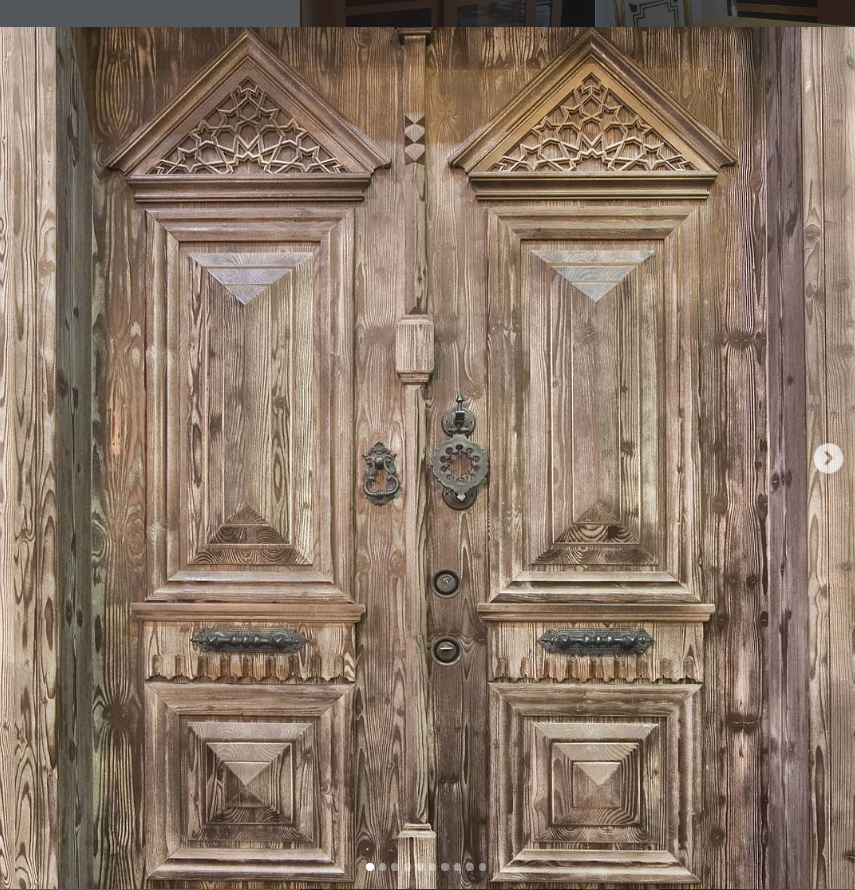
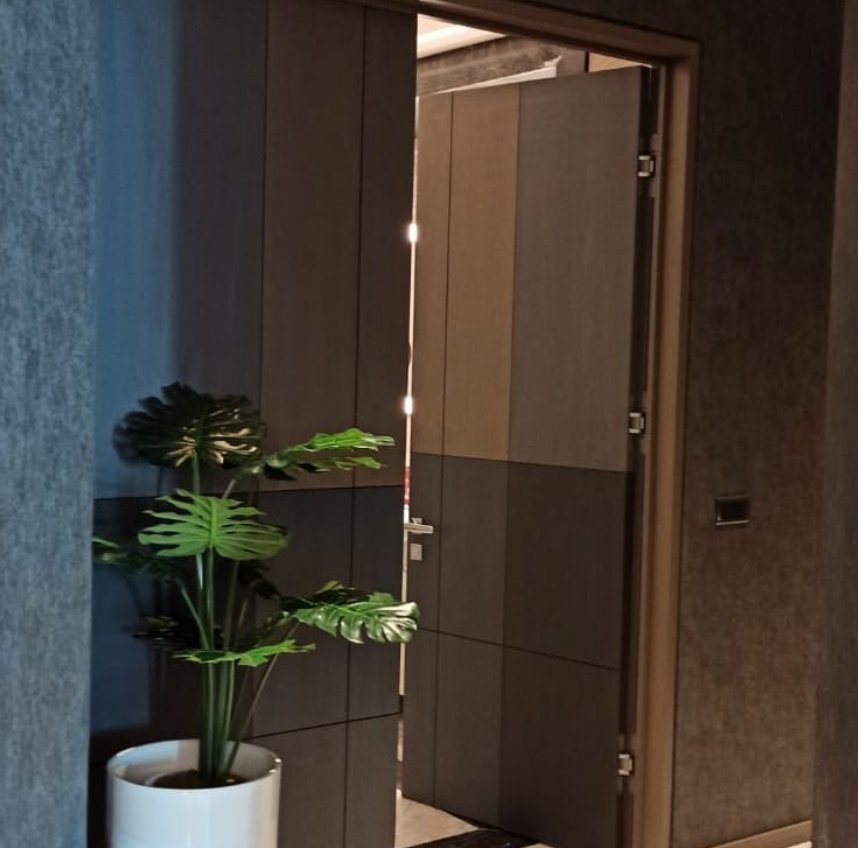
Butik Otel Mobilyaları
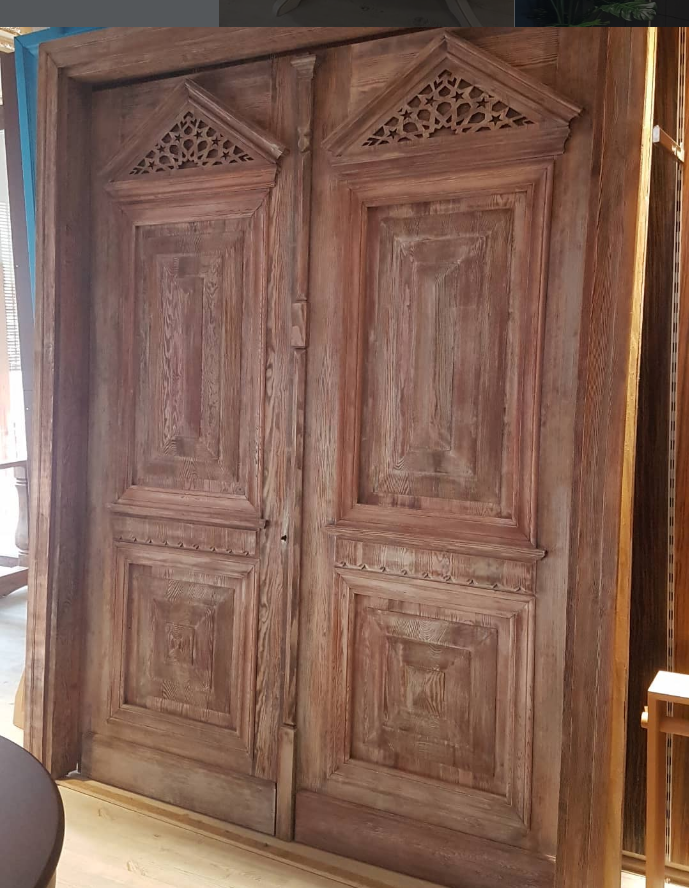
Butik Otel Mobilyaları

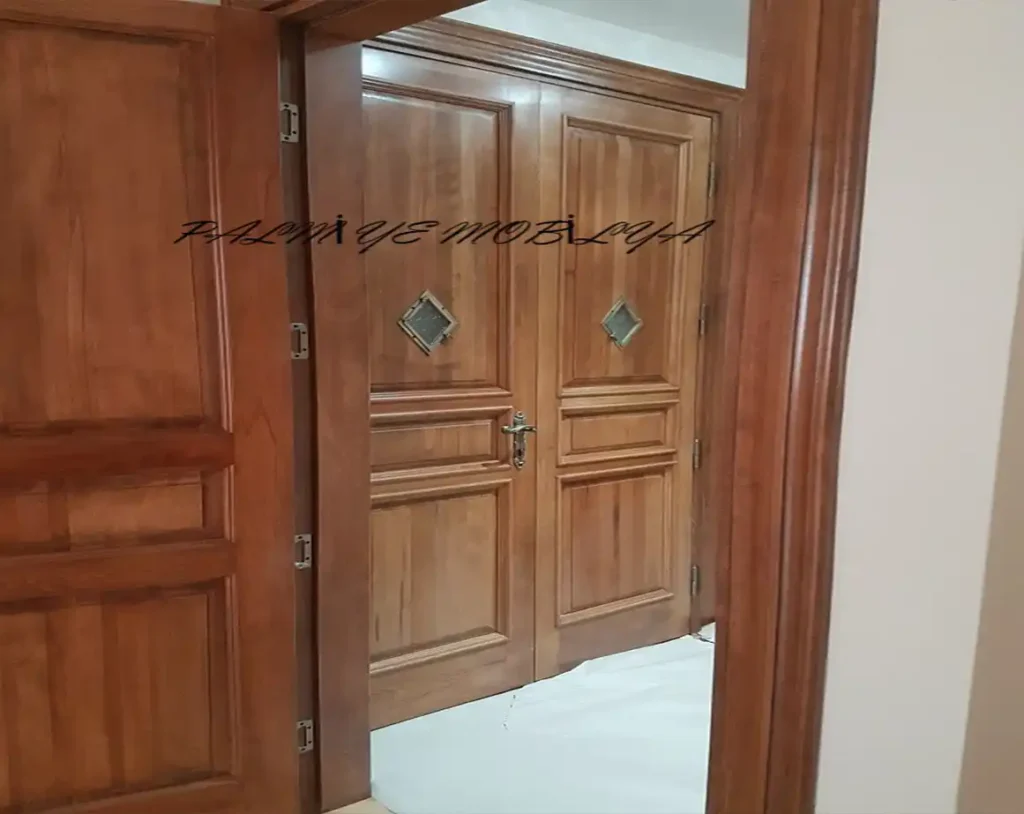
Etiket:Colored Lacquered Doors Turkey, Door Factory Turkey, Door Models Turkey, Economic Lacquered Door Manufacturing Turkey, Flat Lacquered Door Manufacturing Turkey, Lacquered Door Export Import Turkey, Lacquered Door Factory Turkey, Lacquered Door Models Turkey, Lacquered Door Production Turkey, Lacquered Door Types Turkey, Lacquered Hotel Doors Turkey, Lacquered Room Door Turkey, Luxury Lacquered Door Manufacturing Turkey, Mass Production Lacquered Door Turkey, Modern Lacquered Door Turkey, Rustic Lacquered Door Manufacturing Turkey, Solid Wood Door Manufacturing Turkey, Solid Wood Door Turkey

Şunları da sevebilirsiniz
Solid Wood Door Turkey
Flat Lacquered Door Manufacturing Turkey