Console Tables for Restaurants and Bars: Host Stands, Service Stations and Display Units
In food and beverage areas a console is a working piece, not a decorative accent. This guide explains how to specify host stands, waiter stations and bar display units that cope with daily service.
A restaurant service console is a purpose-built piece of joinery that supports daily operations: greeting guests, holding cutlery and glassware, staging plates or displaying bottles. Unlike a lobby console, it is judged by how well staff can work at it during a busy shift. If you are specifying one for a new venue or a refit, the key questions are what it must hold, who uses it and what it will be exposed to.
Below we look at the three most common roles for a console in food and beverage areas, then the materials, dimensions and details that make each one hold up. The advice applies to custom orders manufactured to project drawings and shipped internationally.
Why a console in a restaurant is different
In a hotel entrance, a console is mostly visual. In a restaurant or bar, it is part of the service workflow. Staff open drawers hundreds of times a day, put down hot trays, wipe spills and lean against the edges.
That changes the specification in several ways:
- Surfaces must tolerate heat, liquids, cleaning products and abrasion.
- Storage must be organised around real items such as menus, napkins, cutlery, glassware and payment terminals.
- Edges and corners need protection from trolleys, trays and chairs.
- Services such as power, data and cable routing must be planned from the start.
Host stand furniture: the first point of contact
The host stand sets the tone at the entrance, but it also has to work hard. Host stand furniture usually holds a reservation tablet or screen, menus, a phone, a printer or a card terminal, plus a small amount of hidden storage.
What to plan
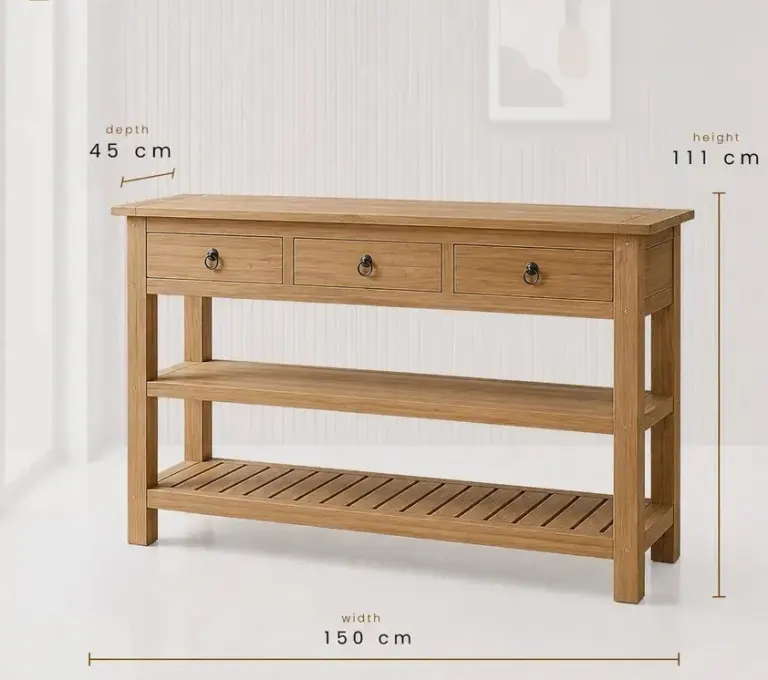
- Height: a standing host stand is commonly designed with a working surface somewhere around 100-110 cm (39-43 in), but you should confirm this with your operator and local accessibility requirements.
- Cable management: concealed cut-outs and a ventilated back panel for devices avoid trailing wires and overheating.
- Storage: a shallow drawer for pens and cards, and a lower shelf or door compartment for menus and spare stationery.
- Front face: a closed, decorative front can carry the restaurant's brand through fluting, slats or a panelled design, while hiding the staff side.
Where guests may lean on the stand, check the top overhang and the stability of the base. A stand that wobbles undermines the first impression.
Waiter station cabinet: the engine of the dining room
A waiter station cabinet sits inside the dining area or at its edge and acts as a service hub. It usually stores cutlery, napkins, condiments, glassware, order pads and sometimes a coffee or water point.
Layout and storage logic
Ask the restaurant team how service actually runs before finalising drawings. A good brief lists every item stored, in what quantity and how often it is refilled. From that list the joinery can be divided into:
- Shallow drawers with dividers for cutlery and small tools.
- Adjustable shelves behind doors for plates, bowls and glass racks.
- A pull-out or fixed tray slot for used items, where the operation requires it.
- A durable work surface at the top for staging plates and bills.
Practical details
Soft-close runners and quiet stops matter in a dining room, because noise carries. Commercial-grade hinges and runners cope better with repeated use. If the piece will stand against a wall, a protective back panel and skirting details help prevent damage from cleaning equipment.
Bar console unit: display, back-bar and support
A bar console unit can serve as a back-bar console behind the counter, a freestanding display for bottles and glassware, or a support piece beside a cocktail station. Here the priorities are weight, moisture resistance and visual presentation under lighting.
- Load: bottles and glassware are heavy. Shelves and fixings should be designed for the real load, and wall-fixing methods should be confirmed against the wall construction.
- Spills: sealed edges, moisture-resistant finishes and easy-to-clean tops are important near a bar.
- Lighting: integrated LED strips can highlight bottles, but they require planning for drivers, access and heat.
- Security: lockable doors or drawers help control stock in some venues.
Choosing materials for food and beverage service
The right material depends on how the piece is used and how it is cleaned. The table below summarises common choices for the top surface, which takes most of the wear.
| Top material | Strengths | Points to consider |
|---|---|---|
| HPL (high-pressure laminate) | Resistant to scratches, moisture and many cleaning products | Visible edge detail needs careful design |
| Solid wood with protective coating | Warm look, can be refinished | Needs a suitable finish and regular care; sensitive to standing liquids |
| Veneer with hard-wearing lacquer | Consistent appearance, stable panels | Edges and corners need protection; deep damage is harder to repair |
| Stone or engineered stone | Heat and stain resistant, easy to wipe | Heavy; needs strong base and careful packing for export |
For the carcass, moisture-resistant boards are worth considering in bar and kitchen-adjacent areas. If the destination requires fire-retardant (FR) materials, raise this early, as it can affect both board choice and lead time.
Dimensions and clearances
Service pieces must fit into circulation routes without blocking staff. As a general principle, leave enough space for a person carrying a loaded tray to pass and for drawers and doors to open fully. Confirm the actual clearance with your designer and local regulations.
- Measure drawer and door swing, not only the overall footprint.
- Allow for skirting boards, uneven floors and wall niches.
- Check that the finished piece can pass through doorways and lifts on the way to its final position.
Finishes that survive service
Restaurants are tough on finishes. Hot plates, coffee, wine, oils and cleaning sprays all test a coating. Satin and matte finishes tend to hide daily marks better than high gloss, while protective lacquers or catalysed coatings suit busy areas. Ask the manufacturer to show a finish sample and, if you want to check performance, request a simple demonstration against the liquids and cleaners your staff use.
Ordering a restaurant service console to your drawings
Because service consoles are often unique to each venue, they are usually produced as made-to-order joinery. A clear brief saves time and avoids revisions.
- Send plans and elevations showing where the piece sits, with wall types and services.
- List everything it must store or hold, including equipment dimensions.
- State the top material, carcass material and finish, with reference samples if you have them.
- Mention fire, hygiene or accessibility requirements for the destination country.
- Agree on shop drawings, sampling and, where useful, a mock-up before production.
We produce to project drawings in our own factory in Istanbul and ship worldwide. Packing, shipping terms such as FOB or DAP, and on-site installation can be discussed alongside the quotation so that delivery matches your opening schedule.
Conclusion
A restaurant service console works best when it is designed around the people who use it. Define the tasks first, then choose surfaces, storage and details that cope with daily service. If you are planning a restaurant, bar or hotel F&B outlet, send us your drawings or a short brief and we will suggest materials, estimated lead time and shipping options for your project.
Sıkça Sorulan Sorular
What is a restaurant service console?
It is a custom cabinet or table used as a working piece in a dining area or bar. Typical roles include host stand, waiter station and bar display unit. It combines a durable top with storage for items such as menus, cutlery, glassware and payment equipment.
What height should a host stand be?
Many host stands are designed with a working surface around 100-110 cm (39-43 in), but the right height depends on your operator, the equipment on top and local accessibility rules. Confirm the dimension with your designer before the shop drawings are approved.
Which top material suits a waiter station?
HPL is a common choice because it resists scratches, moisture and many cleaning products. Sealed solid wood or veneer with a hard-wearing lacquer gives a warmer look but needs more care. Stone works well for heat resistance, though it adds weight.
Can you make service consoles to our own drawings?
Yes. We manufacture to project drawings in our Istanbul factory and can also prepare shop drawings from your concept, sketches or CAD files. Sampling or a mock-up can be arranged before production, and we ship worldwide.
Do restaurant consoles need fire-retardant materials?
It depends on the country and the type of venue. Some projects require fire-retardant boards or fabrics, which can influence cost and lead time. Check the local regulations early and share them with the manufacturer when you request a quotation.
Every hotel project is different. Send us your drawings or room schedule for a tailored proposal on materials, lead time and shipping.