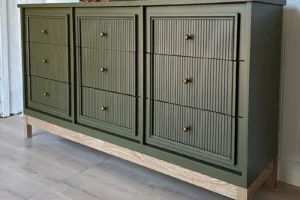

Mass Production Bathroom Cabinets Turkey
Mass production bathroom cabinets Turkey has emerged as one of the most technologically advanced and highly scalable segments within the global home improvement and construction supply chain. Driven by a massive construction boom, urban renewal projects, and a strategic focus on exports, Turkish manufacturers have transitioned from regional suppliers into global industrial powerhouses. Today, Turkish mega-factories supply high-quality, water-resistant modular bathroom vanities to major retail chains, DIY stores, and multi-family residential developers across Europe, North America, the Middle East, and Africa.
This technically rigorous, in-depth guide explores the engineering substrates, automated manufacturing workflows, geographic industrial clusters, and global procurement strategies defining the mass production bathroom cabinets Turkey industry.
The Industrial Scale and Global Dominance of Turkish Bathroom Cabinetry
The international commercial market demands high-volume, cost-effective bathroom furniture that does not compromise on durability. Bathrooms represent a unique challenge for mass-produced furniture: the products are constantly exposed to high relative humidity, ambient temperature fluctuations, direct water splashing, and aggressive chemical cleaning agents. The mass production bathroom cabinets Turkey sector has engineered its entire infrastructure to solve these exact pain points at a macro scale.
Turkey’s geopolitical position offers a logistical gateway to multiple continents, allowing for rapid transit times via sea and land. To capitalize on this, the Turkish furniture sector has invested billions of dollars in Industry 4.0 automated manufacturing complexes. By replacing manual assembly lines with integrated, computerized machinery networks imported from Germany and Italy, Turkish factories achieve a level of output consistency that eliminates human error.
Today, mass production bathroom cabinets Turkey represents a premier choice for B2B enterprise buyers, including global hotel developers, social housing procurement boards, and international DIY megastores. Turkish manufacturers can produce tens of thousands of standardized or modular units per week, matching strict European quality certifications while offering flexible OEM configurations, short lead times, and highly competitive unit economics.
Material Science: Engineered Substrates for High-Moisture Environments
In mass production, material selection must balance cost efficiency with long-term field performance. Because bathroom cabinets are installed in high-humidity zones, utilizing standard particleboard or cheap MDF leads to rapid swelling, edge delamination, and product failure. The mass production bathroom cabinets Turkey industry relies on highly specified, moisture-resistant engineered wood substrates.
1. Moisture-Resistant MDF (MR MDF / Green Core)
For premium mass-market lines and lacquered or thermoformed doors, Turkish factories utilize high-density, Moisture-Resistant Medium Density Fiberboard (MR MDF), frequently identified by its green-tinted core. This substrate is engineered by mixing ultra-fine wood fibers with specialized hydrophobic synthetic resins and wax emulsions before undergoing high-pressure thermal compression. The resulting board has a tightly packed molecular structure that significantly slows down the rate of water vapor absorption, preventing the internal fibers from expanding and destroying the cabinet’s structural integrity.
2. Melamine-Faced Particleboard (MFC) with High-Moisture Rating (P3 Grade)
For high-volume, budget-conscious modular collections, the workhorse substrate is P3-grade Melamine-Faced Particleboard (MFC). Unlike standard P2 particleboard used for dry living areas, P3 particleboard is chemically formulated to withstand high humidity. The board is faced on both sides with hard-wearing melamine papers impregnated with thermosetting resins, cured under heat and pressure. This creates a non-porous, scratch-resistant surface that is completely sealed against ambient moisture.
3. Polyvinyl Chloride (PVC) Lightweight Substrates
For extreme moisture applications or coastal markets where humidity remains permanently near saturation points, advanced Turkish mass producers offer 100% waterproof PVC foam board cabinetry. PVC boards contain zero wood fibers, making them completely immune to rot, swelling, mold, and insect damage. While structurally different from wood, automated CNC lines adapt easily to process PVC sheets, allowing for high-speed mass production of indestructible, lightweight bathroom vanities.
Technical Breakdown: The Automated Mass Production Workflow
The primary objective of mass production bathroom cabinets Turkey is achieving zero-defect uniformity across massive production batches. This requires a completely linear, automated factory floor layout where raw materials enter at one end and fully packed, ready-to-assemble (RTA) or pre-assembled cabinets exit at the other.
[Raw Board Storage] -> [High-Speed Beam Sawing] -> [Multi-Axis CNC Routing]
                                                                |
[Palletized Packing] <- [Automated Assembly] <- [Laser Edge-Banding/Finishing]
Step 1: High-Speed Optimization and Beam Sawing
Raw MR MDF or MFC sheets are transferred from climate-controlled raw material warehouses to automated horizontal beam saws via vacuum gantry lifters. Advanced optimization software analyzes the production order bill of materials (BOM) to arrange the panel cutting patterns. This maximizes yield and reduces wood waste to under 3% to 5%. Multiple sheets of wood (often up to 4 or 5 boards thick) are clamped and cut simultaneously by high-velocity circular saw blades with scoring units, ensuring perfectly clean edges completely free of chipping.
Step 2: Computerized Multi-Axis CNC Routing and Boring
Once cut to size, the individual cabinet tops, bottoms, sides, and door blanks move via motorized roller conveyors to high-speed CNC nesting and boring complexes. These machines operate on automated programs to perform multiple actions in a single cycle:
- Routing out precise grooves for back panels.
- Boring structural dowel holes, cam-and-bolt lock configurations, and shelf-support holes.
- Pre-drilling hinge hinge-plate locations and handle mounting points.
- Millimeter-accurate execution ensures that when the end-consumer opens an RTA flat-pack box, every single pre-drilled hole aligns perfectly during installation.
Step 3: Advanced Edge-Banding Technology
The edge of a bathroom cabinet panel is its most vulnerable point. If moisture penetrates the edge, the board will swell. The mass production bathroom cabinets Turkey sector utilizes state-of-the-art industrial edge-banders equipped with two primary sealing technologies:
- PUR (Polyurethane) Hot-Melt Gluing: Unlike traditional EVA glues which can re-melt or weaken when exposed to high heat and bathroom steam, PUR adhesives undergo a chemical cross-linking process as they cure, absorbing ambient moisture to create an unbreakable, highly heat-and-water-resistant bond line.
- Laser and Hot-Air Zero-Joint Fusion: For premium mass-produced lines, factories utilize laser edge-banding. The edge-banding material features a co-extruded, color-matched polymer functional layer on its reverse side. A laser beam or high-energy hot air melts this layer instantly, fusing the band directly to the wood fibers without any visible glue line. This creates a flawless, seamless edge that provides absolute water protection and a clean visual finish.
Step 4: High-Throughput Surface Finishing Architectural Lines
Depending on the target price point, mass-produced cabinet doors receive one of three high-speed automated finishes:
- Automated UV Roller Coating and Spraying: Flat panel doors pass through automated lines where liquid primers and topcoats are applied via high-precision rollers or reciprocating spray arms. The coated doors pass immediately beneath high-intensity Ultraviolet (UV) light banks, curing the lacquer instantly. This enables immediate mechanical stacked handling and eliminates flash-off bottlenecks.
- Automated Vacuum Membrane Pressing (Thermofoil): For contoured, profiled, or Shaker-style bathroom doors, MR MDF blanks are sprayed with a heat-activated polyurethane adhesive. They are arranged on large shuttle beds and covered with a sheet of flexible Polyvinyl Chloride (PVC) or Polyethylene (PET) foil. The bed enters a thermal vacuum membrane press where heat and intense vacuum pressure draw the foil tightly over the top and down around all 3D edges of the door simultaneously. This encapsulates the door in a seamless, waterproof vinyl skin with zero joints.
- Continuous High-Pressure Lamination (HPL): Panels are wrapped in highly durable laminates that mimic natural exotic woods, stones, or industrial concrete, providing high scratch and impact resistance suitable for high-traffic hospitality bathrooms.
Step 5: Inline Quality Control and Monitored Packaging
Every single component running through a Turkish mass-production line undergoes automated and human quality gate checks. Vision sensor camera arrays scan surfaces for finish defects, scratches, or dimensional variances down to fractions of a millimeter.
Once approved, the parts enter the automated packaging lines. For RTA flat-packs, components are arranged in structural sequences inside heavy-duty corrugated boxes, interspersed with protective foam sheets. Hardware kits—including hinges, screws, drawer runners, and hex keys—are automatically weighed on precision digital scales before drop-insertion to guarantee that no box leaves the factory missing a critical assembly component.
Geographic Industrial Clusters for Mass Production in Turkey
Turkey’s manufacturing capacity is enhanced by its highly organized industrial zones (Organize Sanayi Bölgeleri). These geographic clusters concentrate raw material suppliers, chemical developers, hardware manufacturers, and logistics networks in one area, creating high supply chain efficiency.
İnegöl (Bursa): The Automation Capital
İnegöl is the global epicenter for the mass production of Turkish furniture. The mega-factories located here are designed strictly around the economics of high-volume throughput.
The bathroom cabinet facilities in İnegöl utilize advanced, continuous-flow automated processing lines. These lines turn out thousands of finished vanities per day. The cluster has direct, localized access to Turkey’s premier MDF production mills and automated edge-band suppliers. This significantly reduces internal logistics overheads, making İnegöl the primary sourcing choice for international DIY supermarket procurement teams and volume-based consumer brands.
Kayseri: Central Anatolian Mass-Market Engine
Kayseri hosts some of the largest enclosed manufacturing footprints in the Europe-Asia region. The industrial parks here operate on hyper-efficient, highly automated mass-production matrixes.
Kayseri bathroom cabinet manufacturers focus extensively on flat-pack (RTA) modular systems designed for maximum shipping container optimization. The region leverages highly competitive labor-to-output ratios and fully optimized automated sheet-cutting loops, making it the ideal sourcing hub for massive contract tenders, public housing infrastructure initiatives, and budget-friendly global retail distribution.
İstanbul and the Marmara Region: Strategic Logistics and Trend Adaptation
The industrial peripheries of İstanbul (such as Tuzla, Dilovası, and Hadımköy) bridge the gap between heavy industrial scale and rapid trend response. Bathroom cabinet manufacturers in this cluster benefit from direct proximity to massive deep-water container ports (Ambarlı and Gebze) and immediate access to international design talent.
İstanbul mass producers excel at rapid-turnaround OEM adjustments, integrating smart technological features—such as Bluetooth mirrors, integrated LED lighting tracks, and touchless motion-activated kickboard lighting—into high-volume cabinet lines destined for sophisticated urban markets.
İzmir and the Aegean Cluster: Premium Export Optimization
The Aegean region, centered around İzmir, specializes in highly efficient export manufacturing aimed directly at Western European and North American quality standards. The factories here are highly integrated with nearby ceramic sanitary ware production clusters (such as Manisa and Kütahya). This allows manufacturers to supply complete, unified bathroom packages—consisting of the mass-produced wooden cabinet base, pre-fitted ceramic washbasins, and integrated plumbing connections—direct from a single regional loading center.
Product Categorization and Design Modularization
To maintain maximum high-speed efficiency, mass production bathroom cabinets Turkey relies on sophisticated modular product styling. Instead of creating individual custom designs, factories engineer standardized “cabinet platforms” that can be rapidly configured into multiple aesthetic variations.
1. Wall-Hung (Floating) Vanities
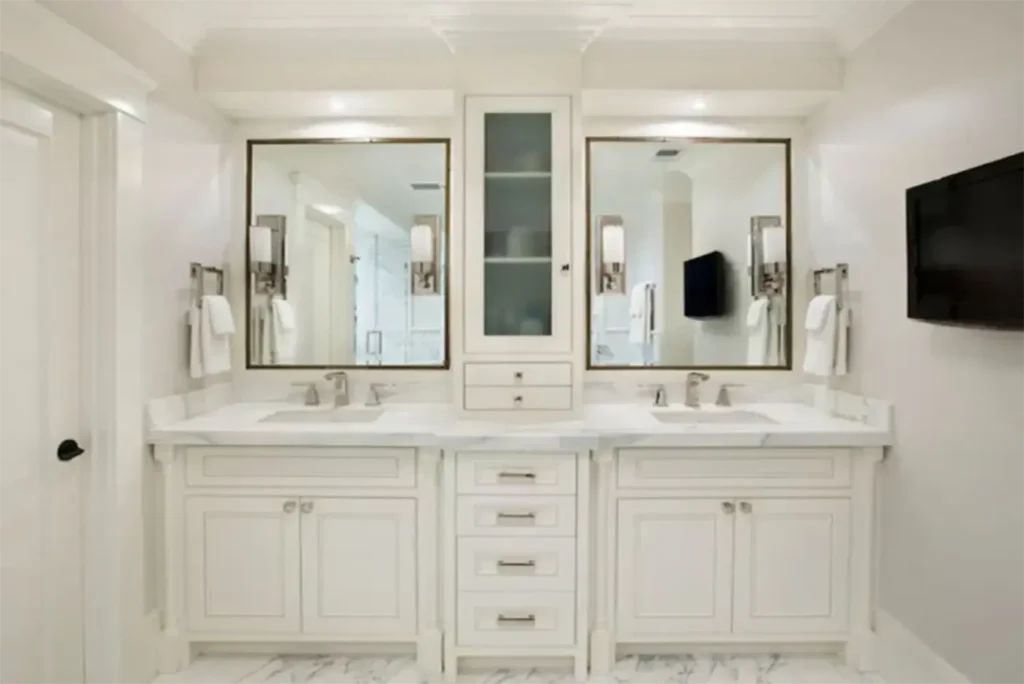
The dominant design trend across European and contemporary international markets is the wall-hung bathroom cabinet. Mass production lines optimize these units by standardizing the chassis sizes (typically in widths of 60cm, 80cm, 100cm, and 120cm).
Floating units require high structural reinforcement. Turkish mass-production complexes solve this by integrating heavy-duty, multi-bolt steel wall-hanging brackets directly into the internal structural dowels of the cabinet sides. This enables fast installation and ensures the unit can safely support the combined weight of heavy ceramic or quartz basins and water retention.
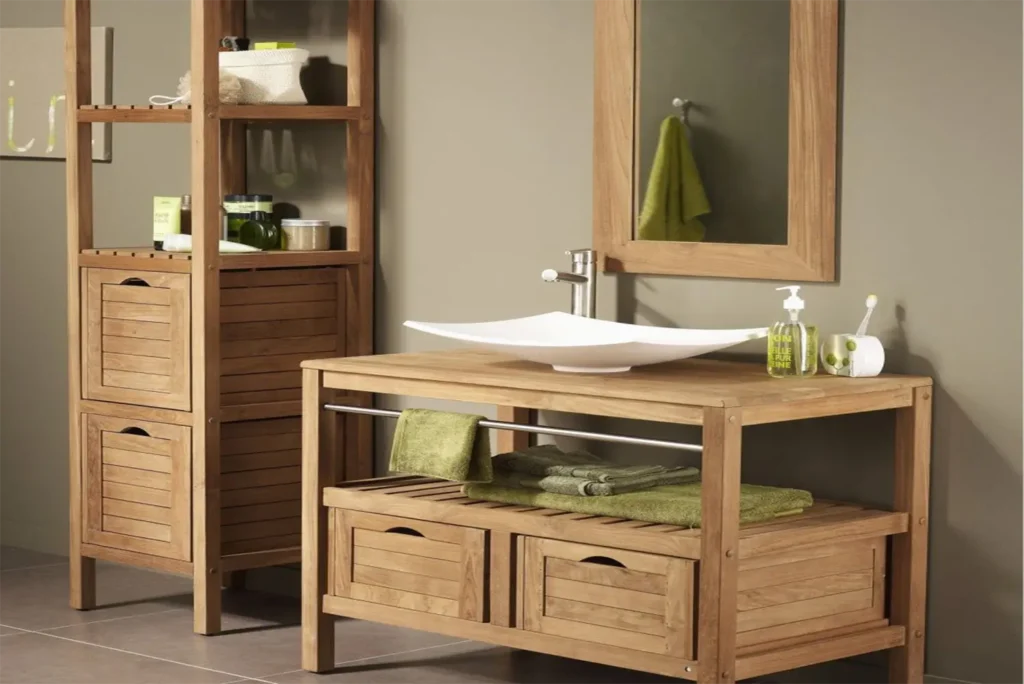
2. Freestanding Floor Cabinets with Integrated Legs
Popular in transitional styles and North American markets, freestanding cabinets utilize standardized outer side panels that extend down to forming integrated legs, or feature pre-drilled bottom arrays for quick screw-insertion of metal or ABS polymer feet. These units offer larger vertical storage capacities and are designed with open or easily removable back panels to allow for swift plumbing alignment across a wide range of residential construction sites.
3. Mirror Cabinets and Modular Side Storage Towers
To increase cross-selling opportunities and maximize shipping container volumes, Turkish mass producers manufacture matching modular add-ons. Mirror cabinets utilize thin, high-density waterproof backing boards with integrated double-sided mirrored doors fitted with soft-close hinges. Tallboy side storage cabinets utilize the exact same side-panel boring matrices as the main vanity units, allowing the automated factory lines to run both product lines concurrently without stopping to recalibrate machinery.
Sourcing, Quality Management, and Compliance Frameworks
Enterprise procurement professionals sourcing mass production bathroom cabinets Turkey must establish rigorous quality gates and technical baseline agreements to ensure the imported products perform flawlessly across diverse global microclimates.
Mandatory Technical Performance Metrics
- Edge Delamination and Moisture Resistance (EN 317): Buyers should demand certification proving that the underlying wood substrate exhibits a thickness swelling rate of below 8% to 10% when completely submerged in water for 24 hours. The edge bond must pass rigorous cycling tests under high humidity without cracking or separating from the core.
- Hardware Durability and Cycle Lifetime (EN 15338): In high-volume procurement, hardware failure is a major driver of customer returns. Top-tier Turkish mass producers fit their cabinetry with certified zinc-plated steel soft-close drawer runners and hinges that are independently tested to withstand a minimum of 40,000 to 80,000 open-and-close cycles under a continuous load.
- Salt Spray Corrosion Resistance (ISO 9227): Due to high bathroom humidity and proximity to coastal environments, all internal metal hardware, mounting brackets, screws, and external drawer handles must undergo accelerated salt spray testing for a minimum of 48 to 96 hours to ensure they are fully immune to oxidation and pitting.
- Emissions and Chemical Transparency (E1 / CARB Phase 2): Mass-produced cabinetry must comply with global indoor environmental health standards. Turkish export factories supply certified E1 or ultra-low emission E0/CARB Phase 2 compliant cabinetry, ensuring zero hazardous formaldehyde off-gassing into enclosed residential spaces.
Advanced Logistics Engineering: Maximizing Container Volumes
The profitability of importing mass-produced bathroom cabinetry depends heavily on freight optimization. Turkish manufacturers are experts at logistics engineering, utilizing two distinct packaging strategies:
- Ready-to-Assemble (RTA / Flat-Pack): RTA packaging provides the highest possible container volume density. A single 40-foot high-cube (40HC) ocean container can hold up to 800 to 1,200 flat-packed vanity units, drastically lowering the per-unit ocean freight cost. This format is ideal for DIY retail store chains and large-scale distributor warehouses.
- Pre-Assembled (Rigid Construction): For major commercial contract projects like hotels or multi-family apartment complexes where on-site labor costs are prohibitively high, units are shipped pre-assembled from the Turkish factory. Utilizing advanced, automated carcass-pressing clamps, components are glued and locked together permanently in a perfect square configuration at the factory. While this reduces the total number of units per container (approximately 300 to 450 units per 40HC), it minimizes installation time on the construction site.
Sustainability, Green Industry Standards, and Future Horizons
As international environmental legislation becomes stricter, the sustainability of industrial manufacturing lines acts as a decisive commercial filter. The mass production bathroom cabinets Turkey sector is actively digitizing and greening its infrastructure to maintain its global competitive edge.
Closed-Loop Circular Biomass Infrastructure
Turkish furniture complexes leverage advanced dust and scrap collection networks. During the continuous cutting, routing, and sizing phases, wood shavings and fiber dust are collected via automated pneumatic overhead vacuum systems.
This wood waste is transported directly into centralized, low-emission factory biomass combustion chambers. This process generates the thermal energy needed to run the plant’s curing ovens, heating systems, and automated machinery loops, reducing the factory’s overall carbon footprint and dependency on external energy grids.
Certified Supply Chain Tracking (FSC and PEFC)
To verify full compliance with international timber laws—such as the European Union Timber Regulation (EUTR) and the United States Lacey Act—Turkish mass producers partner with certified substrate mills.
The wood fibers used to manufacture MR MDF and P3 MFC boards are sourced from sustainably managed state forests that carry valid Forest Stewardship Council (FSC) or Programme for the Endorsement of Forest Certification (PEFC) chain-of-custody tracking. This guarantees to global retailers that their imported lines do not contribute to deforestation or illegal logging.
Industry 4.0 Digital Sourcing Twins
The next phase of growth for mass production bathroom cabinets Turkey involves fully digitalized B2B procurement pipelines. Leading manufacturers are deploying Electronic Data Interchange (EDI) systems and automated digital inventory tracking.
When a global retailer experiences a surge in sales for a specific bathroom vanity line, the inventory drop triggers an automated re-order request directly to the Turkish factory’s ERP system. The automated production lines automatically schedule the raw panel cutting and edge-banding parameters, optimizing lead times and enabling responsive supply chain performance.
Strategic Sourcing Guide for Enterprise B2B Buyers
To successfully optimize a commercial relationship with Turkish mass-production bathroom cabinet suppliers, global enterprise buyers should implement the following strategic procurement matrix:
| Strategic Vector | Operational Implementation Protocols | Primary Commercial Objective |
|---|---|---|
| Industrial Cluster Targeting | Leverage İnegöl for high-volume middle-market retail distribution; contract Kayseri for maximum flat-pack RTA volume efficiency; use İzmir/Marmara for premium integrated vanity packages. | Achieving optimized unit-cost structures aligned with specific retail and market placement tiers. |
| Substrate Standardization | Mandate the exclusive use of green-core MR MDF for thermoformed/lacquered fronts and P3-grade high-moisture MFC for internal carcass panels. | Eliminating structural expansion, edge cracking, and reducing consumer field product failures. |
| Adhesive Verification | Require formal written verification that all automated edge-banding machinery utilizes premium PUR (Polyurethane) hot-melt or laser-fusion technologies. | Preventing steam-induced edge delamination and maximizing product lifespan in wet conditions. |
| Logistics Modeling | Utilize flat-pack RTA packaging formats for commercial retail distribution lines; utilize pre-assembled factory-clamped units for strict developer timelines. | Minimizing total landed shipping costs while matching target local installation capabilities. |
| Certified Green Sourcing | Audit factories for verified FSC/PEFC certifications, E1/CARB Phase 2 chemical compliance, and trace carbon reduction through biomass recovery. | Protecting corporate brand compliance and future-proofing supply chains against global import climate laws. |
The global market sector for mass production bathroom cabinets Turkey is built upon a reliable foundation of highly advanced automated engineering, massive production capacities, and absolute consistency in environmental resistance. By continuously modernizing factory floors with European robotic machinery, focusing on water-resistant substrate chemistry, and structuring lean, cost-efficient logistics networks, Turkey has positioned itself as an essential partner for high-volume global furniture distribution. Sourcing from this established industrial network provides international enterprises with long-term commercial reliability, exceptional volume scaling capabilities, and robust product performance that easily handles the daily challenges of the modern bathroom environment.



Etiket:Fireproof Hotel Doors Turkey, Fireproof Hotel Furniture Turkey, Hornbeam Solid School Desks Turkey, Lacquered Furniture Turkey, Lacquered Kitchen Cabinets Turkey, Luxury Hotel Furniture Turkey, Mass Production Bathroom Cabinets Turkey, Mass Production Kitchen Cabinets Turkey, Mass Production Solid Furniture, Solid Door Factory Turkey, Solid Furnitures Turkey, Solid Wood Consoles Turkey, Solid Wood Furniture Production Turkey, Solid Wood Hotel Furniture Turkey, Solid Wood TV Units Turkey, Wood Chairs Turkey, Wood Window Manufacturing Turkey, Wood Window Production Turkey

Şunları da sevebilirsiniz

Mass Production Kitchen Cabinets Turkey
Lacquered Kitchen Cabinets Turkey