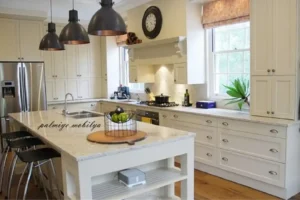
Mass Production Kitchen Cabinets Turkey
Introduction to Mass Production Kitchen Cabinets Turkey
In the international construction, real estate development, and home improvement sectors, the kitchen is recognized as the most capital-intensive and logistically complex zone of any residential project. Whether outfitting a high-rise residential tower with 500 units, supplying a massive suburban social housing development, or stocking a multi-national big-box retail chain, procurement efficiency hinges on three absolute variables: unyielding dimensional precision, scalable volume output, and cost optimization. Over the last two decades, the industrial sector for Mass Production Kitchen Cabinets Turkey has undergone an aggressive technological revolution, establishing itself as the premier global supply chain hub for large-scale cabinetry procurement.
To appreciate the market dominance of Mass Production Kitchen Cabinets Turkey, one must look beyond simple aesthetics to the underlying industrial framework. Mass production in this context does not mean low-quality, generic cabinetry; rather, it refers to highly automated, computer-programmed, high-capacity manufacturing designed to eliminate human error, maximize material yields, compress lead times, and maintain strict consistency across tens of thousands of units. Turkey’s leading manufacturing clusters—situated strategically around industrial powerhouses like Bursa (İnegöl), Kayseri, Istanbul, and Izmir—leverage advanced European machinery to compete directly with traditional German and Italian producers, offering equivalent technical standards with superior logistical flexibility.
This definitive technical manual provides a comprehensive breakdown of the automated production systems, raw material chemistry, structural engineering joinery, surface finishes, international compliance certifications, and global export logistics that define Mass Production Kitchen Cabinets Turkey.
1. The Industrial Architecture of Mass Production: Automation and CNC Precision
The core of a high-volume cabinetry operation lies in its factory floor layout and machinery integration. Sourcing Mass Production Kitchen Cabinets Turkey connects global buyers with factories operating under Industry 4.0 automated workflows, where raw sheet materials enter one side of a continuous line and fully packaged, flat-pack (RTA) or pre-assembled carcases emerge from the other.
The Automated Material Slicing Sequence
The manufacturing sequence begins with automated storage and retrieval systems (ASRS). Giant computer-controlled overhead cranes pick raw panels—such as melamine-faced chipboard (MFC) or Medium-Density Fiberboard (MDF)—and feed them into high-speed industrial panel saws or nested CNC machines.
- Optimization Software: Advanced algorithmic software (such as Ardis or Cut Rite) analyzes the entire project cutting matrix. It calculates the most efficient cutting pattern to maximize yield, reducing material waste below a strict 3% to 5% threshold.
- Precision Tolerances: Industrial panel saws operate with laser-guided precision, cutting multiple stacked sheets simultaneously while maintaining dimensional tolerances tighter than \(\pm 0.2\text{ mm}\). This level of accuracy is critical to ensuring every single cabinet panel aligns perfectly during final modular assembly.
Multi-Axis CNC Boring and Routing Lines
Once sliced into carcase blanks, panels are conveyed automatically to through-feed multi-axis CNC processing stations. These lines execute all machining operations in a single pass:
- Dowel and System Holes: Milling 5mm and 8mm dowel holes, system holes (32mm spacing standard), and shelf-support recesses along the vertical side panels.
- Hardware Pocketing: Machining precise pockets for concealed hinges, structural brackets, and undermount drawer slides.
- Back Panel Grooving: Routing a continuous 4mm to 6mm groove along the rear perimeter of the side panels to accept the slide-in back panel.
Because these steps are controlled via direct digital files (CAD/CAM integration), a factory can switch from producing a 300mm wide base cabinet to a 900mm wide corner pantry unit instantly, without manual recalibration down-time.
2. Material Science: Carcase Substrates and Chemical Formulation
The durability of a kitchen cabinet is directly linked to the composition of its hidden core substrate. A kitchen is a harsh structural environment characterized by continuous humidity fluctuations, localized steam from cooking appliances, liquid spills, and heavy physical weight loads. Factories specializing in Mass Production Kitchen Cabinets Turkey formulate their core substrates to survive these demanding conditions.
Melamine-Faced Chipboard (MFC) vs. High-Density Fiberboard (MDF)
Turkish mass producers utilize two primary raw material streams for cabinet boxes and front profiles, depending on the application zone:
[Cabinet Carcase Matrix]
  ├── Base/Wall Carcases: High-Density, Moisture-Resistant MFC (650–720 kg/m³)
  └── Decorative Fronts: Super-Refined, Uniform MDF (750–850 kg/m³) for Deep Routing
- Particleboard / Chipboard Engineering: For standard cabinet carcases (the structural box), high-density MFC is preferred. The engineered core consists of multi-layered wood chips compressed under intense heat and hydraulic pressure with synthetic resins. Premium Turkish producers enforce a density threshold between 650 kg/m³ and 720 kg/m³. This high particle density ensures excellent screw-holding strength, preventing hinges and drawer tracks from loosening over time.
- Fiberboard (MDF) Engineering: For decorative doors, drawer fronts, and end panels that require intricate profile routing or shaping, high-density MDF (750 kg/m³ to 850 kg/m³) is deployed. Made from fine wood fibers rather than chips, it provides a highly uniform, smooth edge and surface profile that serves as an ideal base for advanced laminates, polymer foils, or lacquer coats.
Moisture-Resistant (MR) Green Core Substrates
For high-exposure damp environments—such as sink base cabinets or locations in tropical regions—Turkish factories swap standard boards for specialized Moisture-Resistant (MR) substrates. These boards are formulated with hydro-phobic melamine-urea-formaldehyde (MUF) resin binders and distinct green identification pigments. They exhibit minimal thickness swelling (typically less than 8% to 12% under immersion testing), ensuring the cabinetry structure will not delaminate, bubble, or structurally sag when exposed to seasonal humidity changes.
3. High-Performance Surface Technologies: Thermofoil, PET, and UV Lacquers
In large-scale housing projects and retail supply chains, the visual appeal and long-term durability of kitchen doors dictate product value. The sector for Mass Production Kitchen Cabinets Turkey features some of the most advanced surface coating and lamination lines globally, enabling high-volume production of popular modern aesthetic finishes.
1. Membrane Pressing and PVC/PET Thermofoil Fronts
For classic shaker-style doors or contoured handleless profiles, factories utilize automated 3D vacuum membrane presses (such as Bürkle or Wemhöner lines).
- The Process: The routed MDF door blank is sprayed with a two-component polyurethane adhesive. It is then fed into the press, where a continuous sheet of polymer foil—PVC or eco-friendly Polyethylene Terephthalate (PET)—is heated and vacuum-drawn over the door profile.
- The Advantage: This application seamlessly wraps the front and all four outer edges in a single step. By eliminating open edge seams, it creates a water-resistant face that prevents moisture from seeping into the core material.
2. High-Gloss and Super-Matte PET Laminated Co-Extrusions
Modern, minimalist kitchen designs frequently demand dead-matte or glass-like high-gloss flat panels. Turkish factories excel at laminating high-performance PET foils onto super-refined MDF panels using reactive polyurethane (PUR) hot-melt adhesives.
- Super-Matte PET: Features advanced anti-fingerprint surface chemistry and an ultra-low gloss level (below 5 gloss units). It soft-diffuses light and incorporates thermal healing properties that allow micro-scratches to be repaired with low heat.
- High-Gloss PET: Delivers a mirror-like sheen with exceptional visual depth and zero orange-peel ripple distortions. This performance is achieved through automated clean-room application lines that prevent dust contamination during production.
3. Continuous UV-Cured Roller Coating Lacquer Lines
To achieve premium painted or lacquered surfaces at a massive scale, Turkish manufacturers replace traditional slow-drying manual spray booths with automated, continuous UV roller-coating lines.
[MDF Core Panel] ──> [Sanding] ──> [UV Base Coat Primer] ──> [UV Intermediate Sealer]
                                                                        │
                                                                        ▼
[Pallet Packing] <── [Cooling Zone] <── [UV Top Coat Shield] <── [UV Lamp Curing Tunnel]
This automated system cures the lacquer instantly under intense ultraviolet lamp tunnels. The resulting hard cross-linked surface provides superior resistance to scratching, chemical stains, and UV yellowing, while achieving a processing speed of several linear meters per minute.
4. Edge-Banding Engineering and PUR Moisture Barriers
The single most common failure point for mass-produced kitchen cabinetry is the edge-banding of the carcase panels. If water from a sink or dishwasher steam breaks through a weak edge seam, the wood core will swell and destroy the cabinet. Turkish mass production operations address this vulnerability by deploying high-speed through-feed edge-banders equipped with advanced adhesive technologies.
EVA vs. PUR Adhesive Systems
While standard mass production often relies on basic EVA (Ethylene Vinyl Acetate) hot-melt glues, premium Turkish kitchen manufacturers utilize PUR (Polyurethane) Hot-Melt edge-banding technology:
| Engineering Attribute | EVA Edge-Banding System (Standard) | PUR Edge-Banding System (Premium Mass Production) |
|---|---|---|
| Chemical Mechanism | Purely physical thermal melting and re-solidification. | Irreversible chemical cross-linking initiated by atmospheric moisture. |
| Moisture Resistance | Moderate; susceptible to water degradation over time. | Absolute waterproof seal; cannot be dissolved by water or steam once cured. |
| Thermal Deflection Threshold | Softens at temperatures above 70°C to 80°C (near ovens). | Stabilizes structurally from -40°C up to 140°C without melting. |
| Glue Line Visual Appearance | Thicker, more visible glue seam; can accumulate dirt over time. | Ultra-thin, nearly invisible micro-glue line for a seamless appearance. |
| Structural Bond Strength | Standard mechanical adhesion properties. | Massive chemical and mechanical bond strength to dense MDF/MFC substrates. |
Laser and Hot-Air Zero-Joint Edge-Banding
At the top tier of Turkish mass production, factories utilize laser or hot-air fusion edge-banding machinery (such as Homag AirTec systems). This technique uses specialized co-extruded edge-banding tapes featuring a functional, color-matched polymer layer on the back. A high-energy heat source melts this layer instantly, fusing the tape directly to the wood fibers without requiring traditional glues. This creates a zero-joint edge that provides outstanding moisture protection and clean design lines.
5. Structural Joinery Systems: Cam-Lock (RTA) vs. Rigid Factory Pre-Assembly
Depending on the procurement model, destination country, and project timeline, developers can select from two distinct structural joinery systems when sourcing Mass Production Kitchen Cabinets Turkey.
Option A: Flat-Pack / Ready-to-Assemble (RTA) Knock-Down Systems
For large international shipments, retail home center distribution, and projects looking to minimize freight costs, the RTA system is ideal.
- Hardware Framework: Panels are machined to utilize heavy-duty zinc-alloy cam-and-pin locks (such as Minifix or Rafix hardware) alongside pre-inserted hardwood fluted dowels.
- Logistical Efficiency: Panels stack flat on pallets, maximizing container space utilization. A single 40ft HC container can hold up to three times as many flat-pack kitchen cabinets as fully assembled ones, drastically reducing ocean freight costs per unit.
- Packaging Automation: Automatic packaging lines sort components using integrated scales and laser scanning arrays. Panels, hardware kits, and instruction sheets are boxed in heavy-duty corrugated cardboard, ensuring parts are packed accurately and protected during transit.
Option B: Factory Pre-Assembled Rigid Carcases
For premium real estate developments requiring rapid on-site installation timelines, Turkish factories offer fully assembled cabinet units.
[Routed Carcase Panels] ──> [Injected PUR Glues] ──> [Squaring Pneumatic Clamp] ──> [Mechanical Fastening]
                                                                                            │
                                                                                            ▼
    [Finished Rigid Cabinet Unit] <── [Hardware Track Installation] <── [Curing Assembly Line]
The panels are assembled on a continuous line, glued with high-strength cross-linking adhesives, and squared using automatic pneumatic frame clamps. This process ensures the cabinet box remains perfectly square and rigid over its lifespan, minimizing manual assembly requirements on the construction site.
6. Global Hardware Integration and Kinetic Reliability
A kitchen cabinet is only as reliable as its moving parts. Even if a cabinet box features premium wood and laminates, a failing hinge or sagging drawer box will render the kitchen unusable. Turkish mass production operations partner with leading international hardware brands to ensure smooth kinetic performance.
Premium Concealed Hinge Systems
Mass-produced kitchens from Turkey are pre-drilled to integrate standard 35mm cup hinges that fully comply with EN 15570 Level 3 (the highest test standard for commercial durability).
- Integrated Soft-Close Dampeners: Silent, fluid-dampened pistons are integrated directly into the hinge cup arm, ensuring kitchen doors close quietly even if closed forcefully.
- Three-Dimensional Adjustability: Installers can adjust doors effortlessly across three axes (up/down, left/right, in/out) using a standard screwdriver, enabling fast alignment on site.
Double-Wall Metal Drawer Systems
Instead of low-cost wooden drawer boxes on basic roller tracks, modern mass production lines use double-wall steel drawer runner systems (such as Blum Tandembox, Hettich InnoTech, or local premium brands like Samet SmartFlow).
- Load-Bearing Profiles: Heavy-duty undermount synchronized slides support structural weights from 30 kg up to 70 kg without binding or sagging.
- Dynamic Soft-Closing: Integrated air or oil dampeners slow the drawer down smoothly at the end of its closing cycle, preventing contents from shifting.
7. Technical Comparative Matrix: Mass Production Sourcing Streams
To assist project managers, quantity surveyors, and retail buyers in optimizing their procurement specifications, the following detailed matrix contrasts the varying tiers of Mass Production Kitchen Cabinets Turkey:
| Engineering Component | Contract Standard Tier (Budget Housing) | Executive Premium Tier (High-Rise Real Estate) | Big-Box Retail Tier (Flat-Pack DIY Distribution) |
|---|---|---|---|
| Carcase Core Board | Standard MFC (620–650 kg/m³ density). | Moisture-Resistant (MR) MFC (680–720 kg/m³ density). | Standard E1-grade uniform density chipboard. |
| Door Front Treatment | Direct Melamine-faced MFC with 1mm PVC edge-bands. | Routed MDF wrapped in PET Super-Matte or multi-layer UV lacquer. | 3D Vacuum-pressed PVC thermofoil over MDF cores. |
| Edge-Banding Chemistry | Traditional EVA hot-melt glue lines. | Laser Zero-Joint or moisture-resistant PUR hot-melts. | High-speed, automated EVA thermal bonding. |
| Joinery Configuration | Knock-down cam-locks with basic wooden dowels. | Factory pre-assembled, glued, and pneumatically clamped rigid boxes. | Tool-less quick-click or standard Minifix knock-down setups. |
| Kinetic Runner Systems | Single-wall metal sides with epoxy roller guides. | Double-wall steel soft-close drawers with synchronized runners. | Soft-close double-wall steel drawer boxes. |
| Formaldehyde Emissions | Strict European E1 Compliance framework. | E0 / CARB Phase 2 Ultra-Low Emission standard. | European E1 Certification profile. |
8. Sourcing from Turkey: Industrial Scales, Supply Chains, and Export Logistics
Turkey’s geographic and economic positioning makes it a highly attractive partner for international B2B buyers looking to de-risk their supply chains and reduce long transit times from Asian factories.
[Geographic Core: Turkey Manufacturing Centers]
   ├── Europe & UK (Overland Trucking & Intermodal Rail Freight: 5-7 Days Transit)
   ├── GCC & Middle East (Direct Sea-Freight & Border Crossings: 4-8 Days Transit)
   └── Americas & Global Markets (Deepwater Shipping Hub Ports: Ambarlı, İzmir, Mersin)
Unmatched Scale and Production Volume Capacity
The scale of Turkish cabinetry manufacturing clusters allows factories to handle massive production runs simultaneously. Top-tier Turkish kitchen producers operate factory floors covering over 50,000 to 100,000 square meters. These facilities can turn out thousands of completed cabinet carcases per day, ensuring reliable lead times even for large multi-family housing developments or peak retail buying seasons.
Sustainable Wood Sourcing and REACH Chemical Compliance
- FSC-Certified Supply Chain: Turkish cabinet manufacturers operate under the Forest Stewardship Council (FSC) chain-of-custody framework, ensuring wood chips and fibers originate from responsibly managed forests.
- REACH Regulation Adherence: All surface treatments, PVC/PET foils, polymer edge-bands, and core resin glues comply fully with European REACH chemical regulations. They are completely free from dangerous plasticizers, phthalates, heavy-metal stabilizers, or volatile organic compounds (VOCs) that could harm indoor air quality.
Strategic Logistical Advantages and Shipping Timelines
Turkey’s geographical position at the crossroads of Europe, Asia, and Africa provides substantial freight shipping advantages:
- To Europe and the UK: Combined overland trucking and intermodal rail lines deliver freight containers directly to construction sites or distribution centers within 5 to 7 days, avoiding long ocean shipping bottlenecks.
- To the Middle East & GCC: Direct shipping routes and overland logistics networks deliver cabinetry shipments to major real estate development zones within 4 to 8 days.
- To the Americas: Regular, cost-effective ocean freight routes run out of deepwater ports like Ambarlı (Istanbul), Izmir, and Mersin, providing reliable delivery timelines to both North and South American commercial ports.
- The ATR Customs Advantage: Under the Customs Union agreement between Turkey and the European Union, exports include an ATR certificate. This document eliminates customs duties and streamlines border clearances across EU member countries.
9. Comprehensive Installation Protocols and On-Site Quality Assurance
The structural performance of mass-produced modular kitchens depends heavily on proper on-site installation and alignment. When dealing with large multi-unit real estate installations, following standard deployment and quality control workflows helps avoid costly alignment mistakes and delays.
Step-by-Step On-Site Installation Sequence
- Site Environmental Clearance: Before unboxing cabinet panels, installers must verify that the room’s wet trades (plastering, concrete screeding, and painting) are completed and dry. The indoor climate must be stabilized with relative humidity below 60% to prevent uninstalled boards from absorbing excess moisture.
- Laser Datum Line Marking: Installers must use self-leveling 3D laser levels to establish a continuous datum line across the walls. This step is essential because uneven subfloors make it impossible to align base cabinets correctly using basic spirit levels alone.
- Base Cabinet Alignment and Rail Mounting: Wall cabinets should be hung using heavy-duty, adjustable continuous steel suspension rails anchored securely into structural wall studs. Base units are positioned, leveled using their adjustable ABS legs, and mechanically connected to adjacent units using male-female binding screws. This unifies the entire runs into a single rigid structure.
- Countertop Installation and Sealing: Once the cabinet run is verified as square and level, the countertop is installed. The junction between the sink cutout and the wood core substrate must be sealed with a generous layer of high-grade silicone to prevent water infiltration.
- Hardware Calibration and Latching Actions: Adjust concealed hinges and drawer slides to achieve uniform, 2mm reveal gaps between all doors and drawer fronts. Calibrate soft-close mechanisms to ensure smooth closing actions.
Post-Installation Commissioning Audit Checklist
Before signing off on a completed multi-unit housing block or residential wing, project managers should complete a comprehensive on-site quality inspection using the following checklist:
- Uniform Reveal Gaps: Check with digital gauges that the gaps between all cabinet doors and drawer profiles are consistent, staying within a \(\pm 0.5\text{ mm}\) alignment tolerance.
- Silent Kinetic Movement: Open and close every door and drawer to confirm slides and hinges move smoothly without catching or making scraping noises.
- Moisture Barriers Verification: Inspect all exposed edges under sinks and around dishwashers to confirm the hot-air/PUR edge-banding seals are complete and undamaged.
- Level Countertop Alignment: Verify that base cabinet rows are flat and level across their full length using precision spirit levels, ensuring countertops can be fitted securely without stress points.
- Complete Mechanical Anchoring: Check that wall hanging brackets are anchored firmly into structural elements, confirming the units can safely support heavy commercial weight loads.
10. Preventive Maintenance and Asset Lifecycle Optimization
Kitchen cabinetry in high-density real estate developments or rental properties undergoes constant, demanding daily use. To protect your investment and maintain a pristine appearance over a 15-to-20-year operational lifespan, asset managers should establish clear preventive maintenance routines.
Correcting Common Field Wear and Tear Challenges
- Managing High Heat and Oven Steam: High temperatures from self-cleaning ovens or steam from dishwashers can stress cabinetry doors if they are opened immediately after a cycle. Installing slim, protective aluminum heat shield strips along the edges of cabinets adjacent to ovens helps deflect excess heat and shields the polymer laminates from peeling.
- Cleaning Delicate High-Gloss and Matte Surfaces: Modern PET doors require gentle cleaning to preserve their factory finishes. Cleaning teams should avoid using ammonia-based glass cleaners or abrasive scouring pads, which can leave fine surface scratches. Instead, use a soft microfiber cloth dampened with a highly diluted, pH-neutral soapy water solution, immediately followed by a dry wipe.
- Hinge Screw Tension Re-Tightening: Regular door movement can cause mounting screws inside high-density chipboard carcases to loosen slightly over time. Facility maintenance teams should schedule annual walkthroughs to re-tighten hinge screws and readjust soft-close mechanisms, keeping doors perfectly aligned and preventing premature hardware wear.
Conclusion: Maximizing Procurement Efficiency and Return on Investment (ROI)
Sourcing Mass Production Kitchen Cabinets Turkey provides international real estate developers, construction entities, and high-volume retail buyers an optimal combination of high-capacity production, material engineering, and logistical convenience. By focusing on automated manufacturing processes—including multi-axis CNC routing, moisture-resistant PUR edge-banding, and high-performance PET finishes—project stakeholders can deliver durable, attractive modular kitchens that stand up to daily commercial use while staying within strict budget limits.
Partnering with certified Turkish contract manufacturers who offer transparent, third-party audited test records and advanced Industry 4.0 production lines ensures your residential project will meet international quality standards, remain on schedule, and protect your capital investment over its full lifecycle.
Butik Otel Mobilyaları
Butik Otel Mobilyaları


Butik Otel Mobilyaları



Şunları da sevebilirsiniz

Distressed Furniture Turkey

Lacquered Furniture Turkey